The Poem by Felix Dahn – German Text and Exact Translation
“Kornblumen” – from Richard Strauss’s Mädchenblumen, Op. 22
German Original Text
Kornblumen nenn ich die Gestalten,
die milden mit den blauen Augen,
die, anspruchslos in stillem Walten,
den Tau des Friedens, den sie saugen
aus ihren eigenen klaren Seelen,
mitteilen allem, dem sie nahen,
bewusstlos der Gefühlsjuwelen,
die sie von Himmelshand empfahn.
Dir wird so wohl in ihrer Nähe,
als gingst du durch ein Saatgefilde,
durch das der Hauch des Abends wehe,
voll frommen Friedens und voll Milde.
Exact English Translation
Cornflowers I call the figures,
the gentle ones with the blue eyes,
who, unpretentious in quiet working,
the dew of peace, which they absorb
from their own clear souls,
communicate to everything they approach,
unconscious of the jewels of feeling
which they received from the hand of heaven.
You feel so well in their nearness,
as if you were walking through a field of grain,
through which the breath of evening were blowing,
full of devout peace and full of gentleness.
Text: Felix Dahn; German text in modern orthography and gently modernised punctuation. Translation: exact, non-poetic.
Work Data & Overview
- Composer: Richard Strauss (1864–1949)
- Title: Kornblumen, Op. 22 No. 1
- Song group: Mädchenblumen, Op. 22
- Text source: Felix Dahn
- Composition: 1888
- Scoring: Voice and piano
- Duration: approx. 2–3 minutes
- Form: song-like miniature with calm, cantabile line and poetic characterisation
Data on the Poem
- Author: Felix Dahn
- Stanza form: three four-line stanzas
- Imagery: cornflowers, blue eyes, dew, clear souls, field of grain, evening breeze
- Stylistic devices: flower metaphor, character portrait, symbolism of peace, synaesthetic images of nature and the soul
Genesis & Context
Richard Strauss’s Mädchenblumen, Op. 22, belong to his early songs. The four songs each create a female character portrait through a flower metaphor. In “Kornblumen”, the flower does not stand for striking beauty or passionate effect, but for modesty, gentleness and spiritual clarity.
The song opens the collection with an attitude of restraint. The figures described do not make an impression through brilliance, drama or seduction, but through their peaceful nearness. Their effect is quiet and unconscious: they give peace without consciously intending to give it.
This is precisely where the song’s special poetic tension lies. The cornflower is a simple field flower, but in the poem it becomes a sign of inner nobility. Strauss takes up this contrast: the music remains delicate and simple, yet through tone colour, line and harmonic warmth it gains a subtle inner radiance.
Performance Practice & Reception
Voice: The voice should be guided lightly, naturally and cantabile. The song does not need a dramatic approach, but a calm, inward line. What matters is an attitude of simplicity: the beauty should not be displayed, but unfold as if of its own accord.
Text & diction: Words such as “mild”, “anspruchslos”, “Frieden” and “Milde” form the inner core of the song. They should not be emphasised sentimentally, but should arise from the overall atmosphere. The language may be soft, but must remain clear, so that the poem’s delicate character traits become audible.
Piano image: The piano should accompany transparently and with breath. The sound may be soft and warm, but never heavy. What matters is an even, peaceful flow that carries the vocal line without covering it.
Reception: “Kornblumen” is performed less often than the major Strauss songs such as “Morgen!”, “Cäcilie” or “Zueignung”. For precisely this reason, it is especially suitable for programmes that also wish to reveal Richard Strauss’s early, finely characterising song art.
Reference Recordings
- Recordings from complete or selected programmes of Strauss songs
- Interpretations of the Mädchenblumen, Op. 22, in the context of early Strauss songs
Current Performers with Whom I Collaborate
Analysis – Music
Gentleness, Line & Restraint
“Kornblumen” lives from a musical attitude of gentleness. The vocal line unfolds in calm, cantabile arcs. The expression is not expansive, but directed inward. Strauss does not draw a dramatic scene, but a quality of the soul.
The music avoids strong contrasts. Instead, its effect arises through balance, soft lines and a careful increase in inner warmth. This corresponds exactly to the imagery of the text: the cornflower figures do not step forward, but act through their quiet presence.
Tone Colour, Harmony & Final Effect
The harmony remains peaceful and luminous in its basic character. Small colourings give individual words a particular warmth, without leaving the fundamental tone of simplicity. The music should therefore not be taken too broadly: its effect lies in a subtle glow, not in grand Strauss pathos.
The ending leads the atmosphere of the poem back into complete stillness. The image of the evening breeze over the field of grain becomes, musically, a gesture of exhalation. The song does not end with a dramatic point, but with the impression of a quiet peace that remains in the room after the sound has faded.
Visual Representation
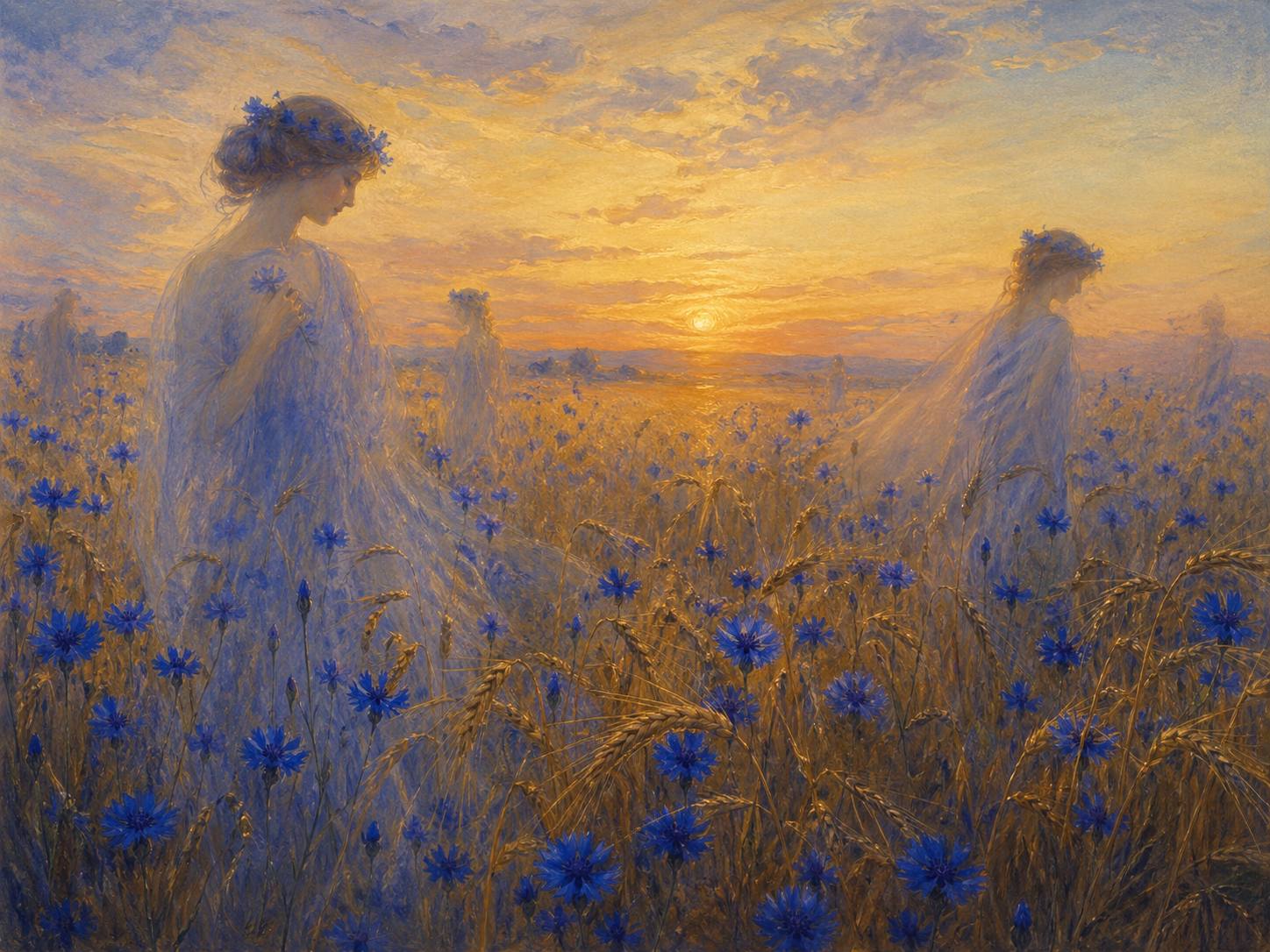
Artistic visualisation by Evgenia Fölsche:
The image shows cornflowers in a quiet, open landscape.
The blue of the blossoms refers to the “milden mit den blauen Augen”,
the gentle ones with blue eyes, of whom the text speaks.
The flowers do not stand at the centre of a dramatic scene,
but appear as a quiet, peaceful presence.
The image takes up the atmosphere of the poem:
unpretentiousness, clarity and a gentleness
that does not impose itself.
The cornflowers do not seem precious in an outward sense,
but through their simple, pure colour.
Precisely this simplicity becomes a sign of inner beauty.
The field of grain and the evening breeze open the space into breadth.
One senses a movement that is hardly movement:
a gentle wafting, a breath over the landscape,
a state of reverent peace.
As in Strauss’s music, the effect arises from delicacy.
The image tells no story,
but holds fast to a quality of the soul:
nearness that does one good;
peace that comes from clear inwardness;
beauty that is not conscious of being beautiful.
Analysis – Poetry
Felix Dahn’s poem “Kornblumen” is a poetic character portrait. It does not describe an individual figure, but a human type: gentle, quiet figures whose nature is symbolised by the cornflower. The flower stands for modesty, a clear soul and a peaceful effect.
The Cornflower as an Image of a Human Being
Kornblumen nenn ich die Gestalten,
die milden mit den blauen Augen,
The poem begins with a direct association: certain people are called “cornflowers”. The blue eyes connect outward appearance and inner quality. The blue is not merely a colour, but an expression of gentleness, clarity and quiet depth.
Unpretentious Effect
die, anspruchslos in stillem Walten,
den Tau des Friedens, den sie saugen
The figures described do not act with conscious effect. Their “working” is quiet, their existence unpretentious. The “dew of peace” is an especially delicate image: peace appears not as a great power, but as fine, nourishing moisture.
Clear Souls and Unconscious Beauty
aus ihren eigenen klaren Seelen,
mitteilen allem, dem sie nahen,
The peace these people give comes from within themselves. They do not pass on something fabricated, but share from their own spiritual clarity. Nearness thereby becomes healing: whoever encounters them receives something of this inner calm.
bewusstlos der Gefühlsjuwelen,
die sie von Himmelshand empfahn.
The word “bewusstlos” is especially important. The beauty of these figures is not self-conscious, not calculated, not aimed at producing an effect. The “jewels of feeling” have been given to them, but they bear them without vanity. The poem thus idealises an unconscious, bestowed inwardness.
The Comforting Nearness
Dir wird so wohl in ihrer Nähe,
als gingst du durch ein Saatgefilde,
In the final stanza, the effect of these people on the observer is described. Their nearness feels good. The comparison with the field of grain leads the human appearance back into nature. The encounter becomes a walk through a peaceful landscape.
Evening Breeze, Peace and Gentleness
durch das der Hauch des Abends wehe,
voll frommen Friedens und voll Milde.
The conclusion gathers the poem’s fundamental mood. The evening breeze brings no agitation, but calm. “Reverent peace” and “gentleness” point to an almost spiritual quality: the figures described have the effect of a blessing, without themselves intending to bless.
Open Semantics & Further Work
“Kornblumen” initially seems simple, yet it is precisely this simplicity that opens a wider space of interpretation. The poem can be read as an idealising image of femininity of its time, but also more generally: as the image of a human attitude that radiates peace without asserting it.
The cornflower thus becomes a sign of a quiet ethics of presence. It is not about achievement, brilliance or self-display, but about the effect of a clear soul. Strauss’s music intensifies this openness by not dramatising the figure, but placing it in a gentle sound-space.
More on this idea in a theoretical context: The Semiotics of Song and Art That Continues to Work.
Meaning & Effect
“Kornblumen” is a song about quiet beauty. It shows a form of effect that does not arise from strength, loudness or outward brilliance, but from gentleness, clarity and inner peace. The unpretentious quality becomes the true quality.
Strauss composes this attitude with restraint. The music does not need to prove that the text is beautiful; it allows its atmosphere to breathe. In this way, a song emerges that remains small in scale and yet possesses great spiritual breadth.
Its effect lies in the aftersound: after the ending, what remains is not the impression of a dramatic scene, but of an encounter. One has sensed a figure whose nearness does one good – like an evening breeze over a peaceful field.
Concert Enquiry
Richard Strauss’s “Kornblumen” is especially suitable for song programmes that, alongside the well-known major Strauss songs, also wish to show his finer, more intimate character pieces. The song can appear as a quiet point of repose, as an image of nature and the soul, or as part of a programme about flowers, images of women and poetic character portraits.
Evgenia Fölsche shapes Strauss’s song art with particular attention to transparency of sound, breath, textual clarity and the subtle transitions between voice and piano. Concert programmes can be flexibly adapted to venue, occasion and scoring.
Send Concert EnquiryFrequently Asked Questions about Richard Strauss: “Kornblumen” Op. 22 No. 1
Click on a question to reveal the answer.
Which song group does “Kornblumen” belong to?
“Kornblumen” is No. 1 from Richard Strauss’s Mädchenblumen, Op. 22.
Who wrote the text of “Kornblumen”?
The text is by Felix Dahn.
What mood characterises the song?
The song is shaped by gentleness, calm and peaceful restraint. It does not portray a dramatic scene, but a quiet character image.
What do the cornflowers symbolise?
The cornflowers stand for gentle, unpretentious figures with clear souls, who radiate peace without being conscious of this effect.
How should “Kornblumen” be interpreted?
With a light, natural line, clear diction and transparent piano sound. The expression should remain inward and simple, without sentimentality or dramatic exaggeration.