The Poem by John Henry Mackay – German Text and Exact Translation
“Morgen!” – John Henry Mackay (1861–1933)
German Original Text
Und morgen wird die Sonne wieder scheinen,
und auf dem Wege, den ich gehen werde,
wird uns, die Glücklichen, sie wieder einen
inmitten dieser sonnenatmenden Erde …
Und zu dem Strand, dem weiten, wogenblauen,
werden wir still und langsam niedersteigen,
stumm werden wir uns in die Augen schauen,
und auf uns sinkt des Glückes stummes Schweigen …
Exact English Translation
And tomorrow the sun will shine again,
and on the path that I will walk,
it will unite us again, the happy ones,
in the midst of this sun-breathing earth …
And to the shore, the wide, wave-blue one,
we will descend quietly and slowly,
silently we will look into each other’s eyes,
and upon us will sink happiness’s silent silence …
Text: John Henry Mackay (1861–1933); German text in modern orthography and gently modernised punctuation. Translation: exact, non-poetic.
Work Data & Overview
- Composer: Richard Strauss (1864–1949)
- Title: Morgen!, Op. 27 No. 4
- Song group: Four Songs, Op. 27
- Text source: John Henry Mackay (1861–1933)
- Composition & dedication: 1894; dedicated to Pauline de Ahna for their wedding
- Key / metre / tempo: E-flat major, 4/4, Tender; very calm, scarcely moving
- Duration: approx. 3–4 minutes
- Scoring: Voice and piano; also orchestrated by Richard Strauss in 1897
- Form: through-composed; two large poetic-musical arcs with a return to the initial calm
Data on the Poem
- Author: John Henry Mackay
- Stanza form: two four-line stanzas
- Verse character: free, song-like tone with calm syntactic movement
- Stylistic devices: future tense, imagery of light and path, sea image, motif of silence, couple perspective “we”
Genesis & Context
Richard Strauss composed the Four Songs, Op. 27, in 1894 and dedicated them to his wife Pauline de Ahna for their wedding. The group comprises Ruhe, meine Seele!, Cäcilie, Heimliche Aufforderung and, as the final song, Morgen!.
Within this song group, “Morgen!” occupies a special place. After the more emotionally charged songs, it feels like a moment of inward stillness. The music avoids outward gesture and dramatic intensification. Instead, a sound-world emerges in which love appears as trust: not as desire, but as quiet certainty.
The later orchestral version of 1897 intensifies this effect through especially transparent instrumentation. Particularly famous is the solo violin, which takes over the floating opening line and gives the song an almost removed, transcendent colour. This orchestral breath remains perceptible even in the piano version: the piano does not merely accompany, but opens a wide inner space.
Performance Practice & Reception
Voice: The voice should be guided with utmost restraint. The sound needs line, breath and calm – no dramatic intensification. It is especially important that the voice should not “enter” theatrically, but arise from the piano sound. The first words may sound like a thought that has already begun.
Text & diction: The future form “wird” should be heard not as mere expectation, but as inner certainty. Words such as “still”, “stumm” and “Schweigen” should not be sentimentally displayed. Rather, they mark the movement of the whole song: a gradual transformation of sound into silence.
Piano image: The piano needs a calm, transparent sound. The wave-like motion may open the space, but must not overfill it. The pedal should be generous enough to allow resonance to arise, yet remain so finely controlled that the harmony does not blur.
Reception: “Morgen!” is one of Richard Strauss’s most frequently performed songs. It is often placed at the end of Strauss programmes or as a quiet high point of a song recital. Its effect lies precisely in the fact that it does not overwhelm, but opens the space inwardly.
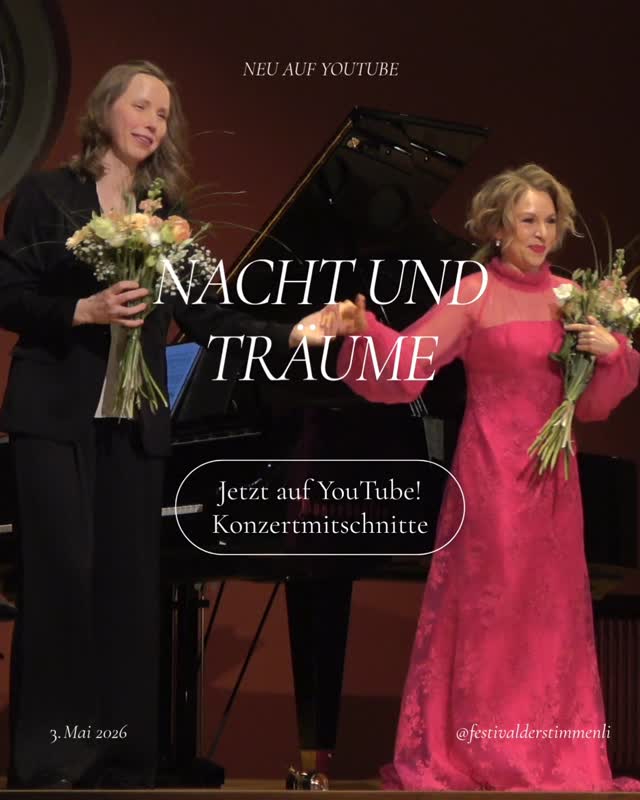
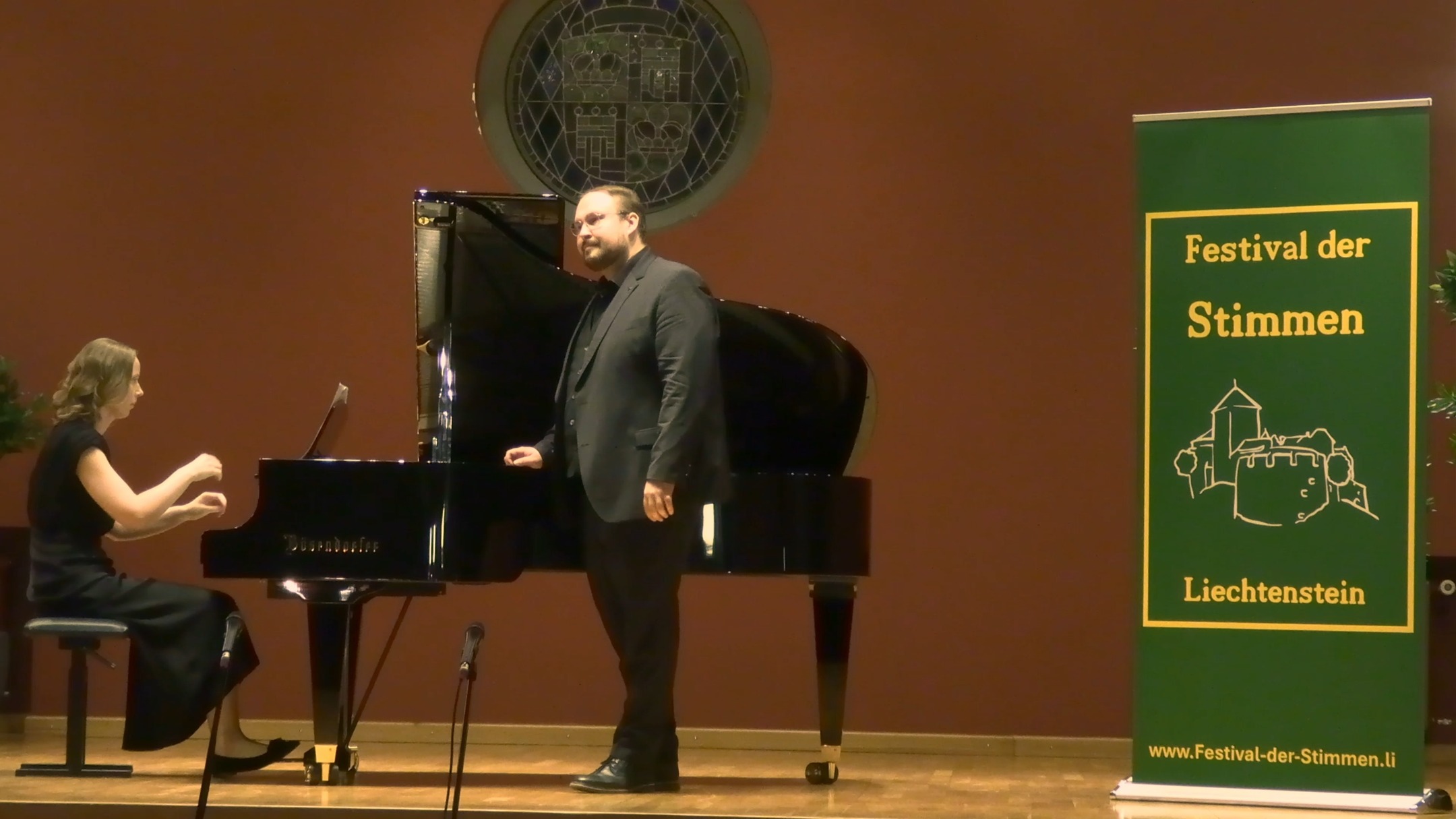
Current Performers with Whom I Collaborate
Analysis – Music
Suspended Time & Sound-Space
“Morgen!” does not begin with a dramatic assertion, but with a sound-space. The piano opens a calm, wave-like motion, above which the voice enters only after a delay. This creates the impression that the music had already existed before the first word.
This temporal suspension is crucial. The song seems less to move forward than to spread out. The future of which the text speaks is not represented musically as a goal, but as a certainty already felt. Strauss composes expectation without unrest.
Melody, Harmony & Final Effect
The vocal line moves in long, connected phrases. The melody seems simple, but not plain: its effect arises from the great calm of the breath and from the breadth of the phrases. The harmony remains largely luminous and diatonic, but gains its tension from the finest shifts and from delayed resolutions.
The final effect is especially impressive. The song does not end with outward affirmation, but with the image of “des Glückes stummes Schweigen”. Sound and language here approach silence. The music confirms happiness not through intensification, but through fading away.
Visual Representation
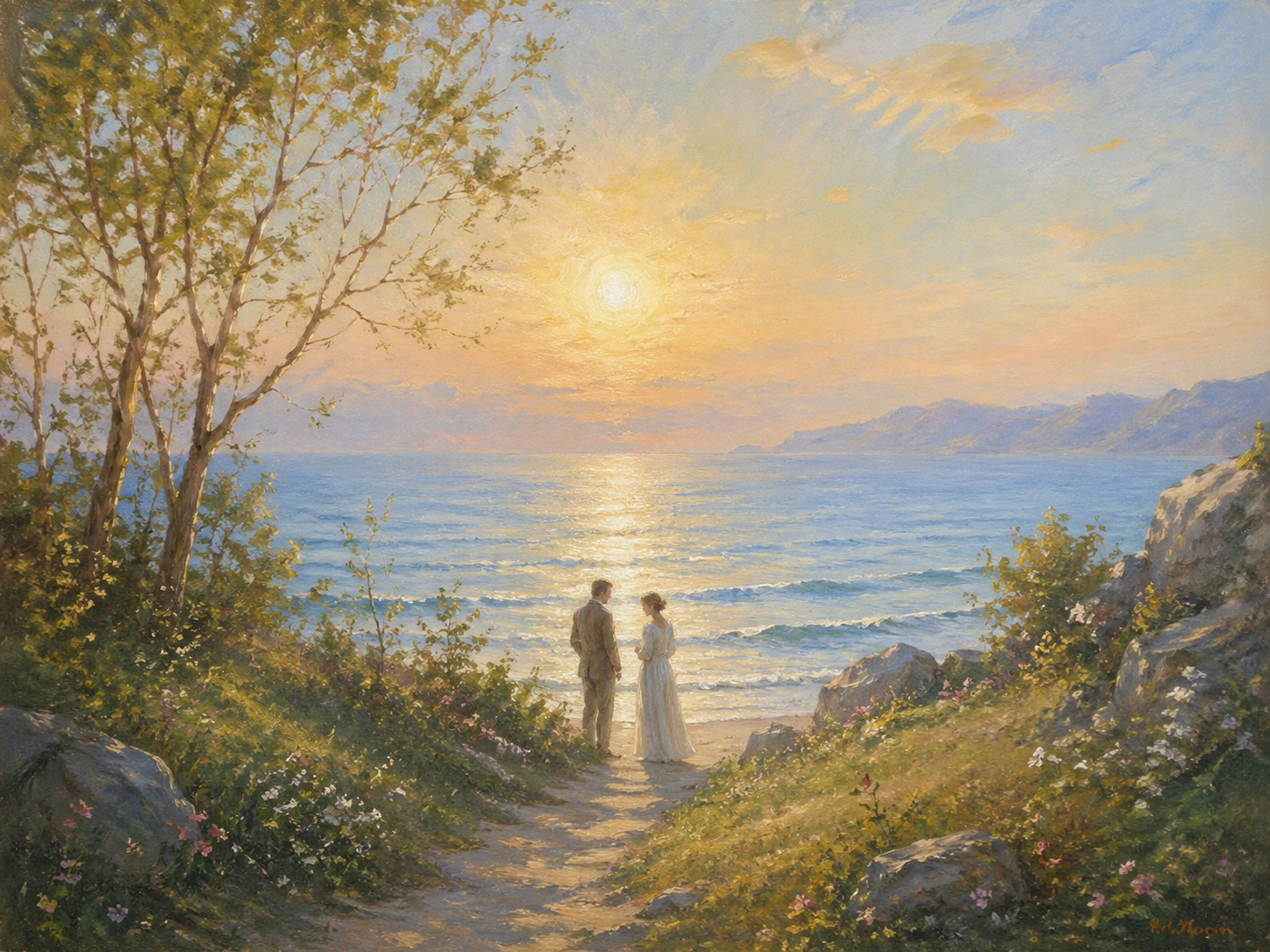
Artistic visualisation by Evgenia Fölsche:
The image shows a wide, light-filled space
in which sky, earth and sea seem to merge into one another.
The image opens forward and into the distance:
not as a dramatic departure, but as a quiet promise.
At the centre is the idea of two people
walking together towards a coming morning.
The path is not steep, not combative, not marked by outward resistance.
It leads slowly and calmly into a landscape
filled with light, breath and spaciousness.
The shore and the wave-blue sea take up the images of the poem.
They stand for transition, openness and a happiness
that does not need to be spoken aloud.
Nature appears not merely as a backdrop,
but as the resonance space of an inner certainty.
As in Strauss’s music, the effect arises from delicacy and restraint.
The image tells no story,
but holds a state:
the moment before perfect silence,
in which two people look at one another
and the world seems, for a moment, to become still.
Analysis – Poetry
John Henry Mackay’s poem “Morgen!” is marked by great linguistic simplicity. It does not describe a dramatic love scene, but a moment of quiet fulfilment anticipated in advance. The future is not formulated as an uncertain wish, but as calm certainty.
Tomorrow as Promise
Und morgen wird die Sonne wieder scheinen,
und auf dem Wege, den ich gehen werde,
The poem begins with the word “Und”. This makes the text feel not like a beginning, but like the continuation of an already existing inner thought. “Tomorrow” is not merely a point in time, but a space of hope. The sun will shine “again”: the light returns, but without a triumphant gesture.
Walking Together
wird uns, die Glücklichen, sie wieder einen
inmitten dieser sonnenatmenden Erde …
At the centre stands not the individual “I”, but the “us”. The lovers appear as “the happy ones”, yet this happiness is not proclaimed. It is embedded in an earth that itself seems to breathe. The word “sonnenatmend” connects light, body and world into a single breathing whole.
The Path to the Shore
Und zu dem Strand, dem weiten, wogenblauen,
werden wir still und langsam niedersteigen,
The second stanza leads into an even greater spatial breadth. The shore is “wide” and “wave-blue”: a place of opening, transition and the border between earth and sea. The descent happens “quietly and slowly”. There is movement, but it is completely calmed.
Happiness as Silence
stumm werden wir uns in die Augen schauen,
und auf uns sinkt des Glückes stummes Schweigen …
The ending is the true goal of the poem. The lovers do not speak. They look silently into each other’s eyes, and happiness appears not as jubilation, but as silence. This silence is not emptiness, but fulfilment: a state in which language is no longer necessary.
Mackay’s poem gains its force precisely from this restraint. It says little and opens much. Strauss recognises in it the ideal space for a music that does not explain, but breathes.
Open Semantics & Further Work
“Morgen!” has such a strong effect because it does not exhaust its meaning. The poem can be read as a love song, as a wedding song, as a vision of shared happiness – but also as a meditative gaze beyond the present. The morning remains concrete and symbolic at the same time.
Strauss’s music, too, preserves this openness. It confirms happiness without holding it fast. The future is not conquered musically, but gently opened. As a result, the song continues to work in the listener after it has faded away.
More on this idea in a theoretical context: The Semiotics of Song and Art That Continues to Work.
Meaning & Effect
“Morgen!” is a song of confession without pathos. Strauss does not compose the unrest of longing, but trust in a happiness to come. Love appears not as a dramatic event, but as a state of inner certainty.
The effect of the song arises from a rare balance: great Romantic breadth with utmost restraint, sensual fullness of sound with almost ascetic calm, hope without pressure. This makes “Morgen!” one of the quietest high points in Richard Strauss’s song output.
It is especially impressive that the song does not grow louder at the end, but softer. The goal is not a climax in the usual sense, but becoming silent. In the “silent silence”, the music finds its highest form of fulfilment.
Concert Enquiry
Richard Strauss’s “Morgen!” is one of the most striking lyrical points of repose in a song recital. The song is especially suited as a quiet ending, as a transition into a meditative section of a programme, or as the centre of a programme about love, hope and transcendence.
Evgenia Fölsche shapes Strauss’s song art with particular attention to transparency of sound, breath, textual clarity and the subtle transitions between voice and piano. Concert programmes can be flexibly adapted to venue, occasion and scoring.
Send Concert EnquiryFrequently Asked Questions about Richard Strauss: “Morgen!” Op. 27 No. 4
Click on a question to reveal the answer.
Which opus does “Morgen!” belong to?
“Morgen!” is No. 4 of the Four Songs, Op. 27, by Richard Strauss. The song group was composed in 1894.
Who wrote the text of “Morgen!”?
The text is by John Henry Mackay (1861–1933).
What key and tempo indication does the song have?
The song is in E-flat major and in 4/4 metre. The performance marking is Tender; very calm, scarcely moving.
Is there an orchestral version?
Yes. Richard Strauss orchestrated “Morgen!” in 1897. The orchestral version has become especially famous for its solo violin.
Why does “Morgen!” sound so calm?
The calm arises through the slow tempo, the floating E-flat major sound-world, the long melodic lines and the restraint of expression. Here Strauss composes not passion, but trust.