“Сон” (“The Dream”), Op. 8 No. 5, comes from the Six Romances, Op. 8 (1893–1894), by Sergei Rachmaninoff. The text by Afanasy Fet describes a dreamlike vision of light, consolation and quiet closeness. An apparition emerges in rosy radiance, speaks lovingly to the lyrical self and transforms sadness into peaceful brightness.
The song is marked by entrancing calm and melancholic luminosity. Unlike many of Rachmaninoff’s more passionate romances, its effect does not arise from outward dramatic eruption, but from an almost imperceptible inner transformation: pain is suspended for a moment, and in its place appears the quiet breathing of happiness.
Afanasy Fet’s poem – Russian / English poetic translation
Russian text:
Мне снился сон: она пришла,
Вся в блеске, в розовом сиянье,
И нежно, ласково сказала:
«Зачем ты грустен? Я с тобой».
И тихо стало, и светло,
И сердце билось без страданья,
И всё забыл я – всё прошло,
Лишь счастья тихое дыханье…
English poetic translation:
I dreamed a dream: she came to me,
all radiant, in rosy light appearing,
and softly, tenderly she said:
“Why are you sad? I am with you.”
And all grew still, and bright, and clear,
the heart beat on without suffering,
and all was forgotten — all had passed,
only the quiet breathing of happiness remained …
Text: Afanasy Fet (1820–1892); English poetic translation after the Russian original. Composition by Sergei Rachmaninoff (1893–1894).
Work details & overview
- Composer: Sergei Rachmaninoff (1873–1943)
- Cycle: 6 Romances, Op. 8 – No. 5 “Сон” / “The Dream”
- Text source: Afanasy Fet
- Composition: 1893–1894
- Publication: 1894 by Gutheil
- Key / metre / tempo: D-flat major (transpositions are common), 3/4, Andante tranquillo
- Duration: approx. 3 minutes
- Scoring: voice and piano
- Form: two-stanza song design with a flowing development of tension that feels through-composed
Details of the poem
- Author: Afanasy Fet (1820–1892)
- Language: Russian
- Central images: dream, apparition, rosy radiance, consolation, light, heart without pain, quiet happiness
- Literary devices: vision, symbolism of light, repetition of stillness and brightness, dream as an intermediate space of the soul
Genesis & context
The song “Сон” was composed at the transition between Rachmaninoff’s student years and his first successes as a composer. Fet’s poem reflects the late-Romantic ideal of the dream as a state of inner elevation: here, the dream is not mere sleep, but a space in which consolation, memory and inner calming become possible.
Rachmaninoff takes up this poetic situation with a luminous, restrained musical language. The music does not develop dramatically outward, but opens from within. Darkness becomes brightness, sadness becomes calm, and inner tension turns into a brief state of peaceful suspension.
This gives “Сон” a special place among Rachmaninoff’s early romances: the song is shaped less by outward passion than by transparency, delicacy and aftersound. It already reveals that capacity for emotional concentration which makes Rachmaninoff’s later songs so unmistakable.
Performance practice & reception
Voice: A very calm line, carried by the breath. The words should not be sung as narration, but should seem to emerge from a dream state. What matters is a floating inwardness: the apparition consoles, yet remains delicate and unreal.
Piano: Broadly spaced chordal fields and soft transitions create a translucent sound space. The pedal should be delicately interwoven, but not used in a way that blurs the texture. The accompaniment carries the feeling of suspension, not of movement.
Reception: “Сон” is not one of Rachmaninoff’s most frequently performed romances, but connoisseurs value it as a particularly refined example of his early lyrical language. Its atmosphere of stillness, rapture and inner light already points ahead to later songs such as “Здесь хорошо”.
Analysis – music
“Сон” works with floating harmonies and slow-moving sonority, making the dream state audible rather than illustrating it. The music remains suspended: it does not progress purposefully toward a goal, but unfolds like light gradually falling into a dark room.
The melodic line is broad and calmly shaped. It avoids sharp contours and preserves a flowing, almost weightless character. This creates the impression that the voice is not speaking from everyday reality, but from an inner threshold: half memory, half dream, half consolation.
The harmony supports this effect through gentle colourings and transitions. Where the text speaks of light, freedom from pain and quiet happiness, the music also opens. The ending does not feel like a definitive resolution, but like a fading away: the dream cannot be held, yet its light continues to resonate.
In this way the song shows exemplarily how Rachmaninoff creates an entire inner space from just a few poetic images. What matters is not the action, but the inner transformation from sadness into consolation. More on the open meaning of such musical signs in song can be found in the background article The Semiotics of Song.
Visual representation
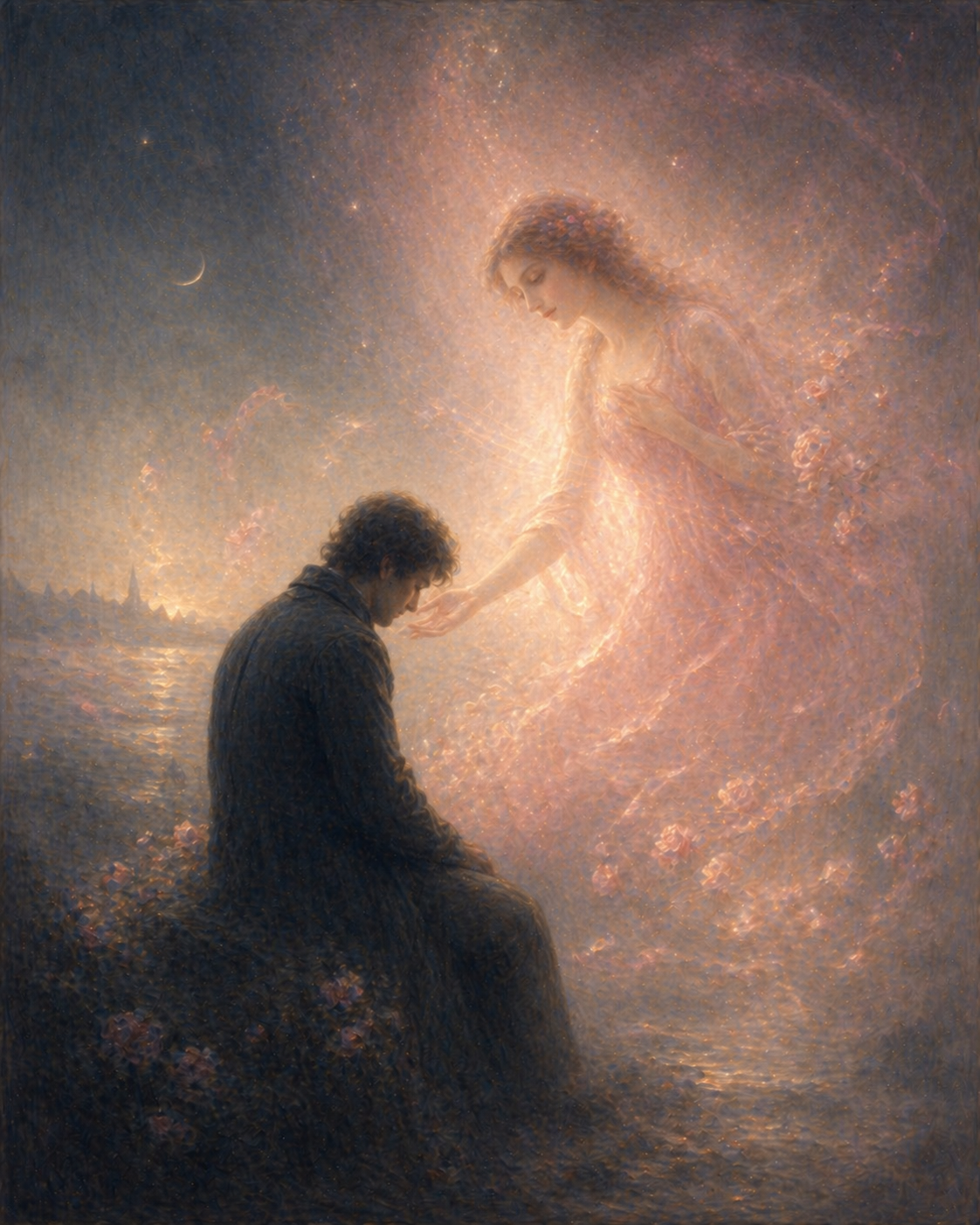
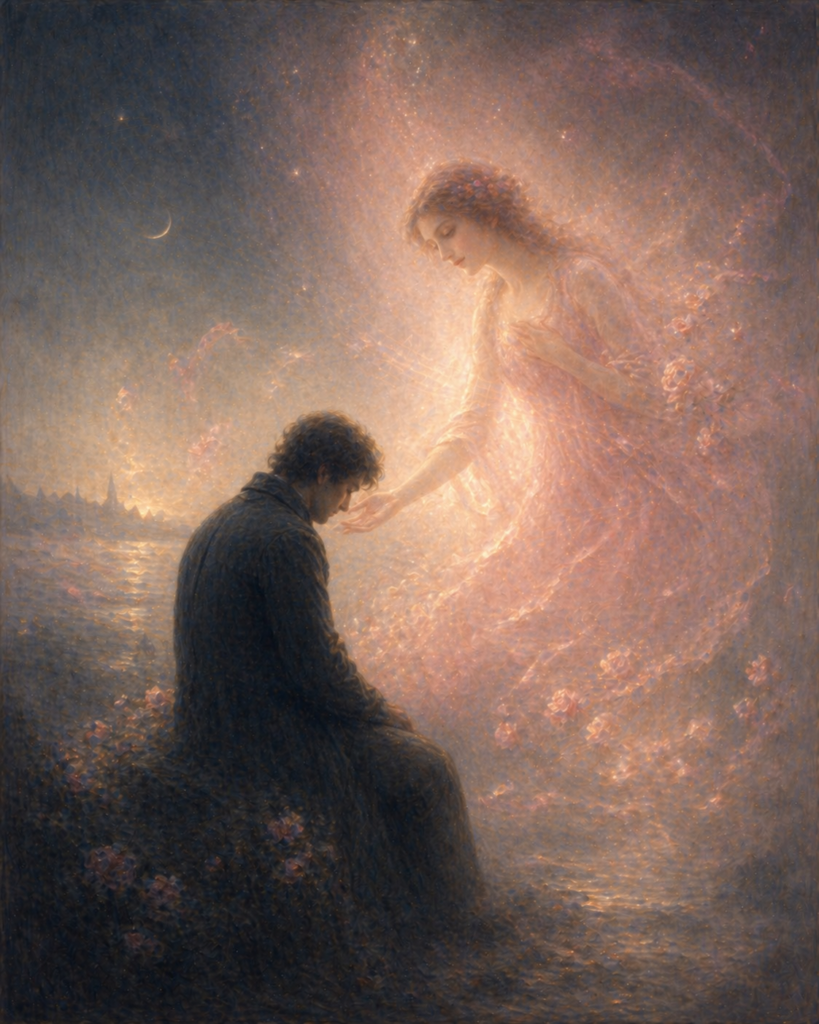
Artistic visualisation by Evgenia Fölsche: Dream in Rosy Light
The image shows the moment in which a dream settles over sadness.
A dark-clad man sits with bowed head in a misty nocturnal landscape.
Above him appears a radiant female figure, surrounded by rosy light,
gently reaching out her hand to him. Her form is not entirely bodily,
but seems like an apparition made of light, mist and memory.
The composition translates the central movement of the poem into an image:
darkness becomes brightness, loneliness becomes closeness,
and pain becomes quiet calm for a moment.
The rosy glow, the delicate blossoms, the mist and the gentle moonlight
let the scene hover between dream, consolation and inner vision.
Nothing is entirely real, yet everything feels inwardly present.
While earlier Rachmaninoff images are more strongly marked by painful memory,
here the consoling transformation stands at the centre.
The woman does not appear as a dramatic rescuer,
but as a gentle presence that suspends the man’s sadness for a moment.
The image makes visible what the poem says only quietly:
the heart beats without suffering, all that has passed sinks away,
and what remains is the quiet breathing of happiness.
Analysis – poetry
Fet’s poem is a miniature about a moment of inner brightening. It does not describe action in the proper sense, but the brief entrance of a consoling apparition into a dream. The beloved or dream figure does not come as a real person, but as an image of light: “in radiance, in rosy glow”.
First stanza
“Мне снился сон: она пришла” / “I dreamed a dream: she came”
The opening places the entire scene in an intermediate space.
What follows is not external reality, but dream reality.
Precisely for this reason, the encounter can feel more intense:
it is not bound by the laws of the outer world.
“Вся в блеске, в розовом сиянье” / “all in radiance, in rosy glow”
The woman appears first not through action or character,
but through light. The rosy glow is an image of tenderness,
warmth and inner transfiguration. The apparition brings another atmosphere with her.
“И нежно, ласково сказала” / “and tenderly, lovingly she said”
The language of the dream figure is not commanding,
but calming. Her voice belongs to the sphere of consolation.
Here the poem works with utmost simplicity:
not a grand confession, but a gentle question changes everything.
“Зачем ты грустен? Я с тобой” / “Why are you sad? I am with you”
This line is the centre of the poem.
Sadness is neither analysed nor explained.
Closeness is set against it.
“I am with you” is not argumentative consolation,
but immediate presence.
Second stanza
“И тихо стало, и светло” / “And it became still and light”
The effect of the apparition is immediately shown in the atmosphere.
Stillness and light are inner states here.
The dream transforms the inner landscape:
unrest becomes calm, darkness becomes brightness.
“И сердце билось без страданья” / “and the heart beat without suffering”
Pain does not disappear through explanation,
but through contact with a consoling presence.
The heart remains alive, but it no longer beats under torment.
This line makes the dream a space of temporary release.
“И всё забыл я – всё прошло” / “and I forgot everything — everything passed”
Forgetting here is not loss,
but relief. Past and suffering recede.
The dream grants no lasting possession,
but a moment in which the burden is lifted.
“Лишь счастья тихое дыханье…” / “only the quiet breathing of happiness …”
The ending dissolves into an open, barely tangible feeling.
Happiness does not appear loud, triumphant or complete,
but as a quiet breath. The ellipsis intensifies the sense of suspension:
the poem does not end; it fades away.
Meaning & effect
“Сон” is a quiet jewel in Rachmaninoff’s early song output. It combines late-Romantic symbolism of light with a deep, but restrained emotionality. The song is not about fulfilment in an external sense, but about a dream in which pain is suspended for a moment.
Its particular effect arises from the delicacy of the process. The dream figure comes, speaks only a few words, and the world becomes still and bright. This simplicity is not naïve, but highly concentrated: Fet’s poetry and Rachmaninoff’s music show that consolation does not have to be loud.
Precisely because the dream cannot be held, its effect remains strong. The song does not end with certainty, but with resonance. It belongs to that kind of art that continues to work, because it does not explain an inner state, but makes it perceptible. More on this in the article Art That Continues to Work.
Evgenia Fölsche – performances & audio
Evgenia Fölsche interprets the song with the utmost restraint: flowing tempo, breath-bound lines and a sound world that does not illustrate the dream, but allows it to arise. The decisive element is the balance between warmth and unreality.
The voice should not seek outward expressivity here, but luminous inwardness. The song needs a tone that comes from stillness and returns to it.
Concert video: Go to the concert recording on this page
Rachmaninoff songs for your concert programme
Sergei Rachmaninoff’s songs combine vocal warmth, late-Romantic harmony and great psychological subtlety. “Сон” is especially well suited to programmes centred on dream, consolation, night, light, memory and Russian song poetry.
Evgenia Fölsche can perform this repertoire as part of song recitals, thematic concert programmes or moderated formats. Particularly attractive is the combination with further Russian romances, but also with songs by Schubert, Strauss, Debussy or Tchaikovsky.
Send a concert inquiryFAQ – Rachmaninoff: “Сон” (“The Dream”), Op. 8 No. 5
Click on a question to display the answer.
Who is the poet of the song?
The text is by Afanasy Fet (1820–1892), one of the most important Russian poets of the late Romantic period. His poems are often marked by images of light, musical brevity and emotional suggestion.
What key and mood characterise the song?
The song is in D-flat major and carries the tempo indication Andante tranquillo. The mood is melancholically bright: not passionately eruptive, but delicate, floating and consoling.
What is the central image of the poem?
The central image is the dream figure, who appears in rosy radiance and speaks tenderly to the saddened lyrical self. Through this apparition, the inner world becomes still, bright and free of pain.
How does “Сон” relate to Rachmaninoff’s other romances?
It forms a lyrical counterpart to more passionate early songs. Its atmosphere of stillness, rapture and inner light already points ahead to later Rachmaninoff romances such as “Здесь хорошо”, Op. 21 No. 7.