“Ночью в саду у меня” (“At Night in My Garden”), Op. 38 No. 1, opens the late Six Romances, Op. 38, by Sergei Rachmaninoff. The song was composed in 1916 and sets a Russian text by Alexander Blok after Avetik Isahakyan. At its centre is a nocturnal garden: a weeping willow, its inconsolability, and the vision of an early morning that wipes away its tears with its curls.
Unlike many of Rachmaninoff’s earlier romances, this song feels especially concise, concentrated and transparent. The scene is small, almost miniature-like, yet it opens a wide inner space: night, pain, nature and morning light become images of inner transformation. The willow is not merely a tree, but a lamenting figure whom the coming dawn meets with tenderness.
Alexander Blok’s poem after Avetik Isahakyan – Russian / English poetic translation
Russian text:
Ночью в саду у меня
Плачет плакучая ива,
И безутешна она,
Ивушка, грустная ива.
Раннее утро блеснёт,
Нежная девушка-зорька
Ивушке, плачущей горько,
Слёзы кудрями сотрёт.
English poetic translation:
At night in my garden
the weeping willow weeps,
and inconsolable it stands,
little willow, sorrowful willow.
Early morning will gleam,
the tender maiden-dawn
will wipe the tears of the bitterly weeping willow
away with her curls.
Text: Alexander Blok (1880–1921) after Avetik Isahakyan (1875–1957); English poetic translation after the Russian text. Rachmaninoff’s sung version uses “сотрёт” at the end. Composition by Sergei Rachmaninoff (1916), Op. 38 No. 1.
Work details & overview
- Composer: Sergei Rachmaninoff (1873–1943)
- Cycle: 6 Romances, Op. 38 – No. 1 “Ночью в саду у меня” / “At Night in My Garden”
- Text source: Alexander Blok after Avetik Isahakyan
- Composition: 1916
- Key / tempo: G minor, Lento
- Duration: approx. 2 minutes
- Scoring: voice and piano; transpositions are possible
- Form: short, concentrated song miniature with two poetic image sections
Details of the poem
- Russian text: Alexander Blok
- After a source by: Avetik Isahakyan
- Language: Russian
- Central images: night, garden, weeping willow, tears, dawn, maiden, curls, consolation
- Literary devices: personification, nature image, symbolism of light, diminutive form, transformation of lament into consolation
Genesis & context
Rachmaninoff’s Op. 38 was composed in 1916 and belongs to his latest groups of songs. Compared with many earlier songs, the six romances often appear more concise, more modern and more strongly concentrated on individual poetic images. “Ночью в саду у меня” opens this cycle with a nocturnal miniature that creates an entire atmosphere from just a few words.
In its Russian form, the text is by Alexander Blok after a source by the Armenian poet Avetik Isahakyan. This origin is already significant: the poem combines simple images of nature with symbolist concentration. The willow is not merely a tree, but a suffering figure. Dawn does not appear abstractly, but as a tender maiden who touches the willow’s tears.
In Rachmaninoff’s setting, this small event becomes a miniature inner drama. Night carries pain and loneliness, yet morning is already announced. The song does not remain in darkness: it moves toward a quiet consolation without declaring that consolation aloud.
Performance practice & reception
Voice: The voice should be led with great calm and concentration. This song does not tolerate grand gesture. What matters is the ability to fill a small scene with the finest tension: the willow weeps, but the music must not become sentimental. The expression arises from restraint, clarity and inner intensity.
Text & diction: The Russian diminutive forms such as “ивушка” and the tenderness of “девушка-зорька” require special attention. They should not sound cute or decorative, but should make the vulnerability of the images audible. The consonants must remain clear without disturbing the soft line.
Piano: The piano part must carry the nocturnal atmosphere without thickening or burdening it. What matters is a dark, transparent sound: enough depth for the sorrow of the opening lines, enough light for the premonition of morning. The pedal should be finely measured so that the sound floats, but does not blur.
Reception: “Ночью в саду у меня” is less popular than some of Rachmaninoff’s earlier romances, but within Op. 38 it is a particularly characteristic example of the late concentration of his song style. The brevity of the song does not make its effect smaller, but more concentrated.
Selected reference recordings
- Sergei Leiferkus / Howard Shelley
- Elena Obraztsova / Vladimir Krainev
- Olga Borodina / Ivari Ilja
- Dmitri Hvorostovsky / Ivari Ilja
Analysis – music
The music of “Ночью в саду у меня” is marked by great economy. Rachmaninoff avoids extended climaxes and concentrates instead on a dense, dark sound surface from which the vocal line emerges like a quiet image. The garden is not an external setting, but a resonating space of feeling.
The first half of the song is shaped by the lamenting figure of the willow. The image of the плакучая ива, the weeping willow, is especially powerful in Russian, because the semantic field of weeping and willow seems to intertwine. Rachmaninoff takes up this closeness without illustrating it too obviously: the music remains controlled, yet inwardly tense.
With the mention of early morning, the perspective of sound changes. The music does not open triumphantly, but tenderly. Consolation appears as a touch, not as redemption. Especially important is the image of dawn as a maiden who wipes away the willow’s tears: Rachmaninoff translates this gesture into a quiet brightening, not into an outward climax.
In this way the song shows a late form of Rachmaninoff’s song language: less broadly flowing than in many earlier romances, but more concentrated, more symbolic and more transparent. Meaning arises not through dramatic development, but through the transformation of a single image: night becomes morning, weeping becomes touch, sorrow becomes an almost inaudible consolation. More on open meaning in art song can be found in the background article The Semiotics of Song.
Visual representation

Artistic visualisation by Evgenia Fölsche: At Night in My Garden
The image shows a nocturnal garden as an inner space of the soul.
At its centre stands a weeping willow, whose hanging branches resemble hair,
veils or tears. It is not merely a tree,
but a vulnerable figure weeping in the darkness of the garden.
The garden remains still and empty of people.
Precisely for this reason, the willow becomes the main figure of the image.
Night surrounds it, but does not swallow it:
at the edge of the scene a delicate golden glow is already beginning,
as if announcing the early morning.
Dawn does not appear as a dramatic sunrise,
but as a gentle, almost maiden-like figure of light.
Her touch is quiet:
she does not dry the tears with force,
but with tenderness.
Thus an image arises between lament and consolation,
between darkness and first light.
As in Rachmaninoff’s music, nothing is finally resolved.
The sorrow remains perceptible,
but it is no longer alone.
The coming morning does not transform pain into jubilation,
but into a moment of quiet, sensitive calming.
Analysis – poetry
Alexander Blok’s text after Avetik Isahakyan is a short symbolist miniature. The outward scene is simple: at night, a weeping willow stands in the garden and weeps. Yet this simplicity is deceptive. Nature is completely humanised: the willow feels, suffers, weeps and is finally consoled by dawn.
First stanza
“Ночью в саду у меня” / “At night in my garden”
The first line sets both place and time.
Night creates intimacy and enclosure.
The garden is not just any garden,
but a personal space:
a quiet realm in which inner images can become visible.
“Плачет плакучая ива” / “the weeping willow weeps”
This line lives from strong linguistic concentration.
The weeping willow already carries weeping in its name,
and yet the weeping is stated explicitly.
This creates a double lament:
the willow looks as though it is weeping,
and in the poem it truly weeps.
“И безутешна она” / “and inconsolable it is”
The willow now becomes fully a figure of the soul.
Its sorrow is not merely a mood,
but inconsolability.
The image remains simple, yet psychologically intense.
“Ивушка, грустная ива” / “little willow, sorrowful willow”
The diminutive form “ивушка” gives the image tenderness.
It makes the willow smaller, closer and more vulnerable.
The poem does not look at sorrow from a distance,
but with loving compassion.
Second stanza
“Раннее утро блеснёт” / “Early morning will gleam”
With morning, a change enters.
Night is not final.
The verb of gleaming brings movement and hope,
but not yet loud triumph.
Consolation begins as light.
“Нежная девушка-зорька” / “the tender maiden-dawn”
Dawn is personified.
It appears not as an abstract natural phenomenon,
but as a young, tender being.
Consolation thus receives a human, almost loving form.
“Ивушке, плачущей горько” / “to the bitterly weeping willow”
The willow’s sorrow is intensified once again.
Morning does not come to a neutral image of nature,
but to a being that is weeping bitterly.
This makes the following gesture of consolation all the more delicate.
“Слёзы кудрями сотрёт” / “will wipe away the tears with her curls”
The ending is the central image of the poem.
Dawn wipes away the willow’s tears not with her hand,
but with her curls.
This is an extremely delicate, almost fairy-tale-like image:
consolation happens not through explanation,
but through touch, light and nearness.
Meaning & effect
“Ночью в саду у меня” shows Rachmaninoff, in the smallest possible space, as a master of emotional concentration. The song does not tell a large story, but transforms an image of nature into an inner drama: a willow weeps, dawn arrives, and pain is touched by a tender light.
The special effect lies in the balance between simplicity and symbolic force. Night, garden, willow and morning are easily understandable images. Yet in their combination they open great emotional depth: loneliness, inconsolability, tenderness and hope. Rachmaninoff does not explain these meanings, but lets them pass into sound.
The song does not end with triumphant redemption. Morning dries the tears, but the memory of the night remains. This is precisely what makes the piece so subtle: it knows pain, but believes in a quiet form of consolation. More on this in the article Art That Continues to Work.
Evgenia Fölsche – performances & audio
Evgenia Fölsche interprets this song with special attention to its quiet, symbolist imagery. What matters is a sound that does not illustrate, but breathes: dark enough for the night, transparent enough for the first light of morning.
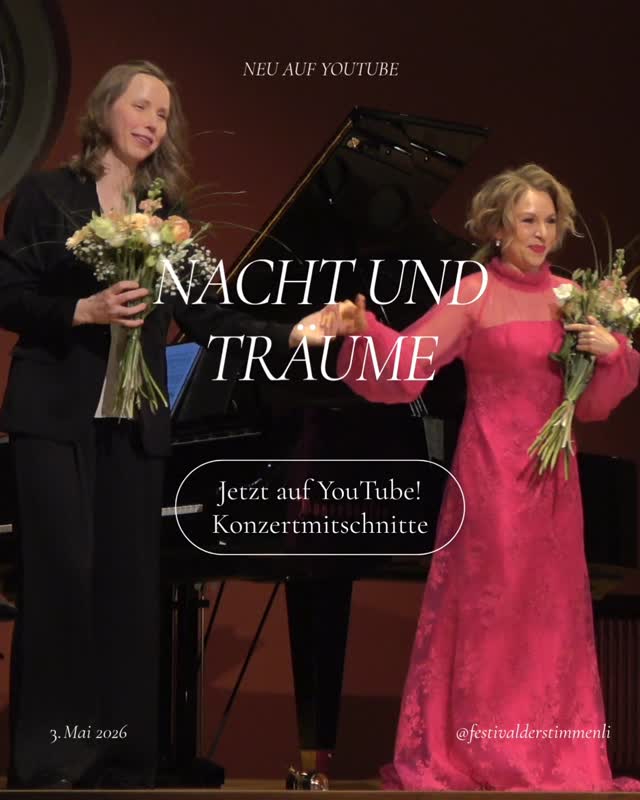
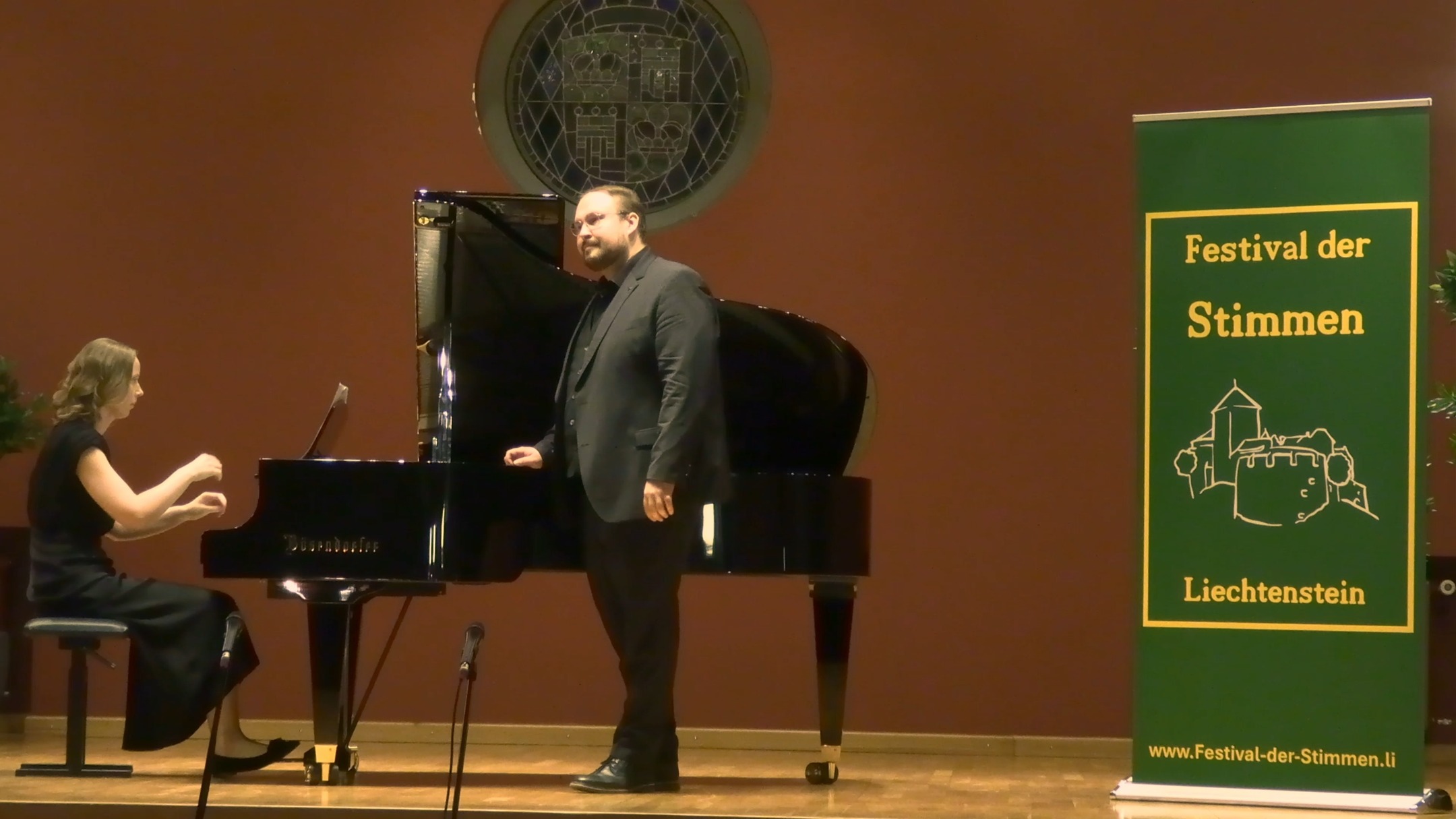
In the recording with Maria Nazarova from the Festival der Stimmen Liechtenstein in the Rathaussaal Vaduz, the miniature emerges as a subtle transition between pain and consolation: the voice remains close to the word, while the piano carries the nocturnal space and the delicate brightening of morning.
Concert video: Go to the concert recording on this page
Rachmaninoff songs for your concert programme
Sergei Rachmaninoff’s songs combine vocal intensity, late-Romantic harmony and an extraordinary sensitivity to poetic images. “Ночью в саду у меня” is especially well suited to programmes centred on night, nature, consolation, Russian Symbolism and the quiet transitions between pain and light.
Evgenia Fölsche can perform this repertoire as part of song recitals, thematic concert programmes or moderated formats. Particularly attractive is the combination with further songs from Op. 38, with Russian romances or with songs by Debussy, Strauss, Schubert and Tchaikovsky.
Send a concert inquiryFAQ – Rachmaninoff: “Ночью в саду у меня” (“At Night in My Garden”), Op. 38 No. 1
Click on a question to display the answer.
Which cycle does the song belong to?
The song opens Rachmaninoff’s Six Romances, Op. 38 from 1916. It is the first number of this late song group.
Who wrote the text?
The Russian text is by Alexander Blok after a source by the Armenian poet Avetik Isahakyan.
What does the title mean?
“Ночью в саду у меня” means approximately “At Night in My Garden”. Literally, the wording also carries the sense of “at night in the garden at my place”.
What is the central image of the song?
The central image is a weeping willow in a nocturnal garden, whose tears are dried in the morning by the personified dawn. In this way, an image of nature becomes a scene of pain and consolation.