“The Roadside Fire” is the third song in Ralph Vaughan Williams’s cycle Songs of Travel after Robert Louis Stevenson (1901–1904). After the march of The Vagabond and the lyrical contemplation of Let Beauty Awake, this song unfolds a lyrically animated vision of love: the wanderer dreams of hearth and home, not as possession, but as a symbol of inner warmth. The music combines folk-like tone, a buoyant 6/8 tread, and orchestral radiance within the piano texture.
The Poem (Robert Louis Stevenson – Original)
From: Songs of Travel and Other Verses (1896) – No. 3
Original (English):
I will make you brooches and toys for your delight
Of bird-song at morning and star-shine at night.
I will make a palace fit for you and me
Of green days in forests and blue days at sea.
I will make my kitchen, and you shall keep your room,
Where white flows the river and bright blows the broom,
And you shall wash your linen and keep your body white
In rainfall at morning and dewfall at night.
And this shall be for music when no one else is near,
The fine song for singing, the rare song to hear!
That only I remember, that only you admire,
Of the broad road that stretches and the roadside fire.
Text: Robert Louis Stevenson (1850–1894), public domain.
Work Data & Overview
- Composer: Ralph Vaughan Williams (1872–1958)
- Cycle: Songs of Travel – No. 3 The Roadside Fire
- Text source: Robert Louis Stevenson, Songs of Travel (1896)
- Composition: c. 1901–1904; published in 1904 (piano version), orchestration later authorised
- Range / Metre / Tempo: major-mixolydian colouring, 6/8; Allegretto moderato
- Duration: approx. 2–3 minutes
- Scoring: voice and piano (also in orchestral version)
- Form: tripartite (A–B–A′); refrain-like idea in the conclusion
Origin & Cycle Context
After the outward wandering of The Vagabond and the inward perception of Let Beauty Awake, the cycle enters the sphere of feeling in “The Roadside Fire”: the vagabond imagines companionship beside the fire. Vaughan Williams combines Stevenson’s simple language with musical warmth – a pastoral vision poised between dream and reality.
Performance Practice & Reception
Voice: flowing 6/8 pulse, cantabile, the text clearly shaped. Tender intensity without indulgent warmth; inward movement matters more than volume.
Piano: the accompaniment carries bright, wave-like figurations; balance between motion and light. Pedal light, never blurring.
Reception: one of the most popular songs of the cycle – often performed separately because of its folk-like character and emotional directness.
Reference Recordings (Selection)
- Gerald Finley – Julius Drake
- Bryn Terfel – Malcolm Martineau
- Sir Thomas Allen – Roger Vignoles
- Roderick Williams – Iain Burnside
Analysis – Music
6/8 Gesture & Motif of Radiance
The piano accompaniment suggests a gentle rocking or the flicker of fire: dotted quavers, rising arpeggios, and modal turns lend warmth. The melody emerges from simple scalar motion, yet carries a high expressive density – poised between folk song and art song.
“Come to my heart” – Climax
The middle stanza culminates in a widening of the melodic line: “Come to my heart, my darling” reaches the emotional high point. Dynamics and harmony open outward – a brief moment of intimacy before the song returns to its quiet glow.
Visual Representation
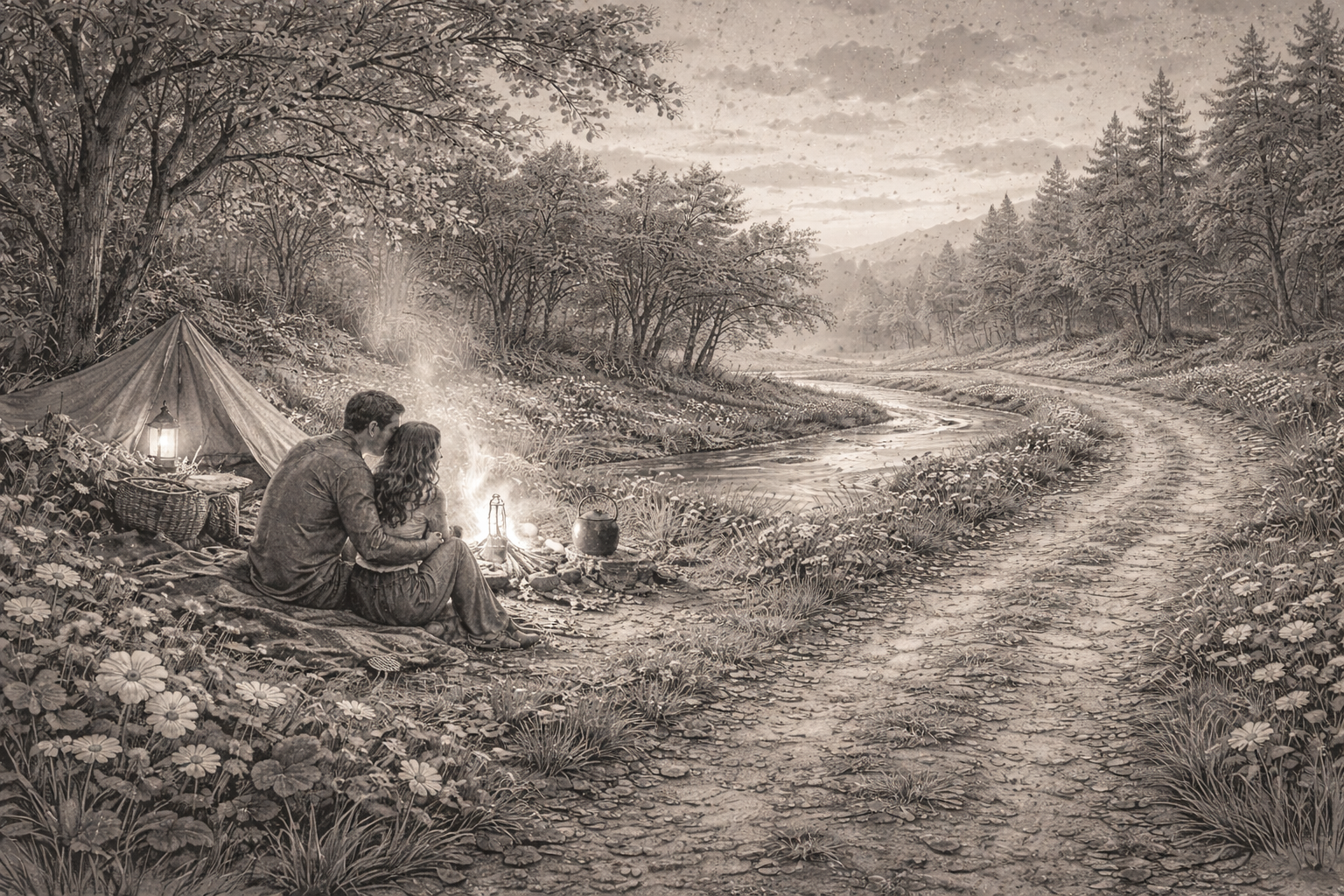
Artistic visualisation by Evgenia Fölsche:
The image shows a couple by a fire at the edge of a wide road.
The open landscape, the warm light of the flames, and the quiet
nearness of the two figures create an atmosphere of shelter
in the midst of being on the way. Not a fixed house, but the
shared moment of rest becomes here the place of warmth and belonging.
In this way, the visualisation captures the core of the song
very precisely. The text sketches a poetic vision of love
founded not on possession or settled domesticity, but on nature,
companionship, and a world experienced together. The roadside fire
thus becomes the symbol of a simple yet intense form of happiness:
intimacy within wandering.
The image also corresponds beautifully to the music. Vaughan Williams
combines warmth, calm, and song-like simplicity with a sense
of open expansiveness. Like the music, the image feels inward
and serene – a poetic vision of a shared life that finds its home
not in a house, but on the road.
Analysis – Poetry
The poem “The Roadside Fire” unfolds the vision of a simple, intimate, and at the same time poetically heightened life together. Unlike “The Vagabond”, where the speaking voice proclaims radical independence, the focus here turns toward companionship, domesticity, and shared experience. Yet this domesticity is not bourgeois in the sense of property, order, and social security. Rather, it arises from nature, song, memory, and the open road. The poem thus joins the longing for closeness with the spirit of wandering.
Poetic Gifts Instead of Material Possessions
I will make you brooches and toys for your delight
Of bird-song at morning and star-shine at night.
I will make a palace fit for you and me
Of green days in forests and blue days at sea.
Right at the beginning, the speaking voice imagines a world of giving and creating. It promises brooches and toys, yet these gifts are made not of precious materials, but of birdsong and starlight. This makes clear that no real provision is meant here, but rather a poetic transformation of the world. Nature itself becomes the wealth from which the gift of love is formed.
The announced “palace,” too, is no actual palace of stone and property, but a structure made of “green days in forests and blue days at sea.” The happiness of togetherness is therefore grounded not in ownership, but in nature experienced together. Forest and sea stand for expansiveness, abundance, and motion; the “palace” becomes an image of inward wealth. Love appears here not as entry into a fixed home, but as a poetic transformation of wandering existence.
Domesticity within Nature
I will make my kitchen, and you shall keep your room,
Where white flows the river and bright blows the broom,
And you shall wash your linen and keep your body white
In rainfall at morning and dewfall at night.
In the second half of the first stanza, this vision becomes more concrete through images of a shared everyday life. Kitchen and room suggest a form of order and division of tasks, elements of domestic existence. Yet this home remains entirely embedded in nature: the river flows white, the broom blooms bright, and rain and dew take on the functions that a house and its protective spaces would otherwise fulfil.
Precisely here lies the peculiarity of the poem. It imagines domesticity without choosing settled life in the strict sense. What sounds like orderly living together remains free from possessiveness and the narrowness of civilisation. Nature is not left behind, but made into the sustaining environment of a shared life. In this way, the poem unites two seemingly opposite longings: the longing for shelter and the longing for freedom.
The Exclusive Song of Togetherness
And this shall be for music when no one else is near,
The fine song for singing, the rare song to hear!
That only I remember, that only you admire,
In the second part of the poem, music moves to the centre. It becomes the expression of an intimacy that exists only between the two people involved. The song is “fine” and “rare,” precious and uncommon, not because it would be publicly admired, but because it is shared only by them. Memory and admiration are distributed reciprocally: what only one remembers, only the other admires. In this way, the song becomes the sign of a unique and enclosed world of togetherness.
This passage deepens the character of the poem decisively. The relationship is grounded not in possession or social form, but in shared perception and memory. Music here is not entertainment, but a cipher for that inward accord that only two people can share. The poem thereby gains a quiet, almost dreamlike tone: the vision of love remains delicate and immaterial.
Road and Fire as a Union of Wandering and Shelter
Of the broad road that stretches and the roadside fire.
The closing line gathers the whole meaning of the poem into a single pair of images. The “broad road that stretches” stands for openness, movement, and the wide horizon of life’s journey. It recalls the basic figure of the wanderer, who does not dissolve into one place, but remains oriented toward distance. Opposed to it stands the “roadside fire,” which symbolises warmth, rest, and human nearness.
It is precisely the conjunction of these two images that gives the poem its charm. The fire is not located in a fixed house, but at the roadside. Shelter therefore appears not as the end of the journey, but as a moment within wandering itself. The love-ideal of the poem does not consist in leaving the road behind, but in finding upon it a place of warmth. In this way, the closing formula unites freedom and closeness, departure and rest, movement and a sense of home in a single poetic image.
“The Roadside Fire” is therefore neither a simple love poem nor merely an idyll of domestic life. Rather, it sketches a poetic utopia in which love and wandering do not contradict one another. Nature becomes the house, song the bond, and the fire by the road the symbol of a form of shelter grounded not in possession, but in a world experienced together.
Meaning & Effect
At the centre of the poem lies the idea that closeness and shelter need not be bound to property, house, or social order. The speaking voice imagines a form of love nourished by nature, memory, song, and shared experience. Yet the road remains as a symbol of the open course of life. Precisely therein lies the distinctive quality of the poem: it unites the longing for togetherness with the ideal of a free and unbound existence.
The poem’s effect arises from its blend of simplicity and poetic transfiguration. The language is song-like, clear, and immediate, yet the images transform ordinary wishes into an almost fairy-tale vision. Birdsong, starlight, river, dew, and the roadside fire lend the text a warm, radiant atmosphere. Thus, “The Roadside Fire” feels like a quiet dream of love within wandering – tender, close to nature, and sustained by inward calm.
Evgenia Fölsche – Performances & Audio
Evgenia Fölsche shapes “The Roadside Fire” with a buoyant 6/8 pulse and a clear vocal tone: no sentimentality, but light. The fire remains chamber-like – a quiet, glowing scene.
Audio example: Add audio/video link here
FAQ – Vaughan Williams: “The Roadside Fire” (Songs of Travel No. 3)
Click on a question to reveal the answer.
How is the song formally structured?
It is tripartite (A–B–A′) with a recurring closing line. The form creates a gentle symmetry and calm within the cycle’s flow.
Which emotion shapes “The Roadside Fire”?
Tender warmth, not pathos. It is a song of longing for closeness and shelter, expressed in poetic simplicity.
How does the song differ from the first two?
“The Vagabond” = will, “Let Beauty Awake” = perception, “The Roadside Fire” = tenderness. The cycle opens emotionally step by step.