“The Infinite Shining Heavens” is the sixth song in Ralph Vaughan Williams’s cycle Songs of Travel after Robert Louis Stevenson (1901–1904). After the introspective night-music of In Dreams, the gaze now opens upward — into cosmic vastness. Sky, stars, and silence become images of a spiritual solitude that does not lament, but marvels: Vaughan Williams combines modal harmony, a suspended pulse, and an almost choral stillness.
The Poem (Robert Louis Stevenson – Original)
From: Songs of Travel and Other Verses (1896) – No. 6
Original Text (English)
The infinite shining heavens
Rose and I saw them shine,
Shining and shining above me,
The infinite shining heavens.
Then I said to my heart, “How is it
That you are envious of mine?
The infinite shining heavens
Are mine, O my heart, and are mine.”
Text: Robert Louis Stevenson (1850–1894), from Songs of Travel and Other Verses (1896), public domain.
Work Data & Overview
- Composer: Ralph Vaughan Williams (1872–1958)
- Cycle: Songs of Travel – No. 6 The Infinite Shining Heavens
- Text source: Robert Louis Stevenson, Songs of Travel (1896)
- Composition: c. 1901–1904; published in 1904 (piano version), later orchestration authorised
- Range / Metre / Tempo: E-flat major / Dorian-Mixolydian colouring, 4/4, Andante tranquillo
- Duration: approx. 2 minutes
- Scoring: voice and piano (also orchestrated)
- Form: bipartite (A–A′); lyrical return with harmonic expansion
Origin & Cycle Context
After the inward dream-station of In Dreams, the gaze in The Infinite Shining Heavens turns outward — and at the same time upward. Vaughan Williams composes a contemplation of vastness: the self merges with the cosmos. This spiritual perspective already anticipates the spacious sound-worlds of later works such as The Lark Ascending and the Pastoral Symphony.
Performance Practice & Reception
Voice: Suspended tone, without emphasis on vibrato. Lines should be carried almost instrumentally, with even breadth of breath. This is not “singing about heaven,” but contemplative utterance.
Piano: Gentle, luminous chordal fields; the accompaniment sustains and breathes. Essential: leave space between the harmonies — silence as resonance.
Reception: Frequently performed as an individual piece; exemplary of Vaughan Williams’s spiritually earthly sound-world. Often programmed as a point of repose between Nos. 5 and 7.
Reference Recordings (Selection)
- Gerald Finley – Julius Drake
- Roderick Williams – Iain Burnside
- Sir Thomas Allen – Roger Vignoles
- Bryn Terfel – Malcolm Martineau
Analysis – Music
Modal Vastness & Suspended Sonority
The song rests on a single harmonic field: a modal E-flat major world without functional tension. The harmony opens spaces rather than closes them. Melody and accompaniment circle — no goal, but suspension.
Sound-Space Instead of Motion
Rhythmically, calm prevails — even quaver motion, hardly any displacement of accent. The dynamics remain layered. Vaughan Williams thus creates a “standing” sound-space that breathes more than it strides.
Visual Representation
Artistic visualisation by Evgenia Fölsche:
A solitary wanderer stands on a height and looks up
into a wide, luminous night sky. The landscape beneath him
remains dark and still, while above him the stars spread out
in great clarity. The result is an impression of deep inward
concentration: the human figure appears small beneath the sky,
and yet connected with it.
In this way, the image takes up the central idea of the song directly.
In the text, the infinite vastness of the heavens is experienced
not as something distant or unreachable, but as something
in which the speaking self inwardly shares. The scene therefore
presents not merely an observation of nature, but a moment
of quiet recognition and belonging.
This image also corresponds beautifully to the music.
Vaughan Williams shapes the song calmly, inwardly, and almost meditatively.
Like the music, the image feels not dramatic, but spacious,
clear, and still — as a moment in which outward vastness
becomes inward repose.
Analysis – Poetry
The poem “The Infinite Shining Heavens” belongs among the quietest and most concentrated texts of the cycle. It describes no outward event and no developing action, but a moment of contemplation. The gaze of the speaking self is directed upward into the infinite vastness of the sky, and from this act of beholding there arises an inward recognition. The poem unites cosmic wonder with quiet self-assurance: the beauty and greatness of the heavens are experienced not as distant or unreachable, but as something that belongs to the self in a deeper sense.
The Beholding of Infinite Vastness
The infinite shining heavens
Rose and I saw them shine
Shining and shining above me,
The infinite shining heavens.
Already the opening lines unfold an atmosphere of calm and sublimity. The heavens appear as “infinite,” and at the same time as shining. The repetition of “shining and shining” intensifies the impression of an unwavering, even presence. Nothing moves dramatically, nothing breaks in; rather, the whole image is held in a condition of quiet duration. The heavens are not merely a backdrop, but a reality that surrounds and surpasses the self.
At the same time, the perspective is strikingly simple. The speaker says no more than that he saw the heavens rise and saw them shine. Precisely this linguistic simplicity lends the image its greatness. Wonder is not rhetorically heightened, but held within a clear, almost childlike perception. In this way, the poem gains its particular concentration: the gaze is directed wholly toward what is essential.
The Heavens as Counter-Image to Inner Lack
Then I said to my heart, “How is it
That you are envious of mine?
In the second half of the poem, the emphasis shifts from outward seeing to inward dialogue. The speaking self addresses its own heart and asks why it is envious. Here, suddenly, a tension emerges: evidently there is within a feeling of lack, desire, or dissatisfaction. The heart appears as that part of the human being which longs for something it believes itself to be missing.
Against the background of the heavens just beheld, this envy appears almost contradictory. The poem thus presents an inner conflict: although infinite beauty is present, the heart still tends to feel poor or excluded. This brief self-dialogue makes the poem more than mere nature-observation. It becomes a meditation on the human inclination to overlook what is already one’s own.
Sharing Rather Than Possessing
The infinite shining heavens
Are mine, O my heart, and are mine.
The answer to this inner tension lies in the surprising assertion: the infinite shining heavens “are mine.” This statement is not to be understood in a material sense. The speaker does not claim the heavens as property, but recognises them as something in which he participates. Precisely here lies the conceptual movement of the poem: the heart is to understand that true fullness lies not in possessing particular things, but in knowing oneself to belong to the infinite.
The double repetition, “and are mine,” strengthens this act of self-assurance. It sounds not triumphant, but calm and convinced. The heavens are not conquered, but inwardly accepted. Thus, wonder at outer vastness becomes a statement about inward freedom. The self recognises that it is not excluded from the beauty of the world, but already stands within it.
Cosmic Vastness and Inner Composure
Then I said to my heart …
… O my heart, and are mine.
In the poem, the heart is not only the seat of feeling, but the addressee of a quiet instruction. The self speaks to itself in order to hold fast to a deeper truth. Thus, a meditative tone arises: the poem is less communication to others than an act of inward composure. Heaven and heart are brought into relation. The outer infinity finds its counterpart in an inward awakening of consciousness.
It is precisely this connection that gives the text its peculiar calm. There is no conflict with others, no action, and no dramatic goal. Everything takes place in a single moment of recognition. Cosmic vastness does not dissolve the self, but quiets it. The heart is to cease desiring, because it already shares in something greater.
A Poem of Quiet Self-Assurance
The infinite shining heavens
Are mine, O my heart, and are mine.
The closing statement gathers the meaning of the poem in utmost simplicity. It is not about dominion, but about belonging; not about appropriation, but about recognising one’s share in the world. Thus, within the cycle, “The Infinite Shining Heavens” stands for a moment of widening and repose. After the subjective pains and memories of earlier songs, a space opens here in which the self looks beyond itself without losing itself.
The poem is so compelling precisely because, in very few words, it accomplishes a great movement: from wonder at the world to reconciliation with one’s own inward being. Out of the vision of the heavens emerges an answer to the heart’s sense of lack. In this quiet self-assurance lies its true greatness.
Meaning & Effect
At the centre of the poem lies the insight that the human being has a share in the beauty and greatness of the world, even without possessing it. In looking at the infinite heavens, the speaking self recognises that its heart need not lose itself in envy or lack. True fullness here arises from belonging, not from possession.
The effect of the poem lies in its great calm and intellectual clarity. The language is plain, almost song-like, yet precisely in this simplicity there unfolds a feeling of vastness, sublimity, and quiet inward composure. “The Infinite Shining Heavens” therefore feels like a meditative pause within the cycle: a moment in which the wanderer is not travelling, but finds inward freedom through contemplation.
Evgenia Fölsche – Performances & Audio
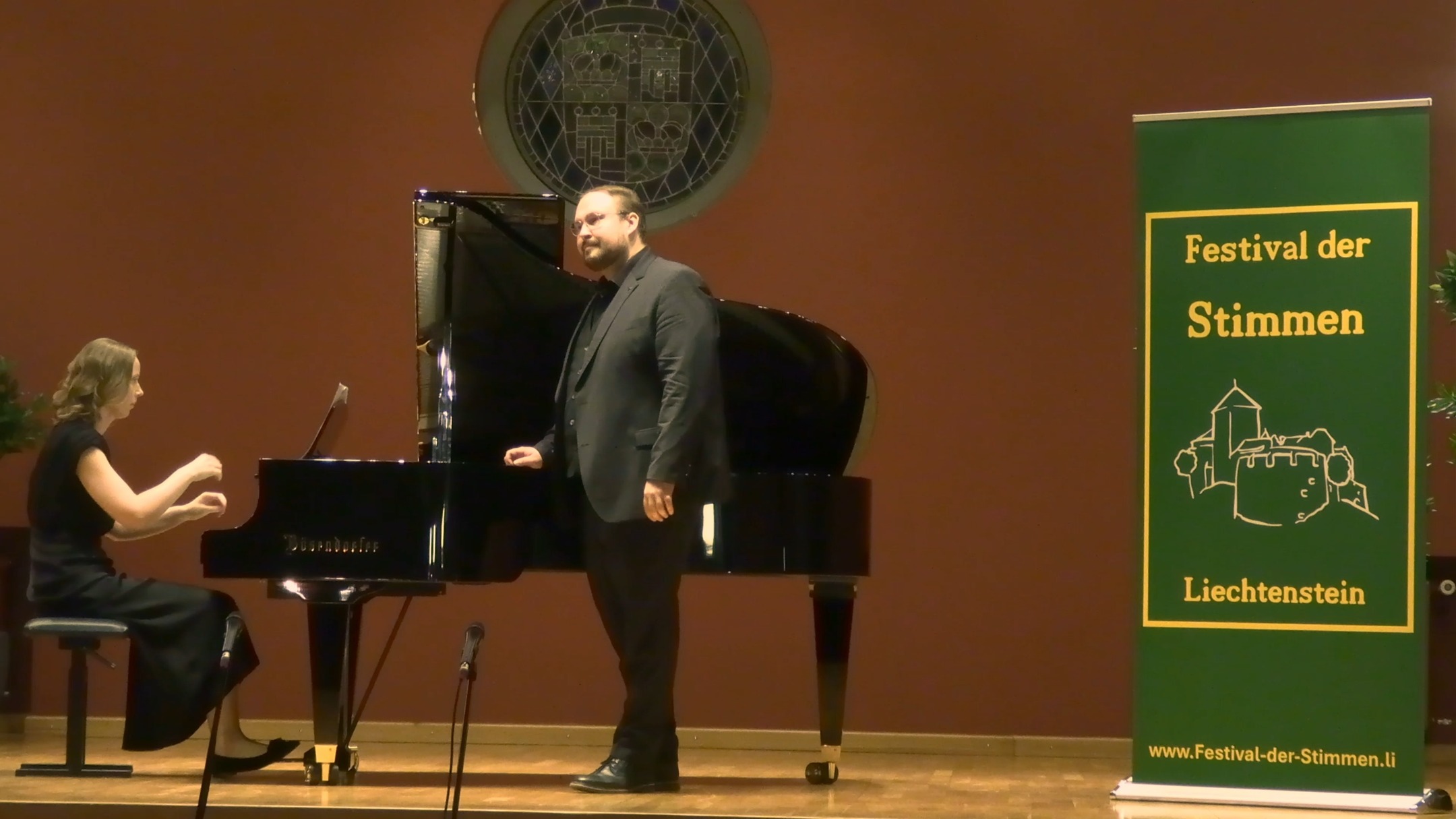
Evgenia Fölsche shapes “The Infinite Shining Heavens” with suspended calm and luminous tone. The piano texture remains transparent, the singing almost whisperingly sustained — a moment of stillness between dream and earth.
FAQ – Vaughan Williams: “The Infinite Shining Heavens” (Songs of Travel No. 6)
Click on a question to reveal the answer.
What mood shapes the song?
A serene, almost mystical calm. No pathos, but quiet contemplation of the infinite.
What role does it play within the cycle?
It expands personal experience into a universal vision. The wanderer stands still — in reverence before vastness.
How is the piece best interpreted?
With control and silence: dynamics below mezzo-forte, broad breath arches, no pressure. Silence is part of the music.