“The Vagabond” opens Ralph Vaughan Williams’s song cycle Songs of Travel to words by Robert Louis Stevenson (composed 1901–1904, originally for voice & piano; later also orchestrated). The wanderer chooses the road, not home – wind, weather, and the open sky become his programme of life. Vaughan Williams shapes this into a striding, songful, hymn-like opening piece with a marching gesture and modal colouring, setting the tone of the cycle between freedom, hardship, and dignity.
The Poem (Robert Louis Stevenson – Original / German Adaptation)
From: Songs of Travel and Other Verses (1896) – No. 1
Original (English):
Give to me the life I love,
Let the lave go by me,
Give the jolly heaven above
And the byway nigh me.
Bed in the bush with stars to see,
Bread I dip in the river –
There’s the life for a man like me,
There’s the life for ever.
Let the blow fall soon or late,
Let what will be o’er me;
Give the face of earth around
And the road before me.
Wealth I seek not, hope nor love,
Nor a friend to know me;
All I seek, the heaven above
And the road below me.
Or let autumn fall on me
Where afield I linger,
Silencing the bird on tree,
Biting the blue finger.
White as meal the frosty field—
Warm the fireside haven—
Not to autumn will I yield,
Not to winter even!
German adaptation (approximate):
Give me the life I love,
let the stream pass by me;
give me cheerful sky above
and the quiet path beside me.
A bed in the bush, the starry sky in view,
bread that I dip into the river –
that is the life for a man like me,
that is the life for ever.
Let the blow fall early or late,
let whatever will come over me;
give me the face of the earth all around
and the road before me.
Wealth I do not seek, neither hope nor love,
nor even a friend who knows me;
all I seek is the heaven above me,
and the road beneath me.
And let autumn fall upon me,
while I still linger out of doors,
silencing the bird in the tree,
with frosty bite upon the blue finger.
White as meal lies the frosted field –
warm beckons the haven by the hearth –
yet I will not yield to autumn,
still less to winter!
Text: Robert Louis Stevenson (1850–1894), public domain. German adaptation: free, singable version.
Work Details & Overview
- Composer: Ralph Vaughan Williams (1872–1958)
- Cycle: Songs of Travel – No. 1 The Vagabond
- Text source: Robert Louis Stevenson, Songs of Travel (1896)
- Composition: ca. 1901–1904; published 1904 (piano version), later orchestrated
- Tonal area / Metre / Tempo: minor-based with modal (Dorian/Mixolydian) colouring; 4/4; Allegro moderato, marziale (striding pulse)
- Duration: approx. 2–3 minutes
- Scoring: voice and piano (transpositions common); version for voice and orchestra also exists
- Form: strophic with recurring refrain line (“All I seek, the heaven above / And the road below me”)
Origins & Cycle Context
“Songs of Travel” marks Vaughan Williams’s early song style: folksong-like melody, modal harmony, and clear prosody. As prologue, “The Vagabond” establishes the central motif of being on the road: self-sufficiency, nature, and the open road. The later orchestration heightens the march character, but the piano version preserves the rough immediacy of chamber music.
Performance Practice & Reception
Voice: Firm, straightforward tone; consonants clear, vowels without excessive vibrato. The attitude is stoic, not pathetic.
Piano: Steady quarter-note pulse with a “walking” figure (chordal ostinato / low fifths). Pedalling sparing; articulation dry yet elastic.
Reception: A frequent opening piece in English song recitals; iconic especially in baritone interpretations (for example, as the cycle’s beginning with a strongly marked marching gesture).
Reference Recordings (Selection)
- Bryn Terfel – Malcolm Martineau
- Gerald Finley – Julius Drake
- Sir Thomas Allen – Roger Vignoles
- Roderick Williams – Iain Burnside
Analysis – Music
March Pulse & Modal Colour
The постоянный quarter-note pulse in the bass creates the walking gesture. Above it lies a syllabic, folksong-like melody with modal colouring (Dorian/Mixolydian), allowing hardness without bitterness. Cadential points remain “open” – the road goes on.
“All I ask…” – Refrain Climax
The refrain line spans the widest range and briefly brightens the sound (a touch of major). Dynamically, this is the call of a chosen way of life – concise, proud, without indulgence.
Visual Representation
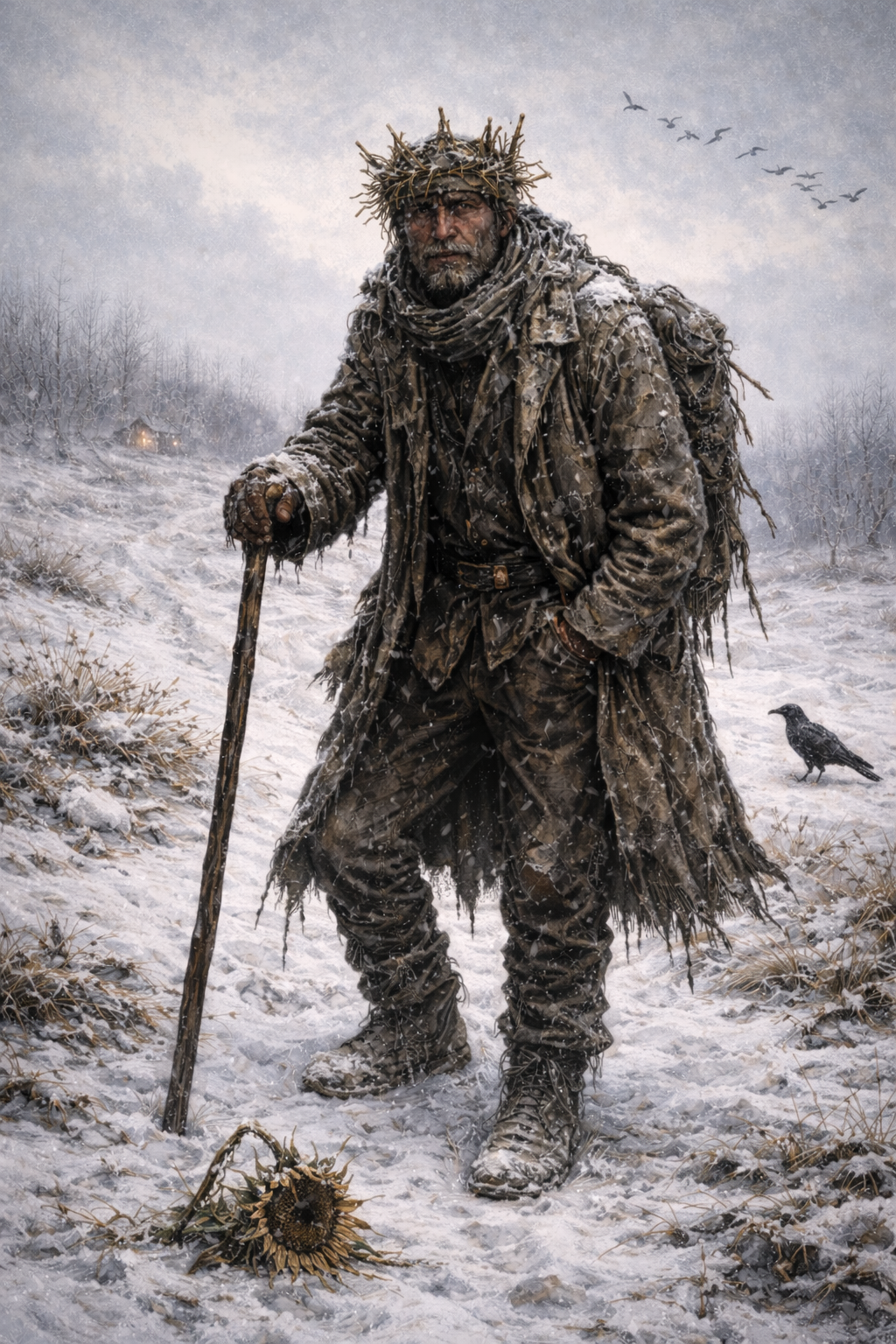
Artistic visualisation by Evgenia Foelsche:
The image shows a solitary vagabond in a barren, snow-covered landscape. With
walking staff, ragged clothing, and a body dusted with snow, he stands upon a path
now visible only as a narrow, windswept trace. Bare shrubs, winter emptiness, and the cold light
of the scene surround him. Everything in the image speaks of cold, hardship, and exposure.
The wanderer appears not as a calm observer of nature, but as a figure who must assert himself
under severe conditions.
On his head he wears a handmade crown of twigs, like a crown of thorns. It is precisely this motif that gives the
image its deepest tension. The crown is neither splendid nor triumphant; it seems
improvised, poor, and yet deliberately worn. In this, one can see what the poem itself
enacts in language: the vagabond possesses almost nothing, yet he does not surrender his dignity. He
transforms his poverty into defiance, self-assertion, and a form of inner sovereignty.
The wanderer thus becomes a concentrated image of a way of life that understands freedom
not as comfort, but as chosen hardness. His stance and gaze reveal
exhaustion, weathering, and resistance all at once. He does not stand above the landscape, but within
it – small in relation to cold, vastness, and winter emptiness, and yet inwardly upright. Life
beneath the open sky appears here as an existential trial.
This reading is intensified by the half-decayed sunflower in the foreground. As a remnant of
summer, it recalls warmth, abundance, and past life. Lying in the snow and yet still
recognisable as a sunflower, it becomes an image of transience and a lost season. It points
to an earlier time that survives in the winter present only as a trace, and gives the
scene a quiet dimension of memory.
The birds, too, contribute to the symbolic density. High in the sky, migratory birds cross
the scene; they stand for movement, distance, and the turning of the seasons. On the ground, by contrast,
a single crow stands in the snow. While the migrating birds suggest breadth and onward motion, the
crow holds the image close to winter, hardness, and the nearness of death. Between these
poles, the wanderer asserts himself as a solitary figure upon the road.
In the distance, moreover, one can see a small warm light: a sign of possible shelter, of a
conceivable refuge. Yet in this image the wanderer belongs to the winter openness. And this
expresses an important idea of The Vagabond: being on the road is not merely
movement through landscape, but a form of inward self-assertion. The road becomes the expression
of an existence that cannot be wholly broken by either cold or misery.
Overall, the visualisation distils the core of The Vagabond as a tense
union of poverty and pride, exposure and self-crowning, winter cold and unbending
perseverance. The image shows a human being who has lost almost everything – and precisely for
that reason clings to a final inner sovereignty.
Analysis – Poetry
The poem “The Vagabond” sketches the ideal of a radically simple, unbound life. The speaking self rejects possession, security, attachment, and social recognition, choosing instead nature, movement, and both outward and inward independence. The two stanzas unfold this ideal of life in concentrated form: first as a positive vision, then as a defiant reaffirmation in the face of danger, loss, and loneliness.
The Ideal of the Free Life
Give to me the life I love,
Let the lave go by me,
Give the jolly heaven above
And the byway nigh me.
From the very beginning, the speaker formulates not merely a wish for happiness, but a decisive commitment to a particular form of life. He asks not for wealth or protection, but for “the life I love”: an existence in freedom, closeness to nature, and independence from social constraints. The passing water and the nearby side-path form images of flow and of being on the move. The road here is not the main highway, but a “byway” – a side road that suggests seclusion, independence, and distance from regulated life.
Poverty as Chosen Sufficiency
Bed in the bush with stars to see,
Bread I dip in the river –
There’s the life for a man like me,
There’s the life for ever.
The images of this stanza describe utter simplicity: the bed is in the bush, the bread dipped into the river. Comfort, house, and possessions are entirely absent. Yet this poverty appears not as lack, but as consciously chosen sufficiency. The gaze toward the stars opens existence into the vast and the cosmic; nature replaces what the civilised world would normally provide. The phrase “There’s the life for ever” lends this vision an almost programmatic character: the free wandering life is presented not as a temporary episode, but as a final ideal.
Indifference Toward Fate
Let the blow fall soon or late,
Let what will be o’er me;
Give the face of earth around
And the road before me.
The second stanza sharpens the tone. The speaker declares himself ready to accept whatever blow fate may deal – sooner or later. What matters is not what happens, but that the fundamental conditions of his free life remain: the earth around him and the road before him. The phrase “the face of earth” gives the world something at once tangible and alive: the earth is not an object of possession, but a presence confronting him. The road before the speaker stands for future, movement, and open possibility. Freedom appears here as the willingness not merely to endure uncertainty, but to accept it as part of one’s own life.
Renunciation of Possession, Hope, and Attachment
Wealth I seek not, hope nor love,
Nor a friend to know me;
All I seek, the heaven above
And the road below me.
The close condenses the radicalism of the poem. Not only wealth is rejected, but also hope, love, and even a friend who knows the self. In this way, the speaker detaches himself from the classic forms of human attachment and social identity. This is more than simplicity: it is a conscious counter-model to bourgeois existence with its possessions, future expectations, and belonging. Against this stands a minimal, almost ascetic formula: heaven above, road beneath. Between these two poles unfolds a life grounded entirely in the present, in movement, and in self-sufficiency.
“The Vagabond” is therefore not merely an idyllic wandering song, but a poem of deliberate renunciation. It does not sentimentalise poverty, but transforms it into a sign of inner freedom. Precisely in the rejection of possession and attachment, the speaking self gains its stance of independence and defiance.
Meaning & Effect
At the centre of the poem lies the idea that freedom is possible only where human beings renounce possession, security, and social expectations. The speaking self sketches a counter-image to an ordered, settled life oriented toward planning for the future. In place of house, property, and relationship stand heaven, earth, and road – the elemental conditions of an existence in motion.
The poem’s effect lies in this mixture of simplicity and radicality. The language remains clear and song-like, yet the content is resolute: the self affirms a life that includes uncertainty, loneliness, and hardship. For precisely that reason, the vagabond appears not merely as an outsider, but as a figure of consistent self-determination. The poem draws its tension from the contrast between outward poverty and inward freedom.
Evgenia Fölsche – Performances & Audio
Evgenia Fölsche emphasises the march without heaviness: dry bass, speech-close syllables, calm brightening on the refrain line. No operatic gesture – a straight tread.
FAQ – Vaughan Williams: “The Vagabond” (Songs of Travel No. 1)
Click on a question to show the answer.
Is the song strophic?
Yes. Recurring stanzas with a refrain line; variations in dynamics and harmonic colouring create the larger arc.
Which version is the “original” one – piano or orchestra?
The piano version came first; the orchestration followed later. Both versions are authorized and firmly established in the repertoire.
Which voice type is suitable?
Traditionally baritone, though singable in other ranges through transposition – what matters is a firm, carrying speech-tone.