“Erstarrung” is song no. 4 from Franz Schubert’s Winterreise D 911 (1827), after Wilhelm Müller. After the inward perception of “Frozen Tears”, the wanderer plunges into a feverish search: he wants to find the beloved’s trace in the snow, to thaw the frozen world with hot tears — and realizes that his own heart, too, has turned to ice.
Schubert draws a driving, through-composed scene in D minor with relentless semiquavers: a perpetuum mobile of unrest that in moments abruptly freezes. The song shows how movement becomes ever more violent outwardly, while inwardly everything remains fixed in the image of rigidity.
The poem (Wilhelm Müller – printed original edition 1824) with Franz Schubert’s changes
From: Winterreise – No. 4: “Erstarrung”
Ich such’ im Schnee vergebens
nach ihrer Tritte Spur,
hier, wo wir oft gewandelt
(Schubert: wo sie an meinem Arme)
Selbander durch die Flur.
(Schubert: durchstrich die grüne Flur.)
Ich will den Boden küssen,
durchdringen Eis und Schnee
mit meinen heißen Tränen,
bis ich die Erde seh’.
Wo find’ ich eine Blüte,
wo find’ ich grünes Gras?
Die Blumen sind erstorben,
der Rasen sieht so blass.
Soll denn kein Angedenken
ich nehmen mit von hier?
Wenn meine Schmerzen schweigen,
wer sagt mir dann von ihr?
Mein Herz ist wie erfroren
(Schubert: Mein Herz ist wie erstorben,)
kalt starrt ihr Bild darin:
schmilzt je das Herz mir wieder,
fließt auch das Bild dahin.
(Schubert: fließt auch ihr Bild dahin.)
English translation
In the snow I search in vain
for the trace of her footsteps,
here, where we so often wandered
(Schubert: where she at my arm)
together through the fields.
(Schubert: strode through the green meadow.)
I want to kiss the ground,
to pierce through ice and snow
with my hot tears,
until I see the earth.
Where shall I find a blossom,
where shall I find green grass?
The flowers have perished,
the turf looks so pale.
Shall I then take no token
from here along with me?
When my pains fall silent,
who then will speak to me of her?
My heart is as though frozen,
(Schubert: My heart is as though lifeless,)
her image stands there cold and rigid:
should my heart ever melt again,
that image too will flow away.
(Schubert: her image too will flow away.)
Work data & overview
- Composer: Franz Schubert (1797–1828)
- Cycle: Winterreise D 911, No. 4 (Erstarrung)
- Text source: Wilhelm Müller, Winterreise (book version 1824; Schubert with divergent readings)
- Composition: 1827; first printed edition 1828 (Part I)
- Tonal space / metre / tempo: D minor, 2/4, very agitated (restless semiquavers)
- Duration: approx. 3:00–3:30 minutes
- Scoring: voice and piano (transpositions common)
- Form: through-composed; contrasts through text-bound “freezing” moments and harmonic shifts
Data on the poem
- Author: Wilhelm Müller (1794–1827)
- Stanza form: 5 stanzas of 4 lines each (cross rhyme)
- Devices: tracking traces, antitheses (warm/cold – blossom/pale), metaphors (freezing/melting), rhetorical questions
Genesis & cycle context
“Erstarrung” accelerates the subjectivization of the early Winterreise: from the house-sign of The Weathervane, through the bodily symptom of Frozen Tears, to the feverish search for the self in the snow. The song marks the leap into an inner world that now uses the outer world only as a mirror.
The search for the beloved’s trace is therefore no longer truly hope for return, but the expression of an inward compulsion. The wanderer moves ever more violently, yet this movement leads not outward, but deeper and deeper into fixation.
More on the overall connection of the songs in the Winterreise – Overview, and on the psychological deepening in the article Winterreise as a journey into the abyss of the soul.
Performance practice & reception
Breath & pulse: forward-moving, but elastic – no nervous haste. The voice remains speech-like, the consonants embedded; the affect arises from continuous motion, not from sheer loudness.
Piano texture: even semiquavers as the motor of the search; pedal used sparingly so that the frosty transparency is preserved. The halts must clearly relax – as moments of freezing within the drive onward.
Historical reference interpreters
- Dietrich Fischer-Dieskau – baritone
- Hermann Prey – baritone
Current interpreters with whom I collaborate
Analysis – music
Motoric motion & “frost” stasis
The perpetuum mobile framework of the semiquavers carries the feverish search; brief withdrawals freeze the motion in place – a musical image of rigidity. The alternation between motoric motion and standstill is the song’s dramatic core.
Precisely in the interplay between restless figuration and sudden inhibition, one sees how song functions as a space of meaning: frost is not described, but made audible. More on this in the background article The semiotics of song.
Harmony, form & shifting perspective
Within the field of D minor, sudden brightenings appear as reflexes of longing; dark returns support the image of cold. The through-composed form gives each stanza its own micro-dramaturgy between urgency and inward collapse.
Visual representation
Artistic visualisation by Evgenia Foelsche:
At the centre of the image lies a heart, enclosed
in a massive block of ice. The surface is clear and yet merciless.
Heavy chains wrap around the frozen form, as though every movement,
every breaking open, were to be prevented. The heart is visible – and yet unreachable.
The image translates the song’s psychic situation into a radical metaphor.
The wanderer’s feelings have not disappeared, but frozen.
Beneath the ice-layer memory, passion, and pain still glow.
Yet melting would mean feeling everything again – in full intensity.
The chains symbolize the conscious decision to harden into rigidity.
It is not only the outer winter cold that freezes the heart,
but also an inner mechanism of protection.
The ice becomes a shell against overwhelming pain.
The rigidity appears almost necessary in order to survive.
In Schubert’s music, restless figures press forward, searching, almost feverishly –
as though the wanderer wanted to break open the frozen traces of the past in the snow.
Yet in the image everything remains bound. Movement seems impossible.
Thus a tense dialectic arises between inner upheaval and outward blockage.
The frozen heart becomes the emblem of a condition
in which feeling and not-feeling are inseparably intertwined.
Liberation would be possible – but it would melt the ice,
and with it release the whole pain.
Rigidity is torment – and at the same time protection from still greater torment.
Analysis – poetry
The poem “Erstarrung” belongs among the central early songs of Winterreise. The wanderer is indeed in motion, but that motion remains external. Inwardly he is trapped in memory, loss, and emotional hardening. Step by step, the poem unfolds a condition in which the past can no longer be recovered and the present offers no support.
The futile search for the trace
Ich such’ im Schnee vergebens
nach ihrer Tritte Spur,
wo sie an meinem Arme
durchstrich die grüne Flur.
The first stanza centres on a futile movement of search. The wanderer seeks in the snow for the beloved’s footsteps – for a visible proof of the shared past. Yet the snow has erased everything. The memory of the “green meadow” stands in sharp contrast to the wintry present.
The attempt to uncover what has been lost
Ich will den Boden küssen,
durchdringen Eis und Schnee
mit meinen heißen Tränen,
bis ich die Erde seh’.
The search intensifies into an act of bodily desperation. The wanderer wants to pierce through ice and snow in order to reach the earth, the original and the living. His “hot tears” stand for emotional intensity, yet remain without effect.
Nature grown lifeless as mirror of the inner state
Wo find’ ich eine Blüte,
wo find’ ich grünes Gras?
Die Blumen sind erstorben,
der Rasen sieht so blass.
Nature offers no consolation, but confirms the wanderer’s inner condition. Blossom and green grass stand for hope, new beginning, and future – yet everything is “dead” and “pale.” The outer world thereby becomes entirely a projection surface for the inner one.
Pain as the last bond of memory
Soll denn kein Angedenken
ich nehmen mit von hier?
Wenn meine Schmerzen schweigen,
wer sagt mir dann von ihr?
Here a new fear emerges: the fear of forgetting. The wanderer recognizes that his pain is the last connection to the beloved. If pain ends, memory ends as well. Suffering thereby becomes the necessary means of preserving identity and the past.
Rigidity as protection against forgetting
Mein Herz ist wie erstorben,
kalt starrt ihr Bild darin;
schmilzt je das Herz mir wieder,
fließt auch ihr Bild dahin.
The final stanza formulates the poem’s core. The heart is not empty, but frozen. The beloved’s image is frozen within it, immobile. Healing would mean forgetting. Rigidity thus becomes an unconscious strategy for preserving memory – at the price of one’s own immobility.
Meaning & effect within the cycle
Within Winterreise, “Erstarrung” marks a decisive moment of inner fixation. The wanderer is already on the road, yet psychologically remains bound to what has been lost. Movement now takes place only in space, no longer inwardly.
The song reverses a central Romantic motif: not warmth means life, but cold preserves memory. Change and healing appear as threats, because they would erase the image of the beloved.
Precisely because the song does not resolve this tension, it continues to work. More on this in the article Art that keeps working.
Evgenia Fölsche – performances & audio
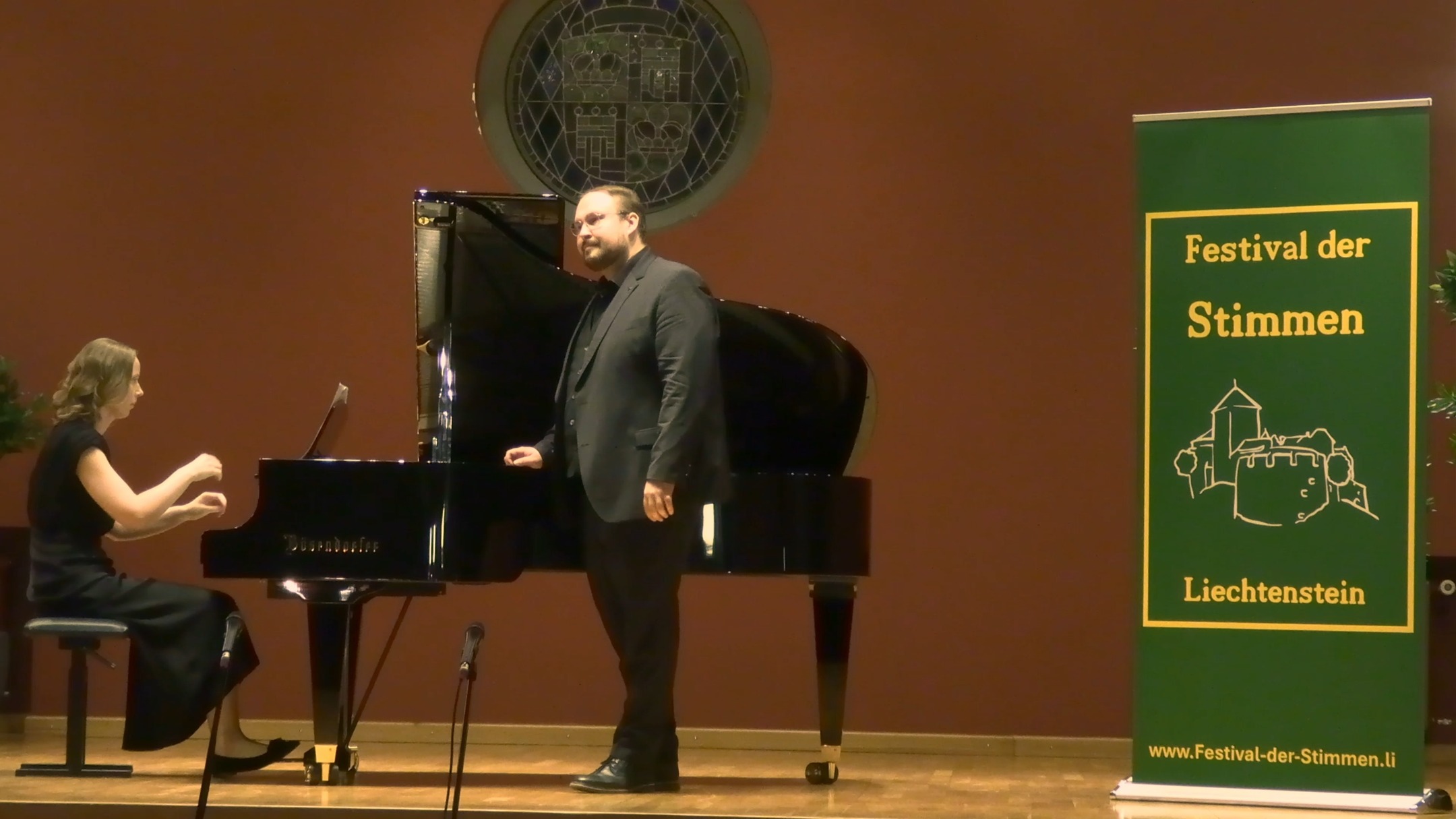
Pianist Evgenia Fölsche reads “Erstarrung” as a search-piece without pathos: even motoric flow, finely measured points of rest, a speech-close line – the cold arises from transparency, not from hardness.
Listening example: Erstarrung with Dietrich Fischer-Dieskau and Gerald Moore
Winterreise for your concert programme
Franz Schubert’s Winterreise belongs to Evgenia Fölsche’s lied repertoire and can be realised in different performance formats. Depending on occasion, venue, and artistic concept, various scorings and forms are possible.
Possible formats include performances with different voice types from soprano to bass, versions with choir, with images, or in staged form. An overview of formats, scorings, and artistic possibilities can be found on the concert page for Winterreise.
Go to the Winterreise concert pageFrequently asked questions about Schubert: “Erstarrung” (Winterreise No. 4)
Click on a question to reveal the answer.
Is “Erstarrung” strophic or through-composed?
Through-composed. Each stanza receives its own micro-dramaturgy, bound together by the continuous motoric motion.
What key and what basic gesture define the song?
D minor, very agitated, with restless semiquavers; brief points of rest as frosty standstills.
How should one pedal it effectively?
Sparingly and clearly. The semiquavers should remain audible as a cold grain; pedal only to let the phrases breathe.