“Im Dorfe” is song no. 17 from Franz Schubert’s Winterreise D 911 (1827), after Wilhelm Müller. After the fragile Last Hope, the gaze turns toward a sleeping world: dogs bark, chains rattle, houses shelter repose – but only for the others.
Schubert shapes this into a through-composed nocturnal piece in D minor, 6/8, not too fast. Growling chordal fields and barking figures meet a sober, speech-like vocal line. It is precisely this contrast that makes the song so compelling: it is not the wanderer who dreams here, but the others – and he recognises that he himself has already fallen out of that order.
The verse (Wilhelm Müller – from the printed original edition of 1824) with the changes made by Franz Schubert
From: Winterreise – Song XVII
Es bellen die Hunde, es rasseln die Ketten.
Die Menschen schnarchen in ihren Betten,
(Schubert: Es schlafen die Menschen in ihren Betten,)
träumen sich manches, was sie nicht haben,
thun sich im Guten und Argen erlaben:
und morgen früh ist alles zerflossen —
je nun, sie haben ihr Theil genossen,
und hoffen, was sie noch übrig ließen,
doch wieder zu finden auf ihren Kissen.
The dogs are barking, the chains are rattling.
The people are snoring in their beds,
(Schubert: The people are sleeping in their beds,)
dreaming themselves many things they do not possess,
refreshing themselves with good and ill alike:
and tomorrow morning all will have melted away —
well then, they have enjoyed their share,
and hope to find again upon their pillows
what they had left over.
Bellt mich nur fort, ihr wachen Hunde,
laßt mich nicht ruhn in der Schlummerstunde!
Ich bin zu Ende mit allen Träumen —
was will ich unter den Schläfern säumen?
Bark me onward, you wakeful dogs,
do not let me rest in the hour of slumber!
I am finished with all dreams —
why should I linger among the sleepers?
Work data & overview
- Composer: Franz Schubert (1797–1828)
- Cycle: Winterreise D 911, no. 17 (Im Dorfe)
- Text source: Wilhelm Müller, Winterreise (1823/24)
- Composition: 1827; first print 1828 (Part II)
- Key / metre / tempo: D minor, 6/8, not too fast
- Duration: approx. 2:00–3:00 minutes
- Scoring: voice and piano (transpositions common)
- Form: through-composed; contrasting dream-like middle section with brightenings
Data on the verse
- Author: Wilhelm Müller (1794–1827)
- Stanza form: 2 long stanzas with changing rhyme structure
- Devices: noise metaphorics, dream-reality antithesis, irony (“well then”), social contrast between sleepers and wanderer
Origins & cycle context
After Last Hope, a still ordered human world appears once more in In the Village: houses, sleep, possession, security, recurrence. Yet the wanderer encounters it only from outside. The village is not a station of return, but a final image of social normality from which he remains excluded.
It is precisely this outsider perspective that makes the song central to the second half of the cycle. The sleepers compensate in dreams for what they lack in life; the wanderer, by contrast, declares himself “finished with all dreams.” He renounces not only consolation, but the very form of self-deception by which the others make their world inhabitable.
Thus In the Village is not only a night scene, but also a song about illusion and social order. For further exploration: The semiotics of song, Art that keeps working, and, in the larger context, Winterreise as a journey into the abyss of the soul.
Performance practice & reception
Piano image & articulation: short, rough chordal fields and growling figures evoke barking and the rattling of chains. The middle section becomes softer, thinner, and more dream-like, without turning sentimental. What matters is the clear change of plane: outer world and dream zone must not blur into one another.
Tempo & line: an elastic 6/8 pulse, never hurried. The voice remains close to speech and sober; the sharpness arises from diction and contrast, not from operatic intensification. It is precisely the tonal distance that gives the song its distinctive hardness.
Historical reference interpreters
- Dietrich Fischer-Dieskau – baritone
- Peter Schreier – tenor
- Hermann Prey – baritone
Current interpreters with whom I collaborate
Analysis – music
Barking, chains & veils of dream
Dotted, broken chordal gestures in the piano evoke the barking of dogs and the rattling of chains. Yet the music is not merely naturalistic in a literal sense, but translates outer noise into a psychological situation: the night is not quiet, but tense, vigilant, and defensive.
In the middle section, the texture thins out. The sound plane becomes more legato, more shadow-like, like an acoustic dream-space. But this space is only temporary: at the end the song falls back into sober reality. The dream was not a counter-image, but only a fleeting veil over the same reality.
Harmony, form & the contrast of outer and inner
The D minor frame keeps the song dark and taut. Brief brightenings open inner perspectives, but never as real consolation. The harmony works with local clearings, which are immediately drawn back into the basic milieu of night.
The through-composed form follows the movement of thought in the text exactly: outer noise, the dream economy of the sleepers, then the wanderer’s resolve no longer to let himself be consoled by this world. Thus the musical form itself becomes the image of a final separation.
Visual representation
Artistic visualisation by Evgenia Foelsche:
Inside a house, a man and a woman sleep peacefully beside one another.
The room appears warm, protected, and enclosed.
Outside, however, a dog barks into the darkness,
while the wanderer passes by at the edge of the village.
The image makes visible the central contrast of the song:
inside, repose, dream, shelter, and repetition –
outside, wakefulness, movement, and exclusion.
The dog becomes the guardian of that order.
The wanderer is not one of the sleepers,
but the one driven onward from the threshold.
In this way the image shows not only a night in the village,
but the wanderer’s distance from the human world itself.
Analysis – poetry
“Im Dorfe” belongs to those songs of Winterreise in which the wanderer once more stands directly before human community. But he does not enter. He hears only from outside what is happening within: sleep, dream, enjoyment, hope of return.
Es bellen die Hunde, es rasseln die Ketten.
Es schlafen die Menschen in ihren Betten,
träumen sich manches, was sie nicht haben,
thun sich im Guten und Argen erlaben:
und morgen früh ist alles zerflossen —
je nun, sie haben ihr Theil genossen,
und hoffen, was sie noch übrig ließen,
doch wieder zu finden auf ihren Kissen.The dogs are barking, the chains are rattling.
The people are sleeping in their beds,
dreaming themselves many things they do not possess,
refreshing themselves with good and ill alike:
and tomorrow morning all will have melted away —
well then, they have enjoyed their share,
and hope to find again upon their pillows
what they had left over.
The first long stanza sketches an entire economy of dreaming. The people do not simply sleep; in dreams they replace what they lack, and in the morning they accept this loss again, only to compensate for it once more the following night. Here lies the bitter irony of the song: the village lives not in truth, but in rhythmic self-soothing.
Schubert’s change from “The people are snoring” to “The people are sleeping” shifts the tone. The scene becomes less satirical and more enclosed. Precisely through this, the world of the sleepers appears as a stable order from which the wanderer is excluded.
Bellt mich nur fort, ihr wachen Hunde,
laßt mich nicht ruhn in der Schlummerstunde!
Ich bin zu Ende mit allen Träumen —
was will ich unter den Schläfern säumen?Bark me onward, you wakeful dogs,
do not let me rest in the hour of slumber!
I am finished with all dreams —
why should I linger among the sleepers?
In the second stanza, the wanderer himself speaks. He calls upon the dogs to drive him away. This is more than a situational reaction: it is a rejection of the world of sleep and dreams altogether. “I am finished with all dreams” belongs among the most decisive sentences in the cycle.
Thus the song becomes a turning point. The wanderer refuses not only participation in social repose, but also the form of hope that would still be possible within such repose. He no longer wishes to linger, to postpone, or to belong.
Meaning & effect within the cycle
In the Village is one of the last songs in which the world of other human beings still appears concretely. But it has become only backdrop, sound, nocturnal order. For the wanderer, it is no longer inhabitable.
In the course of Winterreise, the song therefore marks a decisive step: not only love and hope, but also the ordinary human form of consolation is now explicitly rejected. After this song, the path leads almost only through inner images, signs, and states.
In the Village is therefore not merely a night piece, but a final border scene: here the wanderer passes by the world – and knows it.
Evgenia Fölsche – performances & audio
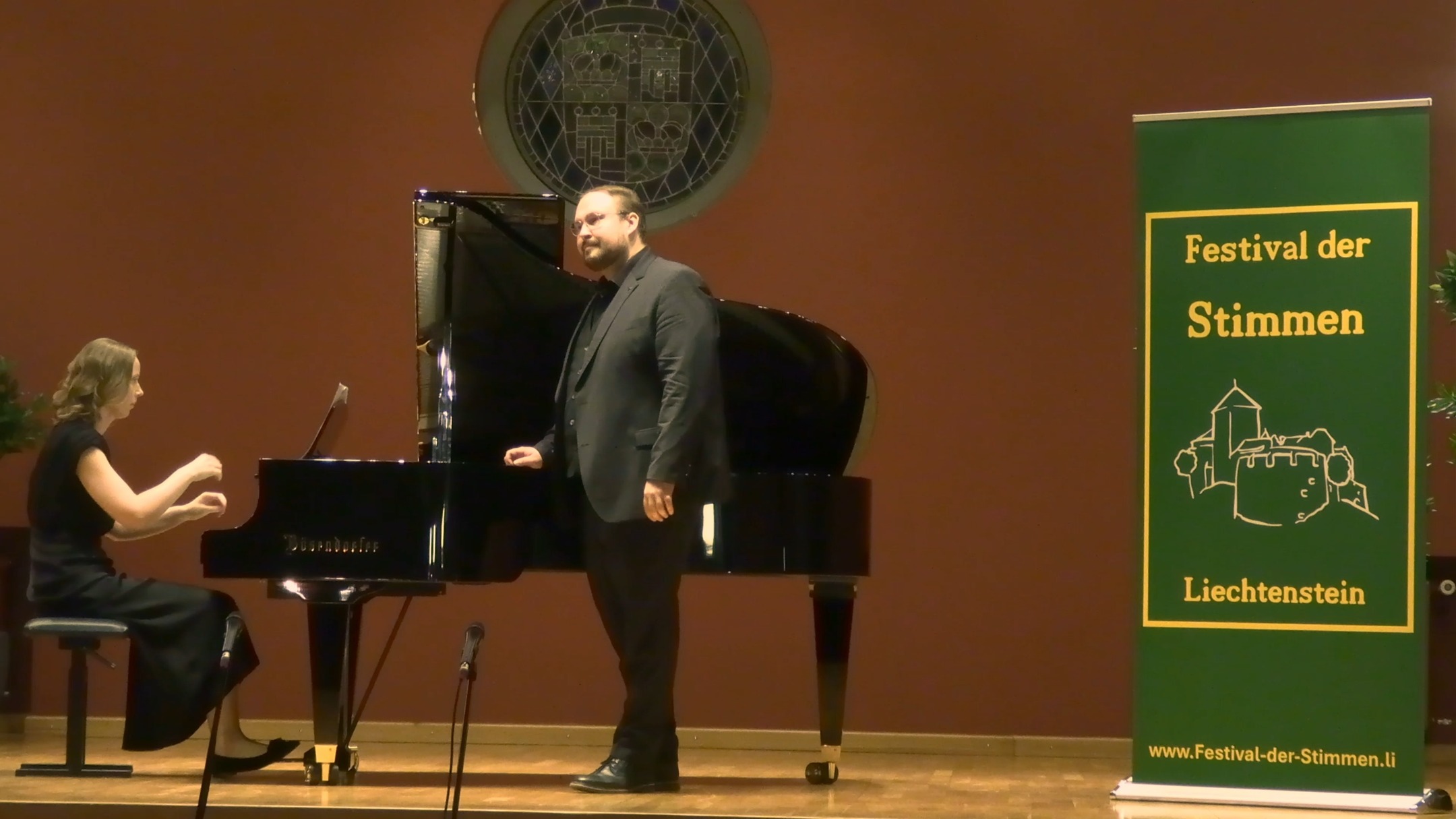
Pianist Evgenia Fölsche contrasts rough outer sounds and delicate veils of dream with precise articulation; the voice remains direct, the pathos controlled.
Listening example: Im Dorfe with Dietrich Fischer-Dieskau and Gerald Moore
Winterreise for your concert programme
Franz Schubert’s Winterreise belongs to Evgenia Fölsche’s song repertoire and can be realised in different performance formats. Depending on the occasion, venue, and artistic concept, various scorings and forms are possible.
Possible options include performances with different voice types from soprano to bass, versions with choir, with images, or in staged form. An overview of formats, scorings, and artistic possibilities can be found on the concert page for Winterreise.
To the Winterreise concert pageFrequently asked questions about Schubert: “Im Dorfe” (Winterreise No. 17)
Click on a question to display the answer.
Is “Im Dorfe” strophic?
No. The setting is through-composed and works with a clearly contrasted dream-like middle section.
Which key and metre shape the song?
D minor, 6/8, not too fast; rough outer fields and softer dream zones stand in opposition to one another.
How does one render “barking” and “chains” musically?
With short, dotted chords, precise diction, and sparing pedal. The dream section should appear thinner and more legato – with a clear shift of plane.