“Der Wegweiser” is song no. 20 from Franz Schubert’s Winterreise D 911 (1827), after Wilhelm Müller. After the playful semblance of Illusion, the wanderer now makes a solitary decision: away from the roads of others, toward a path of no return.
Schubert shapes it into a quiet, variably strophic chamber scene in G minor, 2/4, moderate. The piano writing proceeds imperturbably, the voice remains almost soberly speech-like – and it is precisely this plainness that makes the song one of the most shattering turning points in the cycle.
The verse (Wilhelm Müller – from the printed original edition of 1824)
From: Winterreise – Song XX
Was vermeid’ ich denn die Wege,
wo die andren Wandrer gehn,
suche mir versteckte Stege
durch verschneite Felsenhöhn?
Why do I avoid the roads, then,
where the other wanderers go,
seeking out hidden paths for myself
through snow-covered rocky heights?
Habe ja doch nichts begangen,
daß ich Menschen sollte scheun –
welch ein thörichtes Verlangen
treibt mich in die Wüstenein?
After all, I have done nothing
that should make me shun mankind –
what foolish longing is it
that drives me into the wilderness?
Weiser stehen auf den Straßen,
weisen auf die Städte zu,
und ich wandre sonder Maßen,
ohne Ruh’, und suche Ruh’.
Signposts stand on the roads,
pointing toward the towns,
and I wander measurelessly,
without rest, and seek rest.
Einen Weiser seh’ ich stehen,
unverrückt vor meinem Blick;
eine Straße muß ich gehen,
die noch keiner ging zurück.
One signpost I see standing there,
unmoving before my gaze;
there is a road I must go,
from which no one has ever returned.
Work data & overview
- Composer: Franz Schubert (1797–1828)
- Cycle: Winterreise D 911, no. 20 (Der Wegweiser)
- Text source: Wilhelm Müller, Winterreise (1823/24)
- Composition: 1827; first print 1828 (Part II)
- Key / metre / tempo: G minor, 2/4, moderate
- Duration: approx. 3:30–4:40 minutes
- Scoring: voice and piano (transpositions common)
- Form: Strophic song with variation; continuous walking pulse
Data on the verse
- Author: Wilhelm Müller (1794–1827)
- Stanza form: 4 quatrains; alternating rhyme
- Devices: guiding metaphor of path/signpost, antithesis of road/hidden track, self-questioning, final paradox, image of the road of no return
Origins & cycle context
In the second part of Winterreise, “Der Wegweiser” is one of the central key songs. After the consciously accepted illusion in Illusion, what follows now is no new enticement, but a decision. The wanderer recognises that he avoids the roads of others, and for the first time he names this movement with pitiless clarity.
Precisely for this reason, the song feels like an inner vow. The towns, the community, the social roads remain visible – but the wanderer turns away from them. The signpost thus becomes the symbol of a resolve that can no longer be revoked.
Within the cycle, this song leads directly into the final stations, which become ever more withdrawn from the world. More on the wider context: Winterreise as a journey into the abyss of the soul, Schubert’s illness & Winterreise and The semiotics of song.
Performance practice & reception
Pulse & diction: the 2/4 walking pulse must remain narrow, calm, and unerring. This song can bear no great waves of feeling. Its effect arises from consistency, not from expressive display.
Piano image: the piano continues in steady motion, as though the road beneath the wanderer’s feet were already fixed. Small inner frictions, triplet surges, and repetitions lend the writing pressure without overloading it dramatically.
The voice should be guided almost as speech. Precisely in the final quatrain, no pathos should break forth: “there is a road I must go, / from which no one has ever returned” has its strongest effect when it appears as a sober statement.
Historical reference interpreters
- Dietrich Fischer-Dieskau – baritone
- Peter Schreier – tenor
- Hans Hotter – bass-baritone
Current interpreters with whom I collaborate
Analysis – music
Walking pulse, friction & sobriety
The music of “Der Wegweiser” lives by controlled motion. Nothing presses outwardly, and yet the musical fabric moves forward inexorably. The piano does not create a pictorial landscape of nature, but rather the inward act of going itself: step by step, without evasion.
The voice remains strikingly sober. It does not sing in broad arcs, but formulates, questions, recognises. Precisely this nearness to speech lends the song its existential sharpness.
Harmony, form & the symbolism of the path
The field of G minor remains continuously defining, even when side-steps and fine harmonic shifts mark individual words. The varied strophic form mirrors the character of the song with great exactness: always the same road, but with growing inner consequence.
The final stanza is the decisive point of arrival. Here movement becomes determination. Schubert intensifies not through a great release, but through narrowing and inevitability. The road is no longer sought – it is recognised.
Visual representation
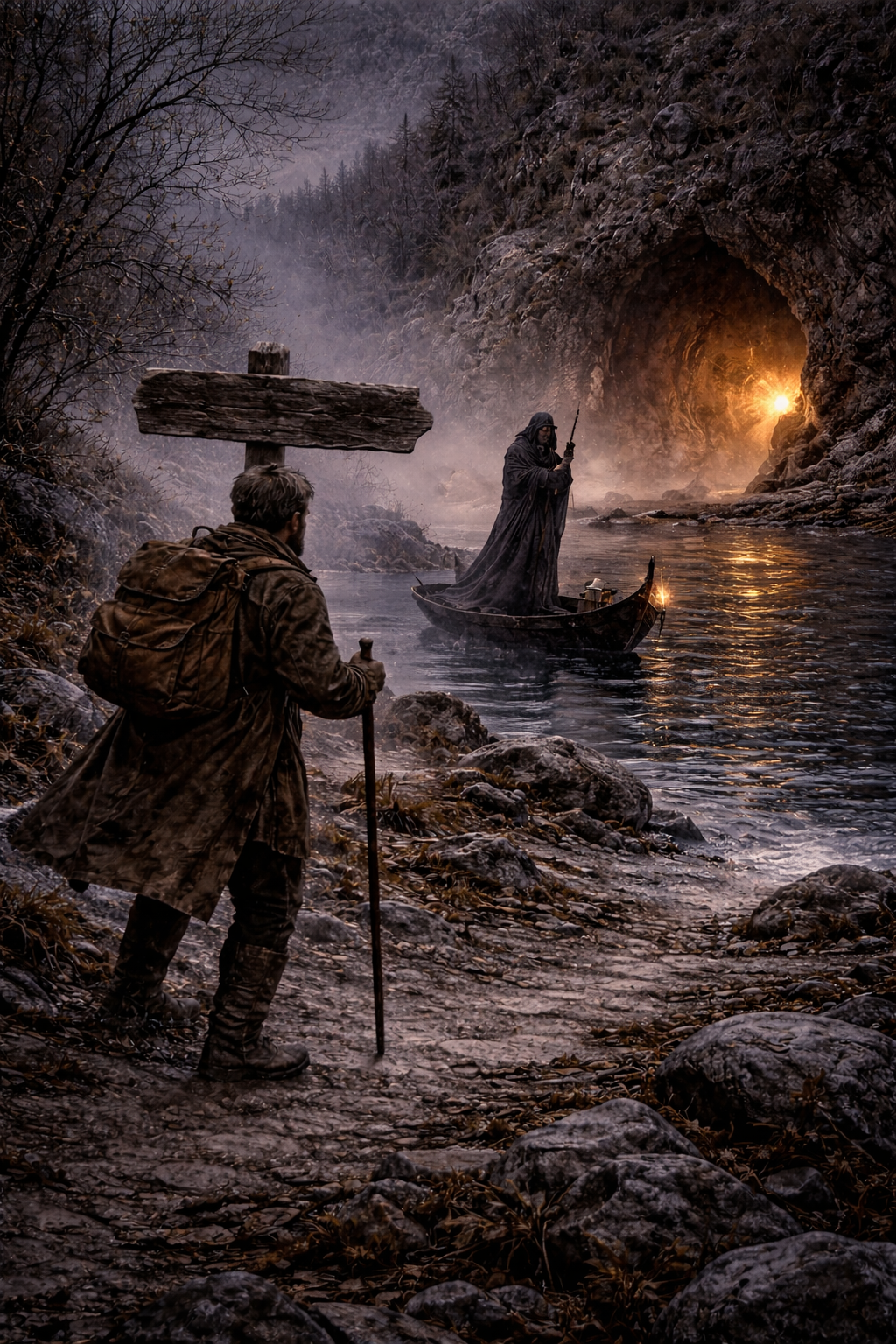
Artistic visualisation by Evgenia Foelsche:
The wanderer stands before a signpost
whose board bears no inscription.
It is precisely the absence of any direction that makes the image so compelling:
it is not a named destination that calls,
but a road into the unknown.
The river,
the boat,
the silent ferryman, and the light beyond the bank condense the song’s existential symbolism.
The signpost points to nothing –
and thereby points precisely to the only thing
that still remains.
Analysis – poetry
“Der Wegweiser” is one of the most philosophical poems of Winterreise. For the first time, the wanderer asks explicitly about his own movement. He observes no longer merely nature or memory, but his own avoidance of the roads of others.
Self-questioning
Was vermeid’ ich denn die Wege,
wo die andren Wandrer gehn,
suche mir versteckte Stege
durch verschneite Felsenhöhn?Why do I avoid the roads, then,
where the other wanderers go,
seeking out hidden paths for myself
through snow-covered rocky heights?
The opening is formulated as a question to oneself. The wanderer recognises that he is deliberately walking apart. He avoids not only people, but also the roads that lead to them. Thus solitude becomes an active movement, not merely a condition endured.
No guilt – and yet flight
Habe ja doch nichts begangen,
daß ich Menschen sollte scheun –
welch ein thörichtes Verlangen
treibt mich in die Wüstenein?After all, I have done nothing
that should make me shun mankind –
what foolish longing is it
that drives me into the wilderness?
It is precisely here that the paradox of the song becomes visible. The wanderer bears no objective guilt, and yet he lives as though he had to hide himself away. The “wilderness” is not merely a landscape, but a condition of radical detachment from the social world.
The signposts of others
Weiser stehen auf den Straßen,
weisen auf die Städte zu,
und ich wandre sonder Maßen,
ohne Ruh’, und suche Ruh’.Signposts stand on the roads,
pointing toward the towns,
and I wander measurelessly,
without rest, and seek rest.
The towns stand for community, order, belonging. The signposts make this possibility visible. Yet the wanderer does not follow them. The contradiction “without rest, and seek rest” brings the whole song to its point: he goes on, seeking something that no human road can any longer contain.
The road of no return
Einen Weiser seh’ ich stehen,
unverrückt vor meinem Blick;
eine Straße muß ich gehen,
die noch keiner ging zurück.One signpost I see standing there,
unmoving before my gaze;
there is a road I must go,
from which no one has ever returned.
In the final stanza, every evasive movement falls away. Out of many roads, one becomes singled out. Question becomes necessity. The road “from which no one has ever returned” is the song’s most powerful image: it names finality, the crossing of a boundary, and leave-taking from the shared world.
Meaning & effect within the cycle
“Der Wegweiser” is one of the great turning points of Winterreise. Here the wanderer no longer merely submits to his road – he recognises it. The turning away from the roads of others becomes conscious, and with it the further course of the cycle becomes inevitable.
The song marks the step from existential lostness to an almost ascetic resolve. No hope, no memory, no illusion now determines his action, but a clear, dark decision.
Thus “Der Wegweiser” opens the space for the final songs: for that zone in which the wanderer steps ever farther out of the social, the human, and finally even out of the world of the living.
Evgenia Fölsche – performances & audio
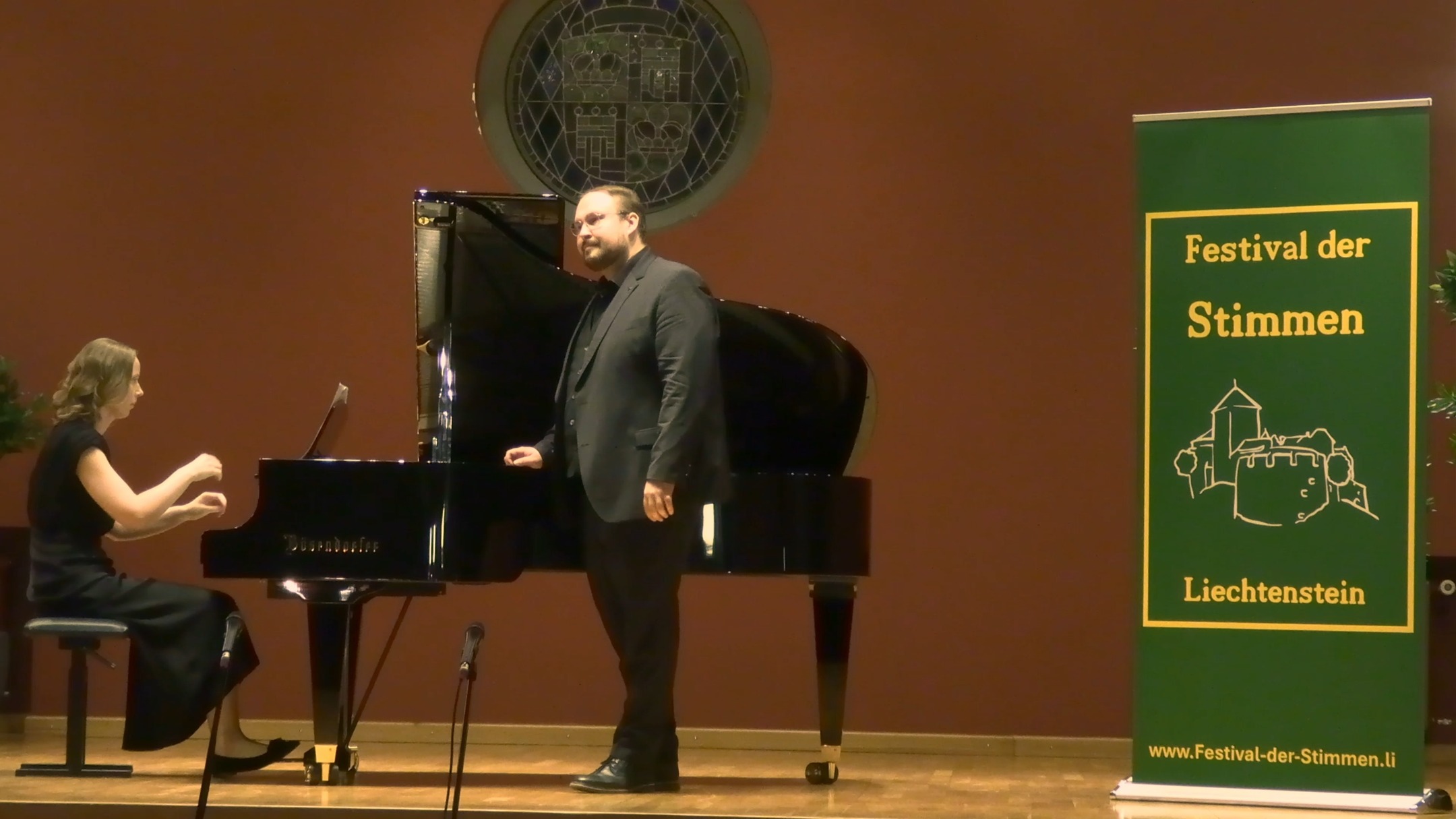
Pianist Evgenia Fölsche keeps the pulse narrow and unwavering; the voice remains direct, with clear caesuras. The final quatrain stands like an inscription: soberly set, without pathos.
Listening example: Der Wegweiser with Dietrich Fischer-Dieskau and Gerald Moore
Winterreise for your concert programme
Franz Schubert’s Winterreise belongs to Evgenia Fölsche’s song repertoire and can be realised in different performance formats. Depending on the occasion, venue, and artistic concept, various scorings and forms are possible.
Possible options include performances with different voice types from soprano to bass, versions with choir, with images, or in staged form. An overview of formats, scorings, and artistic possibilities can be found on the concert page for Winterreise.
To the Winterreise concert pageFrequently asked questions about Schubert: “Der Wegweiser” (Winterreise No. 20)
Click on a question to display the answer.
Is “Der Wegweiser” strophic?
Yes. The song is a strophic song with variation; each stanza is newly weighted in colour and declamation.
Which key and metre shape the song?
G minor, 2/4, moderate. The narrow walking pulse carries the song almost unerringly to the final line.
How should one shape the song’s character of resolve musically?
With direct diction, controlled dynamics, and transparent pedal. The close should not “redeem” pathetically, but remain open and inescapable.