“Das Wirtshaus” is song no. 21 from Franz Schubert’s Winterreise D 911 (1827), after Wilhelm Müller. After the solitary resolve of The Signpost, there follows a station of seeming arrival: the churchyard as an “inn” – yet the chambers are occupied.
Schubert condenses this image into a chorale-like, strophic point of repose in F major, 4/4, very slow. The setting feels like a quiet liturgical tread, spacious and solemn – and it is precisely this calm dignity that makes the rejection at the end all the more devastating.
The verse (Wilhelm Müller – from the printed original edition of 1824)
From: Winterreise – Song XXI
Auf einen Totenacker
hat mich mein Weg gebracht.
allhier will ich einkehren:
hab’ ich bei mir gedacht.
My path has led me
to a graveyard.
Here I will stop and rest:
so I thought to myself.
Ihr grünen Totenkränze
könnt wohl die Zeichen sein,
die müde Wandrer laden
in’s kühle Wirtshaus ein.
You green funeral wreaths,
you may well be the signs
that invite weary wanderers
into the cool inn.
Sind denn in diesem Hause
die Kammern all’ besetzt?
bin matt zum Niedersinken
und tödlich schwer verletzt.
Are all the chambers
in this house already occupied?
I am weary unto collapse
and mortally sorely wounded.
O unbarmherz’ge Schenke,
doch weisest du mich ab?
nun weiter denn, nur weiter,
mein treuer Wanderstab!
O pitiless hostelry,
and yet you turn me away?
Then onward, only onward,
my faithful walking staff!
Work data & overview
- Composer: Franz Schubert (1797–1828)
- Cycle: Winterreise D 911, no. 21 (Das Wirtshaus)
- Text source: Wilhelm Müller, Winterreise (1823/24)
- Composition: 1827; first print 1828 (Part II)
- Key / metre / tempo: F major, 4/4, very slow
- Duration: approx. 2:30–3:30 minutes
- Scoring: voice and piano (transpositions common)
- Form: strophic (4 stanzas) in chorale style
Data on the verse
- Author: Wilhelm Müller (1794–1827)
- Stanza form: 4 quatrains; alternating rhyme
- Devices: allegory of cemetery = inn, funeral wreath as inn sign, irony of the rejecting “hostelry,” pilgrim and lodging language
Origins & cycle context
After “The Signpost”, the wanderer at last seems to have found a station at which the road might end. Yet this supposed arrival is double-edged: the inn is in truth a cemetery, the lodging a metaphor of death.
It is precisely in this way that “Das Wirtshaus” becomes a centre of repose in the second part of the cycle. For the first time, the wanderer speaks quite openly of his wish for final rest. Death appears not as a figure of terror, but as a longed-for resting-place. That even this resting-place is denied to him is one of the bitterest turns in the whole of Winterreise.
Within the cycle, the song finally thrusts the boundary between life and death into the foreground. More on the wider context: Winterreise as a journey into the abyss of the soul, Schubert’s illness & Winterreise and The semiotics of song.
Performance practice & reception
Chorale & diction: the song calls for long, quiet breath and a clear, simple line. The voice should not lament, but speak almost as in a solemn prayer. It is precisely this restraint that lends the song its dignity.
Piano image: the setting is conceived in chordal writing, close to four-part texture. The pedal remains slender, the colours are restrained. At “mortally sorely wounded” the sound may thicken somewhat, but immediately afterward that same pale, liturgical calm must return which carries the whole song.
The closing turn, “Then onward, only onward,” is no outburst, but an exhausted resolve. Whoever gives too much pathos here takes away the song’s essential hardness.
Historical reference interpreters
- Dietrich Fischer-Dieskau – baritone
- Hans Hotter – bass-baritone
- Peter Schreier – tenor
Current interpreters with whom I collaborate
Analysis – music
Chorale gesture & breath
Schubert clothes “Das Wirtshaus” in a chorale gesture. The music feels calm, dignified, and almost sacred. The piano writing moves homophonically, the bass walks slowly, and the voice unfolds syllabically across broad breaths.
Precisely this simplicity is decisive. There are no dramatic effects, no abrupt outbursts, no virtuoso sharpening. The shock arises from the fact that the music opens up a world of repose, order, and acceptance – while the text is denied precisely this repose.
Harmony, form & sacred metaphor
The bright F major is one of the song’s greatest paradoxes. Death appears here not black and harsh, but in a light that recalls consolation and liturgical inwardness. Only individual side-steps and darkenings trace the points of pain, especially where the text speaks of being “mortally sorely wounded.”
The strophic design intensifies the impression of ritual. Each stanza feels like a further, quiet attempt at finding rest. Yet in the end the text compels onward movement: the liturgical frame remains, the hoped-for rest does not.
Visual representation
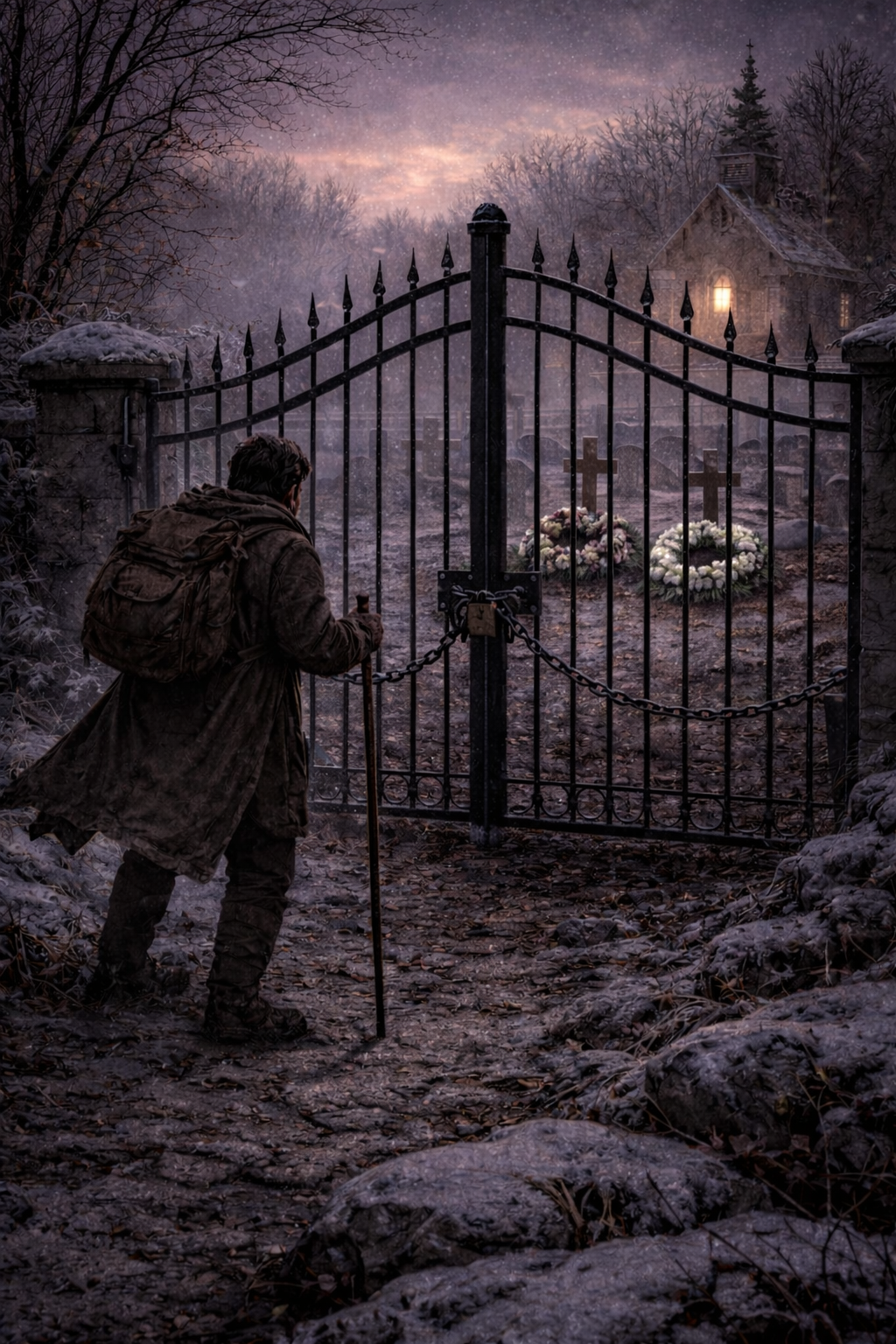
Artistic visualisation by Evgenia Foelsche:
The wanderer stands at the gate of a cemetery.
The two fresh graves with their wreaths seem like the bitterly concrete interpretation of the song title:
the “inn” here is truly the last lodging.
It is precisely the coloured wreaths in the colourless surroundings that make the tension of the image visible.
They seem to suggest a repose
that lies tantalisingly near –
and yet it remains denied to the wanderer.
Analysis – poetry
“Das Wirtshaus” is one of the most radical poems in Winterreise, because it transfers the desire for rest entirely onto death. The cemetery appears not as a place of horror, but as a longed-for lodging. It is this reversal that makes the song so devastating.
Seeking shelter in the field of the dead
Auf einen Totenacker
hat mich mein Weg gebracht.
allhier will ich einkehren:
hab’ ich bei mir gedacht.My path has led me
to a graveyard.
Here I will stop and rest:
so I thought to myself.
Already the first stanza is marked by laconic hardness. The wanderer comes to a cemetery and thinks of lodging there. The language remains sober, almost casual. Precisely בכך it becomes visible how far his longing has moved away from any earthly shelter.
The cemetery as inn
Ihr grünen Totenkränze
könnt wohl die Zeichen sein,
die müde Wandrer laden
in’s kühle Wirtshaus ein.You green funeral wreaths,
you may well be the signs
that invite weary wanderers
into the cool inn.
Here the central metaphor of the song unfolds. Funeral wreaths become inn signs, the cemetery a hostelry. The “cool inn” names not only the place of the grave, but also the longed-for rest from pain, heat, restlessness, and memory.
The wish to be admitted
Sind denn in diesem Hause
die Kammern all’ besetzt?
bin matt zum Niedersinken
und tödlich schwer verletzt.Are all the chambers
in this house already occupied?
I am weary unto collapse
and mortally sorely wounded.
In this stanza the plea is voiced openly. The wanderer asks whether there is still room for him. The “chambers” are graves, the lodging is death. Weariness and injury no longer appear only as spiritual images, but as a condition that longs for final rest.
The refusal
O unbarmherz’ge Schenke,
doch weisest du mich ab?
nun weiter denn, nur weiter,
mein treuer Wanderstab!O pitiless hostelry,
and yet you turn me away?
Then onward, only onward,
my faithful walking staff!
The final stanza enacts the cruel turn. Even death does not receive the wanderer. The “inn” remains closed. Thus the walking staff becomes the only fidelity that remains: not rest, but onward motion is what is allotted to the wanderer.
Meaning & effect within the cycle
“Das Wirtshaus” is one of the darkest resting points in Winterreise. The wanderer recognises death as the longed-for final station, yet even this last refuge is denied him. Therein lies the song’s real hardness: he is not permitted to arrive, not even in the grave.
For the cycle, this marks a decisive step. The final phase of Winterreise begins where even death is still deferred. The road goes on, not out of hope, but out of an almost uncanny compulsion to continue.
Thus “Das Wirtshaus” stands directly on the threshold of the closing songs. The world of the living has been left behind, the world of the dead is not yet reachable – the wanderer now moves definitively in an in-between zone, which finds its final image in The Hurdy-Gurdy Man.
Evgenia Fölsche – performances & audio
Pianist Evgenia Fölsche keeps the chorale narrow and calm, with clear breathing arcs and sparing colouring; the crucial point, “and yet you turn me away,” remains soberly set.
Listening example: Das Wirtshaus with Dietrich Fischer-Dieskau and Gerald Moore
Winterreise for your concert programme
Franz Schubert’s Winterreise belongs to Evgenia Fölsche’s song repertoire and can be realised in different performance formats. Depending on the occasion, venue, and artistic concept, various scorings and forms are possible.
Possible options include performances with different voice types from soprano to bass, versions with choir, with images, or in staged form. An overview of formats, scorings, and artistic possibilities can be found on the concert page for Winterreise.
To the Winterreise concert pageFrequently asked questions about Schubert: “Das Wirtshaus” (Winterreise No. 21)
Click on a question to display the answer.
Is “Das Wirtshaus” strophic?
Yes. The song is strophic in design and, as a whole, resembles a calm chorale with only slight shifts of colour.
Which key and metre shape the song?
F major, 4/4, very slow. The broad breathing arcs and chordal calm give the song its liturgical character.
How does one avoid sacred pathos in performance?
With slender dynamics, clear diction, and sparing pedalling. The song gains through simplicity and calm, not through grand emphasis.