Winterreise - Schubert’s Stroke of Genius
Franz Schubert – Winterreise:
- Winterreise – Gute Nacht
- Winterreise – Die Wetterfahne
- Winterreise – Gefror’ne Thränen
- Winterreise – Erstarrung
- Winterreise – Der Lindenbaum
- Winterreise – Wasserfluth
- Winterreise – Auf dem Flusse
- Winterreise – Rückblick
- Winterreise – Irrlicht
- Winterreise – Rast
- Winterreise – Frühlingstraum
- Winterreise – Einsamkeit
- Winterreise – Die Post
- Winterreise – Der greise Kopf
- Winterreise – Die Krähe
- Winterreise – Letzte Hoffnung
- Winterreise – Im Dorfe
- Winterreise – Der stürmische Morgen
- Winterreise – Täuschung
- Winterreise – Der Wegweiser
- Winterreise – Das Wirtshaus
- Winterreise – Muth
- Winterreise – Nebensonnen
- Winterreise – Der Leiermann
The Composition of Winterreise – Schubert’s Stroke of Genius
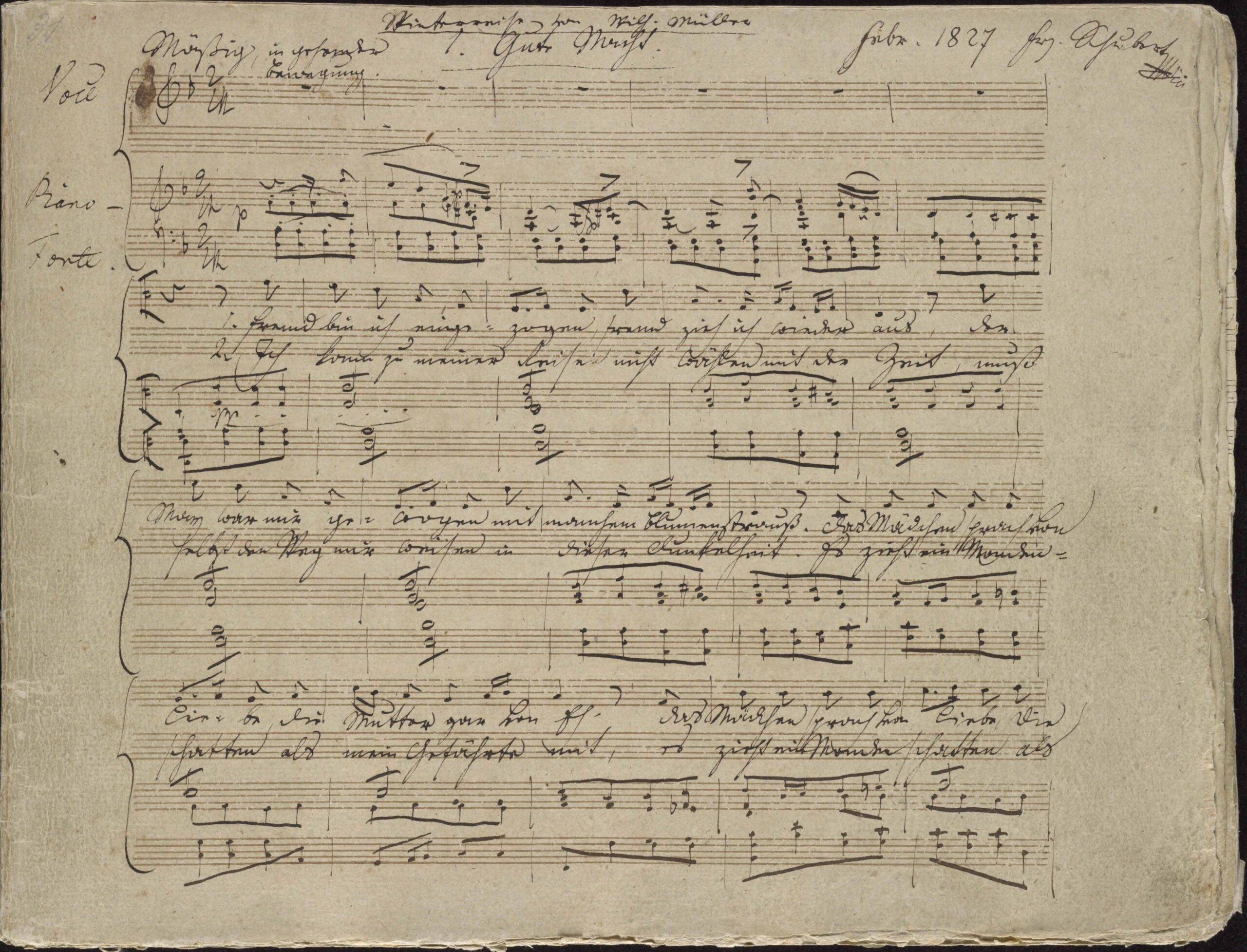
Winterreise D 911 was composed in 1827 during an extraordinary phase of creative concentration. Within just a few weeks, Franz Schubert shaped Wilhelm Müller’s poems into a unified song cycle of previously unmatched psychological depth. The surviving autograph offers an unusually clear glimpse into Schubert’s workshop – and shows how securely, swiftly, and completely he wrote down his musical ideas.
The Autograph – A Glimpse into Schubert’s Workshop
The autograph of Winterreise is one of the most revealing sources for Schubert’s compositional method. It does not show laborious stages of sketching, but predominantly fair copy written directly. Music, text underlay, and piano texture appear simultaneously fully shaped. This suggests that Schubert had already conceived large parts of the work inwardly and in full before he ever took up the pen.
Composing in Flow
The handwriting is dense, even, and fluid. Only isolated corrections or overwritings appear – mostly where musical declamation is adjusted precisely to the rhythm of speech. Sketch leaves or preliminary drafts are almost entirely absent. The autograph thus conveys the impression of a composer able to transfer his musical imagination directly into notated form.
The Unity of Text and Music
In the autograph, the poetic text stands complete beneath the vocal line. Word variants appear directly above the original reading. This shows that Schubert treated text and music as an inseparable unity. Speech rhythm, syllabic distribution, and musical accent visibly arise within one and the same process of thought.
The Piano as a Second Narrative Layer
The piano accompaniments are notated with the same care as the vocal line. Arpeggios, tremolos, chordal textures, and ostinati are fully written out without abbreviation. This underlines that the piano is not accompaniment alone, but an equal narrative voice within the cycle.
Performative Character Fixed from the Beginning
Tempo and expression markings already appear in the autograph. They are part of the original conception, not later editorial additions. Schubert therefore composed not only tones, but already the interpretive character of each individual song.
Economy and Assurance
A few motivic germ cells are clearly recognizable in the autograph as they are varied and developed further. The manuscript has the character of a sounding thought-image: musical imagination, sensitivity to language, and pianistic fantasy merge in one single concentrated act of notation.
Duration of Composition, Working Speed, and Publication
The Period of Composition
The whole of Winterreise was composed in 1827. Schubert presumably received Wilhelm Müller’s collection of poems in the late summer of that same year. Within only a few weeks, he first set the first twelve songs, and shortly thereafter the second half of the cycle. Thus a work of more than seventy minutes of music came into being in the exceptionally short span of only a few weeks to at most two months.
Exceptional Working Speed
The autograph confirms this high speed: fluid fair copy, scarcely any sketches, only minimal corrections. For a cycle of such formal unity, pianistic refinement, and psychological depth, this is remarkable even within Schubert’s highly productive output.
Publication
Winterreise appeared in 1828 in two parts:
- Part I (Songs 1–12): published in early 1828 by Tobias Haslinger in Vienna
- Part II (Songs 13–24): published a few months later
Schubert still lived to see the printing of the first part. The second half appeared shortly after his death in November 1828, yet it was based entirely on his finished autograph.
A Unified Artistic Vision
The rapid composition, the assured notation, and the immediate publication show: Winterreise was not a late work revised over a long period, but an artistic vision created in a short time, self-contained and complete – a stroke of genius in concentrated form.
The Manuscript as a Window into Creative Thought
The autograph of Winterreise makes visible how directly Schubert was able to unite musical imagination, interpretation of language, and sonic fantasy. It shows a composer who does not search by trial, but shapes with assurance – swiftly, intensely, and borne by inner necessity.