“Die Post” is song no. 13 from Franz Schubert’s Winterreise D 911 (1827), after Wilhelm Müller. After the inward rigidity of Loneliness, the distant post-horn brings an outer stimulus: hope flickers up—not as a decision, but as an involuntary reflex of memory.
Schubert shapes this into a varied strophic song in E-flat major with 6/8 metre and a springing coach-pulse. At first the song sounds almost cheerful. Yet it is precisely this mobility that makes audible how deeply the heart still clings to the lost world.
The poem (Wilhelm Müller – from the printed original edition of 1824)
From: Winterreise – Song XIII
Von der Straße her ein Posthorn klingt.
Was hat es, dass es so hoch aufspringt,
mein Herz?
From the road a post-horn sounds.
What ails it, that it leaps so high,
my heart?
Die Post bringt keinen Brief für dich:
Was drängst du denn so wunderlich,
mein Herz?
The post brings no letter for you:
Why then do you press on so strangely,
my heart?
Nun ja, die Post kommt aus der Stadt,
wo ich ein liebes Liebchen hatt’,
mein Herz!
Well then, the post comes from the town
where once I had a dear beloved,
my heart!
Willst wohl einmal hinübersehn
und fragen, wie es dort mag gehn,
mein Herz?
You would like, perhaps, to look across once more
and ask how things may be going there,
my heart?
Work data & overview
- Composer: Franz Schubert (1797–1828)
- Cycle: Winterreise D 911, No. 13 (Die Post)
- Text source: Wilhelm Müller, Winterreise (1823/24)
- Composition: 1827; first print 1828
- Tonal space / metre / tempo: E-flat major, 6/8, rather quick
- Duration: approx. 2:00–3:00 minutes
- Scoring: Voice and piano (transpositions common)
- Form: varied strophic form with motivic recurrence and subtle changes of colour
Data on the poem
- Author: Wilhelm Müller (1794–1827)
- Stanza form: 4 tercets with the recurring address “my heart”
- Devices: personification of the heart, signal-semantics of the post-horn, antithesis of hope and disenchantment, memory of the town of the beloved
Genesis & cycle context
“Die Post” is the first clear outer stimulus after the contemplative Loneliness. A sound from outside sets the inner self in motion. The song thus shows how thin the layer of resignation still is: a single signal is enough to make the heart leap again.
Within the cycle, this song stands on a threshold. Once more hope flashes up, but it remains immediately bound to the recognition of its hopelessness. It is precisely from this that the song draws its special fascination: movement and disenchantment appear at the same time.
More on the broader context in the Winterreise – Overview and on its psychological depth in the article Winterreise as a journey into the abyss of the soul.
Performance practice & reception
Tempo & pulse: buoyant 6/8, with an elastic coach-pulse. The song must never become heavy. Tension arises not from volume, but from an inner urge beneath the apparent lightness.
Articulation & colour: bright, lightly connected signal motifs, clear declamation of the text in the questions addressed to the heart. The post-horn is not a mere effect, but the musical sign of hope as reflex. Transparent pedal, the sound rather gleaming than sentimental.
Historical reference interpreters
- Dietrich Fischer-Dieskau – baritone
- Hermann Prey – baritone
Current interpreters with whom I collaborate
Analysis – music
Post-horn gesture & coach pulse
Dotted signal figures, broken triads and the elastic 6/8 movement evoke the post-horn and the beat of hooves. The song lives from the impression of something passing by: something comes from outside, touches the inner self – and moves on.
Semiotically this is especially interesting, because the post-horn here does not simply mean “message.” It opens an open field of meaning: expectation, memory, hope and emptiness all stand present at once. More on this in the introductory article The semiotics of song.
Harmony, form & affective change
Within the brightness of E-flat major, small side-steps and secondary dominants traverse the space. The stanzas vary accompaniment texture and dynamics only slightly, so that the song’s signal-character is preserved. The scheme is: stimulus – disenchantment – memory – renewed question.
Hope thus appears as an impulse without fulfilment. The song brightens, but it opens no real way out.
Visual representation
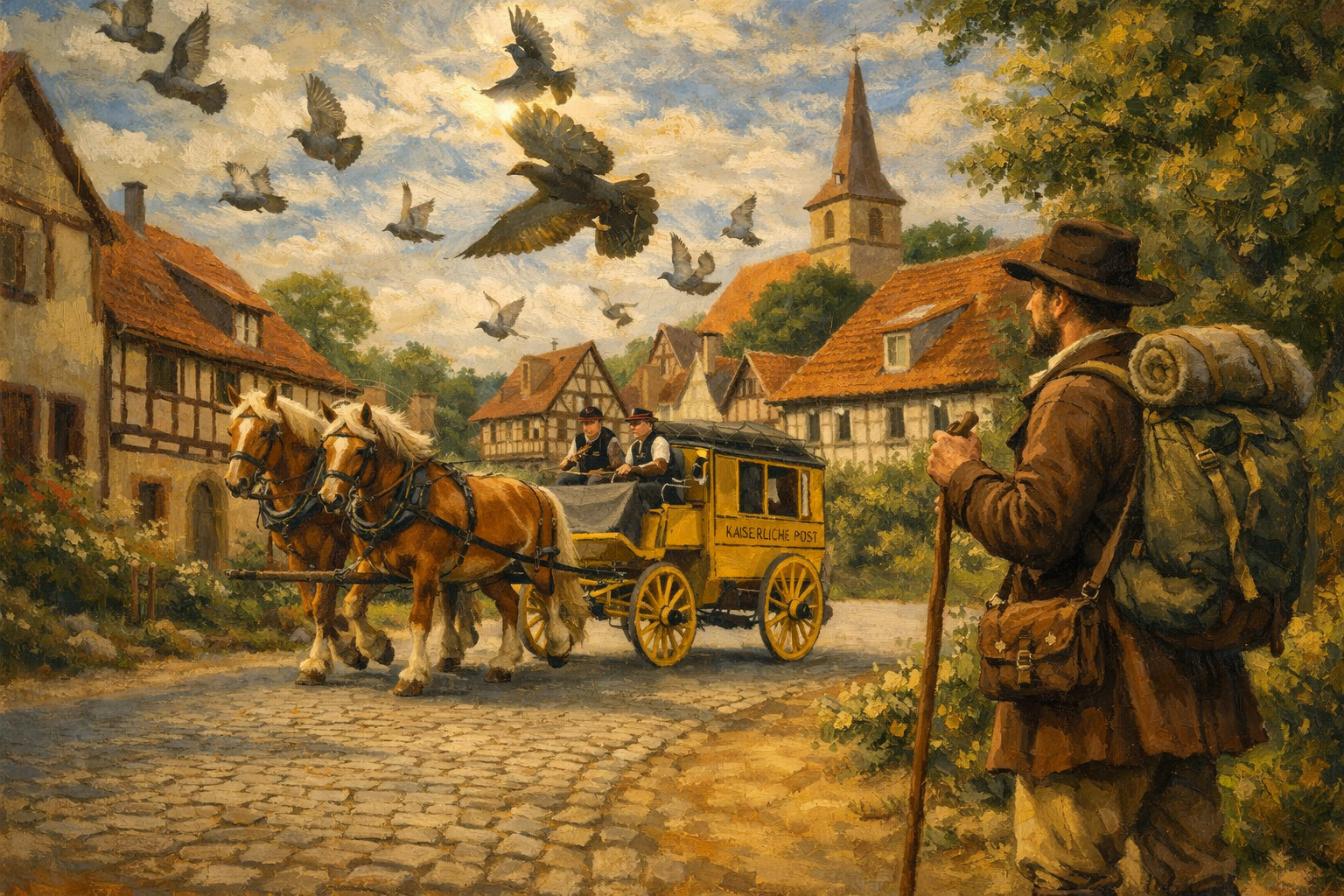
Artistic visualisation by Evgenia Foelsche:
A mail coach approaches along a road that appears brighter and more animated than many other stations of Winterreise.
At the roadside stands the wanderer, directing his gaze expectantly toward the approaching vehicle.
The scene is not static, but charged with tense anticipation.
The image emphasises the inner tension of this moment:
perhaps the post brings a message, a sign, a final remnant of connection.
Yet at the same time the coach remains on its own way.
It does not belong to the wanderer.
Thus the image shows exactly the ambivalence of the song:
hope rises,
although the mind has long known that nothing is to be expected.
The movement of the world goes on – but not for him.
Analysis – poetry
The poem “Die Post” shows a moment of sudden inner agitation. An outer signal – the post-horn – strikes a hope that evidently has never wholly fallen silent within. The poem is shaped as a self-conversation: the heart becomes the counterpart of the self.
Von der Straße her ein Posthorn klingt.
Was hat es, dass es so hoch aufspringt,
mein Herz?
Right at the beginning stands the bodily reaction. The post-horn is a neutral sign from the outer world, yet in the heart it immediately releases movement. Hope appears here not as a conscious thought, but as reflex.
Die Post bringt keinen Brief für dich:
Was drängst du denn so wunderlich,
mein Herz?
The second stanza brings disenchantment. The mind immediately tries to take hope back again. There is no letter, and thus no cause. But the heart remains restless. Feeling and insight fall apart.
Nun ja, die Post kommt aus der Stadt,
wo ich ein liebes Liebchen hatt’,
mein Herz!
In the third stanza it becomes clear why the sign works so strongly. The post comes from the town of the beloved. The sound thus touches not only the present, but an entire space of memory. The past becomes instantly alive.
Willst wohl einmal hinübersehn
und fragen, wie es dort mag gehn,
mein Herz?
The final stanza formulates the temptation to seek connection once more. Yet even this impulse remains in the conditional. Nothing truly happens. The heart presses forward – but the movement remains inward.
Precisely through this, “Die Post” shows how strongly the past continues to work within Winterreise: not as a real possibility, but as an inward attraction that flares up again and again.
Meaning & effect within the cycle
“Die Post” is one of the few songs in Winterreise in which the social outer world becomes distinctly audible once more. The post-horn recalls connection, message and exchange – that is, a world from which the wanderer is in fact excluded.
In the course of the cycle, the song marks a brief relapse into hope. The wanderer at once recognises the hopelessness of it, yet the heart responds all the same. This tension between insight and longing makes the song especially human – and especially painful.
Precisely because hope here only flickers briefly and yet does not vanish, the song continues to work. More on this in the article Art that continues to work.
Evgenia Fölsche – performances & audio
Pianist Evgenia Fölsche sets the signal motifs with brightness and elasticity, with clear textual accentuation. The pulse remains taut, but never hurried.
Listening example: Die Post with Dietrich Fischer-Dieskau and Gerald Moore
Winterreise for your concert programme
Winterreise by Franz Schubert belongs to Evgenia Fölsche’s lied repertoire and can be realised in different performance formats. Depending on the occasion, venue and artistic concept, various scorings and forms are possible.
Possible formats include performances with different voice types from soprano to bass, versions with choir, with images or in staged form. An overview of the formats, scorings and artistic possibilities can be found on the concert page for Winterreise.
Go to the Winterreise concert pageFrequently asked questions about Schubert: “Die Post” (Winterreise No. 13)
Click on a question to display the answer.
Is “Die Post” strophic?
Yes: a varied strophic form with recurring signal motifs and subtle changes of colour.
Which key and metre are typical?
E-flat major in 6/8, rather quick; the dotted profile recalls the rhythm of coach and post-horn.
How should one shape the “post-horn” at the piano?
With bright, clearly accented triadic figures, precise articulation and sparing pedal – buoyant rather than loud.