“Die Wetterfahne” is song no. 2 from Franz Schubert’s Winterreise D 911 (1827), after Wilhelm Müller. After the quiet farewell of “Gute Nacht”, the tone turns bitterly ironic: the wind drives the weather vane on the beloved’s house, and the wanderer realizes that the hearts inside are “joining in” as well.
Schubert shapes a hasty, strophically varied character piece — sharply accented, tinged with G minor, driven by the piano’s “wind” motor. Within the cycle, the song marks a first moment of unmasking: love no longer appears as attachment, but as something changeable and calculating.
The poem (Wilhelm Müller – from the printed original edition of 1824)
From: Winterreise – Song II
Der Wind spielt mit der Wetterfahne
auf meines schönen Liebchens Haus.
Da dacht’ ich schon in meinem Wahne,
sie pfiff den armen Flüchtling aus.
Er hätt’ es eher bemerken sollen,
des Hauses aufgestecktes Schild;
so hätt’ er nimmer suchen wollen
im Haus ein treues Frauenbild.
Der Wind spielt drinnen mit den Herzen,
wie auf dem Dach, nur nicht so laut.
Was fragen sie nach meinen Schmerzen?
Ihr Kind ist eine reiche Braut.
English translation
The wind is playing with the weather vane
upon my lovely darling’s house.
In my delusion I had thought already
it whistled the poor fugitive away.
He should have noticed it much sooner,
the sign set up upon that house;
then he would never have gone on seeking
within the house a faithful woman’s image.
The wind is playing with the hearts inside,
as on the roof, though not so loud.
What do they care about my sorrows?
Their child is a wealthy bride.
Work data & overview
- Composer: Franz Schubert (1797–1828)
- Cycle: Winterreise D 911, No. 2 (Die Wetterfahne)
- Text source: Wilhelm Müller, Winterreise (1823/24)
- Composition: 1827; first printed edition 1828 (Part I)
- Tonal space / metre / tempo: G minor, mostly 2/4, rapid / hasty
- Duration: approx. 1:30–2:30 minutes
- Scoring: voice and piano (transpositions common)
- Form: strophically varied (3 stanzas), clear rhyme and phrase parallelism
Data on the poem
- Author: Wilhelm Müller (1794–1827)
- Stanza form: 3 stanzas of 4 lines each (cross rhyme)
- Devices: personification, irony, symbolism, inner contrast (roof ↔ heart)
Genesis & cycle context
The second song intensifies the departure of No. 1: the wanderer “reads” in the house and the weather vane that attachment and fidelity are outward and dependent on the wind. What in “Gute Nacht” still appeared as a quiet withdrawal here becomes bitter knowledge.
Thus the cycle begins not only a journey through wintry images, but also a sequence of unmaskings. External signs — roof, sign, weather vane — become bearers of inner truth. How Müller’s symbolic language functions within the cycle is shown in the background article Winterreise – Müller’s radically Romantic text.
More on the overall connection of the songs in the Winterreise – Overview.
Performance practice & reception
Gesture: light, sharp, forward-moving — not heavy pathos. The punchline (“wealthy bride”) dry, without a vibrato of bitterness; irony arises from clarity, not exaggeration.
Piano texture: flickering quavers and frictions as wind, with precise accents and minimal pedal. Voice-piano timing should be set so that the textual thrust (“whistled the poor fugitive away”) lands exactly.
Historical reference interpreters
- Dietrich Fischer-Dieskau – baritone
- Hermann Prey – baritone
Current interpreters with whom I collaborate
Analysis – music
“Wind” motoric motion & articulation
The piano writing in 2/4 haste imitates the tugging of the wind: short figures, abrupt accents, occasional sforzati. The voice declaims tersely and syllabically — more speech-like than cantabile, so that the blows of irony land immediately.
Precisely in this interplay of text and piano image, the song becomes a space of signs: the wind is not merely a natural phenomenon, but meaning shaped musically. How such open signs function in song I describe in more detail in the article The semiotics of song.
Form, tonal space & irony
G minor frames the scene; small flashes of major sound like cold metallic light on the roof. The strophic return emphasizes the mechanical character of the sign, while the textual turn of the third stanza makes the music sound deliberately dry and relentless.
Visual representation
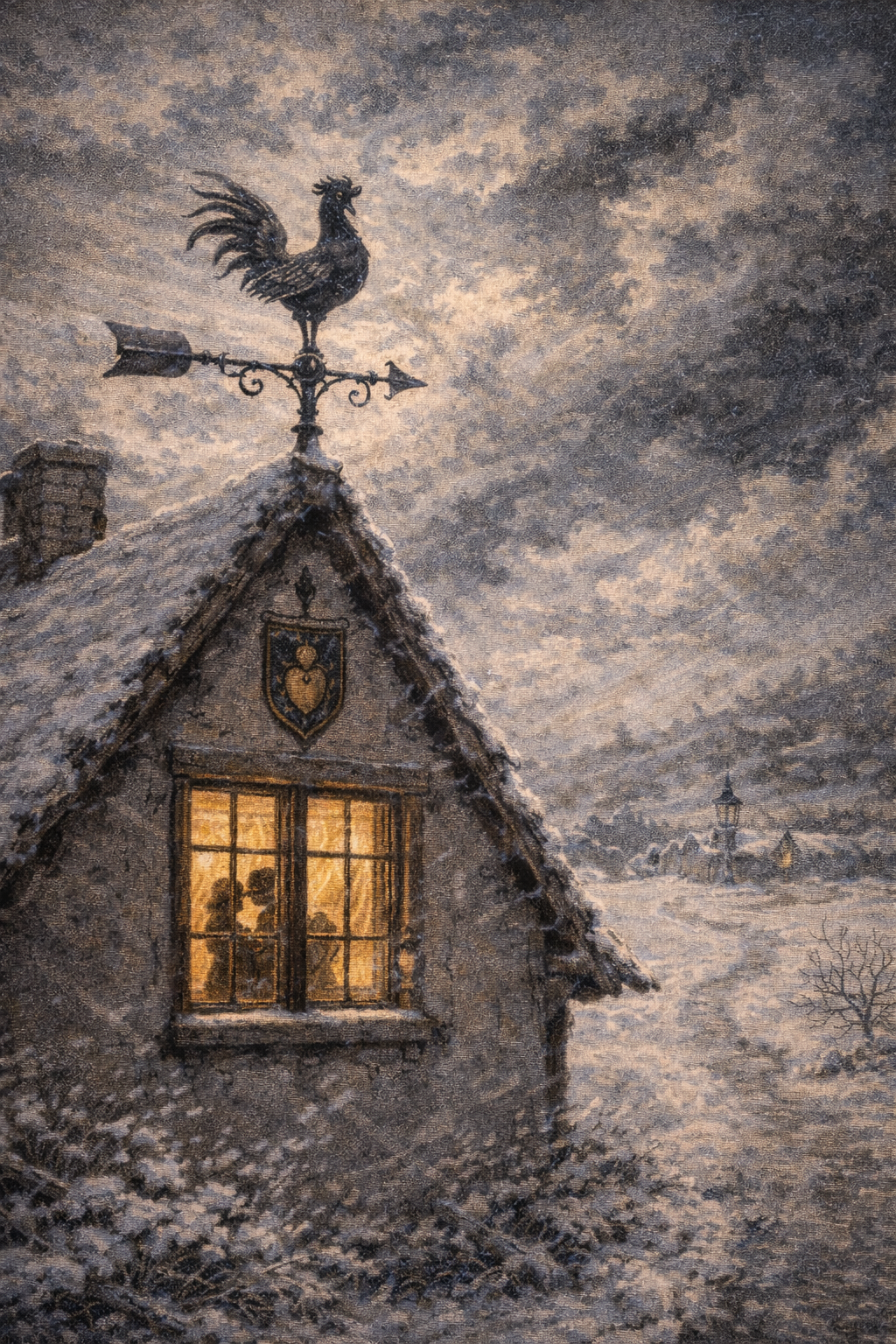
Artistic visualisation by Evgenia Foelsche:
A house stands in the middle of a snow-covered winter landscape.
On the roof the weather vane turns: cockerel and arrow
indicate the changing direction of the wind. The metal seems
restless, exposed to the invisible current of air. Beneath the
roof, however, a window glows warmly into the night.
In the lit room, the outlines of a man
and a woman appear — close together, in familiar
intimacy. The contrast between outer cold and
inner warmth is unmistakable. While outside
wintry loneliness reigns, indoors
a new happiness seems to have arisen.
In the image, the weather vane becomes the central symbol.
It reacts to every gust of wind, changing direction
without any will of its own. In this way it mirrors the inconstancy
of the feelings that the wanderer attributes to the beloved.
What he had felt to be a firm attachment
has proved fickle.
In Schubert’s music, the wind strikes through the piano accompaniment
in sharp, moving figures.
The image too carries this unrest within it:
the turning metal above the silent house
embodies the irony of the beginning of Winterreise.
The wanderer realizes that it is not his own heart,
but the beloved’s, that follows the wind.
Thus the scene marks the first bitter
turning point — the farewell begins.
Analysis – poetry
The poem “Die Wetterfahne”, immediately following “Gute Nacht”, deepens the experience of estrangement and deception opened up in Winterreise. Whereas in the first song the wanderer still carries out the farewell with dignity and control, here a sharper, almost sarcastic perception of the world appears for the first time. The poem no longer directs its gaze toward the inner resolve of the self, but toward an external sign that becomes the symbol of an entire lie of life.
The weather vane as central symbol
Der Wind spielt mit der Wetterfahne
auf meines schönen Liebchens Haus.
The weather vane is a classic symbol of mutability and inconstancy. It does not move of its own will, but reacts mechanically to external forces. By standing upon the house of the “lovely darling,” it becomes a cipher for a love that always turns according to whichever wind is favourable.
The wanderer initially projects meaning into this sign — he believes that it “whistled the poor fugitive away.” This personification reveals his emotional vulnerability: even an inanimate object seems to mock him.
Recognition and self-criticism
Er hätt’ es eher bemerken sollen,
des Hauses aufgestecktes Schild.
In this stanza a painful self-recognition takes place. The “sign set up on the house” points to status, possession, and social order. In retrospect, the wanderer recognizes that he misread the signs or deliberately ignored them. The house was never the place of a “faithful woman’s image,” but an economically marked space.
Inside and outside: heart and roof
Der Wind spielt drinnen mit den Herzen
wie auf dem Dach, nur nicht so laut.
The unrest that had previously been visible outside is now shifted inward. Hearts are just as wind-dependent as the weather vane. The difference lies only in volume, not in essence. This equation unmasks the bourgeois world as morally empty: feelings are moved like things, quietly, changeably, and without responsibility.
Social coldness and emotional isolation
Was fragen sie nach meinen Schmerzen?
Ihr Kind ist eine reiche Braut.
Wealth triumphs over empathy. The parents — and with them society — do not measure by the standard of feeling, but by material success. The wanderer’s pain has become meaningless. With that, his exclusion is complete: he is not only abandoned, but superfluous.
“Die Wetterfahne” is a poem of unmasking. It shows the moment in which romantic hope turns into bitter knowledge. Love no longer appears as a fateful bond, but as a variable quantity within relations of social power.
Meaning & effect within the cycle
Within Winterreise, “Die Wetterfahne” marks a decisive transition. After the quiet farewell in “Gute Nacht”, there follows here a first bitter analysis of the causes of failure. The wanderer begins not only to leave the world, but to see through it.
At the same time, the song prepares the further development of the cycle: external signs — house, weather vane, sign — become projection surfaces for a growing disillusionment. From now on, the journey leads less through real spaces than through inner recognitions.
That is precisely where the lasting effect of this song also lies: it does not explain everything once and for all, but opens an interpretive space between symbol, irony, and bitterness. More on this in the article Art that keeps working.
Evgenia Fölsche – performances & audio
Pianist Evgenia Fölsche accents the wind-motoric motion with dry accents and minimal pedal; the voice remains speech-close, clearly contoured — the irony feels cool, not bitter.
Listening example: Die Wetterfahne with Dietrich Fischer-Dieskau and Gerald Moore
Winterreise for your concert programme
Franz Schubert’s Winterreise belongs to Evgenia Fölsche’s lied repertoire and can be realised in different performance formats. Depending on occasion, venue, and artistic concept, various scorings and forms are possible.
Possible formats include performances with different voice types from soprano to bass, versions with choir, with images, or in staged form. An overview of formats, scorings, and artistic possibilities can be found on the concert page for Winterreise.
Go to the Winterreise concert pageFrequently asked questions about Schubert: “Die Wetterfahne” (Winterreise No. 2)
Click on a question to reveal the answer.
Is “Die Wetterfahne” strophic?
Yes, three stanzas with varying accompaniment and accent structure — the text determines the colouring.
How fast should the song be?
Hasty, but light — the pulse remains elastic. Articulation takes priority over sheer speed.
What key is the original in?
In the original edition, the song is in G minor; transpositions according to voice type are common.