“Einsamkeit” is song no. 12 from Franz Schubert’s Winterreise D 911 (1827), after Wilhelm Müller. After the shimmering Dream of Spring, the cycle returns to a cool clarity: a quiet walking through a bright world that remains inwardly dark.
Schubert shapes a plainly strophic chamber scene in F major with a calm walking pulse. The wanderer becomes the dim cloud in a bright daylight image. Precisely therein lies the hardness of the song: it is not the storm that isolates him, but repose.
The poem (Wilhelm Müller – printed original edition of 1824)
From: Winterreise – Song XII
Wie eine trübe Wolke
durch heitre Lüfte geht,
wann in der Tanne Wipfel
ein mattes Lüftchen weht:
Like a dim cloud
passing through cheerful skies,
when through the fir tree’s topmost branches
a faint little breeze is blowing:
So zieh’ ich meine Straße
dahin mit trägem Fuß,
durch helles, frohes Leben
einsam und ohne Gruß.
So I go my road
onward with sluggish foot,
through bright and joyful life,
lonely and without greeting.
Ach, dass die Luft so ruhig!
Ach, dass die Welt so licht!
Als noch die Stürme tobten,
war ich so elend nicht.
Ah, that the air should be so calm!
Ah, that the world should be so bright!
When the storms were still raging,
I was not so wretched as now.
Work data & overview
- Composer: Franz Schubert (1797–1828)
- Cycle: Winterreise D 911, No. 12 (Einsamkeit)
- Text source: Wilhelm Müller, Winterreise (1823/24)
- Composition: 1827; first print 1828 (Part I)
- Tonal space / metre / tempo: F major, 3/4, calm, walking
- Duration: approx. 2:30–3:30 minutes
- Scoring: Voice and piano (transpositions common)
- Form: plain strophic form with fine colour variations
Data on the poem
- Author: Wilhelm Müller (1794–1827)
- Stanza form: 3 quatrains; cross rhyme
- Devices: guiding metaphor of the dim cloud, antithesis of outer light and inner suffering, personification of nature’s calm, contrasting figure of the “storms”
Genesis & cycle context
After the shock of dream in Dream of Spring, Einsamkeit gathers into focus the condition of the road: movement without encounter. The brightness of the world seems not consoling, but like a cold mirror. It is precisely the calm of nature that intensifies the inward state.
The song thus shows a new stage of Winterreise: no longer is the hostility of the outer world at the centre, but rather the impossibility of sharing in the world’s brightness and joy. Loneliness appears as a state of disconnection.
More on the broader context in the Winterreise – Overview and on its psychological depth in the article Winterreise as a journey into the abyss of the soul.
Performance practice & reception
Pulse & line: even walking pulse, long breath, slender vibrato. The diction remains simple and unagitated. The song lives precisely from the fact that it does not lament, but states things soberly.
Piano texture: transparent, lightly shadowed accompanying figures like a slow passage of clouds. Pedal sparing, colours matte. No grand Romantic charge, but cool spaciousness.
Historical reference interpreters
- Dietrich Fischer-Dieskau – baritone
- Hermann Prey – baritone
Current interpreters with whom I collaborate
Analysis – music
Walking pulse & the sound of the “dim cloud”
The rocking motion in 3/4 creates steady forward movement without any urgency. The wanderer keeps going, but is no longer driven. It is precisely this even movement that allows the inner emptiness to emerge all the more clearly.
Small dynamic cloud-shadows on words such as “dim,” “lonely,” or “wretched” only minimally disturb the bright F major. In this way, the song works with open semantics: brightness is not consolation, but contrast. More on this in the introductory article The semiotics of song.
Harmony, form & outer/inner light
Within the brightness of F major, only delicate darkenings appear, which suggest the inner suffering rather than display it. The closed strophic form intensifies this effect: nothing breaks out, nothing is discharged. The contrast between the luminous outer world and the darkened inner one remains.
Visual representation
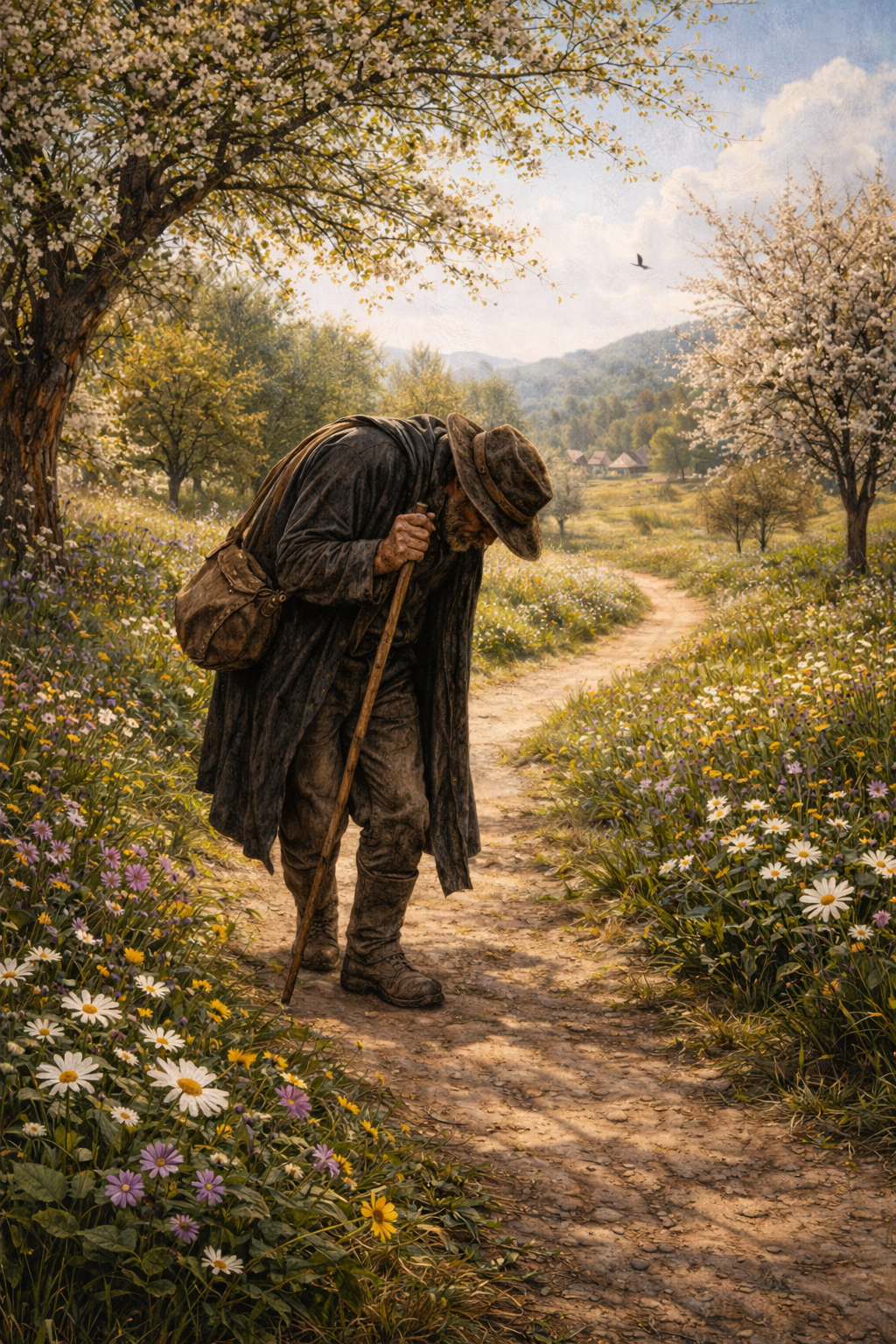
Artistic visualisation by Evgenia Foelsche:
A bright, blossoming spring landscape opens out.
The sun shines, nature appears alive, kindly, almost consoling.
Everything points toward departure and renewal.
In sharp contrast stands the wanderer.
He goes on his way alone, deeply bent, as though an invisible burden were pulling him downward.
Precisely because the surroundings seem so friendly, his inner coldness emerges all the more clearly.
The image makes visible what Einsamkeit shows with particular force:
loneliness is not merely the absence of people,
but a condition that can persist independently of the season.
Spring does not reach him.
Thus the landscape becomes not the remedy,
but the bitter foil:
life is in bloom – only not within him.
Analysis – poetry
The poem “Einsamkeit” forms within Winterreise a moment of outward calming accompanied by an inward sharpening. Movement, nature and the world appear calm and bright, yet precisely this harmony intensifies the feeling of separateness.
Wie eine trübe Wolke
durch heitre Lüfte geht,
wann in der Tanne Wipfel
ein mattes Lüftchen weht:
The first stanza sets up a simile. The dim cloud moves slowly through a cheerful atmosphere. Nothing is dramatic, nothing tears apart. It is precisely this gentleness that makes the metaphor so powerful: loneliness appears as a quiet foreign body in an intact world.
So zieh’ ich meine Straße
dahin mit trägem Fuß,
durch helles, frohes Leben
einsam und ohne Gruß.
In the second stanza, the image from nature is transferred to the wanderer. He moves through bright, joyful life without taking part in it. Loneliness here is not merely the absence of closeness, but the impossibility of resonance. The missing greeting marks the social separation.
Ach, dass die Luft so ruhig!
Ach, dass die Welt so licht!
Als noch die Stürme tobten,
war ich so elend nicht.
The third stanza reverses what one might expect. Calm and brightness are not consolation, but amplifiers of misery. Looking back, even the times of storm seem more bearable, because they still gave suffering movement and counterforce. In calm, only the naked awareness of loneliness remains.
Einsamkeit is therefore one of the quietest and at the same time one of the sharpest songs of Winterreise. It shows that the true threat lies not in outward violence, but in a world that remains bright even though the inner self has long since darkened.
Meaning & effect within the cycle
Einsamkeit marks a decisive shift of mood within Winterreise. The outward conflict recedes, yet precisely through this the inner isolation becomes impossible to overlook. Loneliness no longer arises from storm and cold, but from the contrast with a world that seems intact.
In the course of the cycle, this song deepens the motif of estrangement. The wanderer recognises that the storm was not his greatest adversary, but calm. The journey leads not away from loneliness, but ever deeper into it.
Precisely because the song keeps its images open and does not “close” them psychologically, it continues to work. More on this in the article Art that continues to work.
Evgenia Fölsche – performances & audio
Pianist Evgenia Fölsche shapes Einsamkeit with spacious breath, finely graded dynamics and sober colouring. The light remains bright – the tone remains inwardly cool.
Listening example: Einsamkeit with Dietrich Fischer-Dieskau and Gerald Moore
Winterreise for your concert programme
Winterreise by Franz Schubert belongs to Evgenia Fölsche’s lied repertoire and can be realised in different performance formats. Depending on the occasion, venue and artistic concept, various scorings and forms are possible.
Possible formats include performances with different voice types from soprano to bass, versions with choir, with images or in staged form. An overview of the formats, scorings and artistic possibilities can be found on the concert page for Winterreise.
Go to the Winterreise concert pageFrequently asked questions about Schubert: “Einsamkeit” (Winterreise No. 12)
Click on a question to display the answer.
Is “Einsamkeit” strophic?
Yes: a plain strophic form with fine variations in dynamics and colour.
Which key and metre are typical?
F major in 3/4, calm and walking; transpositions are common depending on voice type.
How does one avoid sentimental pathos?
Keep the line simple, use pedal sparingly, and keep the contrasts small – more cool brightness than grand lament.