“Frühlingstraum” is song no. 11 from Franz Schubert’s Winterreise D 911 (1827), after Wilhelm Müller. After the introspective Rest, a sharply contrasting interplay follows: a radiant dream of flowers, birdsong and love set against cold reality with ravens, darkness and loneliness.
Schubert casts this in a modified strophic form with abrupt tempo changes and tonal colourings around A major. Jubilation flashes forth – and freezes in the very same instant. It is precisely this reversal that makes the song one of the most shattering pieces of contrast in the cycle.
The poem (Wilhelm Müller – printed original edition of 1824) with Schubert’s alteration
From: Winterreise – Song XI
Ich träumte von bunten Blumen,
so wie sie wohl blühen im Mai;
ich träumte von grünen Wiesen,
von lustigem Vogelgeschrei.
I dreamt of many-coloured flowers,
as they perhaps bloom in May;
I dreamt of green meadows,
of cheerful birdsong.
Und als die Hähne krähten,
da ward mein Auge wach;
da war es kalt und finster,
es schrieen die Raben vom Dach.
And when the cocks were crowing,
my eyes awoke;
it was cold and dark,
the ravens cried from the roof.
Doch an den Fensterscheiben,
wer malte die Blätter da?
ihr lacht wohl über den Träumer,
der Blumen im Winter sah?
But on the windowpanes,
who painted those leaves there?
you are surely laughing at the dreamer
who saw flowers in winter?
Ich träumte von Lieb’ um Liebe,
von einer schönen Maid,
von Herzen und von Küssen,
von Wonn’ und Seligkeit.
I dreamt of love requited,
of a lovely maiden,
of hearts and of kisses,
of delight and blessedness.
Und als die Hähne krähten,
da ward mein Herze wach;
nun sitz’ ich hier alleine
und denke dem Traume nach.
And when the cocks were crowing,
my heart awoke;
now I sit here alone
and dwell upon the dream.
Die Augen schließ’ ich wieder,
noch schlägt das Herz so warm.
wann grünt ihr Blätter am Fenster?
wann halt’ ich dich, Liebchen, im Arm?
(Schubert: wann halt’ ich mein Liebchen im Arm?)
I close my eyes again,
my heart still beats so warmly.
when will you leaves turn green upon the window?
when shall I hold you, my beloved, in my arms?
(Schubert: when shall I hold my beloved in my arms?)
Work data & overview
- Composer: Franz Schubert (1797–1828)
- Cycle: Winterreise D 911, No. 11 (Frühlingstraum)
- Text source: Wilhelm Müller, Winterreise (1823/24)
- Composition: 1827; first print 1828 (Part I)
- Tonal space / metre / tempo: A major with darkenings into A minor, 2/4; alternation between quick and slow, sustained
- Duration: approx. 3:00–4:00 minutes
- Scoring: Voice and piano (transpositions common)
- Form: modified strophic form with alternation between dream blocks and reality blocks
Data on the poem
- Author: Wilhelm Müller (1794–1827)
- Stanza form: 6 quatrains; cross rhyme
- Devices: antithesis of dream and reality, nature metaphorics, window motif, repeated formula “the cocks were crowing”
Genesis & cycle context
“Frühlingstraum” brings, after the bodily nearness of Rest, a glaring upsurge of feeling. In the dream, May returns, yet awakening is frosty. The song thus does not lead out of winter, but shows how hope survives only within an inner sphere.
Of particular importance is the window: it becomes a projection surface where inside and outside, wish and reality, longing for spring and frost flowers interlock. It is precisely this open ambiguity that gives the song such strength.
More on the larger context in the Winterreise – Overview and on its psychological depth in the article Winterreise as a journey into the abyss of the soul.
Performance practice & reception
Tempo & contrast: the dream section quick, buoyant and light; on awakening suddenly sustained, cool and without pathos. The transitions should not be softened into smoothness, but made audible clearly as points of fracture.
Articulation & colour: near-staccato figures and light veils of pedal in the dream, dry sound edges in the cuts of reality. The cocks and ravens are not naturalistic effects, but shock points of awakening.
Historical reference interpreters
- Dietrich Fischer-Dieskau – baritone
- Hermann Prey – baritone
Current interpreters with whom I collaborate
Analysis – music
Dream gesture & cut into reality
Buoyant cells of motion, bright triadic melody and light syncopations paint the dream. Awakening abruptly breaks this flow: a slowing of tempo, a fall in register and rougher intervals make reality appear like a tear. It is precisely from this break that the song draws its power.
Semiotically, this is especially revealing: the same music does not simply utter “spring” or “winter,” but generates open spaces of meaning in which hope and disappointment remain present at the same time. More on this in the introductory article The semiotics of song.
Harmony, form & double perspective
Within the brightness of A major, side-steps are passed through quickly; reality darkens into A minor and draws the sound downward. The architecture of the song layers blocks of dream and windows of reality. The final question remains suspended: no solution, only longing idling in place.
Visual representation
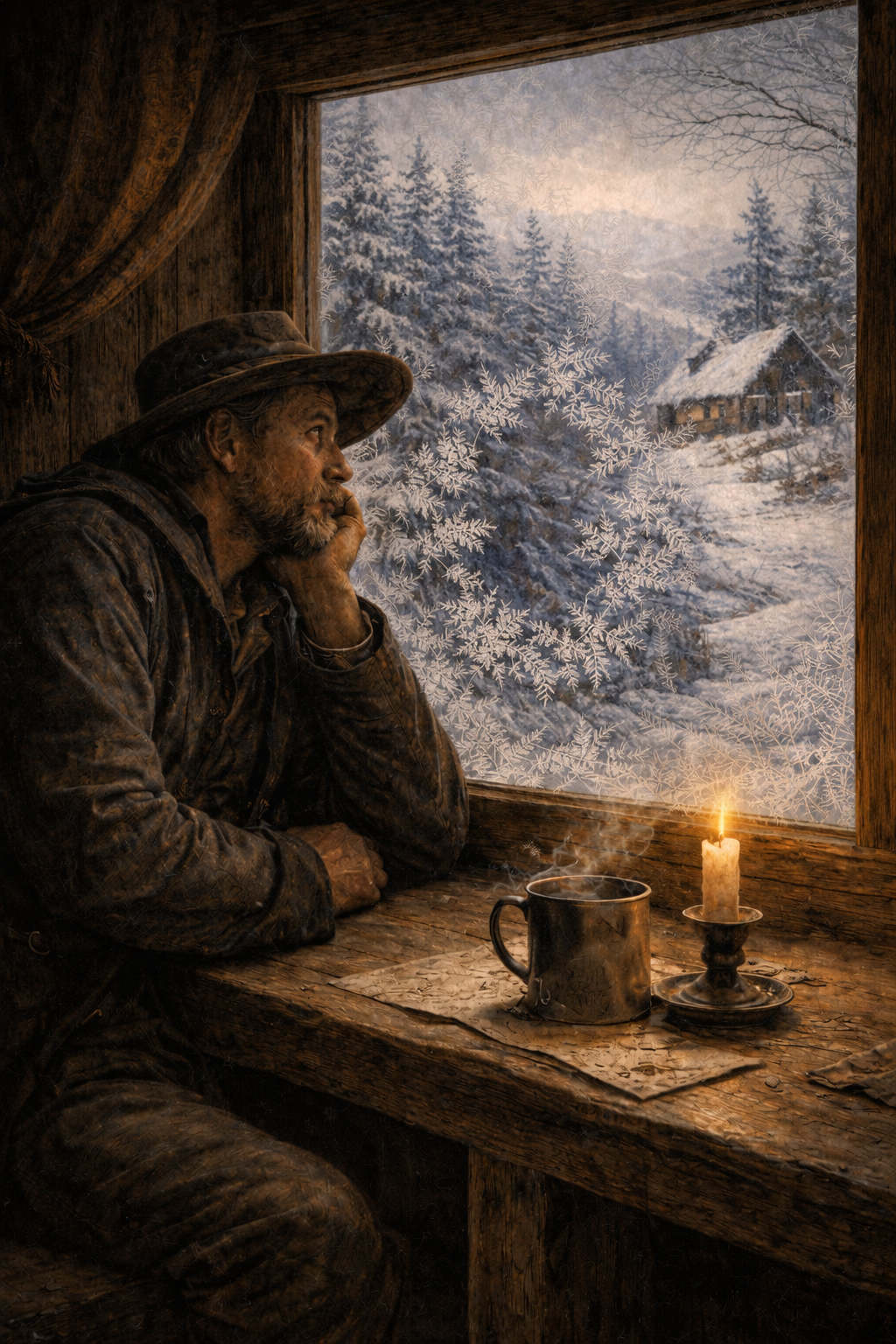
Artistic visualisation by Evgenia Foelsche:
The wanderer sits in a room, before him a cup of steaming drink and a burning candle.
The space seems warm and still, almost sheltered.
Yet his gaze is directed outward – toward a winter landscape that appears cold and forbidding.
Frost crystals have formed upon the window glass.
They wind themselves into leaf-like shapes, forming a wreath that recalls living green.
For a moment it seems as though spring were in the air – as though leaves were beginning to grow.
Yet it is only ice.
The image thus takes up the central tension of the song:
dream and awakening, warmth and rigidity, hope and disillusionment.
The window becomes a boundary between inside and outside, between wish and reality.
Thus spring appears as a vision – beautiful, yet unattainable.
What remains is the insight that even in the seeming blossoming of cold, only ice has grown.
Analysis – poetry
“Frühlingstraum” creates within Winterreise a radical contrast between an inner world of desire and outer reality. Dream and awakening alternate and make palpable how fragile every hope has become.
Ich träumte von bunten Blumen,
so wie sie wohl blühen im Mai;
ich träumte von grünen Wiesen,
von lustigem Vogelgeschrei.
The first stanza sketches an image of the ideal: colour, warmth, nature and sound. Spring stands for fullness and harmony. Yet this world exists only in the dream – no longer in the wanderer’s real experience.
Und als die Hähne krähten,
da ward mein Auge wach;
da war es kalt und finster,
es schrieen die Raben vom Dach.
Awakening abruptly destroys the dream world. In place of colour and birdsong come cold, darkness and ravens. Nature appears here not as consoling, but as hostile reality.
Doch an den Fensterscheiben,
wer malte die Blätter da?
ihr lacht wohl über den Träumer,
der Blumen im Winter sah?
In the third stanza, dream and reality are interwoven. The frost flowers imitate spring, yet are signs of cold. Precisely thereby the open semantics of this song become clear: the window image can mean both hope and mockery at once.
Ich träumte von Lieb’ um Liebe,
von einer schönen Maid,
von Herzen und von Küssen,
von Wonn’ und Seligkeit.
Now the dream shifts from nature into the realm of love. The longed-for nearness appears as a counter-world to loneliness. Yet it too remains explicitly dream – thus an image of desire, not of reality.
Und als die Hähne krähten,
da ward mein Herze wach;
nun sitz’ ich hier alleine
und denke dem Traume nach.
The second awakening goes deeper: not only the eye, but the heart awakens. Loneliness is now not merely felt, but reflected upon. Memory becomes an active source of suffering.
Die Augen schließ’ ich wieder,
noch schlägt das Herz so warm.
wann grünt ihr Blätter am Fenster?
wann halt’ ich dich, Liebchen, im Arm?
In the final stanza, the wanderer attempts to re-enter the dream. Yet only questions remain. Hope no longer appears as future, but as a questioning remnant. Schubert’s variant “my beloved” makes this longing even more personal and immediate.
“Frühlingstraum” therefore shows not merely the contrast between dream and reality, but the destructive power of a longing that no longer has any real place.
Meaning & effect within the cycle
“Frühlingstraum” is one of the central songs of contrast in Winterreise. It demonstrates that hope can exist only in dream and must inevitably shatter upon awakening. It is precisely in the alternation between these two levels that the wanderer’s inner condition becomes especially clear.
In the course of the cycle, the song marks a turning point: even the memory of happiness becomes torment. Hope is no longer sustaining, but dangerous, because it only deepens the pain of awakening.
Precisely because this song does not simply dissolve the dream, but lets it continue to work as an open inner possibility, it continues to work. More on this in the article Art that continues to work.
Evgenia Fölsche – performances & audio
Pianist Evgenia Fölsche shapes the dream passages with buoyancy and light, the cuts of reality dry and cool. Breathing arc clear, text pointed; raven accents as shock points.
Listening example: Frühlingstraum with Dietrich Fischer-Dieskau and Gerald Moore
Winterreise for your concert programme
Winterreise by Franz Schubert belongs to Evgenia Fölsche’s lied repertoire and can be realised in different performance formats. Depending on the occasion, venue and artistic concept, various scorings and forms are possible.
Possible formats include performances with different voice types from soprano to bass, versions with choir, with images, or in staged form. An overview of the formats, scorings and artistic possibilities can be found on the concert page for Winterreise.
Go to the Winterreise concert pageFrequently asked questions about Schubert: “Frühlingstraum” (Winterreise No. 11)
Click on a question to display the answer.
Is “Frühlingstraum” strophic?
Not strictly: the setting uses a modified strophic form with clearly contrasted dream and reality sections.
Which key and metre are typical?
A major as the point of departure, with darkenings into A minor, 2/4; together with alternations between quick and slow, sustained.
How should one shape the “ravens”?
Dry and briefly accented, with little pedal and a harder contour – as a shock incision within the sound-image.