Winterreise – Müller’s Radically Romantic Poetry
Franz Schubert – Winterreise:
- Winterreise – Gute Nacht
- Winterreise – Die Wetterfahne
- Winterreise – Gefror’ne Thränen
- Winterreise – Erstarrung
- Winterreise – Der Lindenbaum
- Winterreise – Wasserfluth
- Winterreise – Auf dem Flusse
- Winterreise – Rückblick
- Winterreise – Irrlicht
- Winterreise – Rast
- Winterreise – Frühlingstraum
- Winterreise – Einsamkeit
- Winterreise – Die Post
- Winterreise – Der greise Kopf
- Winterreise – Die Krähe
- Winterreise – Letzte Hoffnung
- Winterreise – Im Dorfe
- Winterreise – Der stürmische Morgen
- Winterreise – Täuschung
- Winterreise – Der Wegweiser
- Winterreise – Das Wirtshaus
- Winterreise – Muth
- Winterreise – Nebensonnen
- Winterreise – Der Leiermann
Before Schubert composed Winterreise, it was literature: a poetic cycle by Wilhelm Müller of radical inner coherence. This article shows why these texts are far more than mere song material — namely, an autonomous body of poetry of great openness, historical depth, and an impact that remains undiminished to this day.
Wilhelm Müller’s Textual Foundation of Winterreise
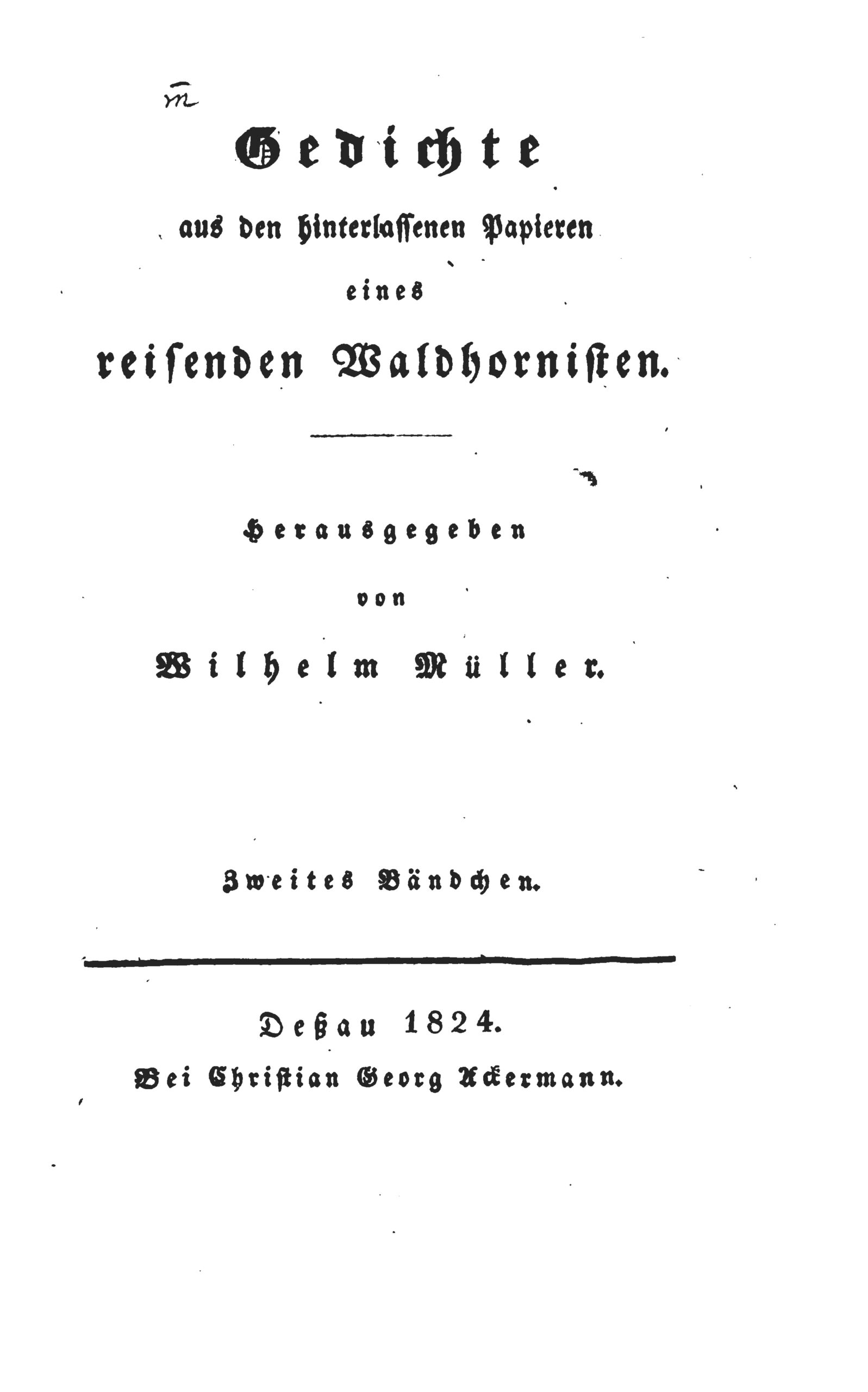
Before Schubert transformed Winterreise into music, it existed as a literary cycle. Wilhelm Müller published the poems in 1823/24 in two installments under the title Winterreise. They belong among the most haunting examples of late Romantic poetry of the soul and of nature and form the indispensable textual foundation for Schubert’s later song cycle.
Yet these poems are far more than material for music. Müller’s Winterreise is an autonomous poetic work: clear in language, radical in perspective, simple in tone and yet of great inner complexity. It is precisely this tension between simplicity and abyssal depth that makes the cycle so fascinating to this day.
When and How Did Müller’s Winterreise Originate?
Wilhelm Müller wrote the poems of Winterreise between 1821 and 1823. At first, twelve poems appeared in 1823 in the literary journal Urania. In 1824, the complete collection of 24 poems followed in book form.
The work therefore extended over roughly two years — considerably longer than Schubert’s later composition. Müller was not working from a single flash of inspiration, but gradually shaped a self-contained poetic cycle.
This development is important: Winterreise did not grow by chance, but was built as literature. Its stations may appear like spontaneous utterances of the soul, but in truth they are carefully arranged. This gives the cycle the inner consistency that still makes it seem so compelling today.
Why Did Müller Write Winterreise?
Müller saw himself as a poet of the simple tone of folk song. He wanted to find a language that would act immediately, without elaborate rhetoric. Winterreise arose from the desire to create a modern form of the Romantic poem of the wanderer and the outsider.
Politically, Müller lived in the Restoration era after the Congress of Vienna. Censorship, social constriction, and disappointed ideals of freedom shaped the outlook of many young intellectuals. The figure of the homeless wanderer, withdrawing from society, thus became the symbol of an entire generation.
Winterreise is therefore not only a cycle about love. It is also a work about alienation, about the loss of belonging, and about the breakdown of the bond between the individual and the world.
Winterreise in the Romantic Spirit of the Age
Müller’s cycle stands at the center of late Romanticism. Typical motifs of the age run through the poems: the solitary wanderer as a counter-image to bourgeois order, nature as a mirror of inner experience, night, winter, and darkness as landscapes of the soul, together with distance, homelessness, and alienation.
Unlike earlier Romantic conceptions, however, Müller’s winter landscape no longer offers reconciliation. Nature is not consoling, but cold, indifferent, or threatening. The wanderer’s path does not lead into a higher harmony, but into increasing abandonment.
In precisely this respect, Winterreise marks a transition: from Romantic longing to a literature that already points toward existential modernity. The poems still live from Romantic motifs — but they no longer use them to create unity, but to show its loss.
The Open Imagery of Müller’s Winterreise
The greatness of Müller’s poetry lies not only in its themes, but in its distinctive imagery. Snow, ice, path, night, wind, village, crow, signpost, or hurdy-gurdy man are never merely decorative motifs. They carry meaning — but that meaning remains open.
Winter is a season and at the same time a state of soul. The path is movement through a landscape and at the same time an inner path. The village is a real place and a symbol of a community from which the wanderer remains excluded. It is precisely this openness that keeps the poems permanently readable.
Müller’s language seems simple, almost like folk song, and for that very reason its semantic depth is easily underestimated. The images do not merely name something, but open up a field of meaning. I describe in more detail how such open signs function in song in the foundational article The Semiotics of Song.
For that reason, the poems are not psychological protocols, but poetic forms of experience. They show loss of love, estrangement, loneliness, and crisis of meaning not as concepts, but as images that continue to work within the reader.
Autobiographical Confession or Literary Fiction?
The question whether Winterreise is autobiographical has often been raised. Müller himself never claimed this. There is no evidence of a concrete personal experience that directly underlies the cycle.
Instead, it is a matter of literary fiction: a consciously shaped figure of the wanderer, who exemplarily embodies human alienation, loss of love, and the search for meaning.
And yet experiences typical of the age do flow into it: unfulfilled love, social constriction, political resignation. The strength of the cycle lies precisely in the fact that it feels individual without being tied to a specific biography.
Precisely in this way it remains open. The wanderer is not fully explained, not psychologically completed, and not historically dissolved. He remains at once a figure and a possibility.
Why Every Age Reads Its Own Winterreise
The enduring impact of Müller’s Winterreise rests not only on its linguistic force, but on its openness. The cycle does not fix its meaning once and for all. It remains readable for different eras, different experiences, and different inner states.
Thus the wanderer may appear as a figure of unhappy love, as an image of social alienation, as a symbol of emotional lostness, as an expression of political resignation, or as an existential boundary figure. None of these interpretations is arbitrary — but none exhausts the work completely.
It is precisely this productive openness that keeps great art enduringly alive. It speaks to people not because it explains everything clearly, but because it creates space for inner participation. More on this in the article Art That Continues to Work.
In this way every age reads its own Winterreise — not because the text is arbitrary, but because its images are open enough to enter ever anew into relationship with human experience.
The Literary Source of a Musical World Heritage
Müller’s Winterreise is not a mere song text, but an autonomous poetic work. Its clear language, its radical inward perspective, and its dark natural metaphoric created a literary form that Schubert could later transform into music of unique depth.
Only in conjunction with Schubert’s composition did the cycle become world-famous. Yet its literary quality was present from the beginning. Without Müller’s precise, concentrated, and at the same time open poetry, that musical expansion would hardly have been conceivable.
Anyone who wishes to understand why Schubert’s Winterreise appears so radical and so modern must therefore return to Müller. For the depth of the music begins already in the depth of the text.
A Poetic Work of Enduring Modernity
Wilhelm Müller’s Winterreise is far more than the prehistory of a famous song cycle. It is itself great literature: clear in form, relentless in consequence, and open in meaning.
It is precisely this conjunction of simplicity and abyss, of imagery and interpretive openness, of historical rootedness and timelessness, that makes the cycle feel so present even today.
Winterreise therefore remains modern because it does not relieve its readers. It offers no final answer. But it gives form to experiences of loss, estrangement, and inner homelessness that people still know today.
Therein lies its greatness: it is Romantic literature — and at the same time a work that points far beyond Romanticism.