“Rast” is song no. 10 from Franz Schubert’s Winterreise D 911 (1827), after Wilhelm Müller. After the flickering Will-o’-the-Wisp, the wanderer seems to find rest in the charcoal burner’s hut – yet only in stillness do fatigue, wounds and the restless heart make themselves felt.
Schubert draws a muted, through-composed chamber scene in C minor with a faltering pulse. The apparent repose heals nothing; it merely lays bare the inner burning. Precisely for that reason, Rast becomes a key song of Winterreise: rest appears not as redemption, but as an intensifier of pain.
The poem (Wilhelm Müller – printed original edition of 1824)
From: Winterreise – Song X
Nun merk’ ich erst, wie müd ich bin,
da ich zur Ruh’ mich lege;
das Wandern hielt mich munter hin
auf unwirtbarem Wege.
Only now do I truly feel how weary I am,
now that I lie down to rest;
wandering had kept me alert
on that inhospitable road.
Die Füße frugen nicht nach Rast,
es war zu kalt zum Stehen;
der Rücken fühlte keine Last,
der Sturm half fort mich wehen.
My feet did not ask for rest,
it was too cold to stand still;
my back felt no burden,
the storm helped blow me onward.
In eines Köhlers engem Haus
hab’ Obdach ich gefunden;
doch meine Glieder ruh’n nicht aus:
so brennen ihre Wunden.
In a charcoal burner’s narrow hut
I have found shelter;
yet my limbs will not come to rest:
so fiercely their wounds burn.
Auch du, mein Herz, in Kampf und Sturm,
so wild und so verwegen,
fühlst in der Still’ erst deinen Wurm
mit heißem Stich sich regen!
You too, my heart, in struggle and storm,
so wild and so daring,
only in stillness do you feel your worm
stirring with its hot sting!
Work data & overview
- Composer: Franz Schubert (1797–1828)
- Cycle: Winterreise D 911, No. 10 (Rast)
- Text source: Wilhelm Müller, Winterreise (1823/24)
- Composition: 1827; first print 1828 (Part I)
- Tonal space / metre / tempo: C minor, 2/4, slow, sustained
- Duration: approx. 2:30–3:30 minutes
- Scoring: Voice and piano (transpositions common)
- Form: through-composed; episodic illumination of the four stanzas
Data on the poem
- Author: Wilhelm Müller (1794–1827)
- Stanza form: 4 quatrains; cross rhyme
- Devices: antithesis of motion and rest, bodily metaphorics, personification of the heart, the charcoal burner’s hut as symbolic place
Genesis & cycle context
After Will-o’-the-Wisp, the cycle comes to a real halt for the first time. Outer movement falls away – and precisely בכך the inner world becomes audible. Rast shows that wandering in Winterreise is not merely a change of place, but also a form of numbing.
The charcoal burner’s hut is not a place of homecoming, but a provisional shelter. Darkness and confinement stand in contrast to the winter landscape outside, yet they create no redemption. Psychologically, the song shifts from the body to the wounds of the heart.
More on the broader context in the Winterreise – Overview and on its psychological depth in the article Winterreise as a journey into the abyss of the soul.
Performance practice & reception
Pulse & diction: calm, sustained pulse; close to the text and with clear caesuras. This is not about grand lament, but about the sober recognition of pain. Weariness sounds matter-of-fact – and therefore all the more penetrating.
Piano texture: muted chordal fields and short figures like faltering breath. Pedal sparing, colour matte. On words such as “burn” or “wounds”, the warmth may gently intensify, without losing the underlying coolness.
Historical reference interpreters
- Dietrich Fischer-Dieskau – baritone
- Hermann Prey – baritone
Current interpreters with whom I collaborate
Analysis – music
Faltering pulse & “wound” gesture
The music avoids flow. Short phrases, resting points and recitative-like cuts make rest appear not as relaxation, but as faltering breath. Precisely the interruption becomes a musical sign here.
On words such as “burn” and “wounds”, inner zones of heat arise within an otherwise cool environment. The song works with open semantics: rest means not peace, but exposure. How music opens up such contradictory spaces of meaning I explain in the introductory article The semiotics of song.
Harmony, form & interior perspective
Within the field of C minor, small side-steps open intimate niches. The four stanzas seem like four interior cameras focusing on weariness, body and heart. The ending does not soothe – it recognises: only silence makes pain audible.
Visual representation
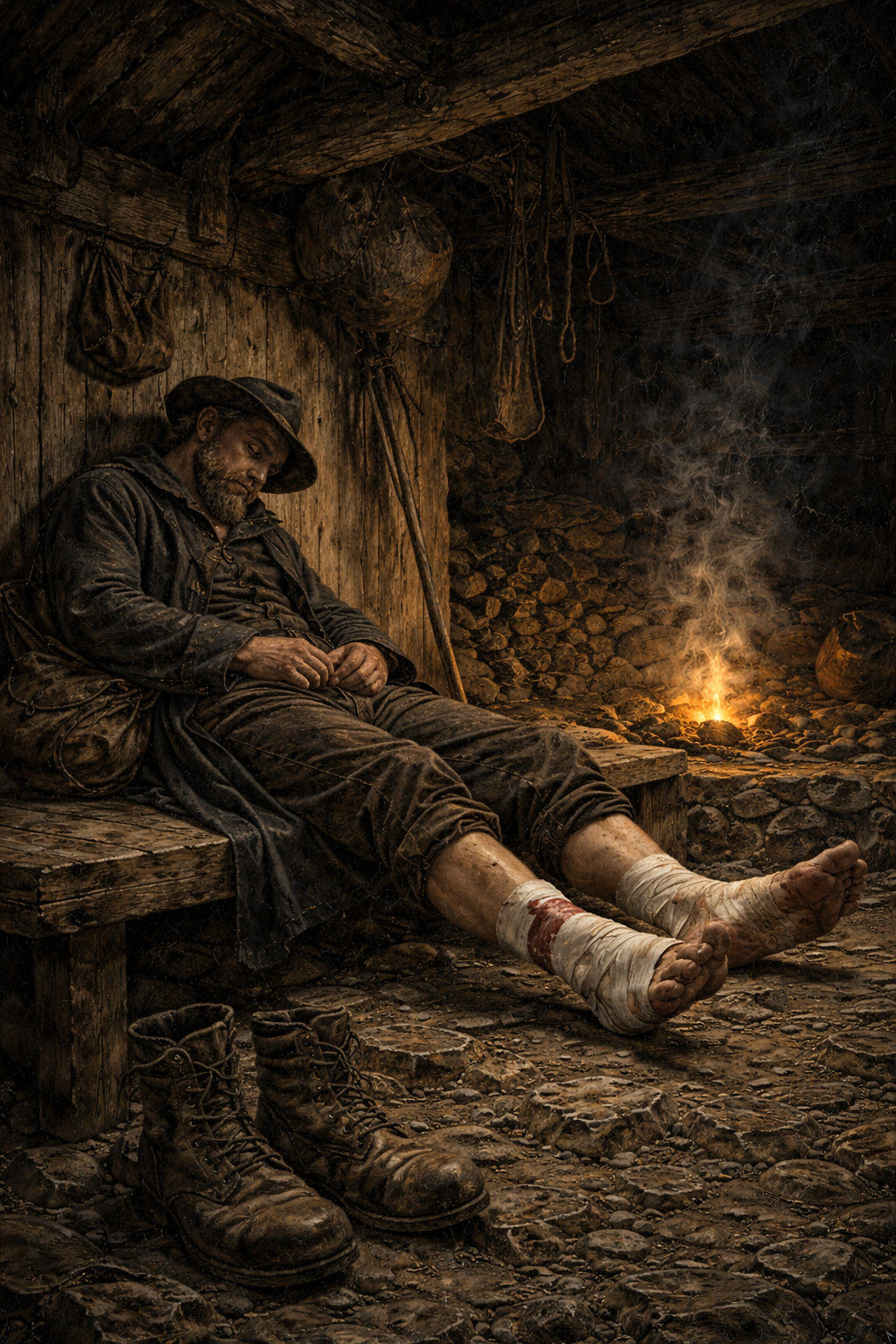
Artistic visualisation by Evgenia Foelsche:
The weary wanderer has found refuge in a simple hut.
Beside a warming fire he sits exhausted, his boots pulled off.
For the first time, his journey comes to a standstill.
His feet are dirty, bandaged – and through the layers of cloth red blood glimmers.
The wounds inflicted by the march now become visible.
The image makes clear what the song describes:
only in rest does pain break forth.
As long as the wanderer kept walking, movement drove him onward and let him step beyond his suffering.
But in pausing, sensation returns.
The warmth of the fire does not soothe – it is what first makes the injuries conscious.
The contrast between outward shelter and inner pain is central.
The hut seems a place of protection, yet it offers no true healing.
The fire illumines the room, while the bandaged feet speak of the cost of the road.
Thus rest becomes visible not as peace,
but as a moment of confrontation:
with one’s own body, with exhaustion, and with the pain
that movement had previously covered over.
Analysis – poetry
The poem “Rast” describes a paradoxical stillness. Only in stopping does the wanderer become aware of what movement had concealed until now: weariness, pain and inner injury. Rest is here not a goal, but an ordeal.
Nun merk’ ich erst, wie müd ich bin,
da ich zur Ruh’ mich lege;
das Wandern hielt mich munter hin
auf unwirtbarem Wege.
The first stanza formulates the central insight: movement has a numbing effect. As long as the wanderer keeps going, wandering itself keeps him “alert”. Weariness is therefore not an immediate feeling, but a delayed recognition.
Die Füße frugen nicht nach Rast,
es war zu kalt zum Stehen;
der Rücken fühlte keine Last,
der Sturm half fort mich wehen.
Here, walking appears as a condition of compulsion. Not resolve, but cold and storm drive the wanderer onward. The body functions almost mechanically. Precisely thereby it becomes visible: pain had not vanished, it had merely been overlaid.
In eines Köhlers engem Haus
hab’ Obdach ich gefunden;
doch meine Glieder ruh’n nicht aus:
so brennen ihre Wunden.
Shelter promises protection, yet does not fulfil the promise. The narrowness of the hut stands in contrast to the openness of the road, without offering any true sense of security. Only now do the wounds emerge. Rest lays pain bare instead of relieving it.
Auch du, mein Herz, in Kampf und Sturm,
so wild und so verwegen,
fühlst in der Still’ erst deinen Wurm
mit heißem Stich sich regen!
In the final stanza, the bodily experience is transferred to the heart. The image of the worm shows an inner suffering that remained concealed amid storm and struggle. Stillness here means psychic self-confrontation. Rest brings no healing, but first makes the wound palpable.
“Rast” thus reveals a central paradox of Winterreise: it is not walking that is painful, but stopping. Movement protects – for a moment – against perceiving what is truly wounded.
Meaning & effect within the cycle
“Rast” marks a decisive psychological turning point within Winterreise. After the misguidance of Will-o’-the-Wisp, it becomes clear here that movement fulfils a protective function. Walking prevents perception; stopping compels it.
The song thus establishes a fundamental paradox of the cycle: rest means not healing, but intensification. The wanderer learns that he cannot escape pain by standing still. Precisely for that reason, the journey must continue.
And precisely because this song unmasks rest as deceptive, it continues to work. More on this in the article Art that continues to work.
Evgenia Fölsche – performances & audio
Pianist Evgenia Fölsche shapes “Rast” as a restrained interior piece: a muted palette of colour, clear breathing caesuras, a line close to speech. The pain glows – it never blazes.
Listening example: Rast with Dietrich Fischer-Dieskau and Gerald Moore
Winterreise for your concert programme
Winterreise by Franz Schubert belongs to Evgenia Fölsche’s lied repertoire and can be realised in different performance formats. Depending on the occasion, venue and artistic concept, various scorings and forms are possible.
Possible formats include performances with different voice types from soprano to bass, versions with choir, with images, or in staged form. An overview of the formats, scorings and artistic possibilities can be found on the concert page for Winterreise.
Go to the Winterreise concert pageFrequently asked questions about Schubert: “Rast” (Winterreise No. 10)
Click on a question to display the answer.
Is “Rast” strophic?
The setting is through-composed; each of the four stanzas receives its own musical illumination.
Which key and metre are typical?
C minor in 2/4, slow and sustained; transpositions are common.
How does one show the “burning of the wounds” musically?
With small inward crescendi, denser legato, and a minimal warming of colour – without abandoning the calm basic pulse.