“Whither must I wander?” forms the emotional centre of Ralph Vaughan Williams’s cycle Songs of Travel after Robert Louis Stevenson (c. 1901–1904). The wanderer looks back on childhood, home, and vanished joy — nostalgia without sentimentality, carried by a melody close to folk song. Vaughan Williams composes a broadly breathing lament in a quiet tread: strophic design, modal colouring, clear prosody — memory as a stance.
Work Data & Overview
- Composer: Ralph Vaughan Williams (1872–1958)
- Cycle: Songs of Travel – No. 7 Whither must I wander?
- Text source: Robert Louis Stevenson, Songs of Travel (1896)
- Composition: c. 1901–1904; published in 1904 (piano version), later orchestration authorised
- Range / Metre / Tempo: major foundation with minor shading, 4/4; Andante semplice
- Duration: approx. 3–4 minutes
- Scoring: voice and piano (transpositions are common); orchestral version also exists
- Form: strophic with recurring refrain formula (“Home no more…”)
Origin & Cycle Context
Within the dramaturgical arc of Songs of Travel, “Whither must I wander?” stands, after the cosmic stillness of The Infinite Shining Heavens, as an earthly return: from stellar vastness to longing for home. The song captures the British folk-song tradition in a melody that is simple yet deeply shaded — a quiet memento of childhood.
The Poem (Robert Louis Stevenson / Ralph Vaughan Williams – Original)
From: Songs of Travel – No. 7
Original Text (English)
Home no more home to me, whither must I wander?
Hunger my driver, I go where I must.
Cold blows the winter wind over hill and heather:
Thick drives the rain and my roof is in the dust.
Loved of wise men was the shade of my roof-tree,
The true word of welcome was spoken in the door—
Dear days of old with the faces in the firelight,
Kind folks of old, you come again no more.
Home was home then, my dear, full of kindly faces,
Home was home then, my dear, happy for the child.
Fire and the windows bright glittered on the moorland;
Song, tuneful song, built a palace in the wild.
Now when day dawns on the brow of the moorland,
Lone stands the house, and the chimney-stone is cold.
Lone let it stand, now the friends are all departed,
The kind hearts, the true hearts, that loved the place of old.
Spring shall come, come again, calling up the moorfowl,
Spring shall bring the sun and rain, bring the bees and flowers;
Red shall the heather bloom over hill and valley,
Soft flow the stream through the even-flowing hours.
Fair the day shine as it shone on my childhood—
Fair shine the day on the house with open door;
Birds come and cry there and twitter in the chimney—
But I go for ever and come again no more.
Text: Robert Louis Stevenson (1850–1894), in the song version used by Ralph Vaughan Williams for Songs of Travel, public domain.
Note: The text of “Whither Must I Wander?” does not simply follow a single poem by Robert Louis Stevenson. Rather, Vaughan Williams selected lines from different Stevenson texts and shaped them into an independent song version for the cycle.
Performance Practice & Reception
Voice: Speech-near, natural line; consonants clear, vowels calmly sustained. No operatic gesture — tell, do not declaim. Refrain lines should feel inward rather than loud.
Piano: Simple, sustaining chordal motion; the bass as a quiet tread. Transparent pedal, so that the text always remains foremost. Local brightening through colour — without excessive rubato.
Reception: One of the best-known songs of the cycle; often performed as a stand-alone piece and valued in both versions (piano and orchestra).
Reference Recordings (Selection)
- Bryn Terfel – Malcolm Martineau
- Gerald Finley – Julius Drake
- Sir Thomas Allen – Roger Vignoles
- Roderick Williams – Iain Burnside
Analysis – Music
Strophic Design & Refrain Formula
The strophic layout creates narrative calm. The recurring refrain formula (“Home no more, home no more…”) forms the fixed point: each return sounds quieter, more clarified — a ritornello of memory.
Major-Minor Shading & Modal Tone
The melody moves between major brightness and minor darkening, often with modal (Mixolydian) inflections. The effect is distinctly “English”: bright without brilliance, sad without tears — a restrained dignity.
Visual Representation
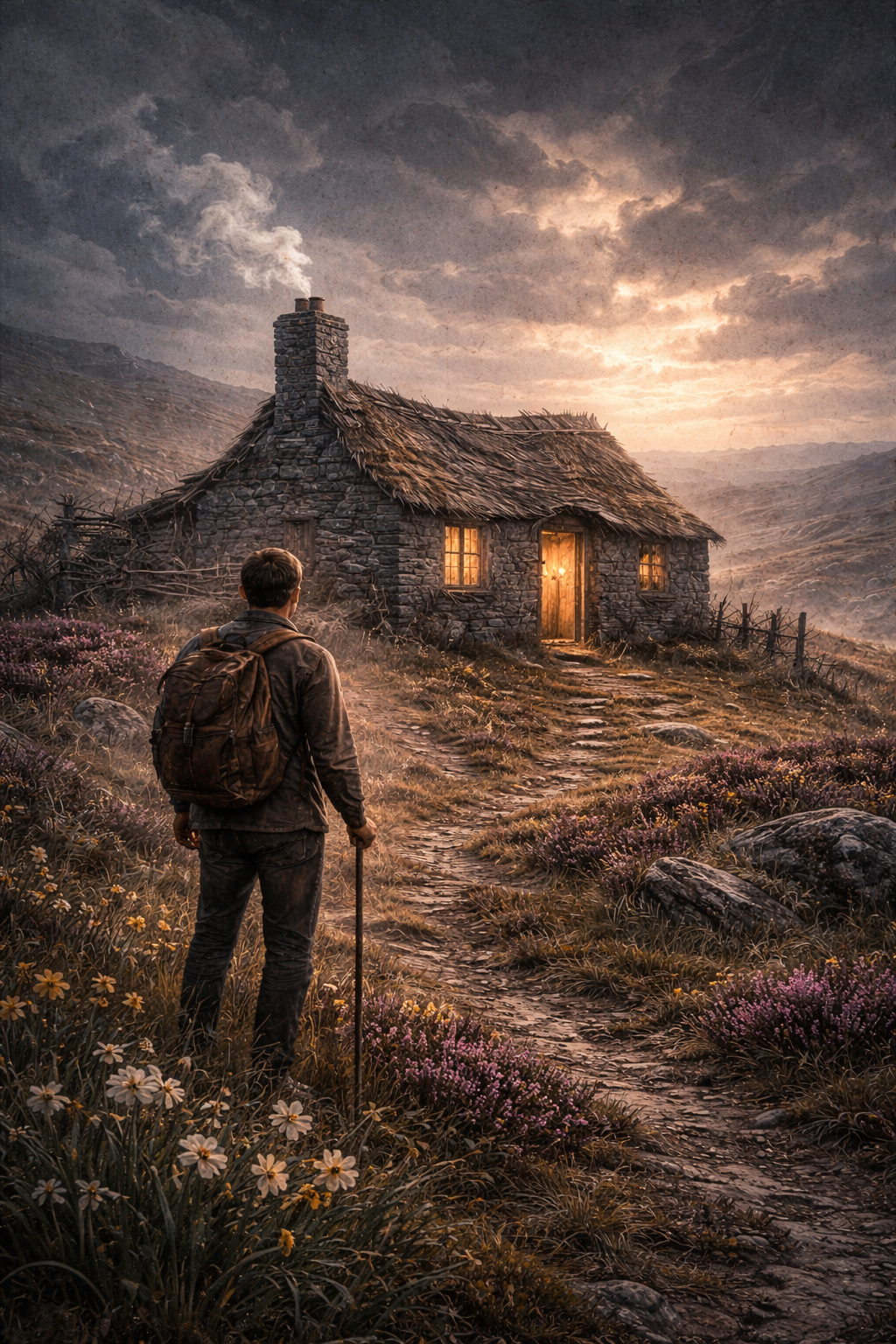
Artistic visualisation by Evgenia Fölsche:
A solitary wanderer stands on a narrow path amid a wide moorland
and looks toward a small house that seems to embody a place
of former shelter. The warm light from door and windows
stands out clearly against the harsh, open surroundings
and makes visible that home is experienced here less
as a real place than as a memory.
In this way, the image takes up the core of the song:
the tension between lost home and irrevocable farewell.
The wanderer stands before the house, but not within it —
he looks back without being able to return.
It is precisely this distance that gives the scene
its quiet melancholy.
The image also suits the music beautifully.
Vaughan Williams combines simple, folk-like lines
with deep wistfulness.
Like the music, the image feels not dramatic,
but calm and gathered:
a quiet moment of remembering a place
that remains inwardly alive and yet is lost.
Analysis – Poetry
“Whither Must I Wander?” belongs among the most poignant texts of home and loss in the cycle. Unlike the earlier songs, in which wandering appears as freedom or inward expansion, wandering is here experienced as the consequence of uprootedness. The speaking self is no longer on the road by free decision, but because it no longer has a home. The movement of the wanderer thus stands under the sign of need, memory, and irretrievable loss. At the same time, the full song text expands this situation into a deeper retrospect on childhood, community, and nature — and into the recognition that the world continues, even when the speaker himself no longer has a place within it.
Homelessness as Point of Departure
Home no more home to me,
Whither must I wander?
Hunger my driver, I go where I must.
Right from the beginning, the speaker formulates his condition with great sharpness. Home is not merely left behind, but definitively lost. The question “Whither must I wander?” sounds not like departure or adventure, but like disorientation. Especially harsh is the phrase “Hunger my driver.” It is not longing or freedom that drives the wanderer onward, but the compulsion of necessity. Wandering is here not a romantic ideal, but an existential necessity.
The Destroyed Home
Cold blows the winter wind
Over hill and heather;
Thick drives the rain,
And my roof is in the dust.
In this stanza, the landscape appears as a harsh and unprotected space. Winter wind, rain, and the barren heath underline the wanderer’s exposure. Especially striking is the image of the ruined house: “my roof is in the dust.” The roof, symbol of shelter and protection, has turned to dust. In this way, the loss of home is radicalised — there is no place left to which one might return.
Memory of the Old House
Loved of wise men was the shade of my roof-tree,
The true word of welcome was spoken in the door.
After describing the present, the gaze turns backward. The former house appears as a place of meeting and hospitality. The “shade of my roof-tree” stands not only for the building itself, but for the sheltering space of human community. The words of welcome at the door recall that home means more than possession: it consists in relationships, trust, and social nearness.
Childhood and Lost Shelter
Home was home then, my dear,
Full of kindly faces,
Happy for the child.
The second major stanza deepens the memory by describing the past as a time of childhood. The house was filled with kindly faces and with an atmosphere of protection. The image of bright windows and the fire within the house evokes warmth and community. Particularly characteristic is the phrase that song “built a palace in the wild.” This makes clear that security lay not only in the building, but in the shared life of the people within it.
The present stands in sharp contrast to this. The house now stands deserted on the moor, the chimney is cold, and the people who once gave the place life have vanished. Home thus becomes a space of memory which lives on inwardly, but no longer exists outwardly.
Nature Remains – the Human Being Departs
Spring shall come again,
Red shall the heather bloom,
Soft flow the stream.
In the final stanza, the perspective broadens from personal memory to nature. Spring will return, the heather will bloom, and the stream will continue to flow gently. These images establish a profound contrast: while human life is transient, the rhythm of nature continues unceasingly.
Precisely here lies a quiet tragedy. The landscape in which the speaker lived his childhood remains, but he himself no longer belongs to it. The house may still stand, the birds may twitter in the chimney, but the community of former days is gone.
The Final Farewell
But I go for ever
And come again no more.
The close of the song is marked by great simplicity and at the same time by final clarity. The wanderer leaves the place of his origin forever. The world remains, nature renews itself, but his own life-path leads onward and does not return.
Thus, wandering acquires a double meaning. On the one hand, it is the consequence of loss and homelessness; on the other, it is also the only possible form of continuing to live. The speaker cannot retrieve the past — he can only go on.
Meaning & Effect
At the centre of the song text lies the experience that home is not merely a place, but a weave of memory, community, and lived time. Once the people vanish who gave a place its meaning, the landscape may remain, but home itself is lost.
At the same time, the text places human life within the larger frame of nature. Spring, flowers, birds, and flowing water renew themselves again and again. The world remains beautiful and alive — even without the human being who was once part of it.
The power of the song lies in this conjunction of personal memory and universal time. The language remains plain and folk-like, yet precisely for that reason a deep melancholy emerges. “Whither Must I Wander?” is therefore a song of farewell: the wanderer looks back once more toward the lost home, recognises that the past cannot be recovered, and finally goes on — alone, yet with the consciousness of a life that has been lived.
Evgenia Fölsche – Performances & Audio
Evgenia Fölsche keeps the tempo calm and the tone simple: text in the foreground, sound warm, without pressure. The refrain returns sinking into quietness — a dignified backward glance of farewell.
FAQ – Vaughan Williams: “Whither must I wander?” (Songs of Travel No. 7)
Click on a question to reveal the answer.
Is the song strophic?
Yes — clearly strophic, with a recurring refrain formula; fine variations occur in dynamics and harmonic colouring.
Which voice types are suitable?
Traditionally baritone within the cycle; in transposition also tenor or mezzo-soprano/contralto. What matters is speech-near simplicity and a sustainable quiet tone.
How does it differ from “The Vagabond”?
The Vagabond affirms departure with march pulse; Whither must I wander? looks quietly backward — folk-song tone instead of march, memory instead of resolve.