“Youth and Love” is the fourth song in Ralph Vaughan Williams’s cycle Songs of Travel after Robert Louis Stevenson (1901–1904). It marks a turning point: the wandering speaker looks back on lost youth and love — not bitterly, but wistfully. The music moves between major and minor, motion and stillness, as a reflection of a farewell that also implies freedom.
The Poem (Robert Louis Stevenson – Original)
From: Songs of Travel and Other Verses (1896) – No. 4
Original (English):
When the youth moves out of the door,
When the love goes down to the river,
When the years are heavy and sore,
And the spring-time comes never more,
Oh, what shall deliver?
When the days are heavy with care,
And the night is weary with sighing,
When the lips have nothing to dare,
And the heart has forgotten to share,
What end but dying?
Text: Robert Louis Stevenson (1850–1894), public domain.
Work Data & Overview
- Composer: Ralph Vaughan Williams (1872–1958)
- Cycle: Songs of Travel – No. 4 Youth and Love
- Text source: Robert Louis Stevenson, Songs of Travel (1896)
- Composition: c. 1901–1904; published in 1904 (piano version), later orchestration authorised
- Range / Metre / Tempo: alternation between major and minor, 6/8 and 3/4; Andante con moto
- Duration: approx. 3–4 minutes
- Scoring: voice and piano (also orchestrated)
- Form: through-composed, free structure with refrain-like suggestions
Origin & Cycle Context
With Youth and Love, Vaughan Williams slows the flow of the cycle. After the brighter early songs comes a reflection on transience. The piece combines floating lyricism with resigned clarity — a kind of “adagio” within the cycle, inwardly marking the farewell to youth.
Performance Practice & Reception
Voice: restrained intensity, inward movement rather than pathos. Lines should be softly shaped, breath arches broad. Clarity of text remains central.
Piano: soft arpeggios, delicate inner motion; more a field of sound than mere accompaniment. Harmonic turns should be coloured with restraint and subtlety.
Reception: less often performed as a stand-alone song, but within the cycle a point of repose with deep melancholy; often contrasted with Whither must I wander?
Reference Recordings (Selection)
- Gerald Finley – Julius Drake
- Sir Thomas Allen – Roger Vignoles
- Roderick Williams – Iain Burnside
- Bryn Terfel – Malcolm Martineau
Analysis – Music
Between Major and Minor: The Colour of Memory
The harmony oscillates between luminous major areas and gentle turns into minor — a musical symbol of memory and loss. Modal inflections lend the sadness a folk-like naturalness.
Flowing Pulse & Gesture of Retrospection
The pulse remains calm, almost wave-like. Brief melodic ascents that quickly withdraw create the impression of a gesture of reflection. The song fades in gentle minor — without a fully closed cadence, open like memory itself.
Visual Representation
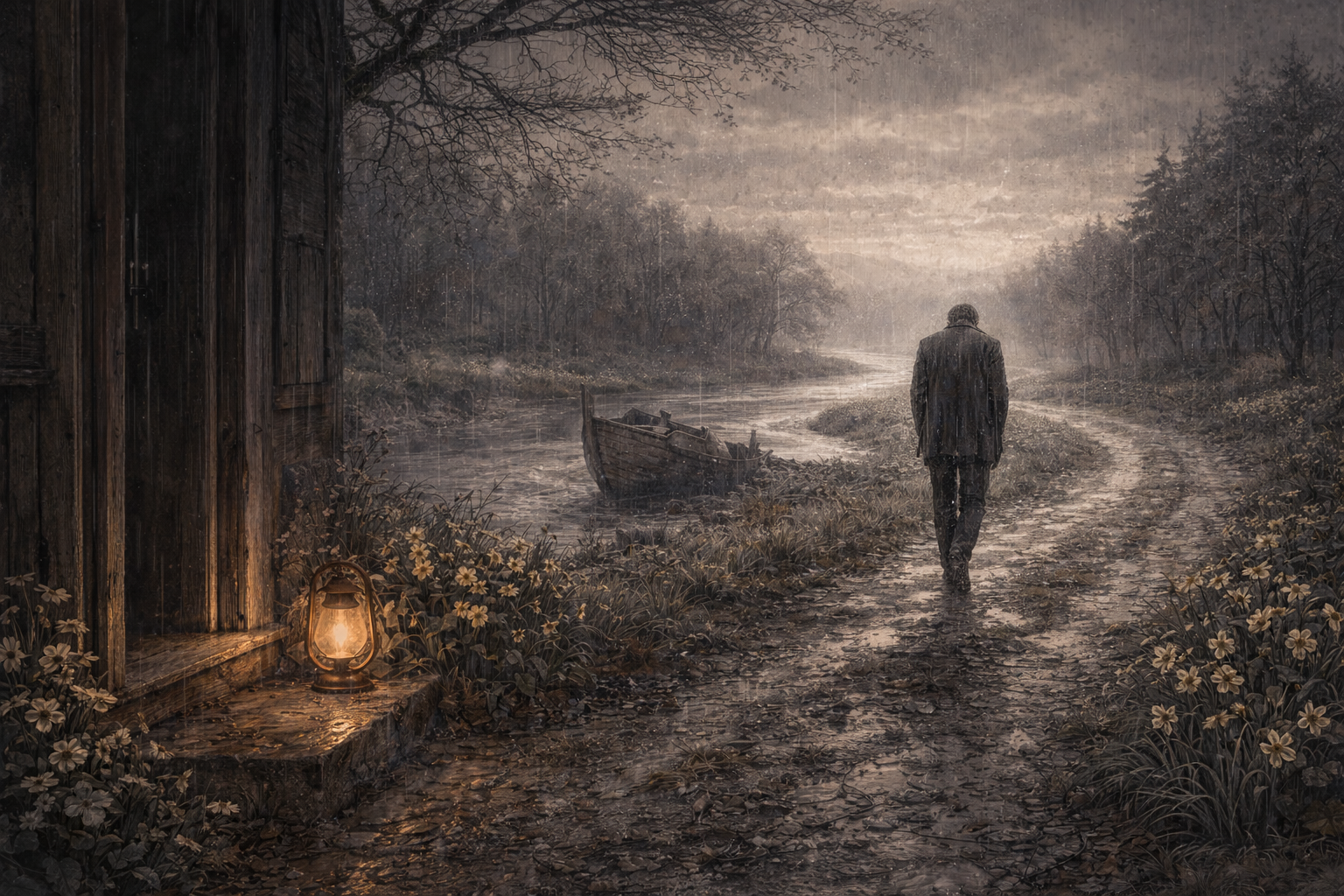
Artistic visualisation by Evgenia Fölsche:
A solitary wanderer walks along a rain-soaked road, moving away
from a bright house and toward a distant river. The landscape
is grey, wet, and silent; light and warmth remain behind him,
while before him there is only distance, cold, and uncertainty.
The image thus conveys the sense of a farewell that is not only
spatial, but inwardly enacted.
In this way, the image directly takes up central motifs of the song:
youth and love appear as forces departing from life, while care,
weariness, and loss remain behind. The road toward the river
and the movement away from the open door give the text
a clear visible shape and make the character of the song
as a lament for what has passed especially vivid.
The image also corresponds closely to the music. Vaughan Williams
shapes the song quietly, weightily, and with a restrained
melancholy. Like the music, the image feels not dramatic,
but serious and exhausted — a silent walk out of warmth
and nearness into a landscape of loss.
Analysis – Poetry
The poem “Youth and Love” belongs among the quieter and more inwardly turned texts of the cycle. It is shaped by an awareness of loss, by weariness, and by resignation, and marks a distinct change of mood. No longer are departure, delight in nature, or the vision of love at the centre; rather, the poem looks toward what has vanished: youth and love are gone, and with them the lightness of being has also disappeared. The poem therefore asks not about new possibilities, but about deliverance in the face of exhaustion and inner impoverishment.
Youth and Love as Lost Forces
When the youth moves out of the door,
When the love goes down to the river,
When the years are heavy and sore,
And the spring-time comes never more,
Oh, what shall deliver?
Right at the beginning, the poem unfolds a sequence of images of loss. Youth “moves out of the door”: it departs like a figure leaving the house and never returning. Love, too, withdraws as it goes “down to the river.” The image of the river intensifies the sense of slipping away and of irreversibility: what has once been set in motion can no longer be held back. Youth and love thus appear not as abstract ideas, but as living powers departing from life.
At the same time, time itself is experienced as a burden. The years are “heavy and sore,” weighted with pain. With the phrase that spring “comes never more,” loss acquires an existential dimension. Spring stands here for renewal, vitality, and hope; its absence means that inward regeneration has failed. The closing question, “Oh, what shall deliver?” sounds like a cry for rescue. It remains unanswered, and gives the stanza its lamenting tone.
From Outer Burden to Inner Numbness
When the days are heavy with care,
And the night is weary with sighing,
When the lips have nothing to dare,
And the heart has forgotten to share,
What end but dying?
The second stanza intensifies the lament by extending the image of heaviness from the years to the whole of daily life. Now not only the years are heavy, but also the days, which become “heavy with care.” Everyday existence is filled with worry, the night with weariness and sighing. Life thus appears wholly permeated by exhaustion: waking and resting, day and night, are no longer distinguished by hope or consolation, but only by different forms of suffering.
Especially striking is the phrase that the lips have “nothing to dare” and that the heart has “forgotten to share.” What is described here is no longer merely sadness, but the loss of inward vitality. The lips dare nothing anymore: speech, kiss, confession, or song have fallen silent. The heart, too, has unlearned how to share; community and emotional openness are no longer possible. Life thereby loses its dialogic structure. At the end stands the dark question, “What end but dying?” — not as a dramatic outburst, but as an almost sober consequence drawn from inner desolation.
The Imagery of Vanishing
When the youth moves out of the door,
When the love goes down to the river
The central poetic power of the poem lies in its simple yet effective imagery. Youth and love are not treated theoretically, but translated into movements: outward through the door, downward to the river. Both movements lead away from the speaking self. In this way, the impression arises that life is not actively destroyed, but slowly withdraws. It is precisely this quiet form of loss that makes the poem so penetrating. It does not lament in grand pathetic images, but shows how what is essential is simply no longer there.
The contrast between spring, day, and night also contributes to this effect. Spring no longer returns, the days are full of care, the nights full of sighing. Natural time and life-time mirror one another. What outwardly might be conceived as a cycle is inwardly blocked. The poem draws much of its force from this tension between the knowledge of natural return and the experience that such return no longer applies to the speaking self.
Resignation without Consolation
Oh, what shall deliver?
...
What end but dying?
The two closing questions of the stanzas give the poem both its form and its inner movement. In the first question there still sounds the search for a possible deliverance. But the second question almost completely withdraws that openness: when the heart can no longer share and the lips no longer dare, only the end seems left. What is remarkable is that the poem offers no religious or moral consolation. It points neither toward rescue nor toward a meaning that redeems, but simply holds fast to the experience of transience in all its starkness.
For precisely this reason, the text feels so immediate. It does not heroically stylise loss, but shows it as a quiet and heavy truth. The poem speaks from a condition in which departure and hope have fallen silent. It thus marks, within the cycle, a moment of disenchantment: the wanderer is no longer only the free and unattached being, but also one who knows the finitude of his own powers.
“Youth and Love” is therefore a poem of retrospection and painful knowledge. It describes not the dramatic loss of a single instant, but the slow farewell to youth, love, and inward participation in life. In its concise, song-like language, it gains much of its force precisely through restraint.
Meaning & Effect
At the centre of the poem lies the experience that youth and love are transient, and that their loss changes the whole feeling of life. As these forces fade, time, everyday existence, and feeling grow heavier. Care, weariness, and inward numbness take the place of hope, daring, and communion. The poem thus shows how closely vitality and the capacity for relationship are linked.
The poem’s effect lies in its plain, lamenting language and in the consistency with which it refuses consolation. The images are clear and easily grasped, yet it is precisely this simplicity that makes the melancholy so penetrating. “Youth and Love” therefore feels not pathetic, but quiet, weighty, and truthful. Within the cycle it appears as a moment of retrospection and disenchantment, in which the wanderer first speaks clearly of the losses of life.
Evgenia Fölsche – Performances & Audio
Evgenia Fölsche shapes the flow calmly and with breath: soft transitions of sound, vocal restraint, harmonic radiance in the inner shades. The melancholy remains noble, never sentimental.
FAQ – Vaughan Williams: “Youth and Love” (Songs of Travel No. 4)
Click on a question to reveal the answer.
What position does “Youth and Love” occupy within the cycle?
It forms the centre of the first part of the cycle — a reflection on vanished youth before the transition toward night and dream.
What is the sonic character of the song?
Soft, warm, suspended. No harshness; modal colouring and restrained dynamics create an atmosphere of quiet remembrance.
Which version is considered definitive?
Both — piano and orchestra. The orchestration intensifies the pastoral breadth, while the piano version feels more intimate.