“Morgengruß” is Song No. 8 from Franz Schubert’s cycle Die schöne Müllerin D 795 (1823), after Wilhelm Müller. After the affective outburst of “Ungeduld”, the mood turns into shy address: the journeyman stands before the miller’s daughter’s window – between hope, hurt, and the plea for a sign. Schubert shapes this tender, uncertain scene in a moderate, song-like 3/4 with a bright tone and simple strophic form.
The Poem (Wilhelm Müller – Seventy-Seven Poems from the Posthumous Papers of a Travelling French-Horn Player, 1821)
Good morning, lovely miller maid!
Why do you hide your little head at once,
As though something had happened to you?
Does my greeting vex you so much?
Does my glance disturb you so deeply?
Then I must go away again.
Oh, only let me stand far away,
Looking toward your dear window,
From afar, from very far!
You fair little head, come forth!
Come forth from your rounded gate,
You blue morning stars!
You sleep-drunken little eyes,
You dew-bedimmed little flowers,
Why do you shun the sun?
Has the night meant so well by you,
That you close yourselves and droop and weep,
For its quiet bliss?
Now shake off the veil of dreams,
And rise up fresh and free
Into God’s bright morning!
The lark whirls in the air,
And from the deep heart
Love calls sorrow and care.
Work Data & Overview
- Composer: Franz Schubert (1797–1828)
- Cycle: Die schöne Müllerin D 795, No. 8
- Text source: Wilhelm Müller, “Morgengruß” (1819/20; printed 1820/1821)
- Composition: October 1823; first published 1824
- Tonal area / meter: C major sphere (transpositions common), 3/4, moderate
- Duration: approx. 3:00–4:00 minutes
- Scoring: Voice and piano
- Form: strophic (4 six-line stanzas)
Data on the Poem
- Author: Wilhelm Müller (1794–1827)
- Stanza form: 4 stanzas of 6 lines each
- Devices: direct address, diminutives (“little eyes”), nature metaphorics (morning stars / lark), antithesis night ↔ morning
Genesis & Cycle Context
“Morgengruß” places the action before the miller’s daughter’s window: after the public confession in “Ungeduld”, we encounter a tender, uncertain address. The self seeks a sign – the answer remains unclear. Dramaturgically, the song acts like a breathing-space image before the following approaches (Des Müllers Blumen, Tränenregen).
More on the cycle (plot, work data, all song articles) can be found on the overview page: Die schöne Müllerin – Overview.
Performance Practice & Reception
Gesture & tempo: moderate, a cantilena close to speech; the piano’s quavers / crotchets remain elastic. No heaviness – it is a courteous, shy greeting.
Shifts of colour: stanzas 1–2: questioning, bright appeal; stanza 3: a slight darkening (night / tears metaphorics); stanza 4: brightening again (lark / morning) without triumph. The ending should not be “grand,” but poised.
Reference Recordings (selection)
- Dietrich Fischer-Dieskau – Gerald Moore (DG)
- Ian Bostridge – Mitsuko Uchida (Decca)
- Christoph Prégardien – Andreas Staier (fortepiano; harmonia mundi)
- Fritz Wunderlich – Hubert Giesen (Orfeo)
- Matthias Goerne – Christoph Eschenbach (Teldec)
Analysis – Music
Window Scene & Gesture of Address
The right hand traces a gentle swaying in 3/4; above it runs a syllabic, speech-like line with delicate questioning cadences. “Come forth!” receives a small point of radiance – never forced.
Strophic Design, Tonal Space & Shifts of Light
Bright basic tonal space, sparing modulations. Stanza 3 (night / dreams) is mildly shadowed; stanza 4 brightens again (lark / light) – a musical light-dark arch without pathos.
Visual Representation
Artistic visualisation by Evgenia Fölsche:
The image shows the miller lad in a quiet moment of hopeful approach.
His gaze is wholly directed toward the lovely miller’s daughter, who stands at the window
and thus appears both near and unattainable at once. In this composition,
the window becomes a threshold between inside and outside, between the world of his longing
and the distance that separates him from the beloved.
Yet the miller’s daughter pays him no attention. She looks in another direction and seems
to offer no reply to his morning greeting. It is precisely in this delicate missing of one another’s
gaze that the image finds its true meaning. The young miller lad directs
his whole feeling toward her, while she gives him no discernible attention.
Thus a quiet, painful imbalance arises between the intimacy of his
gaze and her averted posture.
Like Schubert’s music, the image combines tenderness with inward uncertainty. The
morning greeting is not triumphant courtship, but a quiet hope for reciprocation,
already carrying within it the pain of possible rejection. The bright atmosphere
of morning stands in subtle contrast to the uncertainty of the heart. What becomes visible
is what resonates in text and music: a love that speaks itself cautiously and yet
slips away against the silent remoteness of the beloved.
Analysis – Poetry
The poem “Morgengruß” stands early in the cycle Die schöne Müllerin and marks the transition from unbound wandering to the first concrete attachment. After the programmatic departure of “Wandern,” the gaze is now directed for the first time toward the miller’s daughter herself. The lyrical self addresses her directly – still without answer, still without actual encounter. The dialogue is a monologue of approach: tentative, hopeful, and at the same time marked by uncertainty.
Already the first stanza shows this double movement of greeting and withdrawal:
Good morning, lovely miller maid!
Why do you hide your little head at once,
As though something had happened to you?
Does my greeting vex you so much?
Does my glance disturb you so deeply?
Then I must go away again.
The greeting is friendly and simple – “Good morning” – yet at once comes the experience of distance: the miller’s daughter withdraws from his gaze, “hides her little head.” The lyrical self interprets this evasion as a possible sign of rejection. The final line (“Then I must go away again”) takes up the wandering motif once more: the wanderer is still at any moment ready to move on. Nearness is desired, but not demanded. This courteous self-withdrawal gives the scene its tension between hope and self-protection.
In the second stanza the situation shifts into imagery:
Oh, only let me stand far away,
Looking toward your dear window,
From afar, from very far!
You fair little head, come forth!
Come forth from your rounded gate,
You blue morning stars!
Spatial distance is explicitly named: “from afar, from very far.” The speaker contents himself with the sight from a distance. The window becomes a symbolic threshold between inner and outer world, between sheltered domesticity and open wandering. The miller’s daughter appears not as an acting person, but as an image: fair little head, blue eyes as “morning stars.” The gaze idealises – the beloved becomes part of a morning transfiguration of nature.
In the third stanza, the self no longer addresses the miller’s daughter directly, but her eyes:
You sleep-drunken little eyes,
You dew-bedimmed little flowers,
Why do you shun the sun?
Has the night meant so well by you,
That you close yourselves and droop and weep,
For its quiet bliss?
The eyes are compared to dew-laden flowers. They are still bound to the night, to dream, to inwardness. The sun – symbol of day, encounter, and consciousness – is shunned. Here, for the first time, the opposition of night and day, dream and reality appears. The wanderer interprets the miller’s daughter’s hesitation as attachment to a nocturnal, silent world. At the same time, he attributes to her a sensitivity that he himself longs for.
The fourth stanza opens the scene into the general:
Now shake off the veil of dreams,
And rise up fresh and free
Into God’s bright morning!
The lark whirls in the air,
And from the deep heart
Love calls sorrow and care.
Morning is now heightened both religiously and naturally: “God’s bright morning.” The lark, the classical herald of day, accompanies the call to awakening. Yet the final line brings a surprising turn: from the heart, love calls not only joy, but also “sorrow and care.” Thus, even at this early stage, it is suggested that awakening love promises not only happiness, but also vulnerability. In the midst of the cheerful morning, a first shadow of future conflicts appears.
Formally, the poem relies on direct address, exclamation, and imagery. The wanderer speaks without receiving an answer. In this way a lyrical one-sidedness arises that remains typical of the whole cycle: the miller’s daughter becomes the projection surface of the speaking self.
Meaning & Effect within the Cycle
“Morgengruß” marks within the cycle the first emotional contact between wanderer and miller’s daughter – though still without actual encounter. The wanderer has found a place where he wishes to remain. Free wandering becomes cautious attachment. Yet he remains uncertain and respects distance: he stands “from afar” and dares only the glance.
Leitmotifs of the whole cycle are unfolded here: the window as threshold, morning as beginning, sun as awakening, night as realm of dream. Especially important is the final line: love calls “sorrow and care.” In this way, Müller establishes early the emotional drop of the cycle. The love that is only just awakening already carries within itself the seed-sign of its later pain.
Thus, “Morgengruß” acts like a tender first attempt at contact: hopeful, idealising, and yet threaded through with uncertainty. The wanderer stands at the beginning of a relationship that is still entirely projection – and in precisely that creates the condition for later disappointment.
Evgenia Fölsche – Performances & Audio
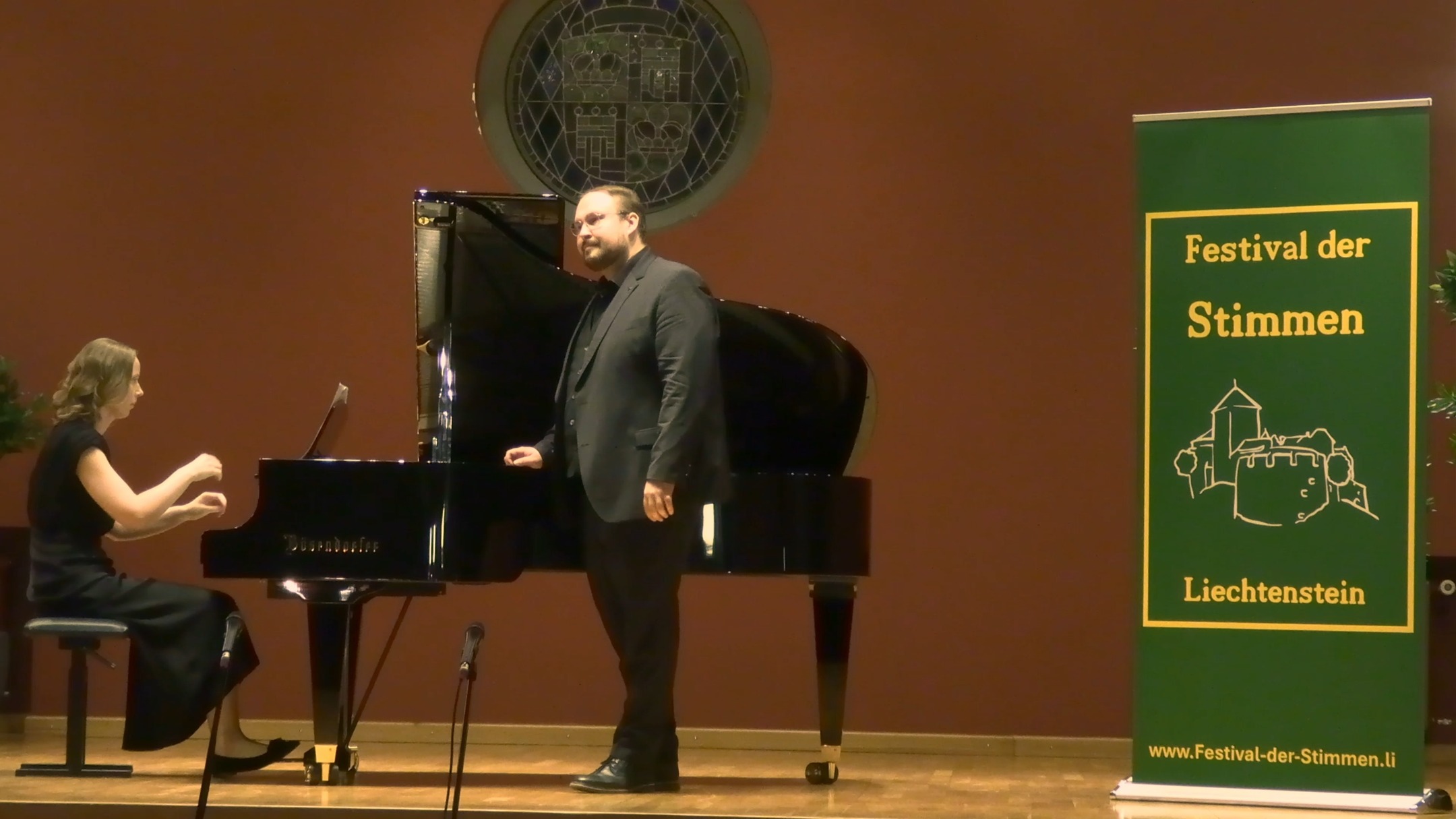
Audio example: Gerrit Illenberger, baritone, and Evgenia Fölsche, piano, at the Festival der Stimmen Liechtenstein 2025