“Eifersucht und Stolz” is song no. 15 from Franz Schubert’s cycle Die schöne Müllerin D 795 (1823), after Wilhelm Müller. After the cutting force of “Der Jäger”, the journeyman turns his emotion against the miller maid — yet he does not speak to her, but to the little brook: reproach, self-control, concealment. Schubert casts this ambivalence into a swift piece with sharp declamation, angular motor rhythm, and an interplay of G minor/G major.
The Poem (Wilhelm Müller – Seventy-Seven Poems from the Posthumous Papers of a Travelling French-Horn Player, 1821)
Why so swift, so rough, so wild, my dear brook?
Are you hurrying in anger after that insolent hunter-brother?
Turn back, turn back, and scold your miller maid first,
For her light, loose, little fluttering mind.
Did you not see her yesterday evening standing by the gate,
Stretching her neck toward the great road?
When the hunter comes home merrily from the chase,
No modest girl would stick her head out of the window.
Go, little brook, and tell her that, but do not tell her,
Do you hear, not a word, of my sorrowful face;
Tell her: he is carving himself a reed pipe beside me
and plays lovely dances and songs for the children.
Work Data & Overview
- Composer: Franz Schubert (1797–1828)
- Cycle: Die schöne Müllerin D 795, No. 15
- Text source: Wilhelm Müller, “Eifersucht und Stolz” (1817; published 1818/1821)
- Composition: October/November 1823; first published 1824
- Key area / tempo: G minor ↔ G major; performance marking Geschwind
- Metre / character: 2/4, speech-like motion with sharp accents
- Duration: approx. 1:10–1:50 minutes
- Scoring: Voice and piano (transpositions common)
- Form: one-part, declamatorily profiled scene (quasi-strophic varied periodicity)
Data on the Poem
- Author: Wilhelm Müller (1794–1827)
- Verse form: 12 lines (continuous period)
- Devices: apostrophe to the brook, imperatives, moral dictum (“modest”), formula of concealment (the reed-pipe fairy tale as façade)
Genesis & Cycle Context
The song follows directly upon “Der Jäger” and continues the arc of jealousy: the journeyman rebukes the miller maid, forbids the glance down the road (the rival’s route), and in the end disguises his “sorrowful face” — pride as mask. Within the cycle, the path leads organically on to the “green” counterpart songs “Die liebe Farbe” / “Die böse Farbe” (Nos. 16/17).
More on the cycle (content, work data, all song articles): Die schöne Müllerin – Overview.
Performance Practice & Reception
Diction & gesture: sharp and precise, not blustering. Ironical peaks (“modest”, “reed pipe”) should be clearly pointed; the closing lines need controlled nonchalance (mask).
Piano texture: dry, springing 2/4 motor rhythm; brief accent edges (no continuous pedalling). Small brightenings (flashes of major) mark the act of self-concealment.
Reference Recordings (Selection)
- Dietrich Fischer-Dieskau – Gerald Moore
- Fritz Wunderlich – Hubert Giesen
- Ian Bostridge – Mitsuko Uchida
- Christoph Prégardien – Andreas Staier (fortepiano)
- Matthias Goerne – Christoph Eschenbach
Analysis – Music
Declamation, Motor Rhythm & Mask
Schubert’s declamatory lines press imperatives, questions, and rebukes tightly together; the 2/4 motion drives forward swiftly. The turn to major in the final lines stages the façade (“reed pipe … dances and songs”) — audible self-concealment.
Form, Tonal Space & Mirror Image
G minor colours jealousy and anger; G major flashes up as a mask-like gleam. The brook’s mirror metaphor (from earlier songs) returns here: the agitated water reflects the agitated self.
Visual Representation
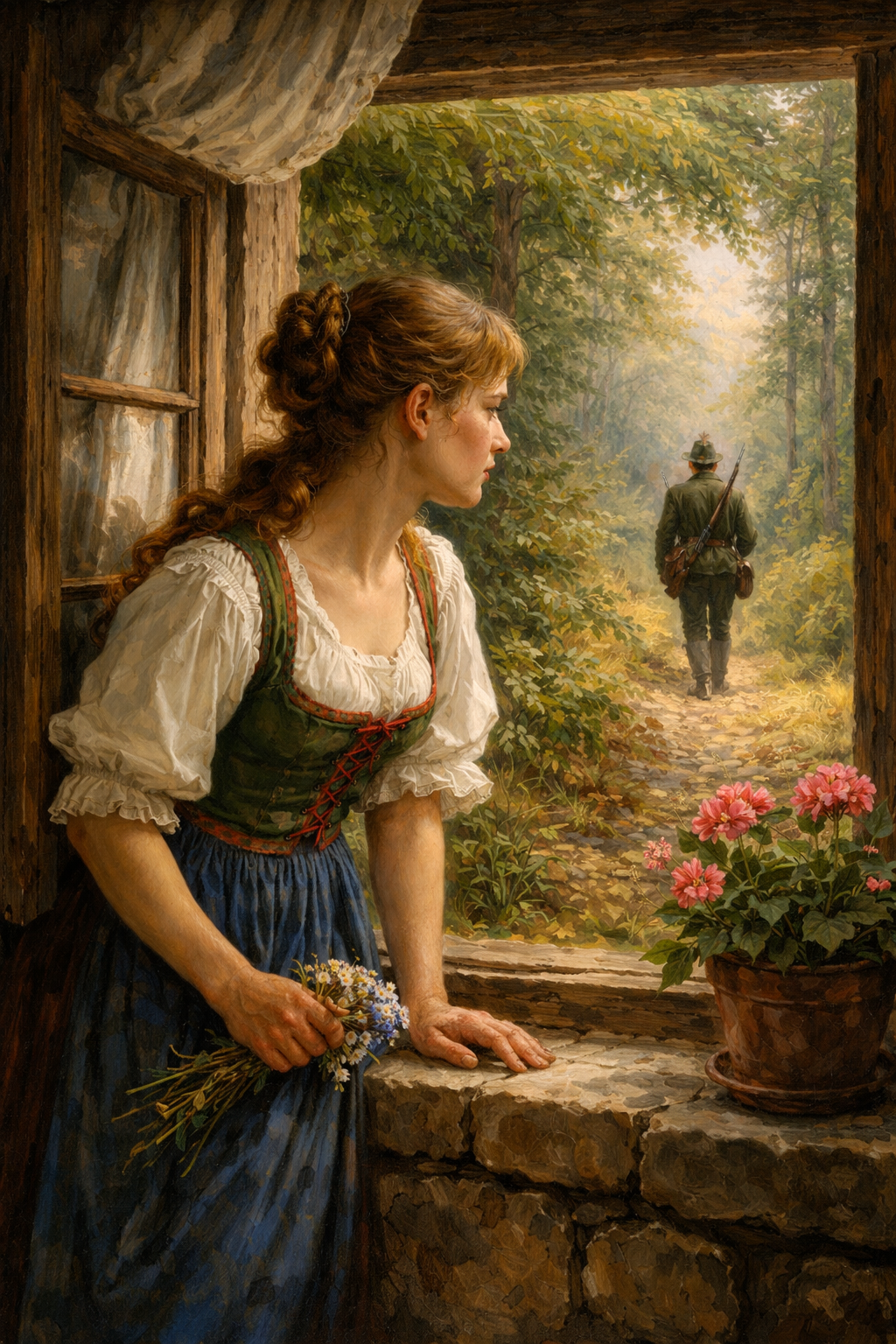
Artistic visualisation by Evgenia Foelsche:
The image shows the fair miller maid at the window, her gaze directed outward,
following the hunter with her eyes. In this simple gesture, the whole humiliation of
the young miller is condensed: her gaze follows not him, but the other man. The window
thus once again becomes a threshold where nearness and distance meet — but this time
it is no longer the lover who looks up in hope, but the miller maid herself, whose
attention has visibly turned away from him.
In this way, the image touches the bitter core of the song. Jealousy and pride stand
here in painful tension with one another. The young miller experiences the miller maid’s
turning toward the hunter as humiliation, yet his wounded pride at the same time prevents
him from simply yielding to lament. Her outward-looking gaze thus becomes a symbol of
his inner wound: in proportion as she turns toward the hunter, he must see himself
excluded from her world.
Like Schubert’s music, the image carries a nervous, agitated energy. It shows no open
scene of encounter, but rather a moment of looking after someone, all the more painful
for the young miller because it is both silent and unmistakable. In the miller maid’s
gaze the decision already lies, one from which his heart can no longer protect itself.
What becomes visible is what resonates in text and music alike: that the young miller’s
love now turns definitively into jealousy, and that his pride can only with difficulty
conceal the depth of his hurt.
Analysis – Poetry
The poem “Eifersucht und Stolz” follows directly after “Der Jäger” and shows the wanderer’s inward reversal. The outer rival has appeared, but now the conflict turns inward: jealousy, humiliation, and self-assertion overlay the earlier hope. The speaker addresses the brook — his former confidant — and tries to bring order to his turbulent feelings.
The first stanza opens with an agitated address:
Why so swift, so rough, so wild, my dear brook?
Are you hurrying in anger after that insolent hunter-brother?
Turn back, turn back, and scold your miller maid first,
For her light, loose, little fluttering mind.
The brook, hitherto a symbol of movement and companionship, now becomes a mirror of inner agitation. Its “rough, wild” movement reflects the speaker’s unrest. At the same time, the wanderer projects his anger onto the brook: it is supposed to reproach the miller maid in his place. In this way, the speaker shifts responsibility for his wound from himself onto nature and the outside world.
In the second stanza, the accusation intensifies:
Did you not see her yesterday evening standing by the gate,
Stretching her neck toward the great road?
When the hunter comes home merrily from the chase,
No modest girl would stick her head out of the window.
The wanderer watches the miller maid and interprets her curiosity as unfaithfulness. Her glance “toward the great road” becomes proof of her “fluttering mind.” In reality, he describes only an ordinary behaviour — but his jealousy transforms it into a moral accusation. The speaker begins to devalue the beloved in order to justify his own pain.
The third stanza strikes a new tone:
Go, little brook, and tell her that, but do not tell her,
Do you hear, not a word, of my sorrowful face;
Tell her: he is carving himself a reed pipe beside me
And plays lovely dances and songs for the children.
Now the term “pride” comes into view. The wanderer forbids the brook to betray his sadness. Instead, he invents an image of himself as a cheerful musician delighting children. It is a conscious act of self-staging: he wishes to appear strong, though inwardly he is breaking apart. The repression of pain becomes his last attempt to preserve dignity.
Formally, quick question-forms, imperatives, and abrupt shifts of thought are combined. The language feels torn — an immediate imprint of the speaker’s inner state.
Meaning & Effect within the Cycle
“Eifersucht und Stolz” shows the wanderer’s inner collapse after the appearance of the hunter. The external threat now becomes a psychological crisis: love turns into mistrust, hope into self-assertion, devotion into wounded pride.
The brook, once a faithful companion, becomes a space for the projection of torn emotions. By commanding it to reproach the miller maid, the wanderer withdraws from responsibility for his own jealousy. At the same time, he reveals his need to save face before the beloved.
The ending especially reveals the song’s psychological core: the speaker hides his sorrow behind the invented role of a cheerful musician. Here pride does not mean strength, but the concealment of weakness. Self-deception becomes the last defence against the loss of love.
At this point the cycle’s turning point has been reached. After this song there is no return to carefree innocence. The wanderer is now trapped in his inward drama — the path toward withdrawal, resignation, and finally the last conversation with the brook is already marked out.
Evgenia Fölsche – Performances & Audio
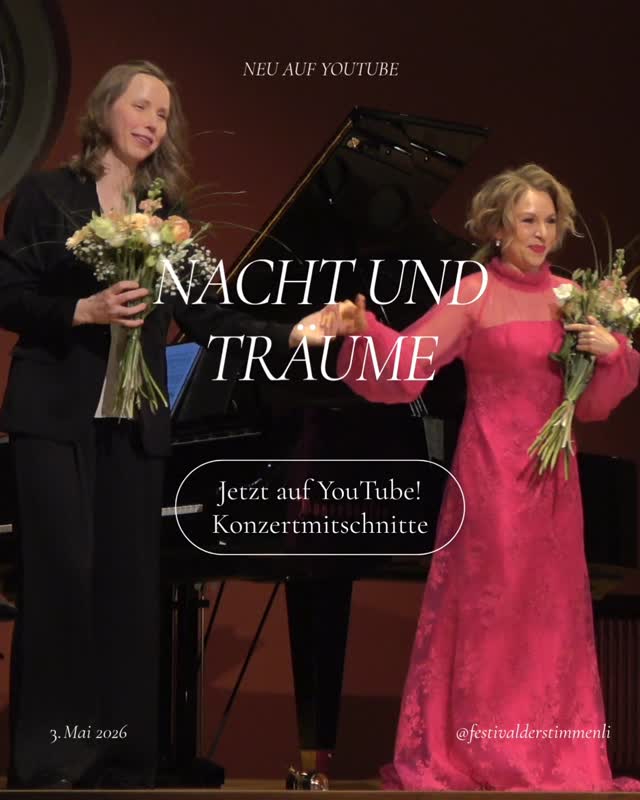
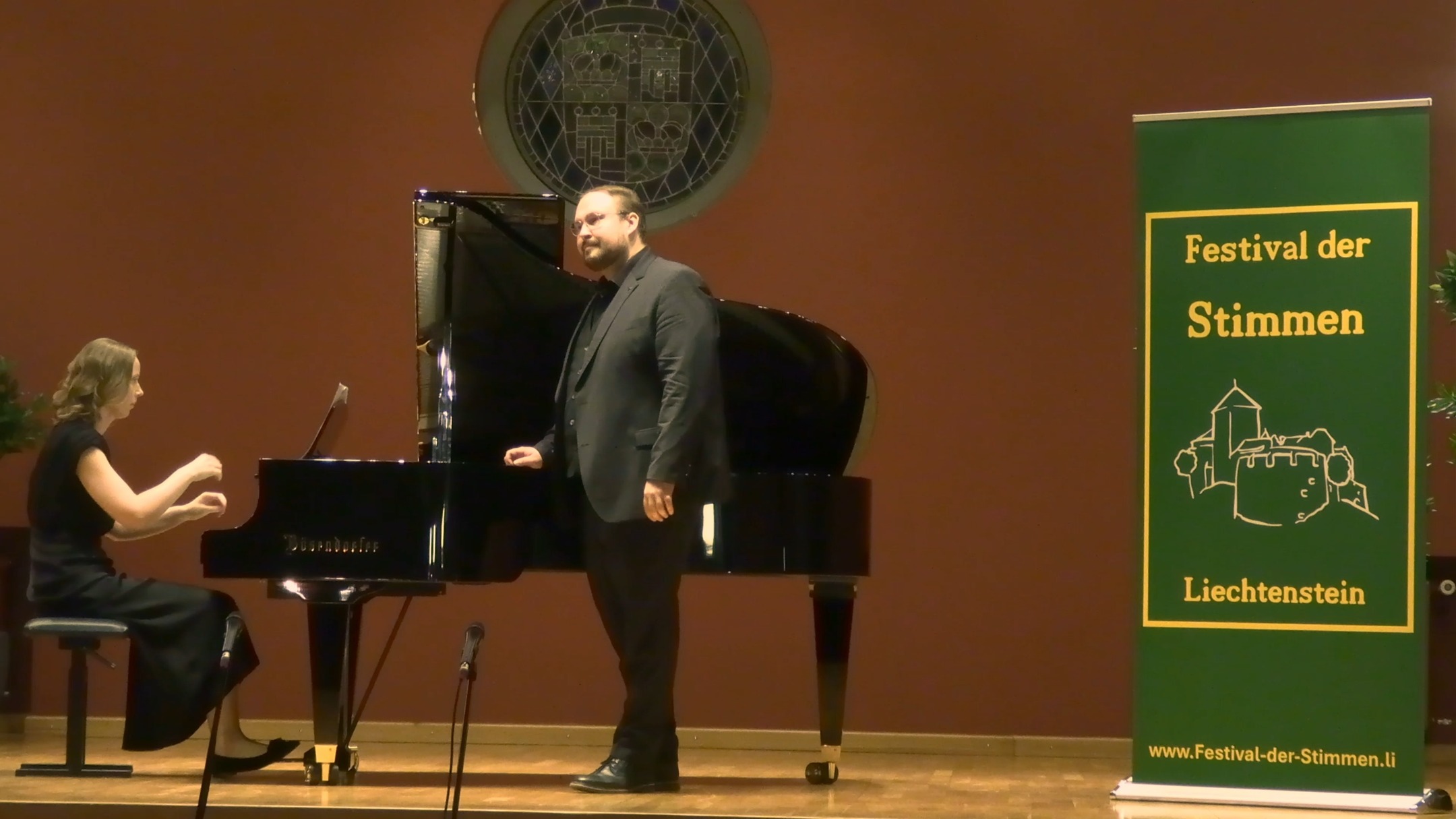
Pianist Evgenia Fölsche accentuates the mask: razor-sharp diction, dry 2/4 drive, brief brightenings into major as an “embarrassed gleam” — the pain remains beneath the surface.
Listening example: Eifersucht und Stolz with Dietrich Fischer-Dieskau and Gerald Moore
Concert Enquiry
Die schöne Müllerin by Franz Schubert belongs to Evgenia Fölsche’s Lied repertoire and is regularly performed in collaboration with renowned singers. Concert programmes can be arranged flexibly and adapted to different scorings.
Evgenia Fölsche has collaborated, among others, with singers such as Johannes Kammler, Benjamin Russell and Gerrit Illenberger, who include Die schöne Müllerin in their repertoire.
Send concert enquiryFrequently Asked Questions about Schubert: “Eifersucht und Stolz” (Die schöne Müllerin No. 15)
Click on a question to reveal the answer.
What key and tempo does Schubert mark?
G minor / G major, performance marking Geschwind; usually notated in 2/4. (See score sources.)
How strongly should it be interpreted “dramatically”?
Pointed and quick, but controlled. Sharpness comes from articulation and accent, not from volume. The final disguise in major should be subtle.
What does the speaker ask the brook to do at the end?
It is to deliver the reproach — but not reveal his suffering. Instead, it should present a harmless image (“reed pipe”) that conceals the pain.