“Am Feierabend” is Song No. 5 from Franz Schubert’s cycle Die schöne Müllerin D 795 (1823), after Wilhelm Müller. After gratitude and purpose, the focus now turns to work: restless activity, self-doubt, and the hoped-for attention of the miller’s daughter. Schubert shapes this into a toccata-like, highly animated piece with an unceasing accompanimental motor and a brief closing image that grows inwardly quieter.
The Poem (Wilhelm Müller – Seventy-Seven Poems from the Posthumous Papers of a Travelling French-Horn Player, 1821) with Schubert’s alterations
Had I a thousand
arms to set in motion!
Could I, roaring,
drive the wheels!
Could I blow
through all the groves,
could I turn
every stone!
So that the lovely miller maid
might notice my faithful heart!
Ah, how weak my arm is!
Whatever I lift, whatever I carry,
whatever I cut, whatever I strike,
every apprentice can do the same.
(Schubert: every apprentice can match me.)
And there I sit in the great circle,
in the still cool hour of rest,
and the master says to all:
Your work has pleased me;
and the dear girl bids
everyone a good night.
Work Data & Overview
- Composer: Franz Schubert (1797–1828)
- Cycle: Die schöne Müllerin D 795, No. 5
- Text source: Wilhelm Müller, “Am Feierabend” (poem 1821; preprint documented in 1818)
- Composition: October 1823; first published 1824
- Original key: A minor; Character: very animated, toccata-like
- Duration: approx. 2:00–2:40 minutes
- Scoring: Voice and piano (transpositions are common)
- Form: ABA′ (fast outer frame, inwardly dimmed middle)
Original key, dating & form after Schubertlied.de (with source references); textual transmission among others via Oxford Song / digitised sources.
Data on the Poem
- Author: Wilhelm Müller (1794–1827)
- First publication (text): 1821 (Seventy-Seven Poems …), preprint 1818
- Stanza form: 2 stanzas of 10 lines each
- Devices: Anaphora (“Could I …”), hyperbole, contrast between vision and disillusionment, direct scene-setting
Genesis & Cycle Context
This song follows directly upon the sense of purpose established in “Danksagung an den Bach”: work becomes the stage on which the protagonist wants to prove himself, hoping to be noticed by the miller’s daughter. What remains at the end is disillusionment: praise from the master, a neutral “good night” — but still no glance from the chosen one.
More on the cycle (plot, work data, all song articles) can be found on the overview page: Die schöne Müllerin – Overview.
Performance Practice & Reception
Tempo & motion: energetic, yet controlled; the accompanimental flow should remain elastic rather than percussively hammered out. Consonants precise, vowels lean — the text in front, without heavy forte weight.
Dynamic topography: stanza 1 as vision (points of brilliance on “thousand,” “wheels,” “stones”); stanza 2 more restrained, more narrative in tone — the inner world becomes audible. The closing lines should not sound bitter, but rather dryly observant.
Reference Recordings (selection)
- Dietrich Fischer-Dieskau – Gerald Moore (DG)
- Ian Bostridge – Mitsuko Uchida (Decca)
- Christoph Prégardien – Andreas Staier (fortepiano; harmonia mundi)
- Jonas Kaufmann – Helmut Deutsch (Sony)
- Thomas Quasthoff – Emanuel Ax (live)
Analysis – Music
Moto perpetuo & Gesture of Work
The piano figure runs on in uninterrupted semiquavers — a sonic allegory of the mill. Above it leaps a syllabic, strongly accented vocal line that translates the “Could I …” hyperboles into musical energy; the attack must never tip into heaviness.
Formal Arc & Closing Image
The ABA′ design frames the scene: the outer sections convey activity and bustle; the middle section brings self-doubt (“my arm is so weak …”), harmonically somewhat brightened and dynamically subdued; A′ offers a brief return swing that leads into a sober closing image (the master’s praise, the miller’s daughter’s neutral farewell).
Visual Representation
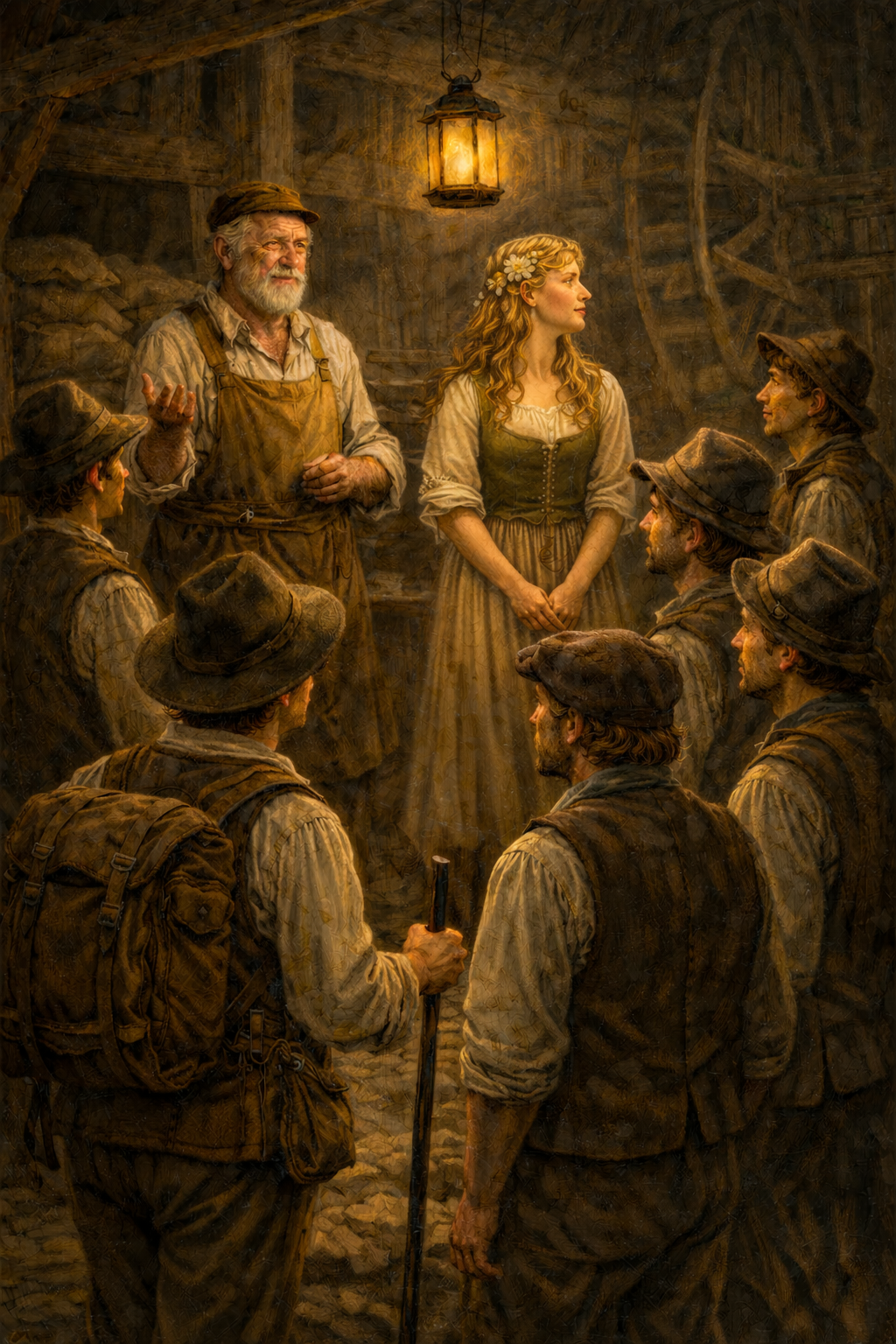
Artistic visualisation by Evgenia Fölsche:
The image shows the young miller in a moment of tense expectation. After his work, his gaze turns entirely toward the miller’s daughter, as though hoping to find in her expression or in a small gesture some answer to his inward longing. Yet the miller’s daughter is looking somewhere else entirely. Her thoughts seem far away, and she appears interested in no one in the room. It is precisely in this quiet mismatch of feeling and attention that the tension of the image lies: his gaze seeks encounter, while hers withdraws from it.
In this way, the composition takes up an essential trait of the song. The young miller wants to distinguish himself through diligence, strength and tireless eagerness in order to be seen, to stand out in the eyes of the beloved. But his effort finds no visible response. The miller’s daughter remains distant, almost untouched by the charged atmosphere that entirely fills him. Thus the image becomes the expression of a first painful disproportion between inner experience and outward reality.
Like Schubert’s music, the image combines motion and unrest with a feeling of inward loneliness. The urge to achieve and to stand out is set against the unattainable calm of the miller’s daughter. Her averted gaze makes visible what is already present in text and music: that the young miller’s love, in all its ardour, has not yet found a place where it might be returned. The scene thus appears not merely as evening rest after work, but as a moment of disappointed hope — full of longing, pride and quiet forlornness.
Analysis – Poetry
“Am Feierabend” stands at the beginning of daily working life in the mill. After arrival, greeting and thanksgiving, the wanderer now enters the social order of the master’s household. The poem shows the transition from the romantic self-interpretation of the journey to the real world of labour — and at the same time marks the beginning of the inner conflict between ideal image and reality.
The first stanza is shaped by overflowing desire:
Had I a thousand
arms to set in motion!
Could I, roaring,
drive the wheels!
Could I blow
through all the groves,
could I turn
every stone!
So that the lovely miller maid
might notice my faithful heart!
The wanderer works himself up into a fantasy of limitless labour power. “A thousand arms,” “all the wheels,” “every stone” — the language deliberately exaggerates into the boundless. Work is not understood as duty, but as a means of self-display: the wanderer wants to be seen and recognised through achievement — above all by the miller’s daughter. In this way, the initial romantic enchantment of the brook is now transferred to a human goal.
The second stanza abruptly leads back into reality:
Ah, how weak my arm is!
Whatever I lift, whatever I carry,
whatever I cut, whatever I strike,
every apprentice can do the same.
(Schubert: every apprentice can match me.)
And there I sit in the great circle,
in the still cool hour of rest,
and the master says to all:
Your work has pleased me;
and the dear girl bids
everyone a good night.
The contrast is sharp: the fantasy of boundless strength becomes an admission of bodily limitation. The wanderer is only “like every apprentice,” interchangeable within the working community. This becomes especially clear in Schubert’s textual alteration: Müller’s “every apprentice does the same” becomes “every apprentice can match me.” In this way, Schubert intensifies the personal humiliation: not only is the work imitated — it is placed on exactly the same level as the wanderer himself.
The scene of the “great circle” reveals the social order of the mill: master, journeymen, the “dear girl” who says good night to all. The wanderer is part of the community — but without any distinguished position. Precisely the polite, general “to all” makes clear that the miller’s daughter does not yet perceive him as an individual.
Formally, the poem combines rapid exclamations and images of desire with a soberly narrative second half. The language itself enacts the fall from idealised expectation into plain reality.
Meaning & Effect within the Cycle
“Am Feierabend” is the first song in which the wanderer’s romantic self-enchantment collides with reality. He wants to earn love through work — yet experiences that his achievement is nothing exceptional. Thus, for the first time, a fissure opens between inward desire and the outward world.
At the same time, the social structure of the mill is firmly established here: master, journeymen, shared labour, shared evening rest. The wanderer is no longer freely wandering, but integrated into an order in which he wishes to prove himself.
The miller’s daughter’s unobtrusive gesture — saying “good night” to everyone — becomes the first quiet hurt. Everything is still friendly and bright, yet in the background the cycle’s central motif has already begun: the wanderer’s struggle for love that is seen and returned.
Thus this song marks the beginning of the inner tension between romantic longing and sober reality — a tension that will intensify more and more over the course of the cycle.
Evgenia Fölsche – Performances & Audio
Pianist Evgenia Fölsche shapes the motoric motion with buoyancy and clarity; the middle section gains narrative calm, while the conclusion remains matter-of-fact — a thoughtful transition into the next arc of the cycle.
Audio example: “Am Feierabend” with Dietrich Fischer-Dieskau and Gerald Moore
Concert Enquiry
Die schöne Müllerin by Franz Schubert is part of Evgenia Fölsche’s song repertoire and is performed regularly in collaboration with renowned singers. Concert programmes can be arranged flexibly and adapted to different line-ups.
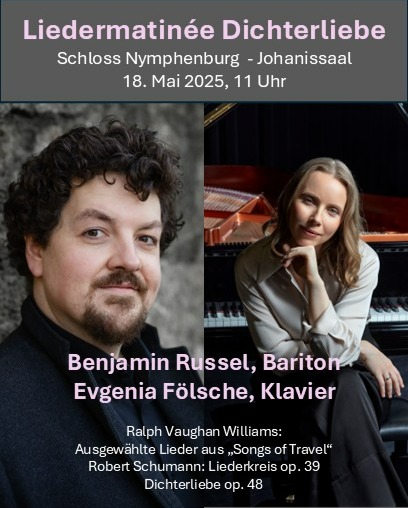
Among others, Evgenia Fölsche has collaborated with singers such as Johannes Kammler, Benjamin Russell and Gerrit Illenberger, all of whom perform Die schöne Müllerin as part of their repertoire.
Send concert enquiryFrequently Asked Questions about Schubert: “Am Feierabend” (Die schöne Müllerin No. 5)
Click on a question to reveal the answer.
Original key & form?
A minor, a three-part ABA′ design; animated moto perpetuo in the outer sections, dimmed middle section.
How does the “mill” sound in the piano?
As an uninterrupted semiquaver figure (moto perpetuo) that paints the turning of the wheels acoustically — always elastic, never hard.
What is the text centred on?
A fantasy of surpassing effort (wanting to be noticed) ↔ self-doubt and a sober ending (praise from the master, a neutral “good night”).
Are there variants in the wording?
Yes, especially in punctuation and orthography; important readings are documented by Oxford Song and LiederNet.