“Der Neugierige” is Song No. 6 from Franz Schubert’s cycle Die schöne Müllerin, D 795 (1823), after Wilhelm Müller. After the outward bustle of “Am Feierabend”, the perspective now turns inward: silence, hesitation, the anxious question of whether love will be returned. Schubert writes for this a quiet, breathing profession of faith in pianissimo — with expanded phrases, sensitive harmony, and an open, “listening” closing gesture.
The Poem (Wilhelm Müller – Seventy-Seven Poems from the Posthumous Papers of a Travelling French-Horn Player, 1821)
I ask no flower,
I ask no star,
they cannot tell me
what I would so gladly learn.
I am no gardener,
the stars stand too high;
my little brook I will ask
whether my heart deceived me.
O brook of my love,
how silent you are today!
I only want to know one thing,
one little word again and again.
Yes is the name of one little word,
the other is called No,
those two little words enclose
the whole world for me.
O brook of my love,
how strange you are!
I will say no more about it,
tell me, brook, does she love me?
Work Data & Overview
- Composer: Franz Schubert (1797–1828)
- Cycle: Die schöne Müllerin D 795, No. 6
- Text source: Wilhelm Müller, “Der Neugierige” (1821)
- Composition: October 1823; first published 1824
- Meter/character: Very slow, songful and cantabile; an extreme culture of softness
- Duration: approx. 3:00–4:00 minutes
- Scoring: Voice and piano (transpositions are common)
- Form: three-part arc (quiet questioning – inner intensification – listening close)
Data on the Poem
- Author: Wilhelm Müller (1794–1827)
- Stanza form: 5 stanzas of 4 lines each
- Devices: Apostrophe (addressing the brook), antithesis (“Yes/No”), reduction (one “little word” as fate)
Genesis & Cycle Context
After work and disillusionment (“Am Feierabend”) comes the first great song of inward reflection: outward motion comes to a halt, and the brook becomes the mirror of doubt. Dramaturgically, “Der Neugierige” forms the psychological hinge before the surplus energy of “Ungeduld” (No. 7).
More on the cycle (plot, work data, all song articles) can be found on the overview page: Die schöne Müllerin – Overview.
Performance Practice & Reception
Sound ideal: breath before tone; p–ppp as the basis; consonants soft, vowels sustained. The piano supports in calm, patient figures — not “murmuring,” but listening.
Key moments: “Yes/No” as temporally extended moments (without increasing volume); the closing question “Tell me, brook — does she love me?” dolcissimo, almost unanswered, placed into the silence.
Reference Recordings (selection)
- Dietrich Fischer-Dieskau – Gerald Moore (DG)
- Ian Bostridge – Mitsuko Uchida (Decca)
- Christoph Prégardien – Andreas Staier (fortepiano; harmonia mundi)
- Fritz Wunderlich – Hubert Giesen (Orfeo)
- Matthias Goerne – Christoph Eschenbach (Teldec)
Analysis – Music
“Questioning” Tempo & Breath
Schubert stretches time: long held notes, fragile intervals, resting harmonies — the text continues to “ask” within the silences. The dynamic curve remains small in scale; the tension arises from waiting and not saying.
Form, Tonal Space & Closing Gesture
The middle section intensifies harmonically (brief shadowings, gentle chromaticism) before the music returns to the brighter region of the opening. The ending leaves the cadence feeling “open” — as an audible question mark.
Visual Representation
Artistic visualisation by Evgenia Fölsche:
The image poetically condenses the miller lad’s inner situation.
He bends questioningly toward the brook, the trusted companion of his path, and seeks in it
an answer to the anxious question of his heart. Yet the water gives him no
clear reply. Instead of a revelation, he sees only his moon-shadow reflected
upon the surface — a fleeting, shimmering image of himself.
Precisely here lies the symbolic force of this visualisation. The miller lad asks
about the beloved, yet what meets him is not certainty, but reflection.
The brook does not become a clear voice, but rather the mysterious resonant space
of his own longing. The moon-shadow on the water points to something delicate,
intangible and indeterminate: to hope that appears and at the same time recedes, to a
feeling that has no firm ground beneath its feet.
Like Schubert’s music, the image suspends the motion of questioning.
Nothing presses forward here; everything listens, hesitates and gropes.
In the still reflection it is revealed that the miller lad is seeking in the brook not only an answer,
but also an encounter with himself — with his unrest, his vulnerability and his desire. The
image makes visible what resonates within text and music: that the decisive question
of love cannot yet be resolved and appears in the water only as the shimmering
shadow of his own hope.
Analysis – Poetry
“Der Neugierige” stands at the centre of the first part of the cycle. After arrival, work and the first encounters with the miller’s daughter, the wanderer is now inwardly completely oriented toward her. The poem shows the moment in which general longing becomes a concrete question of love.
The first stanza excludes other possible sources of knowledge:
I ask no flower,
I ask no star,
they cannot tell me
what I would so gladly learn.
Flowers and stars — the classic romantic oracles of nature — are consciously rejected. The wanderer is not seeking general knowledge of the world, but a deeply personal answer. In this way, his horizon narrows: no longer the wide world, but only one single concern determines his thinking.
In the second stanza he once again chooses the brook as his interlocutor:
I am no gardener,
the stars stand too high;
my little brook I will ask,
whether my heart deceived me.
The brook has long since become a trusted presence — the voice that already appeared as guiding force in “Wohin?” and “Danksagung an den Bach”. But now the wanderer no longer asks about the road, but about the truth of his heart. His inner uncertainty emerges openly: has his own heart deceived him?
The third stanza describes the hoped-for game of answering:
O brook of my love,
how silent you are today!
I only want to know one thing,
one little word again and again.
The brook is silent — this time its murmuring gives no clear interpretation. The wanderer presses for a “little word,” a simple binary answer. The complex world of feeling is to be reduced to a yes-or-no decision.
This sharpening appears in the fourth stanza:
Yes is the name of one little word,
the other is called No,
those two little words enclose
the whole world for me.
For the wanderer, only this alternative still exists. Everything else loses significance. Psychologically, this is the point of total fixation: the whole world contracts to the question of whether love is returned.
The final stanza at last brings the question into the open:
O brook of my love,
how strange you are!
I will say no more about it,
tell me, brook, does she love me?
The wanderer addresses the question of love not to the miller’s daughter herself, but still to the brook. He remains within the space of inward projection and avoids direct confrontation with reality. Thus it becomes clear: the brook is no longer simply a natural phenomenon, but the mouthpiece of his own inner monologue.
Meaning & Effect within the Cycle
“Der Neugierige” marks the transition from romantic enchantment to concrete expectation of love. The wanderer has become inwardly wholly fixed upon the miller’s daughter and now seeks certainty about her feelings.
By questioning the brook as an oracle, he avoids direct dialogue with reality. The decisive question is transferred into an imaginary space. In this way the cycle’s psychological structure becomes clear: the wanderer lives more intensely in his inner images than in the real world.
At the same time, this song prepares the later disappointment. For an answer sought only within one’s own inwardness can at any moment turn from hope to despair. The brook, as supposed adviser, will later become comforter and finally the last companion.
Thus “Der Neugierige” forms the quiet centre of the first part of the cycle: a moment of taut expectation, in which the wanderer’s later tragedy is already foreshadowed.
Evgenia Fölsche – Performances & Audio
Pianist Evgenia Fölsche shapes the song as “standing time”: breathing phrases, delicate ppp, small brightenings at “Yes/No” — and a hovering ending that does not “close”.
Audio example: Der Neugierige with Dietrich Fischer-Dieskau and Gerald Moore
Concert Enquiry
Die schöne Müllerin by Franz Schubert is part of Evgenia Fölsche’s song repertoire and is performed regularly in collaboration with renowned singers. Concert programmes can be arranged flexibly and adapted to different line-ups.
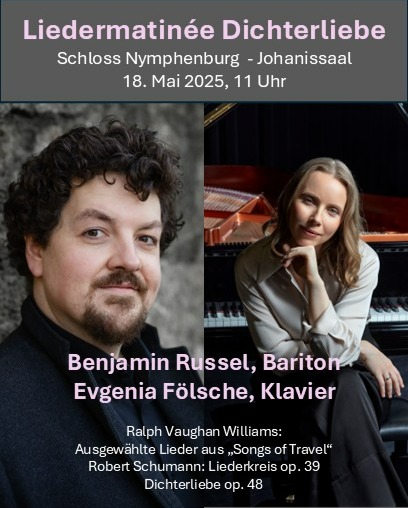
Among others, Evgenia Fölsche has collaborated with singers such as Johannes Kammler, Benjamin Russell and Gerrit Illenberger, all of whom perform Die schöne Müllerin as part of their repertoire.
Send concert enquiryFrequently Asked Questions about Schubert: “Der Neugierige” (Die schöne Müllerin No. 6)
Click on a question to reveal the answer.
Basic character & tempo?
Very slow, quiet and listening; expansion of time rather than dramatic intensification.
How important is “Yes/No”?
Central: two syllables as an existential polarity. Musically brought out in time, dynamically only minimally raised — never operatic.
What role does the piano play?
Support and mirror: resting figures, gentle colourings; the brook’s “non-answering” becomes audible as silence.
Dramaturgical position within the cycle?
Inner hinge between expectation of work and surplus of affect — preparing “Ungeduld” (No. 7).