“Des Müllers Blumen” is Song No. 9 from Franz Schubert’s cycle Die schöne Müllerin D 795 (1823), after Wilhelm Müller. After the shy “Morgengruß”, the action here shifts beneath the miller’s daughter’s window: the journeyman “plants” blue flowers as stand-ins for his glances and messages. Schubert shapes a gently rocking 6/8 song of tender inwardness: dream, plea, and tear in the light of early morning.
The Poem (Wilhelm Müller – Seventy-Seven Poems from the Posthumous Papers of a Travelling French-Horn Player, 1821)
By the brook many little flowers stand,
Looking out of bright blue eyes;
The brook is the miller’s friend,
And my beloved’s eye shines bright blue,
Therefore they are my flowers.
Close beneath her little window
There I will plant the flowers,
There they will call to her when all is silent,
When her head inclines toward slumber,
You know well what I mean.
And when she closes her little eyes,
And sleeps in sweet, sweet rest,
Then, like a dream-vision, they whisper
To her: Forget, forget me not!
That is what I mean.
And when early she opens the shutters,
Then look upward with a loving glance:
The dew in your little eyes,
That shall be my tears,
Which I would weep upon you.
Work Data & Overview
- Composer: Franz Schubert (1797–1828)
- Cycle: Die schöne Müllerin D 795, No. 9
- Text source: Wilhelm Müller, “Des Müllers Blumen” (c. 1816; published 1821)
- Composition: October/November 1823; first published 1824
- Original key: A major; Meter/character: 6/8, moderate
- Duration: approx. 2:00–3:00 minutes
- Scoring: Voice and piano (transpositions are common)
- Form: an ABA′-coloured strophic design (continuous rocking pulse)
Data on the Poem
- Author: Wilhelm Müller (1794–1827)
- Stanza form: 4 stanzas of 5 lines each
- Devices: personification (flowers “call” / “look”), simile (blue eyes), forms of address, refrain-like repetition (“what I mean”)
Genesis & Cycle Context
The flowers take over the brook’s role as messengers of love: silent intermediaries between the shy self and the miller’s daughter. The colour blue (eyes / brook / flowers) becomes a guiding motif in the early middle of the cycle and prepares the scene of tears in “Tränenregen” (No. 10).
More on the cycle (plot, work data, all song articles) can be found on the overview page: Die schöne Müllerin – Overview.
Performance Practice & Reception
Pulse & tone: a calm 6/8 rocking, never sentimental. Consonants soft, vowels sustained; the “dream” tone (stanza 3) dolcissimo; stanza 4 with discreet brightening at “loving glance” and a fine darkening at “tears”.
Balance: piano right hand pearly and lightly arpeggiated, left hand an elastic basic step; the singing in one long line – no over-accentuation of individual words.
Reference Recordings (selection)
- Dietrich Fischer-Dieskau – Gerald Moore (DG)
- Ian Bostridge – Mitsuko Uchida (Decca)
- Christoph Prégardien – Andreas Staier (fortepiano; harmonia mundi)
- Fritz Wunderlich – Hubert Giesen (Orfeo)
- Matthias Goerne – Christoph Eschenbach (Teldec)
Analysis – Music
Rocking Pulse & the Metaphor of the “Glance”
Schubert’s accompaniment figures flow in gentle semiquaver / quaver waves; the 6/8 conveys “rocking” rather than “walking.” The syllabic vocal line allows the metaphors of looking (“blue eyes,” “loving glance”) to gleam in small points of light – always within a piano atmosphere.
Form, Tonal Space & Closing Images
An A–B–A′ impression: the first two stanzas (planting / message) frame the dream core (stanza 3); stanza 4 mirrors the image of tears (dew) – harmonically bright, yet inwardly “moist.” The close lingers without truly closing: a backward glance rather than triumph.
Visual Representation
Artistic visualisation by Evgenia Fölsche:
The image shows the miller lad’s quiet, tender service of love. Beneath
the lovely miller’s daughter’s window he has planted forget-me-nots — small flowers that
become the sign of a hope that does not speak loudly, but wishes to grow
gently. Inside the room, the sleeping miller’s daughter can be seen, still untouched
by this silent confession. In this way, a poetic connection arises between outside and inside, between
the lover’s waking longing and the beloved’s unsuspecting sleep.
The forget-me-nots carry an eloquent symbolism within them. They stand for
fidelity, remembrance, and the wish to be kept within the heart of the other. The
miller lad, as it were, plants his love into the earth so that it may take root and
one day grow upward toward the miller’s daughter. Yet for now this love remains hidden:
it blooms outside before the window, while within the beloved sleeps and knows nothing
of the tender sign meant for her.
Like Schubert’s music, the image combines inwardness with quiet reserve. Nothing
presses, nothing demands; everything is attuned to gentle growth, hope and waiting. The
miller’s daughter’s sleep lends the scene a removed stillness in which the flowers become
stand-ins for the unspoken feeling. What becomes visible is what resonates in text and
music: the hope that love, however inconspicuously it may show itself,
may find its way to the beloved’s heart — like a blossom waiting in secret
for the morning.
Analysis – Poetry
The poem “Des Müllers Blumen” belongs to the middle phase of the cycle Die schöne Müllerin and marks a decisive step: cautious approach now becomes an imaginative act of possession. Inwardly, the wanderer has already bound himself to the miller’s daughter. There is still no spoken declaration of love, yet the self begins to inscribe its feelings into the things around it. Nature, language, and desire merge into a secret ritual of love.
In the first stanza, the flowers by the brook are interpreted as mirrors of the beloved:
By the brook many little flowers stand,
Looking out of bright blue eyes;
The brook is the miller’s friend,
And my beloved’s eye shines bright blue,
Therefore they are my flowers.
Perception is completely coloured by subjectivity: the blue flowers “look” like eyes, and because the miller’s daughter’s eyes are likewise blue, the self declares the flowers to be “my flowers.” The water of the brook — already an established guiding motif — appears as the miller’s friend and as an intermediary between nature and feeling. Possession is not enacted in reality, but imagined. The world is reinterpreted in order to confirm the inner bond.
The second stanza unfolds a nocturnal scenario of action:
Close beneath her little window
There I will plant the flowers,
There they will call to her when all is silent,
When her head inclines toward slumber,
You know well what I mean.
The wanderer plans a secret action: he wants to plant the flowers beneath her window. Once again, the window appears as the threshold between the inner world (the girl) and the outer world (the wanderer). The address remains indirect: “You know well what I mean.” The poem plays with the complicity of things — as though flowers, brook, and window understood the language of love. Reality and fantasy begin to intermingle.
In the third stanza, this dream logic intensifies:
And when she closes her little eyes,
And sleeps in sweet, sweet rest,
Then, like a dream-vision, they whisper
To her: Forget, forget me not!
That is what I mean.
Now the self no longer speaks itself — it lets the flowers speak within the miller’s daughter’s dream. The wish for reciprocation is displaced into a dream voice. Especially telling is the formula “Forget, forget me not!”: the wanderer already fears being overlooked. Love is not yet fulfilled — it exists as a plea for remembrance.
The fourth stanza joins image of night and image of morning:
And when early she opens the shutters,
Then look upward with a loving glance:
The dew in your little eyes,
That shall be my tears,
Which I would weep upon you.
The morning dew on the flowers is interpreted as the lover’s tears. In this way, the previously cheerful image tips into a first intimation of pain. Love is conceived as devotion carried to the point of self-dissolution: his own tears are to become part of nature so that they may be seen by the beloved. The poem joins tenderness and suffering in a single gesture.
Altogether, a clear shift becomes visible here: the wanderer scarcely addresses the miller’s daughter herself any longer, but rather her surroundings. Love becomes a projection into things and images. The self builds itself a world in which its feelings already seem answered — a decisive step on the path toward later disappointment.
Meaning & Effect within the Cycle
“Des Müllers Blumen” marks within the cycle the phase of growing inwardness. The wanderer has found his place and begins to use nature itself as the language of his love. Flowers, dew, window, and brook become bearers of messages. Reality is poetically reshaped.
At the same time, the central structure of the whole cycle becomes visible: love exists above all within the speaker’s interior. There is as yet no real relationship — only images, wishes, and projections. The wanderer speaks to things, not to people. For this very reason, the later rupture is already prepared: where love exists only in imagination, disappointment may strike all the more deeply.
The poem therefore acts like a turning point: from hopeful courtship there emerges a quiet ritual of love, from natural wandering an attachment to a place — and from free movement an increasing fixation. The mill becomes the inward centre of the cycle, the flowers the first signs of a love-suffering that begins gently, yet already bears pain within itself.
Evgenia Fölsche – Performances & Audio
Pianist Evgenia Fölsche reads the song as an intimate window nocturne: a calm rocking pulse, “speaking” legato, a shimmering dream stanza, and a tender, moist close.
Audio example: Des Müllers Blumen with Dietrich Fischer-Dieskau and Gerald Moore
Concert Enquiry
Die schöne Müllerin by Franz Schubert is part of Evgenia Fölsche’s song repertoire and is performed regularly in collaboration with renowned singers. Concert programmes can be arranged flexibly and adapted to different line-ups.
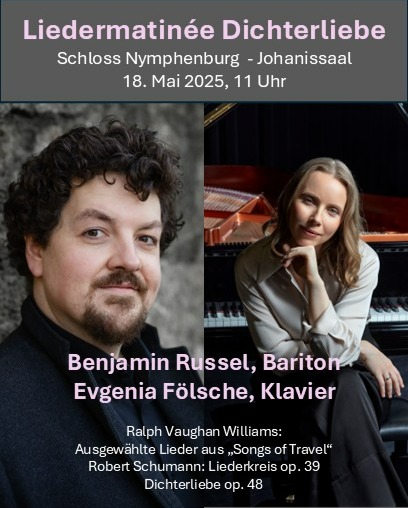
Evgenia Fölsche has collaborated, among others, with singers such as Johannes Kammler, Benjamin Russell and Gerrit Illenberger who have Die schöne Müllerin in their repertoire.
Send concert enquiryFrequently Asked Questions about Schubert: “Des Müllers Blumen” (Die schöne Müllerin No. 9)
Click on a question to reveal the answer.
Which key and meter shape the song?
Original key A major, 6/8, moderate; a rocking, not marching, pulse.
What does “Forget me not” mean in stanza 3?
It alludes to the forget-me-not as a symbolic flower: the flowers whisper the love-message in the dream – an indirect plea for reciprocation.
How does the song lead on dramaturgically?
The images of dew and tears lead into “Tränenregen” (No. 10) – from sign to experience.