“Mit dem grünen Lautenbande” is Song No. 13 from Franz Schubert’s cycle Die schöne Müllerin D 795 (1823), after Wilhelm Müller. The green ribbon hung up in “Pause” here becomes an active message: the journeyman removes it from the lute and sends it to the miller’s daughter — “Now cherish the green!” Schubert draws this as a light, strophic song of homage with shimmering “lute” figuration — immediately before the sudden turn toward “Der Jäger”.
The Poem (Wilhelm Müller – Seventy-Seven Poems from the Posthumous Papers of a Travelling French-Horn Player, 1821)
“A pity about the lovely green ribbon,
That it fades here upon the wall,
I am so fond of green!”
So you spoke, dear beloved, to me today;
At once I shall untie it and send it to you:
Now cherish the green!
Though your whole beloved one is white,
Green must still have its value,
And I too am fond of it.
Because our love is always green,
Because the distances of hope bloom green,
Therefore we cherish it.
Now gracefully wind
The green ribbon into your curls,
For you are so fond of green.
Then I know where hope dwells,
Then I know where love is enthroned,
Only then shall I truly cherish the green.
Work Data & Overview
- Composer: Franz Schubert (1797–1828)
- Cycle: Die schöne Müllerin D 795, No. 13
- Text source: Wilhelm Müller, “Mit dem grünen Lautenbande” (first published 1821)
- Composition: October/November 1823; first published 1824
- Original key / character: B-flat major (editions also in A-flat/B-flat major; transpositions common), moderate, strophic
- Duration: approx. 1:40–2:15 minutes
- Scoring: Voice and piano
- Form: Strophic song (3 stanzas) with a songlike refrain effect (“… cherish it” / “… fond of it”)
Data on the Poem
- Author: Wilhelm Müller (1794–1827)
- Stanza form: 3 stanzas of 6 lines each, with a tendency toward paired rhyme
- Devices: the symbolic colour green (hope/love), direct address, refrain formula, a trace of irony (the beloved “white” ↔ green)
Genesis & Cycle Context
The song follows directly upon “Pause” and leads the green ribbon from symbol to gesture: gift, confession, sign of hope. Dramaturgically, it forms the bright edge before the entrance of the hunter (No. 14) and the following “green” counterparts “Die liebe Farbe” / “Die böse Farbe”.
Overall context and all song articles: Die schöne Müllerin – Overview.
Performance Practice & Reception
Gesture: friendly, bright, unpretentious; the joy appears in lightness, not in volume. Phrase endings (“… fond of it” / “… cherish it”) should be small points of light, not a continuous vibrato display.
Piano image: right hand with delicate, “lute-like” figures; left hand elastically supportive. Small agogic inflections on words of tender address (dear beloved, green), immediately drawn back at the end of the stanza.
Reference Recordings (selection)
- Dietrich Fischer-Dieskau – Gerald Moore
- Christoph Prégardien – Andreas Staier (fortepiano)
- Ian Bostridge – Mitsuko Uchida
- Fritz Wunderlich – Hubert Giesen
- Matthias Goerne – Christoph Eschenbach
Analysis – Music
Lute Figure & Stanzas
The accompaniment evokes plucked strings — an apparently simple rocking motion that carries the formula of confession (“now cherish the green”). Strophic form allows fine nuances: 1) gift; 2) justification (hope/love); 3) physical closeness (“curls”) — the music remains discreet.
The Colour Semantics of “Green”
Bright B-flat major and a moderate pulse let the green shimmer kindly; not triumph, but rather a light of hope. Within the cycle, “green” soon becomes ambiguous: the colour of the miller’s daughter and of the hunter — the musical innocence here contrasts sharply with the fractures to come.
Visual Representation
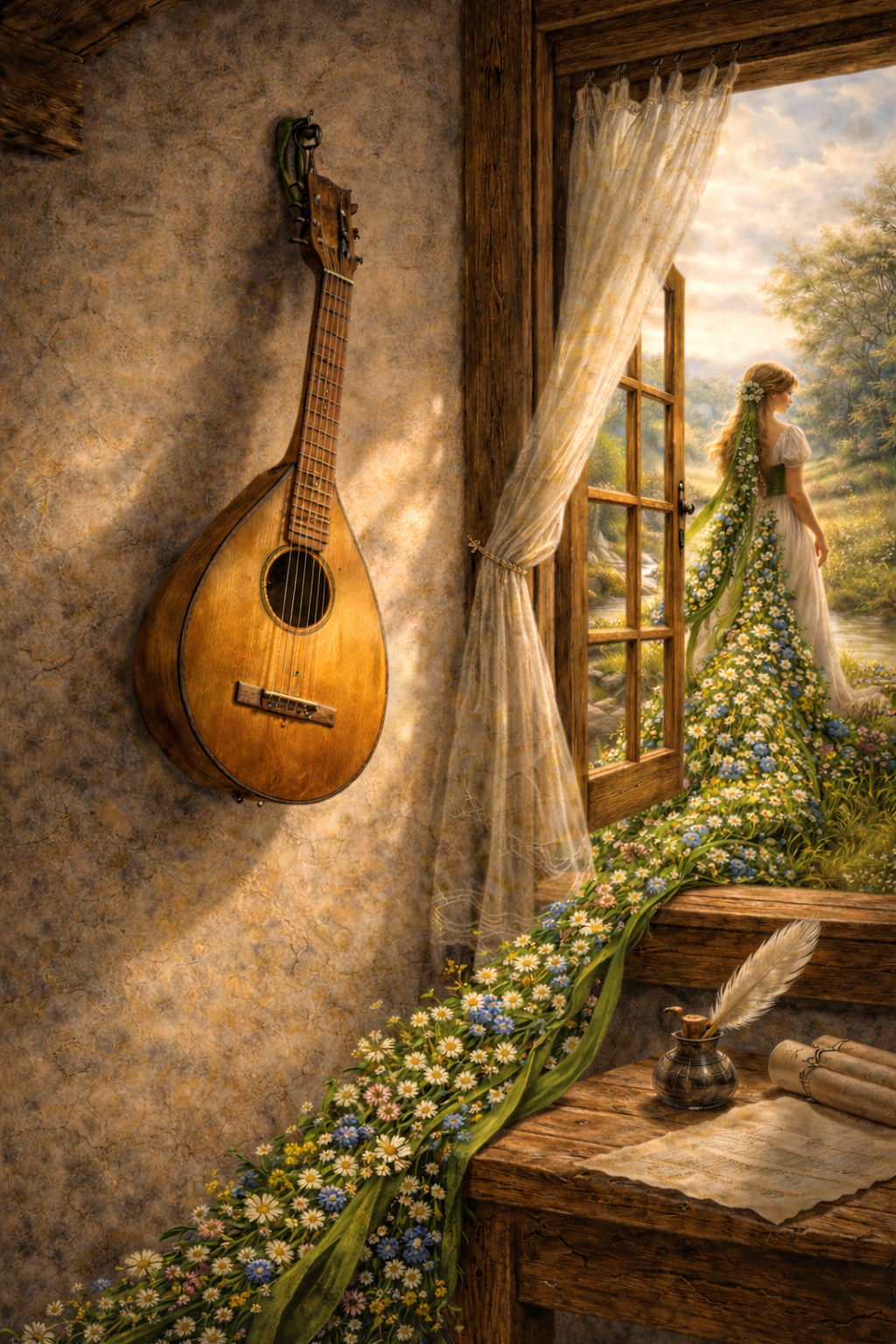
Artistic visualisation by Evgenia Foelsche:
The image transforms the green lute-ribbon into a poetic emblem of love.
It is no longer bound to the instrument, but detaches itself from the lute and
flows outward toward the miller’s daughter. In this movement the ribbon itself becomes a confession:
it no longer remains within sound and song, but seeks the way toward the beloved,
as though music wished to become visible and turn into a sign of connection.
Of particular pictorial force is the way the green ribbon unfolds like a flower-covered
wedding train. In this way the token of courtship acquires a festive,
almost dreamlike radiance. Green, which in the cycle carries within it hope, nature, and the desire for love,
here becomes a ribbon of longing, adorning and wooing as it
stretches itself toward the miller’s daughter. At the same time, in the image of a wedding train
there already lies a quiet foreshadowing of future fulfilment — or perhaps only a
wish-image of the miller lad, anticipating reality before it arrives.
Like Schubert’s music, the image joins grace with inward movement. Nothing seems
heavy or fixed; everything seems to flow, to expand, and to strive toward the beloved.
The lute-ribbon is no longer merely an ornament of the instrument, but
the expression of a feeling that presses outward and wants to take visible form. What becomes visible
is what resonates in text and music: that the miller lad’s love transforms itself into
a delicate, coloured, almost ceremonial sign — as though it wished to envelop the miller’s daughter
like a promise.
Analysis – Poetry
The poem “Mit dem grünen Lautenbande” stands in Die schöne Müllerin immediately after “Pause” and continues its imagery. The green ribbon, which had previously encircled the silenced lute, now becomes the central symbol of a new hope: the miller’s daughter has noticed it and regrets that it “fades there upon the wall.” The wanderer interprets this as a sign of affection — and turns the ribbon into a token of love.
The first stanza narrates this occasion:
“A pity about the lovely green ribbon,
That it fades here upon the wall,
I am so fond of green!”
So you spoke, dear beloved, to me today;
At once I shall untie it and send it to you:
Now cherish the green!
The miller’s daughter voices a casual fondness for the colour green. The wanderer, however, immediately gives this remark existential weight. He removes the ribbon from the lute — that is, from the instrument of his own inwardness — and sends it to her. The symbol of his art and his silence is rededicated as a sign of love. In this way, the centre of his world shifts still more strongly away from himself and toward the beloved.
The second stanza unfolds the meaning of green:
Though your whole beloved one is white,
Green must still have its value,
And I too am fond of it.
Because our love is always green,
Because the distances of hope bloom green,
Therefore we cherish it.
Green now becomes the colour of hope, constancy, and beginning. The speaker links the colour with the future (“the distances of hope”) and declares it the shared identity of the lovers. Remarkable here is the self-evidence with which he speaks of “our love” — although that love has so far existed only within himself. Language here creates reality.
The third stanza returns the image to a concrete, intimate vision:
Now gracefully wind
The green ribbon into your curls,
For you are so fond of green.
Then I know where hope dwells,
Then I know where love is enthroned,
Only then shall I truly cherish the green.
The ribbon is meant to become part of the beloved’s body — woven into her hair. In this way the symbol becomes physically close and visible at once. For the wanderer, this creates a place of certainty: where the ribbon is, there hope and love dwell. The outward sign becomes an inward support. Yet behind the delicate imagery there already shows itself the speaker’s dependence upon signs and interpretations that he alone creates.
Formally, the poem remains simple, songlike, and circling. The repeated closing lines (“… I am fond of it” / “… cherish it”) produce a gentle refrain character. Language and structure thus themselves imitate the circling of thoughts — an early echo of the later emotional cycle within the work.
Meaning & Effect within the Cycle
“Mit dem grünen Lautenbande” marks the moment in the cycle when hope first takes on concrete form. The wanderer believes he has found a sign of reciprocation. A simple ribbon becomes a token of love — and from a casual remark there emerges a supposed certainty.
At the same time, the song establishes the central colour-symbol of the entire cycle: green as the colour of nature, youth, and hope. What here appears as a sign of enduring love will later become a bitter contrast, when hope is disappointed and nature remains indifferent. Thus the cycle lays down early a symbolic trail whose full meaning only becomes clear in retrospect.
Psychologically, the wanderer’s romantic projection is especially clear here. The miller’s daughter merely expresses a liking for a colour — the wanderer shapes it into a confession of love. The song remains outwardly bright and idyllic, yet it already contains the seed of later disappointment: the love exists above all within the speaker himself.
Thus this song forms a delicate resting-point between arrival and passion. Hope, symbolic imagination, and self-assurance shape the moment — a brief phase in which the world still appears “green,” before the emotional course of the cycle intensifies and darkens.
Evgenia Fölsche – Performances & Audio
Pianist Evgenia Fölsche reads the song as a finely wrought piece of homage: airy “lute” colour, speaking legato, pointed closing formulas — without oversweetening.
Audio example: Mit dem grünen Lautenbande with Dietrich Fischer-Dieskau and Gerald Moore
Frequently Asked Questions about Schubert: “Mit dem grünen Lautenbande” (Die schöne Müllerin No. 13)
Click on a question to reveal the answer.
How many stanzas does the poem have?
Three stanzas; some editions print only two. The third stanza (“curls … ribbon …”) is transmitted in authoritative text sources.
Original key & tempo?
Frequently transmitted in B-flat major (editions vary); character moderate, strophic. Transpositions (for example A-flat major) are common.
What does the “green ribbon” mean within the cycle?
A symbol of hope and love (the miller’s daughter); it builds the bridge from “Pause” to the later “green” counterparts (hunter complex, “Beloved / Evil Colour”).
Variant “dwells” / “grows green”?
In the final stanza, alongside “dwells,” the reading “grows green” also circulates — a variant reflecting Schubert-related editorial tradition; in meaning, “grows green” underscores the colour symbolism.
Concert Enquiry
Die schöne Müllerin by Franz Schubert is part of Evgenia Fölsche’s song repertoire and is performed regularly in collaboration with renowned singers. Concert programmes can be arranged flexibly and adapted to different line-ups.
Evgenia Fölsche has collaborated, among others, with singers such as Johannes Kammler, Benjamin Russell and Gerrit Illenberger who have Die schöne Müllerin in their repertoire.
Send concert enquiry