“Tränenregen” is Song No. 10 from Franz Schubert’s cycle Die schöne Müllerin D 795 (1823), after Wilhelm Müller. Before the miller’s daughter’s window, the cycle’s guiding images culminate here—brook, moon and stars, blue flowers, glances—until the journeyman’s tears ruffle the water and she goes away. Schubert shapes the scene as a flowing nocturne with a gentle wave-motion and a shadowy turn into the minor at the end.
The Poem (Wilhelm Müller – Seventy-Seven Poems from the Posthumous Papers of a Travelling French-Horn Player, 1821)
We sat together so trustfully
Beneath the cool alder boughs,
We looked together so trustfully
Down into the murmuring brook.
The moon had also come,
The little stars behind it,
And they too looked so trustfully together
Into the silver mirror.
I looked for no moon,
For no starlight,
I looked for her image,
For her eyes alone.
And I saw them nodding and glancing
Up from the blessed brook,
The little flowers on the bank, the blue ones,
They nodded and glanced after her.
And sunk into the brook
The whole heaven seemed,
And wanted to draw me down with it
Into its depth.
And above the clouds and stars
The brook rippled along merrily
And called with singing and ringing:
Journeyman, journeyman, follow me!
Then my eyes brimmed over,
Then the mirror grew so ruffled:
She said: Rain is coming,
Farewell, I’m going home.
Work Data & Overview
- Composer: Franz Schubert (1797–1828)
- Cycle: Die schöne Müllerin D 795, No. 10
- Text source: Wilhelm Müller, “Tränenregen” (1817/1821 first publication)
- Composition: October/November 1823; first published 1824
- Tonal space / character: bright major sphere (often A major in editions), andante, flowing; final verse clouded by the minor
- Duration: approx. 3:00–4:00 minutes
- Scoring: Voice and piano (transpositions are common)
- Form: predominantly strophic with a varied closing gesture (minor epilogue)
Data on the Poem
- Author: Wilhelm Müller (1794–1827)
- Stanza form: 7 stanzas of 4 lines each
- Devices: mirror and glance imagery, personification (the brook calls), colour symbolism (blue), antithetical ending (“rain”)
Genesis & Cycle Context
After “Des Müllers Blumen”, “Tränenregen” brings together the blue symbolism (eyes / flowers / brook) and the mirror motif: closeness arises—yet the misunderstanding remains. Her only direct speech in the cycle (“Rain is coming …”) ends the scene abruptly and marks the self’s first clear hurt.
More on the cycle (plot, work data, all song articles) can be found on the overview page: Die schöne Müllerin – Overview.
Performance Practice & Reception
Pulse & sound: a softly flowing nocturne; the piano draws a shimmering water-surface (even, gentle waves), while the voice remains cantabile and close to speech. No sentimentality—the darkening happens “in the mirror.”
Turning points: “Journeyman, follow me” (the brook’s call) with discreet inward glowing; final stanza as a fine shading into the minor and immediate fading away at “Farewell.” No expansive afterthought.
Reference Recordings (selection)
- Dietrich Fischer-Dieskau – Gerald Moore
- Ian Bostridge – Mitsuko Uchida
- Christoph Prégardien – Andreas Staier (fortepiano)
- Fritz Wunderlich – Hubert Giesen
- Matthias Goerne – Christoph Eschenbach
Analysis – Music
“Silver Mirror” & Sonic Surface
The accompaniment figures create a calm, glittering surface; the syllabic vocal line feels its way across it—the glances are oblique (into the brook), not direct. The “ruffling” arises dynamically and harmonically as a delicate darkening, not as an effect of loudness.
Form, Tonal Space & Minor Epilogue
Strophically conceived; the final bars withdraw into the tonic minor region—an expressive dimming down after the tears. In this way, Schubert answers the turn in the text and frames the scene without drawing a final line beneath it.
Visual Representation
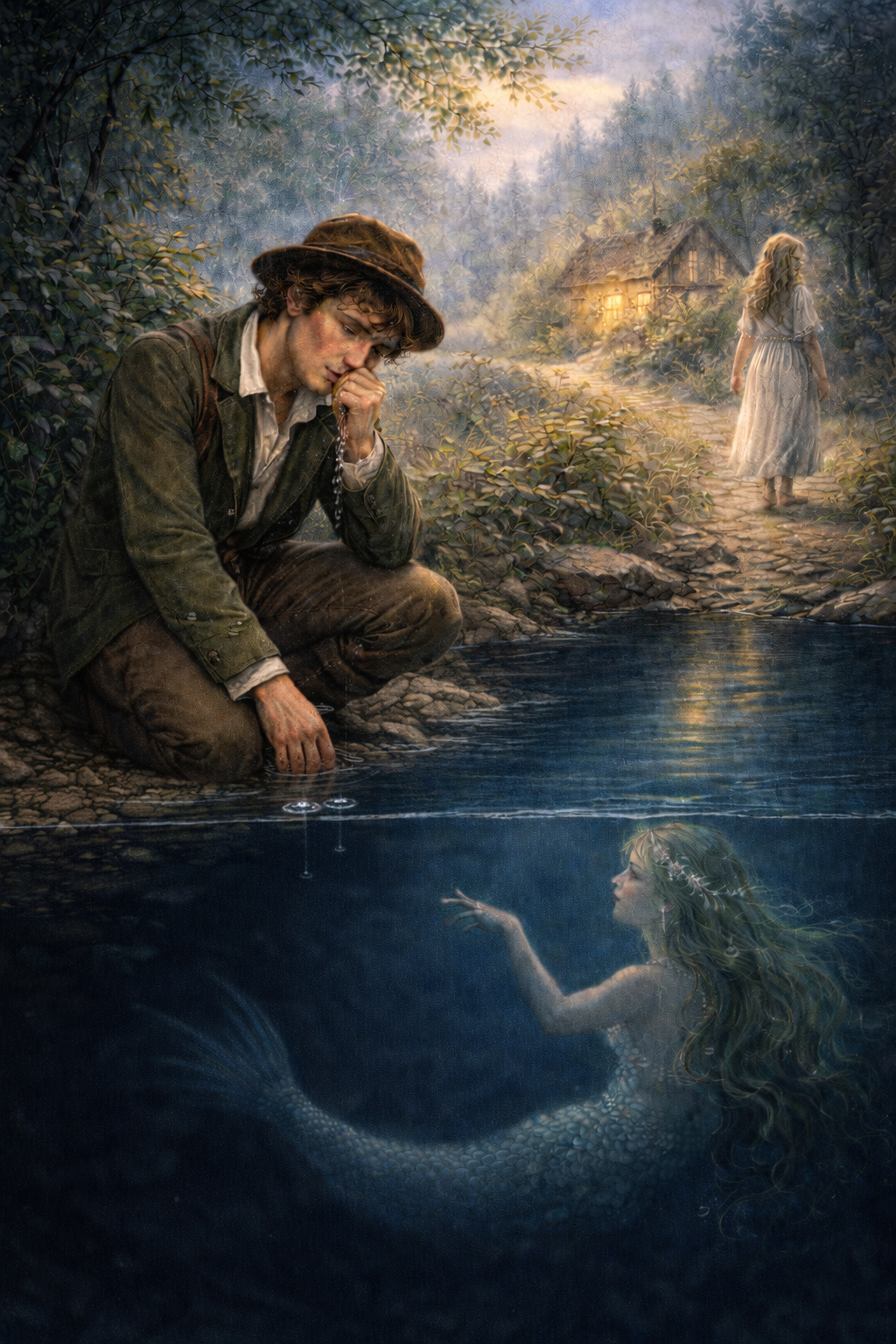
Artistic visualisation by Evgenia Fölsche:
The image shows the wanderer in a moment of silent despair by the brook.
His tears fall into the water, yet what rises from his innermost being remains
unrecognized by the outer world. Beneath the surface of the water the water-nymph can be seen—
that mysterious power of the brook that has accompanied, lured, and guided him
since the beginning of his journey. Thus the brook becomes here as well the mirror of his soul
and the space of a hidden, deeper happening.
Particularly striking is the contrast between inward truth and outward
misunderstanding. The lovely miller’s daughter thinks it is going to rain and returns
into the house. She does not realise that it is the wanderer’s tears that disturb the
surface of the water. In this very point the song’s tragic situation becomes concentrated:
what most deeply shakes him appears to her merely as an insignificant event of nature. His
feeling is not perceived, but mistaken for the weather.
The water-nymph beneath the surface lends the scene an added poetic depth.
She appears like the secret witness of his pain, perhaps even like the
only figure who truly receives his tears. While the miller’s daughter turns away,
the brook remains the animated counterpart to his suffering. Like Schubert’s music,
the image too unites delicate beauty with growing grief. What becomes visible is what resonates in text and
music: that the wanderer’s love, at the moment of greatest inward intensity, is not
understood and finds a space of resonance only in the waters of the brook.
Analysis – Poetry
The poem “Tränenregen” stands at the centre of the cycle Die schöne Müllerin and describes the first moment of real closeness between wanderer and miller’s daughter. For the first time, the two sit together side by side. Yet precisely in this apparently fulfilled moment, the forces that will later lead to catastrophe are already gathering: projection, loss of self, and the seductive power of the brook.
The first stanza sketches a scene full of quiet intimacy:
We sat together so trustfully
Beneath the cool alder boughs,
We looked together so trustfully
Down into the murmuring brook.
The word “trustfully” is repeated twice and conjures up an idyll. The place is sheltered (“beneath alder boughs”) and cool—a counter-image to burning passion. The brook flows quietly, as though sharing in the still togetherness. For the first time, the self is not alone: the longed-for being-together has been attained.
In the second stanza, the gaze widens into the cosmic:
The moon had also come,
The little stars behind it,
And they too looked so trustfully together
Into the silver mirror.
Nature and sky are reflected in the water. The brook becomes a “silver mirror” in which the whole world gathers. The scene takes on something timeless, almost sacred. Yet already here a dangerous dynamic announces itself: the mirror-image begins to replace reality.
The third stanza shifts perception entirely onto the beloved:
I looked for no moon,
For no starlight,
I looked for her image,
For her eyes alone.
The wanderer now perceives the world only through the image of the miller’s daughter. Everything else recedes. The beloved’s eyes become the sole fixed point. The glance of love narrows perception—a central motif of the cycle: the outer world now exists only as the mirror of inner longing.
In the fourth stanza, projection begins:
And I saw them nodding and glancing
Up from the blessed brook,
The little flowers on the bank, the blue ones,
They nodded and glanced after her.
The reflection in the brook seems to come alive. The flowers—already connected in earlier songs with the miller’s daughter’s eyes—now “glance” and “nod.” Nature seems to answer the wanderer’s love. Reality and imagination merge. The brook becomes the voice of inward desire.
The fifth stanza leads into a dangerous depth:
And sunk into the brook
The whole heaven seemed,
And wanted to draw me down with it
Into its depth.
The mirror of the water draws the self toward it. The whole sky seems to have fallen into the depth—a powerful image of self-loss. The brook becomes a suction that wants to “draw the wanderer down.” Here, for the first time, the proximity of death appears clearly, a proximity that will later conclude the cycle.
In the sixth stanza, the brook itself speaks:
And above the clouds and stars
The brook rippled along merrily
And called with singing and ringing:
Journeyman, journeyman, follow me!
The brook receives a voice and calls to the wanderer. It becomes the seductive companion who offers an alternative world—beyond social order and human attachment. The “journeyman” is meant to follow: a call into self-dissolution.
The last stanza returns abruptly to reality:
Then my eyes brimmed over,
Then the mirror grew so ruffled:
She said: Rain is coming,
Farewell, I’m going home.
The wanderer’s tears ruffle the water. The spell is broken. The miller’s daughter speaks directly for the first time—matter-of-factly, soberly, without any knowledge of the self’s inward upheaval. She interprets the tears as “rain.” With her departure, the moment of closeness ends. The self remains behind—alone, with a brook that has already appeared as the voice of his own undoing.
The poem thus shows the turning point of the cycle: the greatest nearness already bears within it the seed of farewell. Love reaches its apparent climax—and at the same time reveals its destructive dynamic.
Meaning & Effect within the Cycle
“Tränenregen” forms the emotional centre of Die schöne Müllerin. For the first and only time, wanderer and miller’s daughter truly sit together. Yet the poem makes clear that this encounter is less a real relationship than an inward experience of the speaker. The miller’s daughter remains distant, while the wanderer loses himself in reflections, flowers, and water.
Here the brook definitively assumes the role of the true counterpart. It reflects, speaks, lures, and draws. What in earlier songs was friend now becomes seducer. The wanderer begins to replace the human relationship with a relationship to nature—a decisive step toward self-surrender.
Thus “Tränenregen” stands at the turning point of the cycle: hopeful love becomes painful fixation. The miller’s daughter’s departure is outwardly casual, but inwardly it marks the beginning of final disintegration. The wanderer is left behind—no longer sustained by wandering, but drawn by the depth of the brook.
Evgenia Fölsche – Performances & Audio
Pianist Evgenia Fölsche shapes a fine water-nocturne: even waves in the piano, speaking legato, discreet brightening at the brook’s call, and a quiet, “faded” ending.
Audio example: Tränenregen with Dietrich Fischer-Dieskau and Gerald Moore
Concert Enquiry
Die schöne Müllerin by Franz Schubert is part of Evgenia Fölsche’s song repertoire and is performed regularly in collaboration with renowned singers. Concert programmes can be arranged flexibly and adapted to different line-ups.
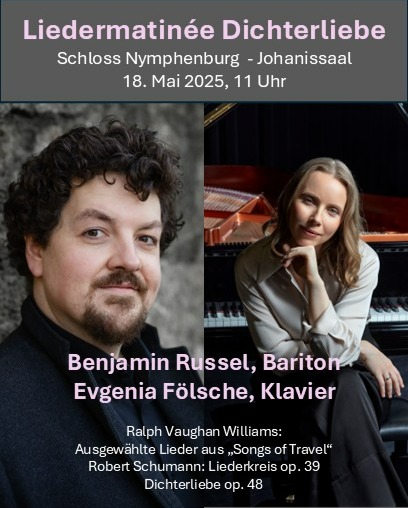
Evgenia Fölsche has collaborated, among others, with singers such as Johannes Kammler, Benjamin Russell and Gerrit Illenberger who have Die schöne Müllerin in their repertoire.
Send concert enquiryFrequently Asked Questions about Schubert: “Tränenregen” (Die schöne Müllerin No. 10)
Click on a question to reveal the answer.
Is the song strophic?
Yes, essentially strophic; however, the final verse receives a characteristic minor shading as an epilogue-like colouring.
What key / meter?
Bright major-tonal space (often A major in editions); calmly flowing andante with even wave-motion; ending with a nuance of minor.
Text detail “eye / eyes”?
Müller’s printed text gives “eyes” (plural); Schubert at times sets “eye” (singular)—a small but often discussed variant.