“Wohin?” is Song No. 2 from Franz Schubert’s cycle Die schöne Müllerin D 795 (1823), after Wilhelm Müller. After the programmatic departure of No. 1 (“Das Wandern”), the first dialogue with the brook follows here: a beckoning call, wonder, and an almost imperceptible being drawn “downward and ever onward.” Schubert sets this as a 6/8-driven, strophic song in which the piano depicts the brook’s glitter and the current’s pull.
The Verse (Wilhelm Müller - Seventy-Seven Poems from the Posthumous Papers of a Travelling French Horn Player, 1821)
From: Die schöne Müllerin – cycle “Wanderschaft”
I heard a little brook murmuring
Out of the rocky spring,
Murmuring down into the valley,
So fresh and wondrously bright.
I do not know what came over me,
Nor who gave me the counsel,
But I too had to go down
With my walking staff.
Downward and ever farther,
And always following the brook,
And ever brighter murmured
And ever brighter the brook.
Can this then be my road?
O little brook, speak, where to?
With your murmuring
You have utterly intoxicated my senses.
Why do I speak of murmuring?
That can be no mere murmuring:
Surely the nixies are singing
Deep below in their dance.
Let them sing, my friend, let it murmur,
And wander on cheerfully!
For mill wheels turn
In every clear brook.
Work Data & Overview
- Composer: Franz Schubert (1797–1828)
- Cycle: Die schöne Müllerin D 795, No. 2
- Text source: Wilhelm Müller, poem “Wohin?” (cycle Die schöne Müllerin)
- Composition: October 1823; first print 1824 (Book 1)
- Tonal range / meter: in the orbit of G major (transpositions common), 6/8, lively and flowing
- Duration: approx. 2:30–3:30 minutes
- Scoring: Voice and piano (all ranges via transposition)
- Form: strophic (6–7 stanzas depending on edition; here 7)
Data on the Poem
- Author: Wilhelm Müller (1794–1827)
- First publication (text): 1821 in the cycle Die schöne Müllerin
- Stylistic devices: personification (brook), rhetorical question (“Where to?”), onomatopoeia (“murmuring”), mythical cipher (nixies)
Origins & Cycle Context
“Wohin?” follows directly on No. 1 and deepens the miller lad’s identification with the brook: the stream becomes a guide—and a surface of projection for longing and restlessness. Dramatically, the song shifts the hero from general delight in wandering to a directed movement: toward the mill and toward encounter.
More about the cycle (content, work data, all song articles) on the overview page: Die schöne Müllerin – Overview.
Performance Practice & Reception
Pulse & breathing: The 6/8 flow remains buoyant; do not rush, but let it draw onward. The piano lets the glittering eighth-note figure sparkle, while the singing remains syllabically clear. Text before volume—the question “O little brook, speak, where to?” should receive a subtle moment of suspension.
Changes of color: the “nixies” stanza slightly enchanted (more delicate dynamics, a minimal shimmer of pedal); final stanza (love) with a careful diminuendo—premonition rather than pathos.
Reference Recordings (Selection)
- Fritz Wunderlich – Hubert Giesen (Orfeo)
- Ian Bostridge – Graham Johnson / Mitsuko Uchida (EMI/Decca)
- Christoph Prégardien – Andreas Staier (fortepiano; harmonia mundi)
- Dietrich Fischer-Dieskau – Gerald Moore (DG)
- Matthias Goerne – Christoph Eschenbach (Teldec)
Analysis – Music
Brook Figure & Pulling Force
The right hand glitters in undulating eighth notes/arpeggios, while the bass outlines the direction of the current—a moving ostinato as the leading gesture. Above the flow lies a simple, speech-like line; the music “pulls” the singer along just as the brook pulls the wanderer—semantic unity of text and accompaniment.
Strophic Form, Phrases & Turning Points
Schubert preserves the strophic form, yet colors it subtly: slight brightenings at “fresh and wondrously bright,” a brief pause at “O little brook, speak, where to?” The “nixies” lines receive a gentler articulation.
Visual Representation
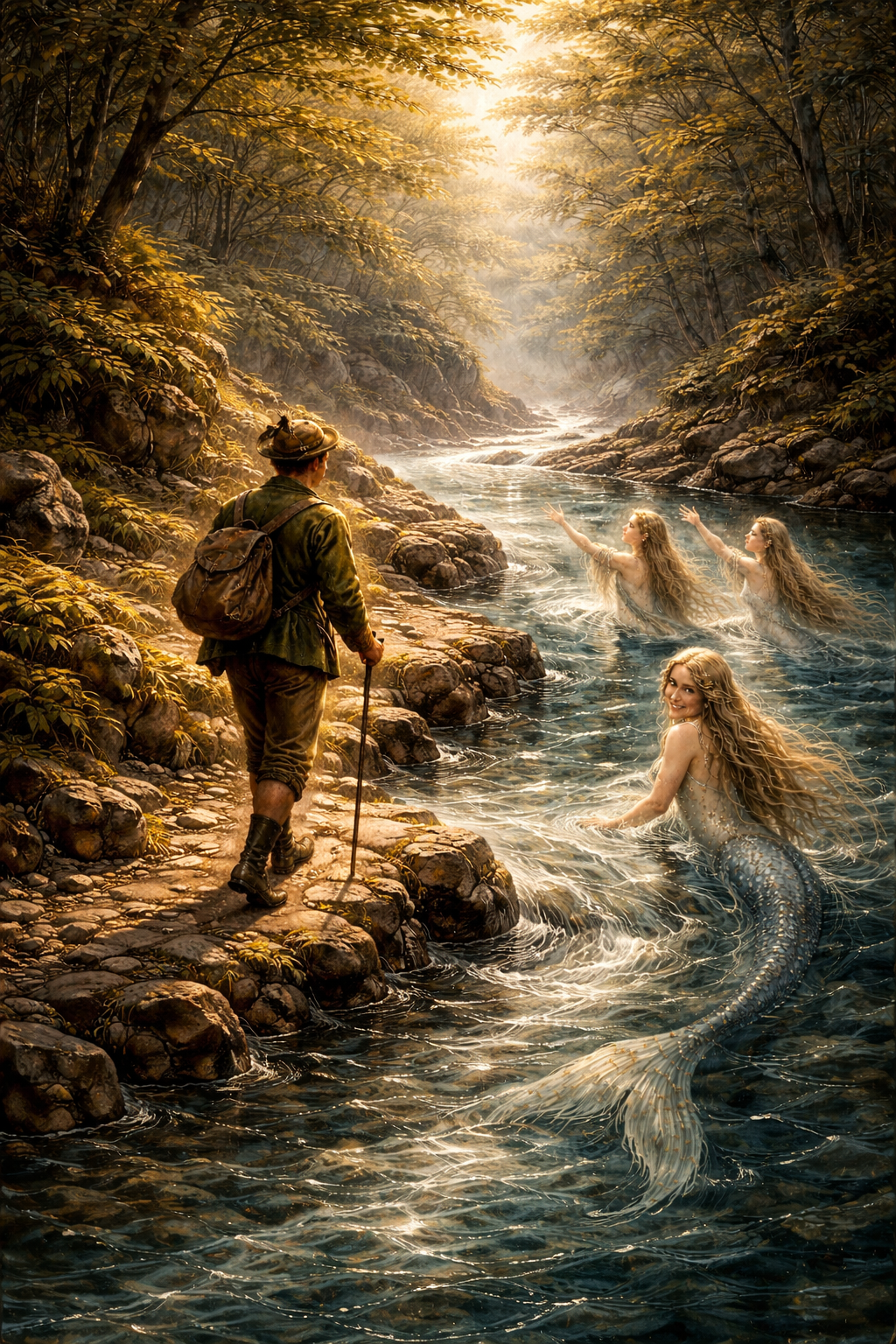
Artistic visualization by Evgenia Foelsche:
The image shows the young miller lad at the moment of questioning and seeking.
He follows the course of the brook, which leads him enticingly through the landscape,
though his destination is not yet clearly visible. In this way, the picture captures
a moment in which movement and uncertainty are closely bound together: the path is open,
yet its direction seems determined less by the wanderer himself than by the flowing water.
At the same time, the brook in this visualization takes on something enchanted and seductive.
In its shimmer and movement, one senses the nixies who show the miller lad the way.
They intoxicate him, lure him onward, and guide him with a gentle, almost irresistible force.
Thus the brook becomes not only a natural companion, but an animated, mysterious power
that draws the wanderer onward and shapes his questioning.
Like Schubert’s music, the image also conveys a feeling of lightness and flowing motion.
Lines, visual guidance, and atmosphere follow the pull of the water and let the eye wander along.
The scene still carries the bright tone of the beginning within it: nature, youth, and hope form a unity,
yet in the brook’s seductive guidance there is already an element of enchantment and distance from reality.
What becomes visible is what resonates in text and music alike—the search for a destination that is at the same time
a surrender to an intoxicating, guiding force.
Analysis – Poetry
The poem “Wohin?” forms the second song of the cycle Die schöne Müllerin and follows immediately upon the programmatic declaration of the first poem. While “Das Wandern” establishes movement as a general principle of life, “Wohin?” shows for the first time a concrete sense of direction: the wanderer encounters the brook—and follows it. In this way, the water becomes the central leitmotif of the entire cycle.
Right at the beginning, the brook appears as a natural voice:
I heard a little brook murmuring
Out of the rocky spring,
Murmuring down into the valley,
So fresh and wondrously bright.
The water is not only seen, but heard. The “murmuring” is the cycle’s first acoustic signal and creates an immediate sensual attraction. The brook comes “out of the rocky spring”—from a hidden depth—and streams “down into the valley.” Already here there is a double motion: the natural flow of the water and the symbolic direction of the fate to come.
In the second stanza, the effect of this call on the lyrical self becomes clear:
I do not know what came over me,
Nor who gave me the counsel,
But I too had to go down
With my walking staff.
The decision to follow does not appear rational, but like an inspiration. The self briefly loses control over its own actions—“I had to.” Wandering is now no longer a freely chosen principle, but a response to an external summons. The walking staff, still a sign of self-determined travel in the first poem, here becomes the tool of an inner compulsion.
The third stanza intensifies the motion:
Downward and ever farther,
And always following the brook,
And ever brighter murmured
And ever brighter the brook.
The repetition of “ever” creates a sense of pull. The language itself imitates the continued movement. At the same time, the brook becomes “ever brighter”—not only louder, but more luminous, more alluring. Outer perception rises into inner excitement: the wanderer enters a state of increasing fascination.
In the fourth stanza, the cycle’s first dialogic relationship begins:
Can this then be my road?
O little brook, speak, where to?
With your murmuring
You have utterly intoxicated my senses.
The brook is directly addressed and personified. It is now interlocutor and guide. The question “Where to?” gives the poem its title and marks a decisive point: general wandering becomes purposeful following. At the same time, the brook’s influence is described as intoxication—a first hint of emotional enchantment that will later turn into the suffering of love.
The fifth stanza lifts perception into the fantastic:
Why do I speak of murmuring?
That can be no mere murmuring:
Surely the nixies are singing
Deep below in their dance.
The brook is now interpreted as a mythical place. Voices of nixies replace the natural sound. Reality is poetically heightened—the wanderer projects his longing into nature. In this way, the space opens toward the fairy-tale-like, which in the further course of the cycle will take concrete form in the figure of the miller maid.
In the closing stanza, the poem returns to motion:
Let them sing, my friend, let it murmur,
And wander on cheerfully!
For mill wheels turn
In every clear brook.
The wanderer finally accepts the call of the water. The brook becomes a “friend,” a companion. The last line establishes the connection to the mill: where a clear brook flows, mill wheels turn. Thus the goal of the action to come—the mill—is indirectly announced, without yet being named. The motion of the water necessarily leads to the motion of the wheels—and likewise, the wanderer’s motion will necessarily lead him to the miller maid.
Formally, the poem works with strong repetitions, the onomatopoetic “murmuring,” and a steadily increasing intensification. In this way, the pull of the water is linguistically enacted, and the reader is drawn into the same current as the wanderer.
Meaning & Effect Within the Cycle
“Wohin?” is the true starting signal of the action. The wanderer has accepted the principle of wandering, but only here does his motion gain direction. Water becomes the leitmotif of the entire cycle: as guide, interlocutor, mirror of inner states, and finally as the last refuge.
At the same time, the poem shows the first enchantment of the self by an external voice. The wanderer no longer follows only his own will, but a lure that he himself heightens into the mystical. Thus the basic pattern of the coming love story is already established: surrender, projection, and the willingness to let oneself be led.
At the end stands the quiet certainty: where the water leads, the mill awaits—and with it the encounter that will determine the rest of the cycle. Free wandering becomes bound longing.
Evgenia Fölsche – Performances & Audio
Audio example: Gerrit Illenberger, baritone, and Evgenia Fölsche, piano, at the Festival der Stimmen Liechtenstein 2025