“I Have Trod the Upward and the Downward Slope” closes Ralph Vaughan Williams’ Songs of Travel after Robert Louis Stevenson as the epilogue of the cycle. The wanderer gathers his life into a path of ascents and descents – without complaint, in plain dignity. Musically, Vaughan Williams returns to the calm tread and the nearness of folksong simplicity: a quiet, open Amen to the journey.
Text (Robert Louis Stevenson – Original)
From: Songs of Travel and Other Verses (1896) – Epilogue
Original (English):
I have trod the upward and the downward slope;
I have endured and done in days before;
I have longed for all, and bid farewell to hope;
And I have lived and loved, and closed the door.
Text: Robert Louis Stevenson (1850–1894), public domain.
Work Data & Overview
- Composer: Ralph Vaughan Williams (1872–1958)
- Cycle: Songs of Travel – No. 9 I Have Trod the Upward and the Downward Slope (Epilogue)
- Text source: Robert Louis Stevenson, Songs of Travel (1896)
- Composition: c. 1901–1904 (piano version of the cycle); the epilogue is presented in modern editions as No. 9; the orchestral version became established later in the 20th century.
- Tonal space / Metre / Tempo: minor-inflected foundation with modal brightenings; 4/4; Andante semplice
- Duration: approx. 1½–2½ minutes
- Scoring: voice and piano (transpositions are common); also widely performed in orchestral form
- Form: brief strophic epilogue; with reminiscences of earlier gestures in the cycle
Genesis & Cycle Context
The original printed version of Songs of Travel comprised eight songs; the epilogue I Have Trod… is now performed as the ninth and concluding piece. Dramaturgically, it closes the circle: after departure, love, dream, stellar vastness, and homespun remembrance, the voice now speaks in summary – without pathos, in a plain final stillness.
Performance Practice & Reception
Voice: Narrative in bearing; the text should carry, vowels remain calm, consonants never hard. The ending is gently assented to, not demonstrated.
Piano: A steady tread in the bass, simple chordal layering; transparent pedal so that the final stillness is not blurred.
Reception: Standard in modern performances as the cycle’s epilogue – for its laconic and deeply moving simplicity.
Reference Recordings (Selection)
- Gerald Finley – Julius Drake
- Roderick Williams – Iain Burnside
- Sir Thomas Allen – Roger Vignoles
- Bryn Terfel – Malcolm Martineau
Analysis – Music
Epilogue Formula & Reminiscences
The melodic writing recalls earlier songs of the cycle: the calm tread, the syllabic line, the modal inflections. Small intervallic closures – a kind of “step” cadence – evoke the beginning of the cycle, though now in a mood of inward settlement.
Open Ending & Quiet Cadence
The close avoids any triumphal cadence. A quiet sustaining sonority allows the journey to continue inwardly – the door closes softly, but the road remains.
Visual Representation
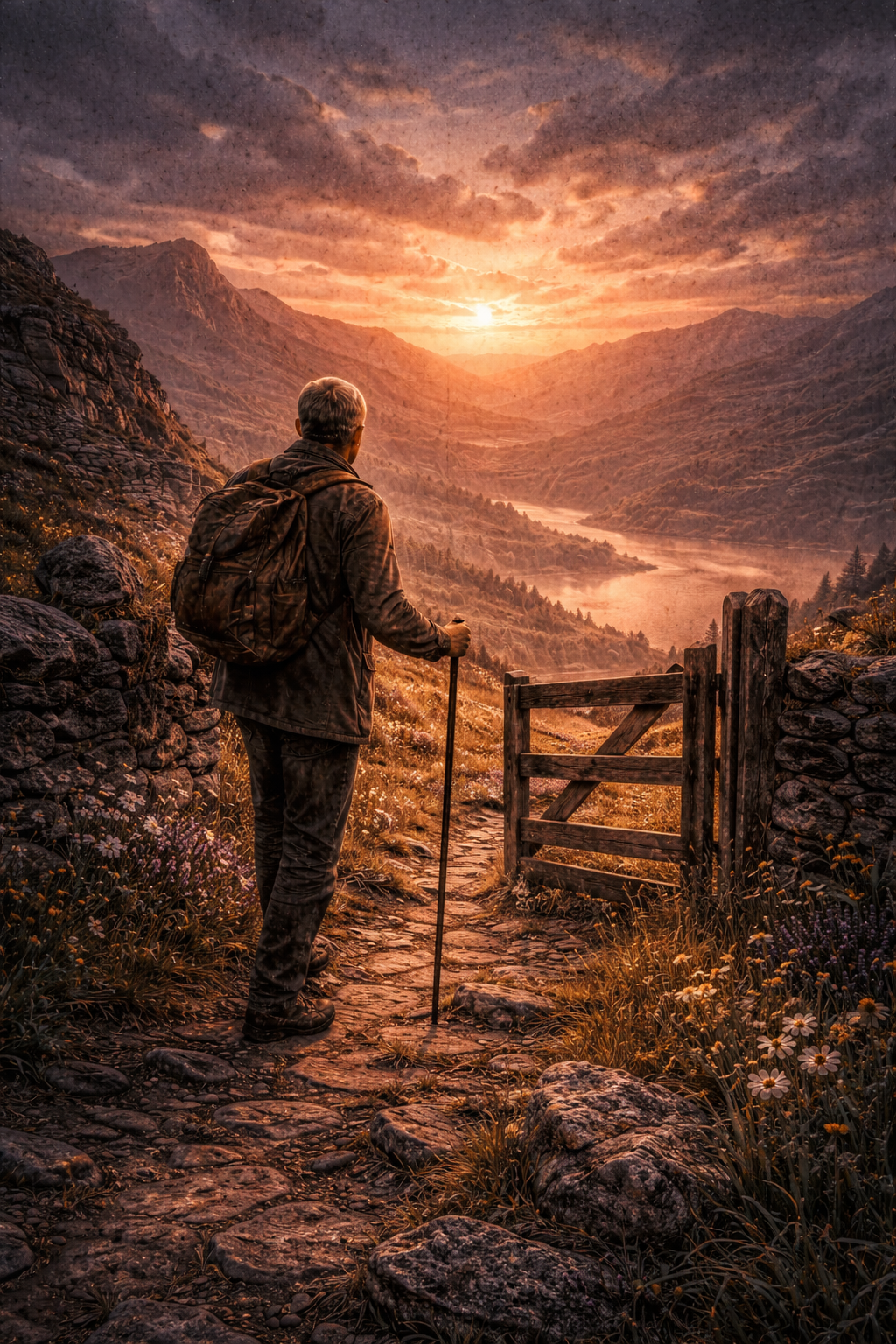
Artistic visualisation:
An old wanderer stands on a narrow stony path in a mountainous
landscape. Before him the view opens into a wide distance filled
with evening light. Beside him stands a wooden gate, marking the
road like a final threshold. The walking staff, the knapsack,
and the figure’s composed bearing make clear that this is no longer
a departure, but a pause at the end of a long life’s road.
In this way, the image takes up the song’s central symbolism with
immediate force. The path stands for the “upward and the downward
slope”, that is, for the heights and depths of life through which
the speaker has already passed. The landscape appears wide and open,
yet no longer promising in the sense of a new beginning. Rather,
it resembles a still panorama of retrospection: the wanderer looks
not forward in expectation, but backward and outward into a larger calm.
Particularly meaningful is the gate at the roadside. It gives visible
form to the song’s final line – “and closed the door”. The image shows
no dramatically slamming entrance, but a simple boundary in which
conclusion, decision, and composure gather together. Precisely בכך,
it corresponds to the song’s character: the ending feels not desperate,
but collected, quiet, and dignified.
Musically, this visual idea suits the cycle’s epilogue with particular
aptness. Vaughan Williams shapes the song not as a large outburst,
but as a concise, grave, and clarified summing-up of life. The music
bears no outward drama, but a calm, almost walking solemnity.
Just as the wanderer in the image pauses upon the path, so the music
holds the moment between movement and ending.
The warm evening light finally lends the scene a double significance:
it is the light of farewell, but also of fulfilment. The day declines,
yet it has not passed without meaning. In this way the image becomes
an emblem of the whole song: of a life that has measured heights and
depths, known love and loss, and at the end has brought its road to
rest not in lament, but in quiet acceptance.
Analysis – Poetry
“I Have Trod the Upward and the Downward Slope” forms the quiet conclusion of the cycle. In the utmost brevity, the speaking voice draws up a reckoning of an entire life. Unlike the earlier songs, neither departure nor loss, neither landscape nor concrete memory stands at the forefront here, but retrospective summation itself. The text names in dense succession the fundamental motions of human existence: ascent and descent, endurance and action, longing and farewell, life and love. Precisely through this concentration, the poem functions as an epilogue in the fullest sense: it closes the road not by means of an event, but through a stance of inward acceptance.
Life as a path through heights and depths
I have trod the upward and the downward slope;
Already in its opening line, the poem gathers life into the image of a path. The speaking self has walked both the upward and the downward incline. Human existence thus appears as motion through opposing experiences: success and failure, hope and disenchantment, ease and burden. Characteristically, the line neither elaborates nor judges these opposites. It names them in a quiet, matter-of-fact formula. That very restraint creates the impression of a seasoned voice, one that no longer struggles, but looks back and lets the whole stand.
At the same time, this image of the path connects to the governing idea of the cycle as a whole. There, the road was the place of freedom, longing, love, loss, and remembrance. In the epilogue, it becomes a metaphor for an entire life. The wanderer is no longer simply a figure of being on the way, but a human being who surveys his whole course in a single sentence.
Endurance and action
I have endured and done in days before;
The second line joins two elemental forms of human existence: enduring and doing. Life consists not only in action of one’s own, but equally in what must be borne and suffered. In this compressed juxtaposition there is a remarkable sobriety. The self does not boast of its deeds, nor does it complain of what it has endured. Both are placed beside one another as equally essential parts of the past.
It is precisely this balance that gives the poem its dignity. There is no heroisation of action and no lament over suffering. Instead, life appears as something both actively shaped and passively borne. The speaker derives authority not from superiority, but from having lived through both conditions.
Longing and the farewell to hope
I have longed for all, and bid farewell to hope;
In the third line, the reckoning deepens into something more existential. The self has longed “for all”. In that phrase there gathers once more the whole breadth of human desire: the wish for happiness, love, fulfilment, meaning, perhaps even for a wholeness that can never be fully attained. Yet this comprehensive longing is followed by a farewell to hope. The movement of the line thus leads from desire to renunciation.
Here lies the poem’s gravest accent. It is not the triumph-song of one who has been fulfilled, but the voice of someone who has recognised the limits of life. And yet the farewell to hope does not simply mean despair. It sounds more like a releasing of illusions. Hope is not dramatically shattered, but quietly let go. The poem thereby acquires a tone of renunciation that is not bitter, but clarified.
To live, to love, and to close the door
And I have lived and loved, and closed the door.
The final line gathers the life’s account into one last and memorable formula. To live and to love appear as the two decisive enactments of human existence. It is striking that after privation, after ascent and descent, after longing and farewell, the poem names not resignation or emptiness, but these two simple verbs: lived and loved. They lend the reckoning, for all its finitude, a quiet positive core.
All the more powerful, then, is the final turn: “and closed the door”. The closing of the door is a potent image of conclusion. It may suggest death, the end of a life’s road, or more generally the conscious ending of a chapter. What matters is that the gesture appears neither dramatic nor desperate. The door is closed, not slammed. In this way, the poem ends in a posture of calm, decision, and finality.
The epilogue as a voice of acceptance
I have trod …
… and closed the door.
The poem’s distinctive power lies in its extreme compression. In only four lines, the image of an entire life emerges. Each line contains a pair of opposites or a double movement, and from this sequence grows the impression of fullness and completion. The poem renounces concrete detail and thereby gains universality. It speaks not only of one wanderer’s fate, but of a human life-experience as such.
As the cycle’s epilogue, the text therefore fulfils a special function. It gathers once more, in condensed form, the motifs of journeying, longing, love, and loss, without narrating them anew. What remains is no grand conclusion and no promise of consolation, but a stance: life has been traversed, in its heights and depths accepted, and its ending carried out with quiet dignity.
“I Have Trod the Upward and the Downward Slope” is thus a poem of reckoning and farewell. It speaks of finitude without falling into complaint, and of fulfilment without claiming triumph. It is precisely in this plain and composed language that it attains its extraordinary stature.
Meaning & Effect
At the centre of the poem lies the insight that a life does not consist only of successes or hopes, but equally of hardship, loss, and leave-taking. Yet that life does not appear as a failure. The speaking self has lived, loved, endured, and acted – and in this precisely lies its dignity. The poem thus articulates a stance of acceptance: one cannot keep hold of life, but one can affirm it as a whole and bring it quietly to a close.
The poem’s effect resides in its concise and ceremonially simple language. Without pathos and without elaborate imagery, it opens a large inward space. The text feels not dramatic, but gathered, calm, and final. Within the cycle, it is therefore a perfect ending: the wanderer no longer speaks of the road before him, but of the road he has walked, and closes the journey in quiet dignity.
Evgenia Fölsche – Performances & Audio
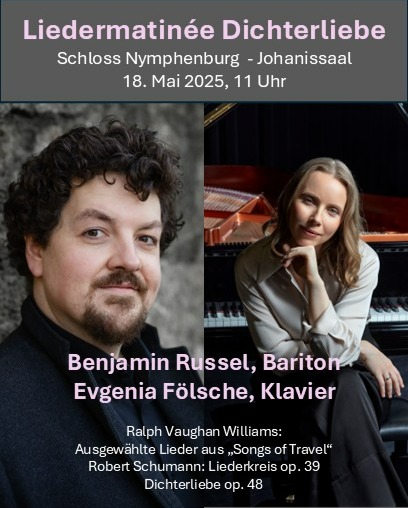
Evgenia Fölsche keeps the tempo plain and the tone narrative: no pathos, clear words, a warm pianissimo. The postlude remains breathing – a closing of the door in half-light.
FAQ – Vaughan Williams: “I Have Trod the Upward and the Downward Slope” (Songs of Travel No. 9)
Click on a question to reveal the answer.
Was the cycle originally in eight songs or nine?
Originally, eight songs were published; the epilogue I Have Trod… is added in modern editions as No. 9 and is now standard in performance.
Is the orchestral version authentic?
An authorised orchestral version of the cycle exists; the establishment of the epilogue as the concluding number took hold in the 20th century. In practice, piano and orchestral versions stand on equal footing.
What attitude does the ending require?
Laconic calm, without pathos. These lines are a summation, not a lament – tell them, do not explode them.