“Здесь хорошо” (“How fair this spot” / “Here it is beautiful”), Op. 21 No. 7, is one of the best-known songs by Sergei Rachmaninoff from the cycle 12 Romances, Op. 21 (1902). The setting of a poem by Glafira Galina describes a quiet moment in nature, in which stillness, light and inward concentration merge into a musical meditation.
The song is not a decorative nature scene. The landscape becomes an inner place: a glowing river in the distance, meadows like a coloured carpet, white clouds, flowers, an old pine — and an almost unspeakable presence, which the lyrical self calls “my dream”. From this, in delicate A major, Rachmaninoff unfolds a broadly breathing, luminous calm of sound.
The poem: Glafira Galina – Russian / English poetic translation
Russian text:
Здесь нет людей… Здесь тишина…
Здесь только Бог да я,
цветы, да старая сосна,
да ты, мечта моя!
Здесь нет людей… Здесь тишина…
Здесь только Бог да я,
цветы, да старая сосна,
да ты, мечта моя!
English poetic translation:
How fair this place — look, far away
the river burns like fire;
the meadows lie like coloured carpets,
white clouds shine in the sky.
There are no people here… Here there is silence…
here only God and I,
the flowers, and the old pine tree,
and you, my dream!
Text: Glafira Galina (1848–1918); free English rendering after the Russian original. Composition by Sergei Rachmaninoff (1902).
Work details & overview
- Composer: Sergei Rachmaninoff (1873–1943)
- Cycle: 12 Romances, Op. 21 – No. 7 “Здесь хорошо” / “How fair this spot”
- Text source: Glafira Galina
- Composition: 1902
- First publication: 1903 by Gutheil
- Key / metre / tempo: A major, 3/4, Andante tranquillo
- Duration: approx. 2–3 minutes
- Scoring: voice and piano; transpositions are common
- Form: two-stanza through-composed song with a calm arc of tension
Details of the poem
- Author: Glafira Galina (1848–1918)
- Language: Russian
- Central images: glowing river, coloured meadows, white clouds, silence, God, flowers, old pine, dream figure
- Literary devices: nature image, repetition of “here”, symbolism of light, religious suggestion, semantics of love and dream
Genesis & context
Rachmaninoff composed the 12 Romances, Op. 21 in 1902, a period in which his lyrical musical language found particular breadth and coherence. “Здесь хорошо” stands within this cycle as a moment of pure inward concentration: no dramatic monologue, no tragic scene, but a pause within the light.
Galina’s poem describes a landscape that seems both real and inward. The river burns in the distance, the meadows lie like a coloured carpet, the clouds gleam white. These images of nature are not mere surroundings, but the expression of an inner state. The beauty of the landscape becomes the form of a quiet, almost religious presence.
What is decisive is the absence of people: “There are no people here” — only through this absence does that enclosed space arise in which the lyrical self knows itself alone with God, nature and the invoked dream figure. Rachmaninoff transforms this situation into music of stillness, in which every movement grows out of the breath of sound.
Performance practice & reception
Voice: The vocal line needs a broadly sustained legato and calm, breathing phrasing. The expression should not be heightened operatically. Even in the emotionally more intense moments, the language remains turned inward: it is about fulfilled stillness, not dramatic expansion.
Piano: The accompaniment must sound like light on water: gently moving, softly arpeggiated, but never blurred. The pedal should connect the harmony without obscuring the contours. The piano figure carries both the image of the river and the breathing of the landscape.
Reception: “Здесь хорошо” is among Rachmaninoff’s most frequently performed songs. It often appears in song recitals, Russian song programmes and instrumental arrangements. The piano transcription by Arcadi Volodos is particularly well known.
Selected reference recordings
- Dmitri Hvorostovsky / Ivari Ilja
- Anna Netrebko / Daniel Barenboim
- Sergei Leiferkus / Malcolm Martineau
- Instrumental version: Arcadi Volodos
Analysis – music
The song rests on a gently moving piano foundation that does less to accompany than to open a shimmering space. The arpeggiated figures suggest water, light and quiet breathing. Above this calm movement unfolds a broad melodic line, whose effect arises from continuity and inner stillness.
Rachmaninoff avoids any harsh dramatic intensification. The harmony remains luminous and softly coloured; small deviations and chromatic transitions do not create conflict, but deepen the colour. A major therefore does not sound simply idyllic, but like a state of inner clarity.
Especially important is the connection between musical motion and stillness. The piano flows, but it does not push forward. The voice rises and opens without destroying the underlying stillness. This creates a paradoxical effect: the song moves, yet at the same time seems to dwell entirely in the moment.
This is precisely where Rachmaninoff’s art of stillness lies. The music does not describe a landscape from the outside, but allows the listener to enter a state in which nature, love, faith and dream appear undivided for a moment. More on open meaning in art song can be found in the background article The Semiotics of Song.
Visual representation
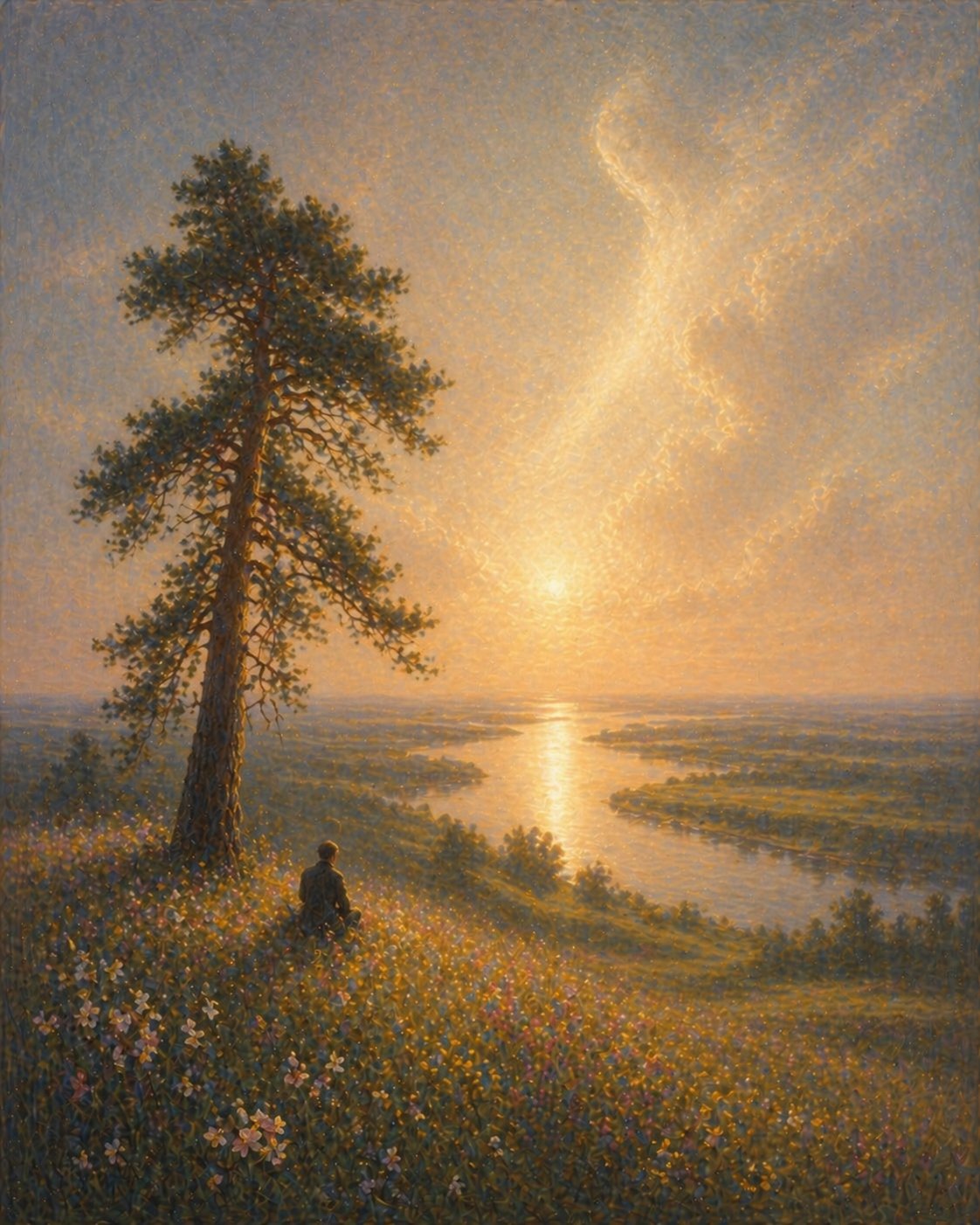
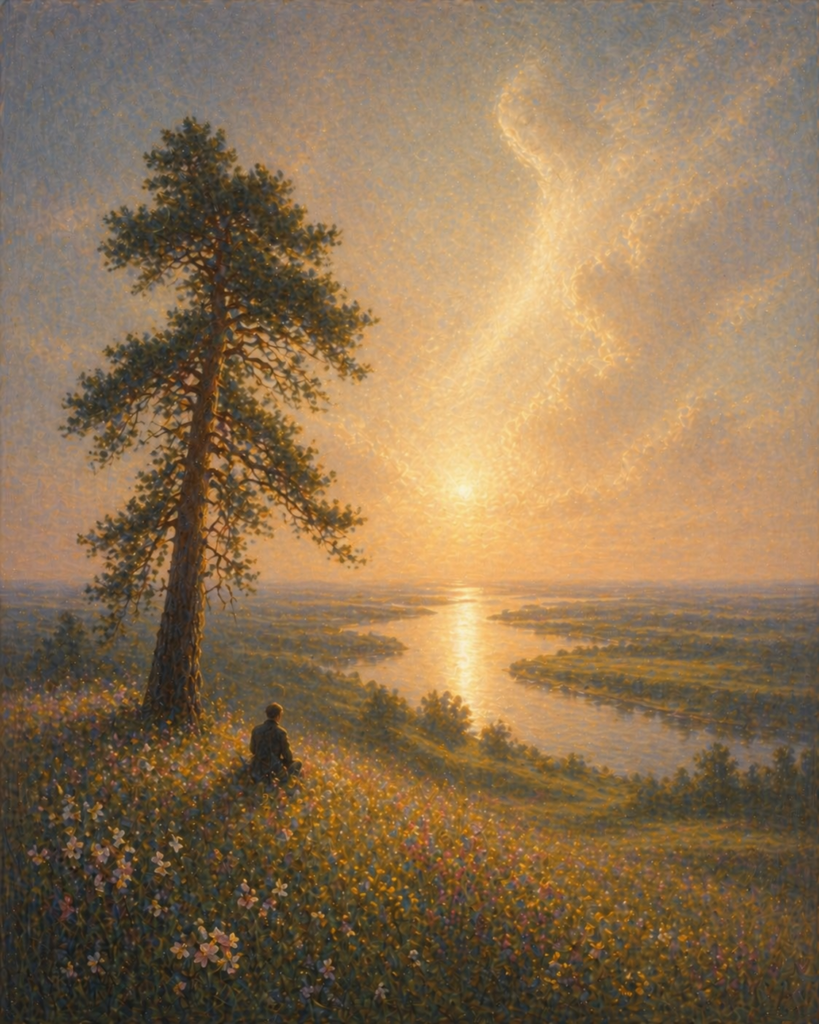
Artistic visualisation by Evgenia Fölsche: Here it is still and beautiful
The image shows a wide, light-filled landscape as a place of inner calm.
A small solitary figure sits beneath an old pine tree and gazes into the distance.
Before the figure stretches a flowering meadow; behind it, a river glows in golden light.
The landscape seems empty of people, but not abandoned:
it is filled with stillness, nature and an almost intangible presence.
The image takes up the central motifs of the poem:
the river glowing like fire, the meadows as a coloured carpet,
the white expanse of the sky, the flowers and the old pine.
The small figure remains modest in relation to the landscape.
This creates not an impression of loneliness as lack,
but of solitude as inward gathering.
The suggested dream presence dissolves almost entirely into light.
It does not appear as a concrete figure, but as a quiet shimmer
in the atmosphere. It therefore remains open whether “you, my dream” means a beloved person,
an inner vision or a form of spiritual closeness.
The warm colouring and the calm horizon make visible
what becomes audible in the song:
a quiet blessedness in which nature, God, self and dream
coincide for a moment.
Analysis – poetry
Galina’s poem does not describe a sequence of action, but a state. The repeated “here” is decisive: it does not merely designate a place, but an inner space. The lyrical self finds itself in a landscape which, through its silence and beauty, becomes a counter-image to the human world.
First stanza
“Здесь хорошо…” / “How fair this place …”
The opening sentence is simple, yet all-encompassing.
It contains no explanation and no justification,
but an immediate experience.
Beauty is not argued for, but stated:
this place is sufficient unto itself.
“Взгляни, вдали / огнём горит река” / “Look, in the distance the river burns like fire”
The gaze is directed into the distance.
The river appears not merely as an element of landscape,
but as a phenomenon of light.
Here, fire is not destructive,
but an expression of radiance, warmth and heightened perception.
“цветным ковром луга легли” / “the meadows lie like a coloured carpet”
The meadows become an ordered, almost festive surface.
The comparison with a carpet gives nature something precious and sheltered.
The landscape is not wild or threatening,
but gently spread out.
“белеют облака” / “the clouds gleam white”
The clouds close the stanza upward.
After river and meadows, the sky opens.
The colour white intensifies the impression of purity,
stillness and luminous distance.
Second stanza
“Здесь нет людей… Здесь тишина…” / “There are no people here … Here there is silence …”
The second stanza begins with a negation:
no people. Yet this absence is not lamented,
but becomes the condition for inner peace.
Silence is named explicitly and takes on an almost sacred meaning.
“Здесь только Бог да я” / “Here there is only God and I”
Solitude is placed within a religious horizon.
The self is not simply alone,
but held within a quiet presence.
God does not appear as a dogmatic figure,
but as a name for the depth and consecration of this place.
“цветы, да старая сосна” / “the flowers and the old pine tree”
Nature now becomes more concrete and closer.
Flowers stand for delicacy and presentness,
the old pine for duration, age and quiet dignity.
Both motifs join transience and permanence.
“да ты, мечта моя!” / “and you, my dream!”
The ending opens the poem into ambiguity.
Who or what this dream is remains open:
a beloved person, an inner vision, beauty itself or an unattainable fulfilment.
Precisely this openness gives the line its strength.
The poem does not end in possession,
but in a hovering invocation.
Meaning & effect
“Здесь хорошо” is one of Rachmaninoff’s purest meditations in sound. The song presents beauty not as overwhelming force, but as quiet presence. Nature is not a background here, but a state of inner order: river, meadow, clouds, flowers and pine form a space in which the self comes to rest.
The special effect lies in the union of simplicity and depth. The text names only a few things, but these things open a vast inner space. Rachmaninoff’s music intensifies this process by not dramatizing it, but by expanding the moment.
At the end there is neither possession nor resolution, but a quiet nearness: God, nature, self and dream stand side by side. The song remains open because it does not explain what “my dream” is. Precisely for this reason, it continues to work. More on this in the article Art That Continues to Work.
Evgenia Fölsche – performances & audio
Evgenia Fölsche interprets the song with a floating tempo, broad breath support and the greatest possible transparency of sound. The voice should not stand above the landscape, but emerge from it: like a line breathing with the light.
What matters is the balance between stillness and inner intensity. The song must not become sentimental; its beauty lies in simplicity, in the clear line and in the long resonance.
Concert video: Go to the concert recording on this page
Rachmaninoff songs for your concert programme
Sergei Rachmaninoff’s songs combine vocal warmth, late-Romantic harmony and great psychological subtlety. “Здесь хорошо” is especially well suited to programmes centred on nature, stillness, light, Russian Romanticism and the spiritual dimension of art song.
Evgenia Fölsche can perform this repertoire as part of song recitals, thematic concert programmes or moderated formats. Particularly attractive is the combination with further Russian romances, but also with songs by Schubert, Strauss, Debussy or Tchaikovsky.
Send a concert inquiryFAQ – Rachmaninoff: “How fair this spot” / “Здесь хорошо”, Op. 21 No. 7
Click on a question to display the answer.
Which cycle does the song belong to?
The song belongs to the cycle 12 Romances, Op. 21 from 1902. It is the seventh number and is among Rachmaninoff’s best-known romances.
What key and mood characterise the song?
The song is in A major and carries the tempo indication Andante tranquillo. Its mood is luminous, calm, intimate and without dramatic intensification.
What is the central image of the poem?
The central image is a quiet, empty landscape: a river glowing in the distance, coloured meadows, white clouds, flowers, an old pine tree and the invoked dream figure.
What is especially important in performance?
The decisive element is the balance between stillness and breath. The voice must flow freely above the gently moving piano, without operatic gesture or sentimentality.