“Danksagung an den Bach” is Song No. 4 from Franz Schubert’s cycle Die schöne Müllerin D 795 (1823), after Wilhelm Müller. After arriving in “Halt!”, the miller lad for the first time addresses a conscious dialogue of thanks to the brook—as a guide “toward the miller maid.” Schubert shapes this into an intimate, song-like piece in G major, 2/4 (Somewhat slow), with simple strophic rhetoric and a refined ABA′ arch.
The Verse (Wilhelm Müller - Seventy-Seven Poems from the Posthumous Papers of a Travelling French Horn Player, 1821)
From: Die schöne Müllerin – “Wanderschaft”
So that was what you meant,
my murmuring friend,
your singing, your sounding,
so that was what you meant?
Toward the miller maid!
that is the meaning.
See, have I understood it?
Toward the miller maid!
Did she send you?
or have you enchanted me?
This I would still like to know,
whether she sent you.
Well, however it may be,
I resign myself to it:
What I sought, I have found,
however it may be.
I asked for work,
now I have enough,
for the hands, for the heart,
more than enough!
Work Data & Overview
- Composer: Franz Schubert (1797–1828)
- Cycle: Die schöne Müllerin D 795, No. 4
- Text source: Wilhelm Müller, “Danksagung an den Bach” (1821)
- Composition: October 1823; first print 1824 (Book 1)
- Original key: G major; Meter/character: 2/4, Somewhat slow
- Duration: approx. 2:00–2:30 minutes
- Scoring: Voice and piano (transpositions common)
- Form: ABA′ (a strophically shaped arch)
Key, dating, and form according, among others, to Schubertlied.de (urtext/source information) and score material.
Data on the Verse
- Author: Wilhelm Müller (1794–1827)
- First publication (text): 1821 (Seventy-Seven Poems …)
- Stanza form: 5 stanzas of 4 lines each (final stanza with internal extension)
- Stylistic devices: direct address, refrain formula (“Toward the miller maid!”), rhetorical questions, parallelism
Origins & Cycle Context
After the “threshold moment” of “Halt!”, the brook becomes the interpreter: “Toward the miller maid!”—the meaning is deciphered, the path gains both goal and motive. The song shifts the narrative from mere travelling into a conscious, grateful attachment to a goal—work and love emerge as promise.
More on the cycle (content, work data, all song articles) can be found on the overview page: Die schöne Müllerin – Overview.
Performance Practice & Reception
Pulse & diction: Somewhat slow, with a calm 2/4 step; the speech of thanks comes first. Consonants soft, vowels sustained; small points of brightness on “Toward the miller maid!”—without operatic inflation.
Stanza colouring: the question stanzas slightly forward-moving, the answering refrain with gentle brightening; final stanza (“work”/“heart”) as simple, cheerful contentment—no triumph.
Reference Recordings (Selection)
- Dietrich Fischer-Dieskau – Gerald Moore (DG)
- Ian Bostridge – Mitsuko Uchida (Decca)
- Christoph Prégardien – Andreas Staier (fortepiano; harmonia mundi)
- Fritz Wunderlich – Hubert Giesen (Orfeo)
- Andrè Schuen – Daniel Heide (DG/Live)
Analysis – Music
Dialogue of Thanks & Gesture of Flow
The piano calms the previously tireless 6/8 motion of the first songs into an ordered 2/4 step; short figures “answer” the voice. The brook becomes a serene supporting current—the thanks speaks over a gentle flow.
Form (ABA′), Tonal Space & Ending
The A sections frame the formula of question and answer; the B section (reflection) sounds somewhat more inward. G major serves as a bright basic colour; the final turn remains simple and confident—“for the hands, for the heart” is musically not pathos, but repose.
Visual Representation
Artistic visualization by Evgenia Foelsche:
The image shows the miller lad in a moment of intimate surrender to the
brook, which has long since become more to him than merely a companion along the way. It is voice,
guidance, and mysterious power—a being that not only carries the wanderer, but
draws him into a new world. In the composition of the picture, this power appears once more
in the figure of the nixie, who gently leads him to the miller maid, as if she herself were the
soul of the flowing water.
Of particular poetic force is the fact that the nixie and the miller maid
remarkably look alike. The miller maid thus seems not simply to stand on the bank, but almost
to have emerged from the brook itself. She appears as the earthly form of that
enchantment which has been luring and guiding him since the beginning of his journey. The nixie not
only points the way to the beloved—she seems to take shape in her. In this way it becomes
visible how thoroughly, in the miller lad’s gaze, nature, longing, and love
intermingle.
Like Schubert’s music, the image also carries a tone of gratitude, enchantment, and
quiet emotion. The flow of the water becomes the flow of feeling; the
brook is no longer merely landscape, but an ensouled counterpart. In the
sameness of appearance between nixie and miller maid, it is revealed that the young miller lad does
not merely find the beloved, but receives her as if in a mirror of the water. The
image makes visible what softly resonates in text and music: that his love itself
seems born from the enchantment of the brook.
Analysis – Poetry
The song “Danksagung an den Bach” follows directly after “Halt!”. The wanderer has reached the mill—now he retrospectively interprets his path as purposeful guidance. The brook is explicitly addressed as an acting, almost personal presence. What began in “Wohin?” as the alluring song of nixies appears here as conscious “guidance.”
This interpretation is established already in the first stanza:
So that was what you meant,
my murmuring friend,
your singing, your sounding,
so that was what you meant?
The wanderer calls the brook a “friend.” He now attributes intention to its murmuring: the singing meant something. Natural sound has definitively become language. Psychologically, this is the moment at which the wanderer fully projects his inner longing outward and understands it as guidance from without.
The second stanza formulates the supposed goal:
Toward the miller maid!
that is the meaning.
See, have I understood it?
Toward the miller maid!
The path is now explicitly interpreted as a path “toward the miller maid.” The wanderer believes he has recognized the meaning of his wandering. Yet the repeated question “See, have I understood it?” betrays an inner uncertainty: he seeks confirmation from the voice of the brook—and thus ultimately from his own projection.
In the third stanza, this projection is intensified further:
Did she send you?
or have you enchanted me?
This I would still like to know,
whether she sent you.
The wanderer asks whether the miller maid herself sent the brook—or whether the brook has “bewitched” him. In doing so, he unconsciously poses the decisive alternative: external reality or inner enchantment. Yet he does not answer the question—he leaves it open and does not choose reality.
The fourth stanza shows the consequence:
Well, however it may be,
I resign myself to it:
What I sought, I have found,
however it may be.
The wanderer surrenders completely to this interpretation. Whether the path was determined from outside or dreamed from within no longer matters. What is decisive is this alone: he believes he has found what he sought. Here begins the self-binding to an inner image that later will no longer be dissolvable.
The final stanza carries this self-binding into the everyday:
I asked for work,
now I have enough,
for the hands, for the heart,
more than enough!
The mill now appears as a place of practical labour and at the same time as a place of emotional fulfilment. The wanderer believes he has now found “enough,” outwardly as well as inwardly. The harmony of nature, work, and feeling seems complete.
Formally, the poem works with questions, exclamations, and repetitions. The language itself circles, confirms, intensifies—a linguistic mirror of the wanderer’s inner self-assurance.
Meaning & Effect Within the Cycle
“Danksagung an den Bach” is the song of self-interpretation. Looking back, the wanderer declares his path to have been a meaningfully guided movement and binds himself definitively to the place of the mill.
At the same time, the cycle’s central psychological structure is fixed here: the wanderer speaks with an imagined voice of nature, seeks confirmation from it, and interprets his inner longing as outward guidance. In this way, his later fixation on the miller maid is already prepared.
Harmony still reigns: nature, work, and feeling seem in accord. Yet it is precisely this apparent fulfilment that creates the precondition for the later crisis. The wanderer has bound himself to an image that reality cannot sustain.
Thus this song forms the quiet conclusion of the entrance into the world of the mill— a moment of happy self-assurance from which the tragedy of the further cycle will only gradually unfold.
Evgenia Fölsche – Performances & Audio
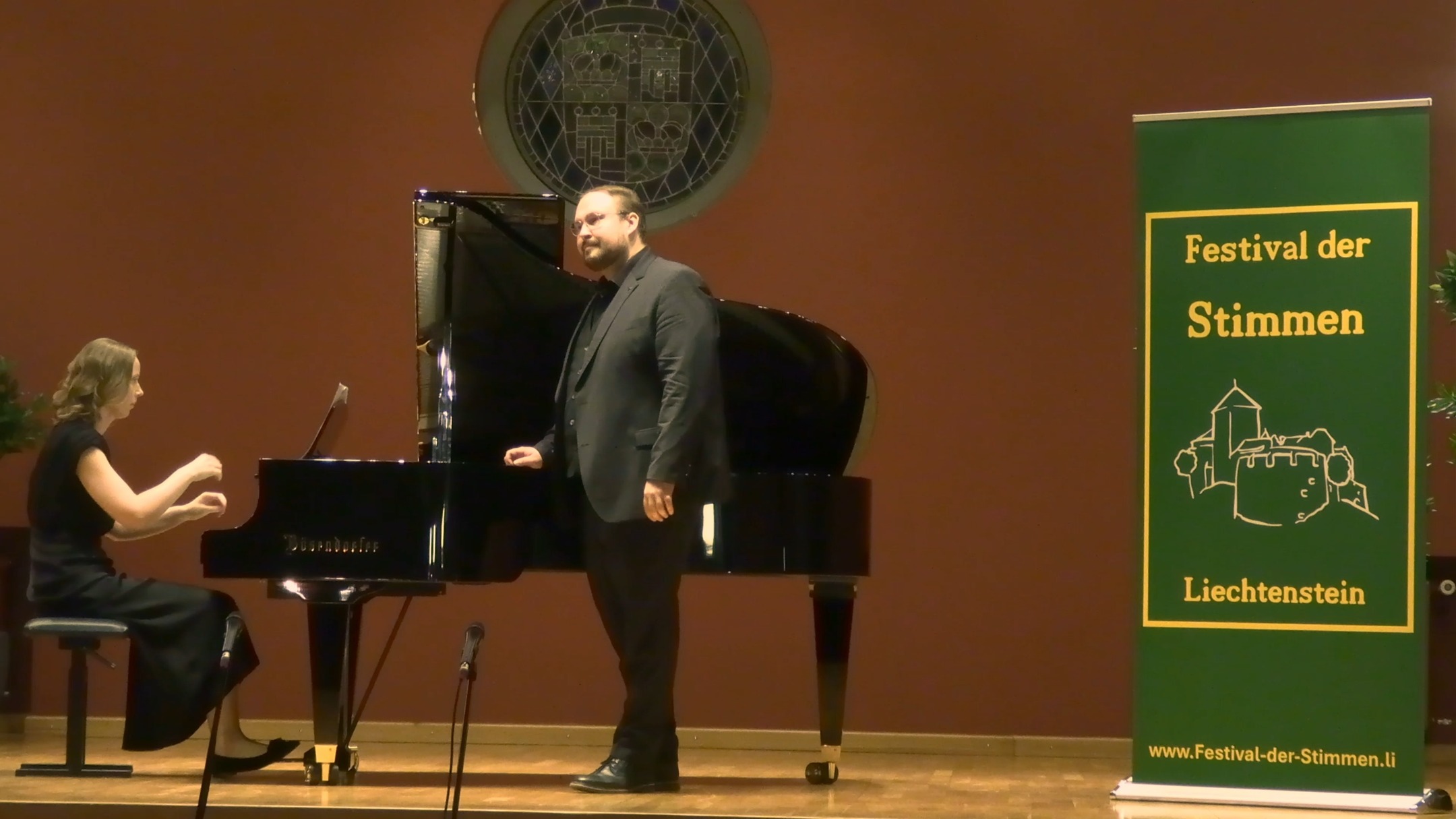
Audio example: Gerrit Illenberger, baritone, and Evgenia Fölsche, piano, at the Festival der Stimmen Liechtenstein 2025