“Trockne Blumen” is song no. 18 from Franz Schubert’s cycle Die schöne Müllerin D 795 (1823), after Wilhelm Müller. After the bright-driven counterpiece “Die böse Farbe”, the tableau turns into a ritual of mourning: the miller lad wants to take the withered love-flowers with him into the grave — a vision of death that briefly flashes into transfiguration. Schubert shapes this into a lamenting scene in E minor, with hints of funeral march, drone colouring, and an inward brightening before the darkness returns.
The Poem (Wilhelm Müller – Seventy-Seven Poems from the Posthumous Papers of a Travelling French-Horn Player, 1821)
You little flowers all,
That she gave me,
You shall be laid
With me in the grave.
How you all
Look at me so sorrowfully,
As though you knew
What has befallen me.
You little flowers all,
How withered, how pale!
You little flowers all,
Why are you so wet?
Ah, tears do not make
Things May-green,
They do not make dead love
Bloom again.
And spring will come,
And winter will go,
And little flowers will stand
In the grass,
And little flowers will lie
In my grave,
All the little flowers
That she gave me.
And when she walks
Past the hillock
And thinks in her heart:
He meant it truly!
Then, little flowers all,
Out, out!
May has come,
Winter is over.
Work Data & Overview
- Composer: Franz Schubert (1797–1828)
- Cycle: Die schöne Müllerin D 795, No. 18
- Text source: Wilhelm Müller, “Trockne Blumen” (first published 1818; collection 1821/1826)
- Composition: Autumn 1823; first published 1824
- Key area / character: E minor, calm, solemn (with hints of funeral march), brief vision in the major
- Metre / duration: 3/4; approx. 3:30–5:00 minutes (depending on forces)
- Scoring: Voice and piano (transpositions common)
- Form: through-composed lamenting scene with contrasting vision and withdrawal
Data on the Poem
- Author: Wilhelm Müller (1794–1827)
- Stanza form: 8 quatrains; repetitive formulas (“You little flowers all …”)
- Devices: emblem (flowers), seasonal antithesis (spring/winter), image of death (grave/hillock), performative imperative (“out”)
Genesis & Cycle Context
“Trockne Blumen” is the tragic culmination point of the cycle: after the reversal of the colour symbolism (Nos. 16/17), the token of love becomes a burial ritual. The brief vision (“Then, little flowers all, out, out!”) opens a moment of transfiguration, which is dramaturgically taken up in “Der Müller und der Bach” (No. 19).
General overview, contents & links to all song articles: Die schöne Müllerin – Overview.
Performance Practice & Reception
Gesture: quiet, collected; no lamenting pathos. The opening lines should be handled gently, the invocations (“You little flowers …”) like a small litany for the dead; the vision bright, but still shadow-touched.
Piano texture: deep drone / organ-point colours, sparse movement; sustained piano, minimal pedal. The brightening into the major as a distant gleam, not as triumph.
Reference Recordings (Selection)
- Dietrich Fischer-Dieskau – Gerald Moore
- Ian Bostridge – Mitsuko Uchida
- Christoph Prégardien – Andreas Staier (fortepiano)
- Matthias Goerne – Christoph Eschenbach
- Fritz Wunderlich – Hubert Giesen
Work and text confirmation, among others, from Oxford Song; LiederNet / SchubertSong.uk (full wording). The sequence of keys in the cycle (E minor for No. 18) is documented in IMSLP. Additional note: Schubert’s Introduction and Variations on “Trockne Blumen” D 802 (for flute and piano).
Analysis – Music
Mourning Gesture & Drone
A persistent deep ground (drone / organ point) carries the syllabic lament. The funeral-march pulse arises from plain triple steps; the voice remains narrow and close to the word — litany rather than aria.
Form, Tonal Space & Vision
E minor encloses the scene; in the vision (“hillock / May / winter is over”) Schubert briefly brightens the colouring — a transfiguration (a gleam of major) that immediately fades again. In this way a hinge point is created before Nos. 19/20.
Visual Representation
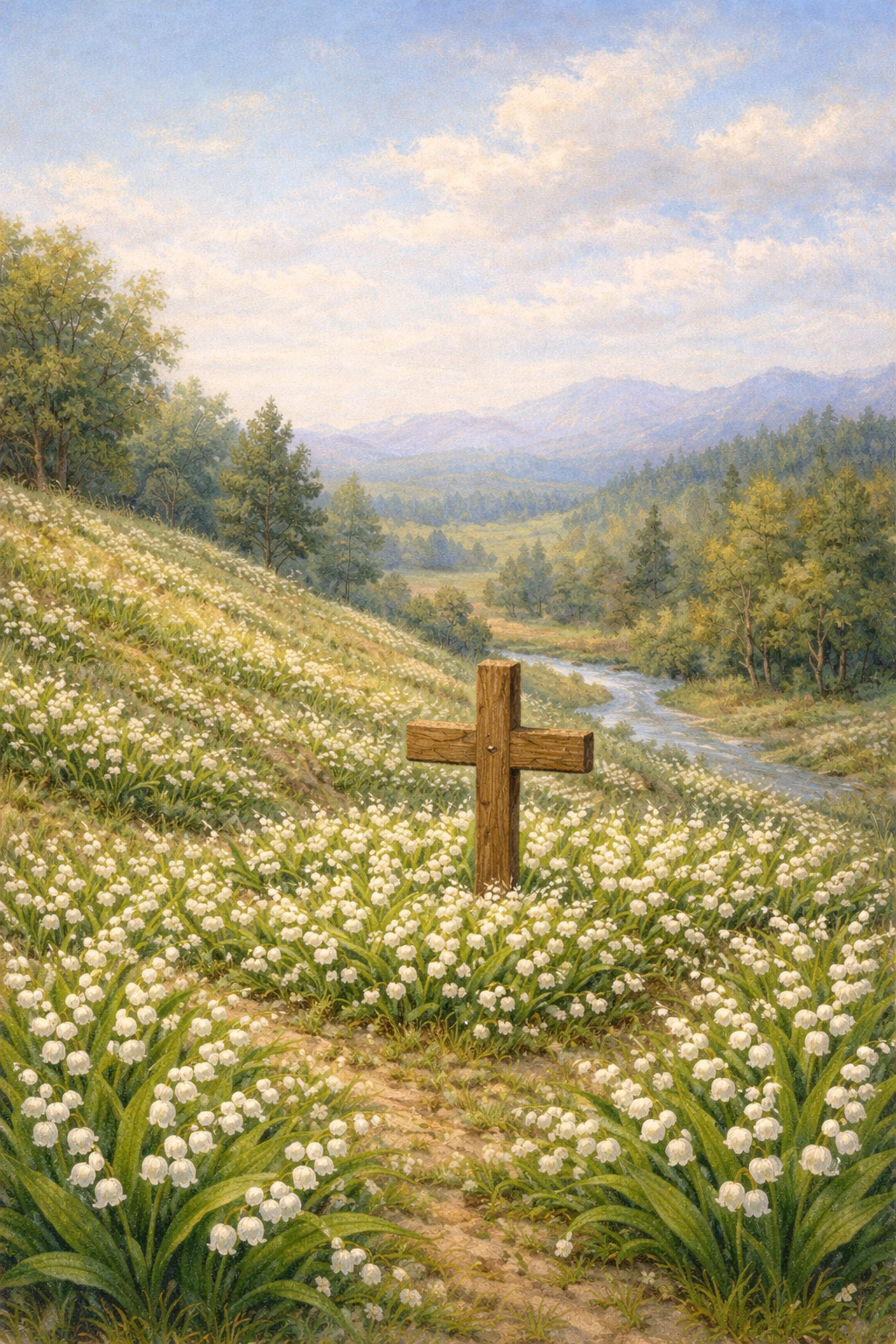
Artistic visualisation by Evgenia Foelsche:
The image shows a grave in a quiet landscape of lily of the valley. In this way the
imagery of the song is condensed with striking intensity: what was once thought of as a
token of love has now moved into the sphere of death, remembrance, and lost hope. The
grave does not lie in barren emptiness, but in the midst of delicate blossoms — and it
is precisely here that the peculiar tension of this visualisation resides. Fading and
flowering stand immediately side by side.
The lily of the valley gives the scene a subtle and many-layered symbolism. It belongs
to the flowers of spring and carries associations of purity, tenderness, and renewed
awakening. At the same time it appears here like a flower of the grave, quietly
surrounding a feeling that belongs to the past. Thus it becomes visible that the miller
lad’s love has indeed withered, yet its memory continues to live on. The grave is not
only the place of ending, but also a space in which remembrance blooms — softly, white,
and painfully beautiful.
Like Schubert’s music, the image unites mourning with a strangely transfigured radiance.
The scene appears gathered and still, yet beneath this quiet lies a deep movement of
feeling. The grave amid the lily of the valley makes visible what resonates in text and
music: that no new earthly happiness grows from the “withered flowers,” yet there does
remain one last, transfigured hope that points beyond decay. Thus the landscape appears
not only as a place of lament, but also as a quiet image of a love that, even in death,
is still surrounded by blossoms.
Analysis – Poetry
Wilhelm Müller’s poem “Trockne Blumen” belongs to the cycle Die schöne Müllerin. It shows the miller lad in a phase of quiet, resigned proximity to death. The flowers, once gifts of love from the beloved, have withered — and become the emblem of lost love and of his own approaching death.
The first stanza expresses the wish for the grave:
You little flowers all,
That she gave me,
You shall be laid
With me in the grave.
The flowers are keepsakes of love. The speaker wishes to take them with him into the grave — love and death are inseparably joined. The grave is imagined as the final resting-place of remembrance.
The second stanza gives the flowers a consciousness:
How you all
Look at me so sorrowfully,
As though you knew
What has befallen me.
The flowers are personified. Their “sorrowful gaze” mirrors the speaker’s inward pain. Nature is no longer consoling, but sympathetic and suffering with him.
The third stanza describes their condition:
You little flowers all,
How withered, how pale!
You little flowers all,
Why are you so wet?
The flowers’ withering corresponds to the inward decay of the lover. Their wetness is understood as the result of tears — grief has inscribed itself into nature.
The fourth stanza formulates a sobering insight:
Ah, tears do not make
Things May-green,
They do not make dead love
Bloom again.
Tears can no longer change anything. Love that is “dead” cannot come to life again. This is one of the most sober and resigned moments in the cycle.
The fifth stanza widens the view to the turning of the seasons:
And spring will come,
And winter will go,
And little flowers will stand
In the grass,
Nature renews itself in cycles. Spring follows winter — but that renewal does not apply to the speaker himself. Nature and human being are temporally out of step.
The sixth stanza brings the juxtaposition:
And little flowers will lie
In my grave,
All the little flowers
That she gave me.
While new life arises outside, his flowers lie in the grave. Love remains bound to death. Memory is preserved, not renewed.
The seventh stanza imagines a future scene:
And when she walks
Past the hillock
And thinks in her heart:
He meant it truly!
The speaker imagines the beloved passing his grave and recognising his faithfulness. This hope is quiet, retrospective, and entirely without demand.
The eighth stanza brings a paradoxical turn:
Then, little flowers all,
Out, out!
May has come,
Winter is over.
The flowers are to come forth from the grave when spring arrives. Death and renewal are symbolically intertwined. Hope is no longer directed toward the speaker’s own life, but toward the remembrance of his love.
Formally, the poem is simple, song-like, and shaped by calm repetition. Its plain language heightens the poignancy of the farewell.
Meaning & Effect within the Cycle
“Trockne Blumen” shows love as remembrance that is meant to outlast death. The speaker accepts loss without being able to overcome it.
Nature appears in a double light: it renews itself unceasingly, while the human being passes away. Hope exists only under the sign of remembrance.
Within Die schöne Müllerin, this song belongs among the quietest and most shattering moments. Death has inwardly already been accepted.
Schubert gives the poem a restrained, almost rigid music that only in later transformations takes on a transfigured tone — as a foretaste of peace beyond.
Evgenia Fölsche – Performances & Audio
Pianist Evgenia Fölsche emphasizes the quiet litany: calm triple pulse, dark foundation, the bright vision only gently lightened — and at the end the withdrawal without gesture.
Listening example: Trockne Blumen with Dietrich Fischer-Dieskau and Gerald Moore
Concert Enquiry
Die schöne Müllerin by Franz Schubert belongs to Evgenia Fölsche’s Lied repertoire and is regularly performed in collaboration with renowned singers. Concert programmes can be arranged flexibly and adapted to different scorings.
Evgenia Fölsche has collaborated, among others, with singers such as Johannes Kammler, Benjamin Russell and Gerrit Illenberger who include Die schöne Müllerin in their repertoire.
Send concert enquiryFrequently Asked Questions about Schubert: “Trockne Blumen” (Die schöne Müllerin No. 18)
Click on a question to reveal the answer.
Is there a reliable poem text online?
Yes: Oxford Song (text & translation), LiederNet (critical readings), and SchubertSong.uk (evidence from first editions) provide the full wording.
What key is it in, and where does it stand in the cycle?
E minor, No. 18; it is followed by “Der Müller und der Bach” (No. 19) and “Des Baches Wiegenlied” (No. 20). The sequence of keys is documented in IMSLP.
Are there later arrangements or reworkings?
Yes: Schubert composed the Introduction and Variations on “Trockne Blumen” D 802 for flute and piano — a virtuoso afterpiece to the song’s lament.