“Der Jäger” is song no. 14 from Franz Schubert’s cycle Die schöne Müllerin D 795 (1823), based on poetry by Wilhelm Müller. After the bright intermezzo of “Mit dem grünen Lautenbande”, the impulse of jealousy breaks out: the journeyman pushes back against the rival dressed in green — sharply, mockingly, and with exaggerated images. Schubert sets this as a cuttingly swift, strophic hunting piece with horn-like gestures, pointed declamation, and a cheeky 6/8 momentum.
The Poem (Wilhelm Müller – Seventy-Seven Poems from the Posthumous Papers of a Travelling French-Horn Player, 1821)
What is the hunter looking for here by the mill brook?
Stay in your own territory, defiant hunter!
There is no game here for you to hunt,
Only a little roe deer lives here, a tame one, for me.
And if you want to see the tender little roe,
Then leave your rifles standing in the forest,
And leave your baying dogs at home,
And leave the bluster and blare upon your horn,
And shave the shaggy hair from your chin,
Else the little roe in the garden will take fright indeed.
But better still if you remained in the forest,
And left the mills and millers in peace!
What are little fishes doing in the green branches?
What would a squirrel want in the bluish pond?
So stay, defiant hunter, in the grove,
And leave me alone with my three wheels,
And if you wish to make yourself beloved to my sweetheart,
Then know, my friend, what saddens her little heart:
The boars that come at night out of the grove
And break into her cabbage garden,
And trample and root about in the field:
Those boars — shoot them, heroic hunter!
Work Data & Overview
- Composer: Franz Schubert (1797–1828)
- Cycle: Die schöne Müllerin D 795, No. 14
- Text source: Wilhelm Müller, “Der Jäger” (first printed 1818/1821 in the context of the cycle)
- Composition: Autumn 1823; first published 1824
- Key / metre: often transmitted in C minor (transpositions common), 6/8, fast / bold
- Duration: approx. 1:10–1:40 minutes
- Scoring: Voice and piano
- Form: strophic (2 stanzas) – hunting piece with horn figures
Data on the Poem
- Author: Wilhelm Müller (1794–1827)
- Stanza form: 2 stanzas of 12 lines each
- Devices: imperatives, mocking imagery (boars in the cabbage patch), dislocated metaphors (little fish in the branches / squirrel in the pond), colour leitmotif green (hunter)
Genesis & Cycle Context
With “Der Jäger”, the “green” crisis phase of the cycle begins: the hopeful sign of green shifts from a symbol of love to a symbol of rivalry. The song stands as an aggressive rupture between the gift-idyll (No. 13) and the self-wounding bitterness of “Eifersucht und Stolz” (No. 15).
All articles & cycle overview: Die schöne Müllerin – Overview.
Performance Practice & Reception
Gesture: bold, incisive, yet precisely articulated; not raw volume in place of language. Consonants should be sharp, syllables compact; ironic points (“boars… heroic hunter”) should be pointed, not shouted.
Piano texture: staccato chord strokes / broken chords with horn-like resonance; clear 6/8 motor rhythm, dry pedal. Agogically, tiny moments of restraint on mocking points, then immediate renewed forward drive.
Reference Recordings (Selection)
- Fritz Wunderlich – Hubert Giesen
- Dietrich Fischer-Dieskau – Gerald Moore
- Ian Bostridge – Mitsuko Uchida
- Christoph Prégardien – Andreas Staier (fortepiano)
- Thomas Quasthoff – Emanuel Ax
Analysis – Music
Horn Call, 6/8 & Patter Gesture
The accompaniment imitates hunting-horn signals (staccato, chordal leaps); the voice moves in syllabic chains close to a patter style. The 6/8 pulse creates forward thrust — the sharpness arises from articulation and syncopation, not from a headlong rush of tempo.
Form, Tonal Space & Contrast Technique
A strophic scheme with the repetitive force of the imperatives; C minor ↔ moments of brightening provide lightning-like contrasts. The cadence-like mocking rhymes (“heroic hunter”) act as a closing stamp to each stanza.
Visual Representation
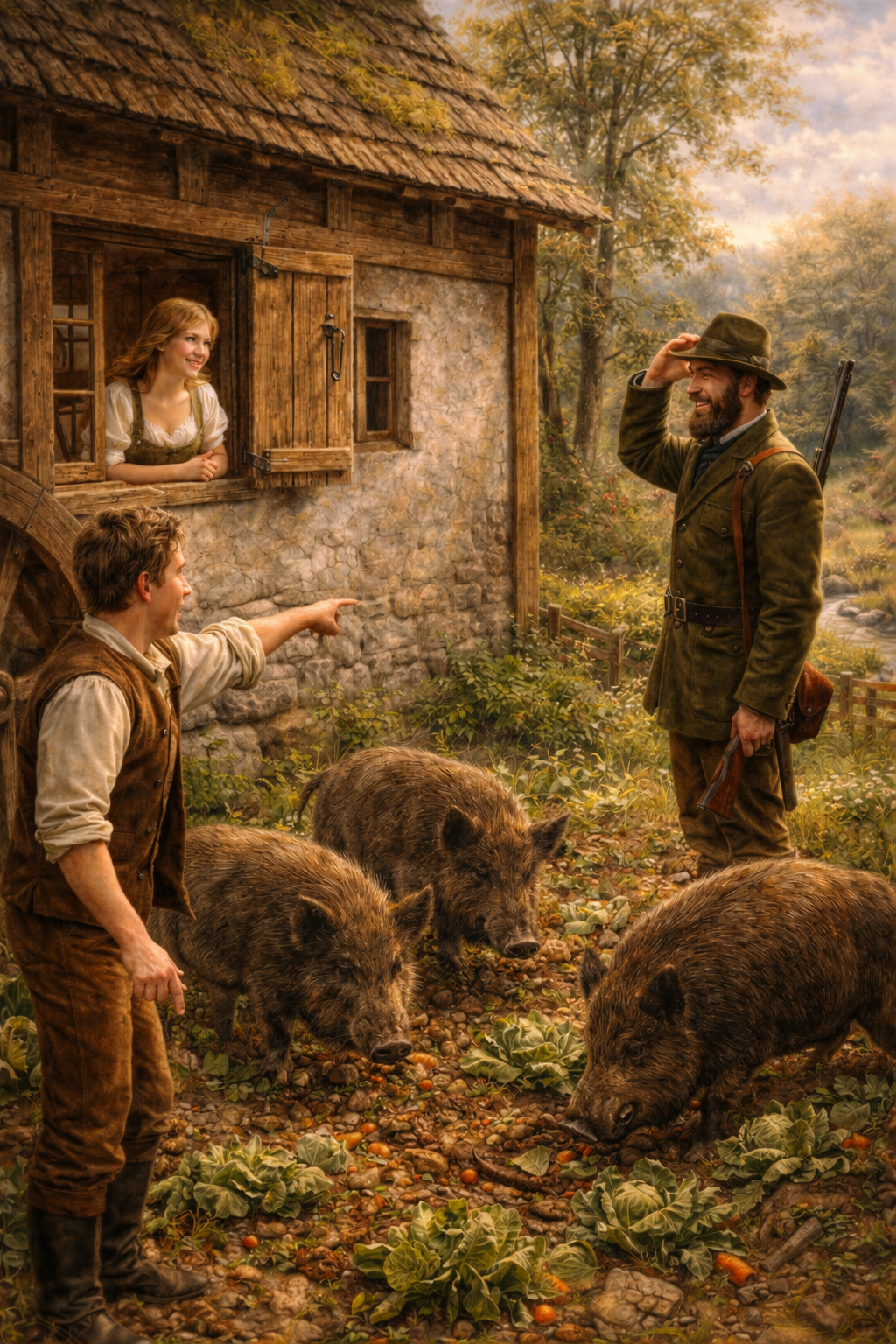
Artistic visualisation by Evgenia Foelsche:
The image condenses the miller lad’s painful jealousy into a scene of exclusion.
His wish is unmistakable: the hunter should go back out into the forest and drive away
the wild boars there, instead of being with the fair miller maid. Yet this wish remains
unfulfilled. The miller maid and the hunter are turned toward one another, or else wholly
enclosed within their own sphere, while the miller lad remains unnoticed. He appears not
as the active figure, but as the one set aside, whose gaze falls with bitterness upon a
bond that excludes him.
In this way, the image takes up the more aggressive tone of the song. The harmless world
of brook, flowers, and green ribbon has here given way to a scene of rivalry and displacement.
The hunter becomes the counterfigure to the miller lad: masculine, self-assured, and linked
to a wildness against which the lover has nothing to set. That the miller lad would rather
see the hunter among the wild boars shows how deeply his humiliation turns into rejection,
anger, and bitter wish-images.
Like Schubert’s music, the image too is marked by unrest, sharpness, and inner turmoil.
The miller lad is no longer the hopeful suitor, but the excluded one who must watch as
another takes his place. That neither the miller maid nor the hunter pays him any attention
makes the harshness of this scene especially clear. Visible here is what resonates through
both text and music: the transformation of love into jealousy, and the pain of a rejection
that no longer appears merely as silence, but as open displacement.
Analysis – Poetry
The poem “Der Jäger” stands in the second third of the cycle Die schöne Müllerin and marks the arrival of a rival. After the songs of approach and hope, a new figure now appears: the hunter. With him, a foreign and threatening world breaks into the mill space that had previously been sheltered. The wanderer responds with defensiveness, jealousy, and aggressive fantasy.
The first stanza is shaped as a direct address:
What is the hunter looking for here by the mill brook?
Stay in your own territory, defiant hunter!
There is no game here for you to hunt,
Only a little roe deer lives here, a tame one, for me.
The wanderer claims the mill space as his own territory. In his language, the miller maid appears as a “little roe deer” — a tender image, but at the same time one marked by possession. The hunter is cast as an intruder. Nature metaphors shift: idyllic landscape becomes hunting ground. Already here it becomes clear that the speaker imagines the beloved not as a self-determined counterpart, but as a being to be guarded.
In the following passage, this defensiveness intensifies into a series of demands:
And if you want to see the tender little roe,
Then leave your rifles standing in the forest,
And leave your baying dogs at home,
And leave the bluster and blare upon your horn,
And shave the shaggy hair from your chin,
Else the little roe in the garden will take fright indeed.
The hunter is meant to lay aside his weapons, his dogs, and his horn — in other words, everything that defines him as a hunter. Thus the wanderer demands nothing less than the surrender of the hunter’s identity. The sequence creates a commanding, almost hammering tone. Behind the apparent concern for the “little roe” lies the speaker’s fear of rivalry and superiority.
The second stanza shifts the argument into apparently logical channels:
But better still if you remained in the forest,
And left the mills and millers in peace!
What are little fishes doing in the green branches?
What would a squirrel want in the bluish pond?
By means of seemingly natural comparisons, the wanderer tries to banish the hunter from the miller’s world. Animals and habitats are wrongly paired — fish in the branches, squirrels in the pond. These deliberately absurd images show just how far the speaker distorts the order of the world in order to make his fear seem rational.
In the final passage, the fantasy tips fully into the aggressive:
The boars that come at night out of the grove
And break into her cabbage garden,
And trample and root about in the field:
Those boars — shoot them, heroic hunter!
The wanderer now offers the hunter a new hunt: wild boars devastating the garden. The threatening animal metaphor shifts: the “tame little roe deer” stands opposite destructive wilderness. At the same time, this is a barely veiled wish-fantasy: the hunter should eliminate what is “harmful” — an indirect projection of violence that reveals the speaker’s inner loss of control.
Formally, the poem remains lively and dialogic in its stanzaic design, with many imperatives, exclamations, and quick shifts of imagery. The language mirrors emotional agitation — a sharp contrast to the calm symbolic language of the preceding songs.
Meaning & Effect within the Cycle
“Der Jäger” marks the dramatic turning point of the cycle. With the appearance of the hunter, the phase of carefree hope comes to an end. For the first time, the wanderer’s love is seriously threatened — no longer by inner doubt, but by a real rival figure.
The song reveals the psychological shift from yearning devotion to possessiveness and jealousy. The wanderer tries to control the space of the mill and displace the rival. In doing so, the destructive side of his love emerges openly for the first time.
Symbolically, two worlds collide: the mill as a place of work, domesticity, and former shelter — and the hunter’s forest as a realm of freedom, wildness, and danger. That the miller maid later turns toward the hunter is already prepared here: the foreign world enters the protected order.
Musically and poetically, the narrative accelerates with this song. After “Der Jäger”, the path toward disappointment and finally catastrophe is set. The cycle leaves the sphere of romantic hope and enters a zone of existential threat.
Evgenia Fölsche – Performances & Audio
Pianist Evgenia Fölsche reads the song as a sharply cut hunting piece: dry horn chords, springing 6/8 drive, razor-sharp diction — irony instead of a shouted gesture.
Listening example: Der Jäger with Dietrich Fischer-Dieskau and Gerald Moore
Concert Enquiry
Die schöne Müllerin by Franz Schubert is part of Evgenia Fölsche’s Lied repertoire and is regularly performed in collaboration with renowned singers. Concert programmes can be arranged flexibly and adapted to different vocal and instrumental settings.
Evgenia Fölsche has collaborated, among others, with singers such as Johannes Kammler, Benjamin Russell and Gerrit Illenberger, who all include Die schöne Müllerin in their repertoire.
Send concert enquiryFrequently Asked Questions about Schubert: “Der Jäger” (Die schöne Müllerin No. 14)
Click on a question to reveal the answer.
Is the song strophic?
Yes. Two stanzas with an analogous musical design; the recurrence of the imperative formulas creates a refrain-like effect.
Key & metre?
Often transmitted in C minor (transpositions are common), 6/8, fast; with a hunting-horn character in the piano.
How strongly should it be performed “theatrically”?
Pointed, but precise: irony and mockery should be articulated clearly; no constant shouting. The piano remains dry and propulsive.