“Die liebe Farbe” is song no. 16 from Franz Schubert’s cycle Die schöne Müllerin D 795 (1823), after Wilhelm Müller. After “Eifersucht und Stolz”, the cycle turns inward again: green — just now the colour of hope and love — becomes the emblem of longing for death and stasis. Schubert composes a hypnotic lament with drone, closely pressed declamation, and a dark veil of B minor.
The Poem (Wilhelm Müller – Seventy-Seven Poems from the Posthumous Papers of a Travelling French-Horn Player, 1821) with Schubert’s adaptations.
In green I mean to clothe myself,
In green weeping-willows,
My sweetheart loves green so much.
I shall seek a grove of cypresses,
A heath full of green rosemary,
My sweetheart loves green so much.
Up now for the merry hunt!
Up now through heath and hedge!
My sweetheart loves hunting so much.
The game that I hunt is death,
The heath I call love’s distress,
My sweetheart loves hunting so much.
Dig me a grave in the turf,
Cover me with green grass,
My sweetheart loves green so much.
No little black cross, no brightly coloured flower,
Green, all green, round about and everywhere!
(Schubert: Green, all green all round about me,)
My sweetheart loves green so much.
Work Data & Overview
- Composer: Franz Schubert (1797–1828)
- Cycle: Die schöne Müllerin D 795, No. 16
- Text source: Wilhelm Müller, “Die liebe Farbe” (1817/1821)
- Composition: Autumn 1823; first published 1824
- Key / metre / tempo: B minor, 3/4, often with the direction etwas geschwind (with a calm pulse)
- Duration: approx. 3:00–4:00 minutes
- Scoring: Voice and piano
- Form: strophic (3 stanzas) with refrain-like closing formula “… loves green/hunting so much”
Key and numbering after IMSLP; metre and tempo discussed in analyses (JSTOR reference).
Data on the Poem
- Author: Wilhelm Müller (1794–1827)
- Stanza form: 3 stanzas of 6 lines each; refrain formula
- Devices: colour symbolism (green), irony/reversal (hunting = death), funerary metaphorics (cypress, grave/turf)
Genesis & Cycle Context
After the “green” rival episode (the hunter), the colour system shifts: green no longer signifies hope, but fixation — reaching as far as the wish for a green grave. “Die liebe Farbe” forms a contrasting pair with “Die böse Farbe” (No. 17, bright and driven): the same colour, two radically different perspectives.
More on the cycle (content, work data, all song articles): Die schöne Müllerin – Overview.
Performance Practice & Reception
Gesture: not dragging — the pulse remains quietly consistent, almost obsessive. The voice stays narrow, close to the syllables; the refrain formulas are unagitated, as though nailed into place.
Piano texture: low drone / sustained note with plain surrounding motion — no wave painting. Pedal should be used sparingly; the uniformity is expressive, not a lack — “green” as monochrome.
Reference Recordings (Selection)
- Dietrich Fischer-Dieskau – Gerald Moore
- Ian Bostridge – Mitsuko Uchida
- Christoph Prégardien – Andreas Staier (fortepiano)
- Matthias Goerne – Christoph Eschenbach
- Samuel Hasselhorn – Ammiel Bushakevitz
Comparative listening and documentation, among others, via streaming releases.
Analysis – Music
Drone & Breathlessness
The left hand maintains an insistent sustained note/drone, while the right hand circles in narrow figures; the voice declaims syllabically. This creates both fixation (green) and rigidity (proximity to death).
Form, Tonal Space & Refrain Formula
Strophic design with an almost identical close (“… loves green/hunting so much”) — semantic cementing. B minor remains relentless; only small brightenings flash up, without changing the fundamental tone.
Visual Representation
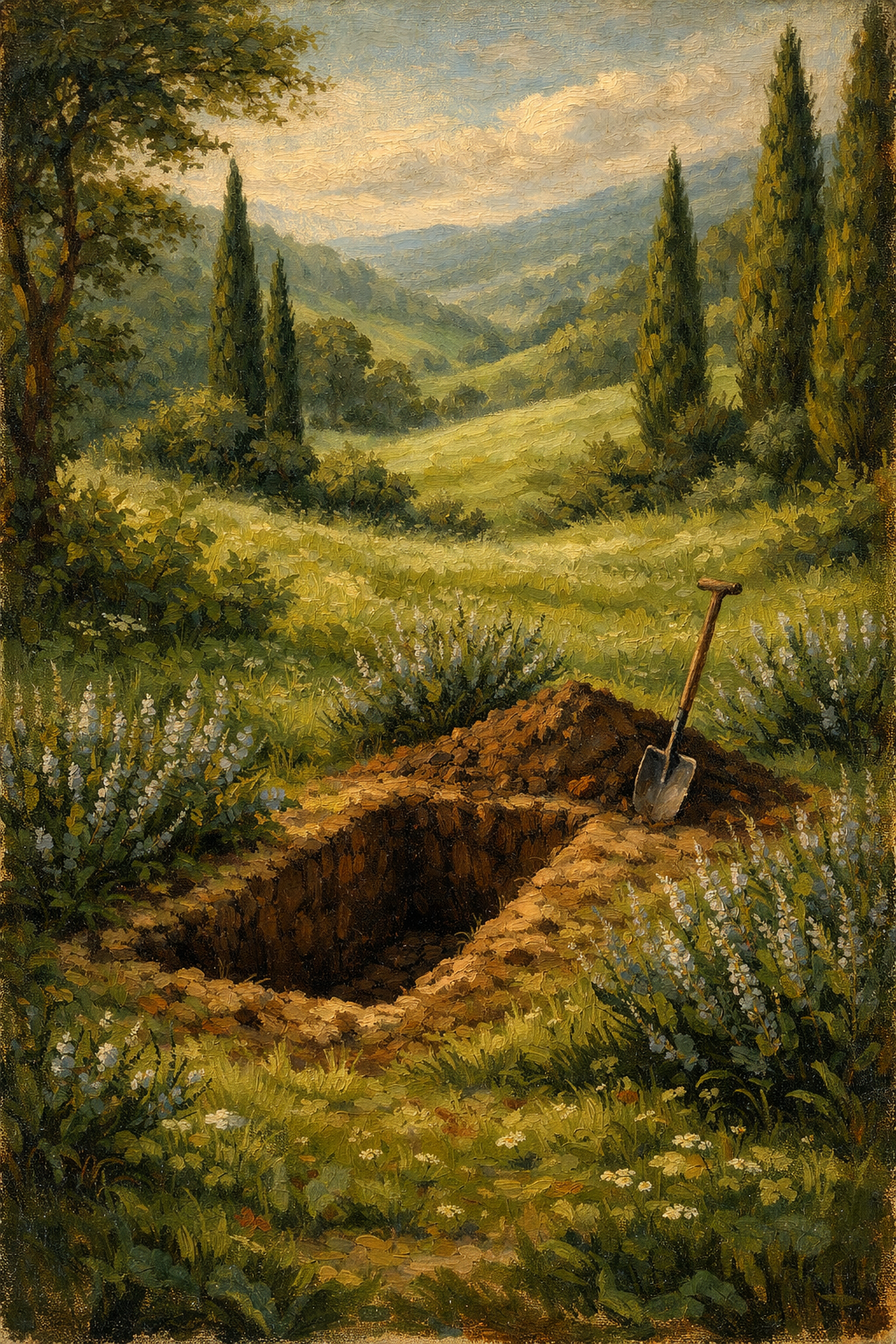
Artistic visualisation by Evgenia Foelsche:
The image shows a freshly opened grave in a quiet landscape of rosemary and cypresses.
In this way, the song’s imagery is concentrated with striking force: what once appeared
as the “beloved colour” is now inseparably bound to proximity to death, farewell, and a
longing for rest. The landscape does not feel bleak in a merely barren sense, but solemn,
collected, and filled with a quiet finality.
Rosemary and cypresses carry strong symbolic meaning here. Rosemary recalls fidelity,
remembrance, and funerary custom, while the cypress has long been regarded as the tree
of mourning and the graveyard. Thus the grave appears not as an accidental place, but as
the final consequence of a love that no longer finds any place in life. The colour green,
which earlier in the cycle signified hope, nature, and nearness in love, has here turned
into its opposite: it becomes the colour of the grave, of grave plants, and of painfully
preserved remembrance.
Like Schubert’s music, the image joins simplicity with profound inward shock. Nothing is
theatrically displayed here; precisely the stillness of the scene makes its tragedy all
the more compelling. The freshly opened grave seems like an answer to a suffering that can
no longer find consolation in the world of the living. What becomes visible is what resonates
in the text and in the music: that the “beloved colour” is no longer the sign of fulfilled
love, but has become the quiet garment of mourning, longing for death, and ultimate devotion.
Analysis – Poetry
Wilhelm Müller’s poem “Die liebe Farbe” belongs to the cycle Die schöne Müllerin. It shows the young miller in a stage of profound inward transformation: hope for love has become a fixation on the colour green, which changes from the colour of life into the colour of death.
The first stanza opens with a confession of allegiance to the colour green:
In green I mean to clothe myself,
In green weeping-willows,
My sweetheart loves green so much.
I shall seek a grove of cypresses,
A heath full of green rosemary,
My sweetheart loves green so much.
The speaker wishes to clothe himself wholly in green, outwardly and inwardly. Green is the colour of nature, hope, and youth, but here it is already bound up with “weeping-willows” and a “grove of cypresses” — both classical images of mourning and death. Love, nature, and pain begin to interweave.
The second stanza intensifies the image into hunting:
Up now for the merry hunt!
Up now through heath and hedge!
My sweetheart loves hunting so much.
The game that I hunt is death,
The heath I call love’s distress,
My sweetheart loves hunting so much.
What at first sounds like a cheerful hunting song suddenly turns into confession: the quarry being hunted is death. The outward motion of the hunt becomes the inward pursuit of self-annihilation. “Love’s distress” replaces the landscape — nature becomes a pure metaphor of the soul.
The third stanza draws the final consequence:
Dig me a grave in the turf,
Cover me with green grass,
My sweetheart loves green so much.
No little black cross, no brightly coloured flower,
Green, all green, round about and everywhere!
My sweetheart loves green so much.
The speaker demands his own grave. Even in death everything is to be green: no Christian grave-signs, no colourful flowers. The colour green has now completely changed from a symbol of life into the colour of death. Love for the miller maid is transformed into an obsessive, self-dissolving longing.
Formally, the poem resembles a simple folk song with refrain. It is precisely this plain repetition (“My sweetheart loves green so much”) that heightens the compulsiveness of thought and allows the reader to experience the speaker’s psychic fixation at first hand.
Meaning & Effect within the Cycle
“Die liebe Farbe” marks the psychological turning point of Die schöne Müllerin. Hopeful love becomes despair, and the idyll of nature becomes a landscape of death.
The colour green undergoes a symbolic transformation: from a sign of hope, through jealousy, to the colour of the grave. In this way it becomes visible how the perception of the world is determined by the speaker’s inner state.
Within the cycle, this song prepares the tragic outcome. The young miller has inwardly already accepted death before he carries it out in reality.
Schubert sets this poem with oppressive consistency: rigid harmonies, insistent accompaniment figures, and almost mantra-like repetitions make the speaker’s obsession audible.
Evgenia Fölsche – Performances & Audio
Pianist Evgenia Fölsche emphasizes the monotonous dignity of the drone: calm breath, narrow vocal line, unpathetic refrains — a quiet obsession under the sign of green.
Listening example: Die liebe Farbe with Dietrich Fischer-Dieskau and Gerald Moore
Concert Enquiry
Die schöne Müllerin by Franz Schubert belongs to Evgenia Fölsche’s Lied repertoire and is regularly performed in collaboration with renowned singers. Concert programmes can be arranged flexibly and adapted to different scorings.
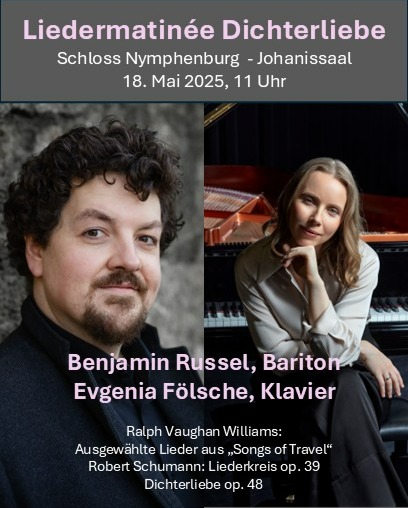
Evgenia Fölsche has collaborated, among others, with singers such as Johannes Kammler, Benjamin Russell and Gerrit Illenberger who include Die schöne Müllerin in their repertoire.
Send concert enquiryFrequently Asked Questions about Schubert: “Die liebe Farbe” (Die schöne Müllerin No. 16)
Click on a question to reveal the answer.
Original key, metre, and tempo?
B minor, 3/4, often with the direction etwas geschwind in the score and analyses, despite the song’s calm overall character.
How does the song relate to “Die böse Farbe”?
It is the counterpart: “Die liebe Farbe” is dark and monochrome; “Die böse Farbe” bright and driven. Both break open the earlier hopeful motif of “green” in opposite ways.
Is there a reliable poem text online?
Yes, among others at Schubertlied.de (with variant notes) and Oxford Song (text/translation).