“Seit ich ihn gesehen” opens Robert Schumann’s song cycle Frauenliebe und -leben op. 42, based on poems by Adelbert von Chamisso. The song presents the first moment of falling in love as a radical change in perception: the world loses color, contour, and its own value, while the image of the beloved man outshines everything. In the visual interpretation developed here, this moment appears both as romantic transfiguration and as the beginning of a bourgeois role attachment.
The text by Adelbert von Chamisso
From: Frauenliebe und -leben
German original
Seit ich ihn gesehen,
Glaub’ ich blind zu sein;
Wo ich hin nur blicke,
Seh’ ich ihn allein;
Wie im wachen Traume
Schwebt sein Bild mir vor,
Taucht aus tiefstem Dunkel,
Heller nur empor.
Sonst ist licht- und farblos
Alles um mich her,
Nach der Schwestern Spiele
Nicht begehr’ ich mehr,
Möchte lieber weinen,
Still im Kämmerlein;
Seit ich ihn gesehen,
Glaub’ ich blind zu sein.
Direct English translation
Since I have seen him,
I believe I am blind;
Wherever I only look,
I see him alone;
As in a waking dream
His image floats before me,
Rises from deepest darkness,
Only brighter upward.
Otherwise lightless and colorless
Is everything around me,
For the sisters’ games
I no longer have desire,
I would rather weep,
Quietly in the little chamber;
Since I have seen him,
I believe I am blind.
Work data & overview
- Composer: Robert Schumann (1810–1856)
- Cycle: Frauenliebe und -leben op. 42, No. 1
- Text source: Adelbert von Chamisso, Frauenliebe und -leben
- Origin of the composition: 1840
- First edition: 1843, published by Friedrich Whistling in Leipzig
- Key: B-flat major
- Tempo indication: Larghetto
- Scoring: Voice and piano
- Duration: approx. 2–3 minutes
- Position in the cycle: Opening song; beginning of the story of love and life
Data on the poem
- Poet: Adelbert von Chamisso (1781–1838)
- Poem cycle: Frauenliebe und -leben
- Stanza form: 2 stanzas of 8 verses each
- Central motif: Change of perception through love
- Guiding motifs: Blindness, dream, inner image, darkness, light, withdrawal into the little chamber
Origin & contexts
Schumann composed Frauenliebe und -leben in 1840, his so-called year of song. In this year, many central song compositions were created, including Dichterliebe op. 48 and the two Liederkreise op. 24 and op. 39.
Chamisso’s poem cycle describes a bourgeois-romantic woman’s life from the first encounter with the beloved man through engagement, wedding, and motherhood to the death of the husband. Schumann set eight of the poems and omitted the ninth poem of the literary cycle.
“Seit ich ihn gesehen” opens this arc. There is still no external action in the narrower sense. The event is internal: one glance has been enough to change the woman’s perception completely.
Performance practice & reception
As the first song of the cycle, “Seit ich ihn gesehen” places special interpretive demands. The singer must not display the state of rapture dramatically, but shape it with great restraint. The decisive impression is one of inner floating: the voice seems less to narrate than carefully to reveal a state of the soul.
In pianistic terms, the song is marked by restraint and the finest balance of sound. The piano must not only accompany, but must make the changed perception of the figure audible: muted, soft, as if veiled.
Reference recordings — selection
- Christa Ludwig – Geoffrey Parsons
- Elisabeth Schwarzkopf – Gerald Moore
- Brigitte Fassbaender – Irwin Gage
- Barbara Bonney – Vladimir Ashkenazy
- Bernarda Fink – Anthony Spiri
Analysis – Music
Larghetto, inwardness and stillness
Schumann’s tempo indication Larghetto already points to a state of extended inwardness. The music moves calmly, almost shyly. It does not press forward, but remains in the after-effect of a moment.
The vocal line is simple and restrained. Precisely this simplicity makes the shift of the soul credible: the lyrical I is not outwardly excited, but inwardly overwhelmed. The singing has the effect of a quiet confession.
Piano part as veil of perception
The piano creates a soft, covered sound space. It does not depict an external scene, but the atmosphere of consciousness. The recurring figures work like a veil through which the world is perceived only dimly.
In this way, exactly the state described by the text comes into being musically: the external world becomes indistinct, while the inner image of the beloved emerges ever more brightly.
Visual representation
Artistic visualization:
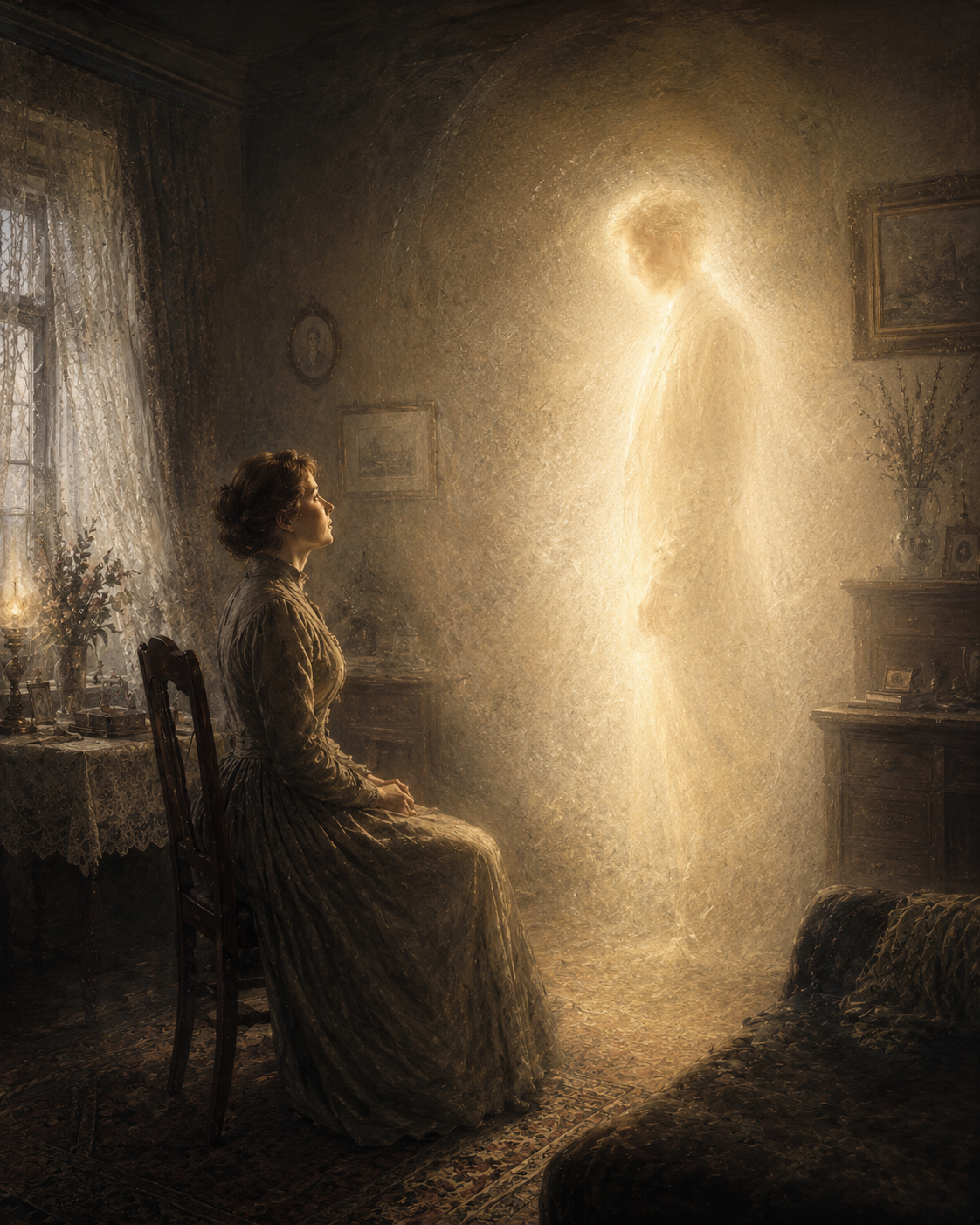
A young woman sits in a bourgeois chamber of the late 19th century. Before her stands a male figure, but he does not appear as a clearly real person. He shines brightly, almost like the sun, and outshines the room.
The details of the man remain blurred. Face, clothing, and body contour dissolve in the light. Around him lies a fine aura that lets his appearance float between reality, memory, longing, and inner image.
The chamber itself is domestic, ordered, and narrow. Precisely this bourgeois interior world forms the starting point of the entire image cycle. It is both protective space and limitation. In this first image, it is not yet visible as a prison, but it is already overlaid by the inner image of the man.
The motif takes up the central verses of the song: “Glaub’ ich blind zu sein” and “Wie im wachen Traume / Schwebt sein Bild mir vor”. The woman does not simply see a man. She experiences a change in her perception. The world loses independence, while his image emerges from the darkness.
Within the cycle, this image marks the beginning of transfiguration. The man appears as a figure of light that outshines everything else. Later this light will pass to other signs: to the ring, to becoming a bride, to marriage, to motherhood. Only at the end will this glow break apart.
Analysis – Poetry
Seit ich ihn gesehen,
Glaub’ ich blind zu sein;
Wo ich hin nur blicke,
Seh’ ich ihn allein;
The poem begins with a paradoxical statement: precisely seeing has led to blindness. The encounter with the man does not open the world for the woman, but closes it to everything else.
Love appears here as concentration and narrowing at the same time. The beloved becomes the only object of perception. Everything else recedes.
Wie im wachen Traume
Schwebt sein Bild mir vor,
Taucht aus tiefstem Dunkel,
Heller nur empor.
The expression “waking dream” describes an intermediate state. The woman is not truly asleep, but she is also no longer soberly anchored in reality. The image of the man is internal, visionary, and at the same time overwhelmingly present.
Especially important is the contrast of darkness and light. The man does not simply enter the room; his image rises out of darkness and becomes ever brighter. In this way, being in love gains an almost religious or visionary quality.
Sonst ist licht- und farblos
Alles um mich her,
Nach der Schwestern Spiele
Nicht begehr’ ich mehr,
The second stanza shifts the gaze to the surroundings. Everything except him appears “lightless and colorless”. The poem therefore describes not only inner agitation, but a complete revaluation of the world.
The community with the sisters also loses its attraction. The woman detaches herself from the previous female space of play and social life and inwardly enters a new order.
Möchte lieber weinen,
Still im Kämmerlein;
Seit ich ihn gesehen,
Glaub’ ich blind zu sein.
The “little chamber” is a central word for the interpretation of the entire cycle. It denotes a private inner space, but also withdrawal, separation, and limitation. Love does not lead the woman outward, but still deeper into the interior space.
The ending repeats the beginning. Through this, a circular state arises: the woman does not get out of her new perception. The song does not end with action, but with enchantment.
Statement & effect in the cycle
“Seit ich ihn gesehen” is the starting point of the entire development in Frauenliebe und -leben. Nothing has yet been decided: no engagement, no wedding, no motherhood, no loss. And yet the basic movement of the cycle is already laid out.
The woman experiences the man as an overpowering inner image. He becomes the center of her perception. This creates the romantic glow that carries the following songs.
In a critical reading, however, the song also shows the beginning of a diminishment of the self. The woman’s own world loses color and meaning. Her perception subordinates itself to the image of the man.
The image cycle takes up this thought by first presenting the man as a figure of light. Later this light moves on: to the ring, to becoming a bride, to marriage, to the child. At the end, in the last song, this glow is destroyed and bourgeois reality emerges bleakly.
Evgenia Fölsche – Performances & audio
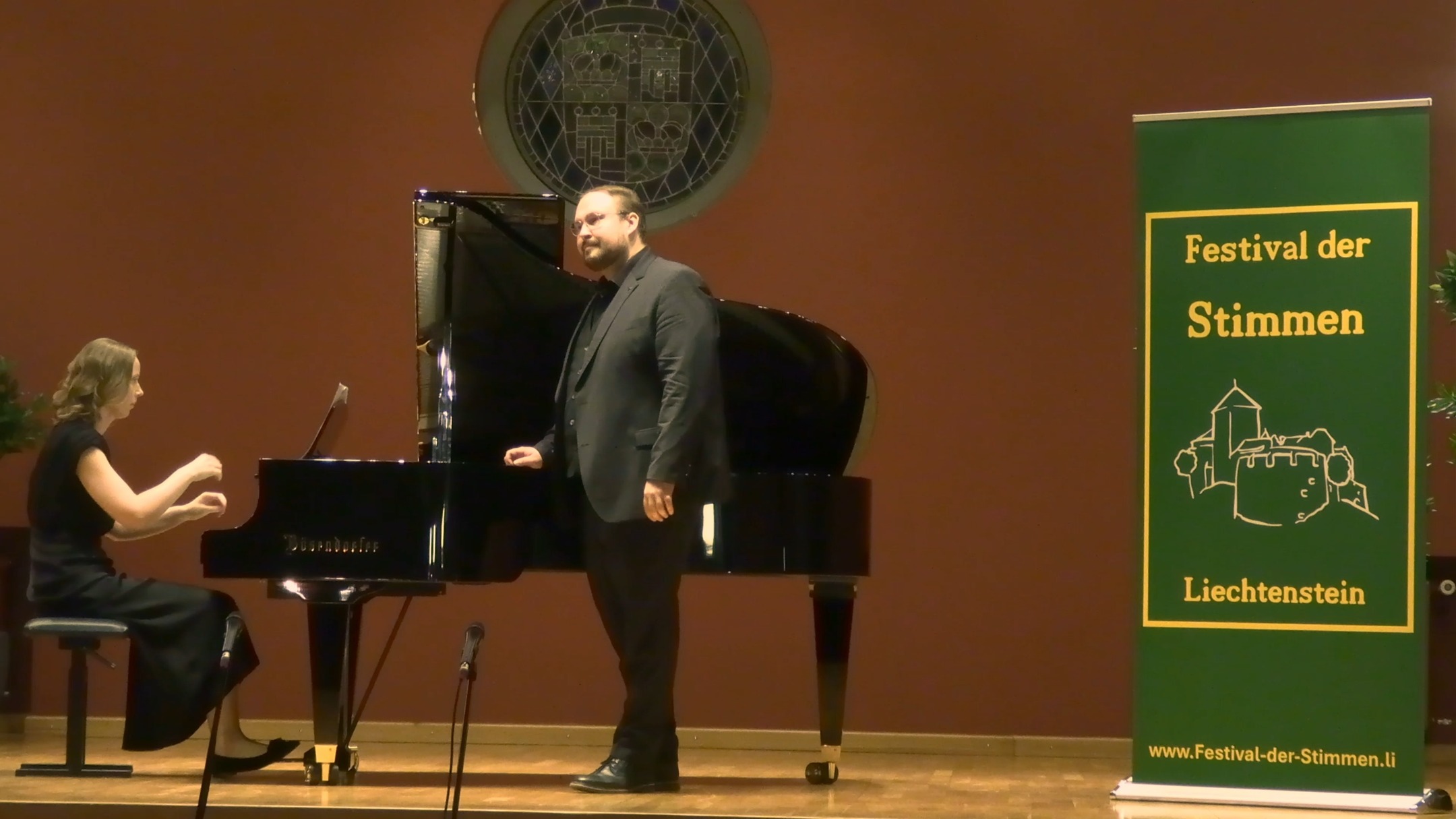
Pianist Evgenia Fölsche regularly engages in song programs with the Romantic art song and its psychological, poetic, and social layers of meaning. Frauenliebe und -leben is especially suitable for an interpretation that connects musical inwardness with a critical perspective.
Frequently asked questions about Schumann: “Seit ich ihn gesehen”
Click on a question to show the answer.
What is “Seit ich ihn gesehen” about?
The song describes the first state of being in love. Since the woman has seen the man, the rest of the world appears colorless to her; his image dominates her perception.
What role does the “little chamber” play in the poem?
The “little chamber” stands for withdrawal and inwardness. In a critical interpretation, it can also be read as an image of the bourgeois limitation within which the woman’s life of the cycle unfolds.
Why is the image of the man represented so brightly?
The light visualizes the transfiguration of the man. He appears not only as a real person, but as an inner image that outshines the woman’s entire perception.
Is “Seit ich ihn gesehen” a purely Romantic love song?
It can be read romantically, but it also shows a problematic narrowing of female perception onto the man. Precisely this ambivalence makes the song so significant in the cycle.
What position does the song have in the cycle?
It is the opening song of Frauenliebe und -leben. It sets the starting point: the first encounter, the transfiguration of the man, and the beginning of an inner bond.