“In Dreams” is the fifth song in Ralph Vaughan Williams’s cycle Songs of Travel after Robert Louis Stevenson (c. 1901–1904). After Youth and Love, the cycle slips into a realm of night and memory: in dreams, the wanderer encounters the past — softly, painfully, inescapably. Vaughan Williams responds with muted musical speech, modal colouring, and a carefully suspended sense of time.
The Poem (Robert Louis Stevenson)
From: Songs of Travel and Other Verses (1896) – No. 5
Original Text (English)
In dreams, unhappy, I behold you stand
As heretofore:
The unremember’d tokens in your hand
Avail no more.
No more the morning glow, no more the grace,
Enshrines, endears.
Cold beats the light of time upon your face
And shows your tears.
He came and went. Perchance you wept awhile
And then forgot.
Ah me! but he that left you with a smile
Forgets you not.
Text: Robert Louis Stevenson (1850–1894), from Songs of Travel and Other Verses (1896), public domain.
Work Data & Overview
- Composer: Ralph Vaughan Williams (1872–1958)
- Cycle: Songs of Travel – No. 5 In Dreams
- Text source: Robert Louis Stevenson, Songs of Travel (1896)
- Composition: c. 1901–1904; published in 1904 (piano version), later orchestration authorised
- Range / Metre / Tempo: minor foundation with modal (Dorian/Mixolydian) colouring; 4/4; Andante sostenuto
- Duration: approx. 2–3 minutes
- Scoring: voice and piano (also orchestrated)
- Form: through-composed with a calm arch of tension (A – B – A′ afterglow)
Origin & Cycle Context
In Dreams follows directly after Youth and Love and deepens its melancholy retrospection. Dramaturgically, it is the first true night-piece of the cycle: not a lullaby, but a space of memory. The wanderer pauses; in the morning he will go on — but for now, the past speaks.
Performance Practice & Reception
Voice: Very close to the text, restrained, carried on the breath. No operatic gesture; the forte, if it comes at all, must arise from inward pressure.
Piano: Velvet-like textures and quiet inner motion; the pedal should be differentiated so that the modal colours do not blur. Silence itself carries the song.
Reception: Less frequently performed on its own than the opening numbers, but within the cycle a highly valued point of repose — often presented as a group with Nos. 4 and 6.
Reference Recordings (Selection)
- Gerald Finley – Julius Drake
- Sir Thomas Allen – Roger Vignoles
- Roderick Williams – Iain Burnside
- Bryn Terfel – Malcolm Martineau
Analysis – Music
Suspended Time & Modal Colouring
Broad phrases over a quiet quarter-note pulse create the feeling of slowed time. Modal turns (Dorian/Mixolydian) lend the minor mode a mild brightness — pain without harshness.
Open Cadences – No Consoling Close
Vaughan Williams avoids firm cadential closure; the harmony “breathes” and lets the final line fade as though the dream remained unfinished. The postlude is more of a dying away than a conclusion.
Visual Representation
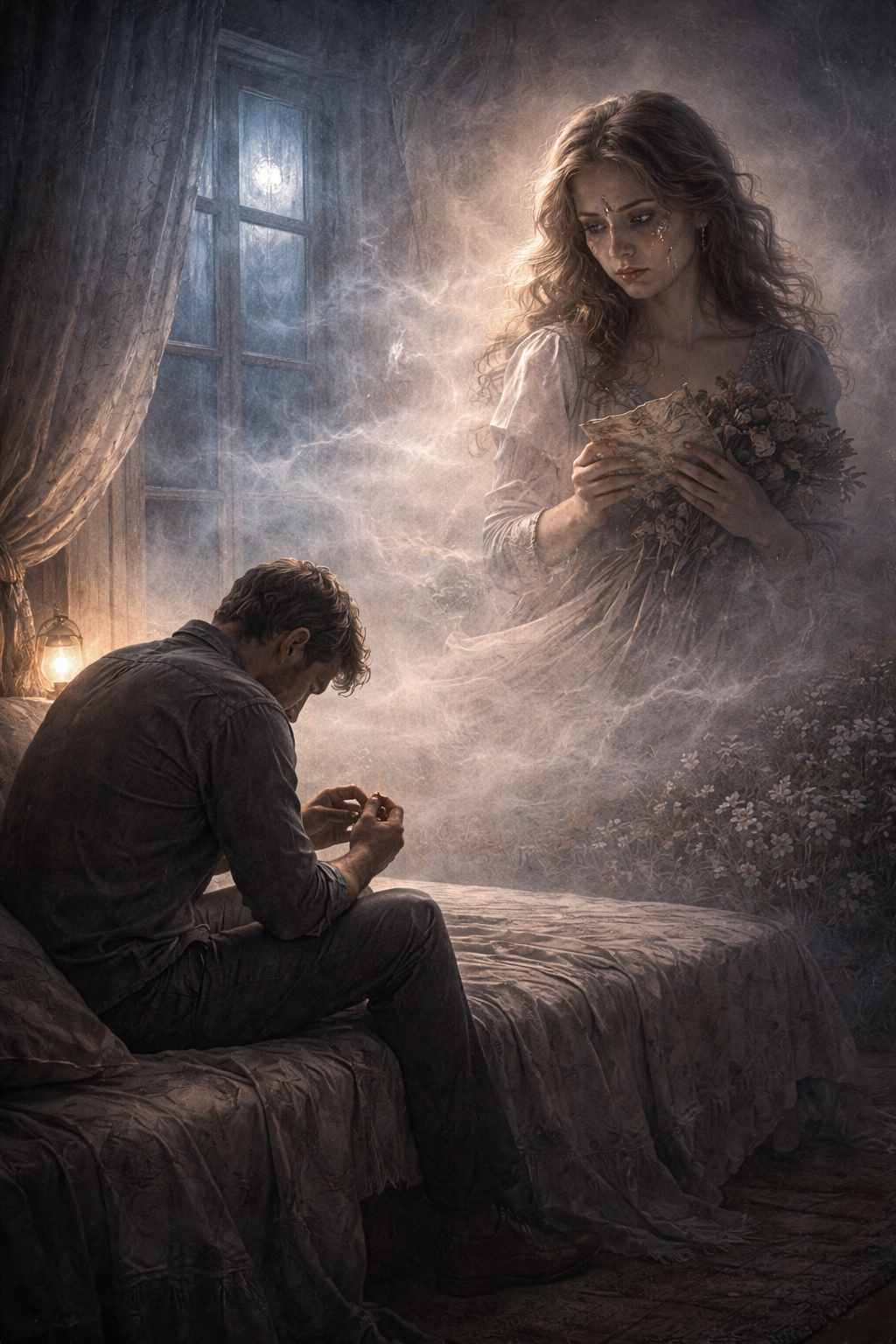
Artistic visualisation by Evgenia Fölsche:
The image shows a quiet, nocturnal interior in which
a man sits turned inward, while above him the distant
appearance of a woman becomes visible. The scene does not
feel like a real encounter, but like memory within a dream:
near and yet unreachable, present and at the same time remote.
In this way, the image captures the core of the song very precisely.
In the dream, the figure from the past returns once more,
but not in order to restore closeness; rather, to make loss
all the more palpable. The image holds exactly this painful
suspended state — between memory, longing, and final separation.
The visualisation also suits the music well. Vaughan Williams
shapes the song quietly, restrainedly, and permeated
by deep melancholy. Like the music, the image feels not dramatic,
but hushed and inward — as a dream-figure of a past
that glimmers once again and yet does not return.
Analysis – Poetry
The poem “In Dreams” belongs to the quietest and most painful moments of the cycle. It depicts no outward movement, no road and no landscape, but an inward scene of memory. In the dream, the speaking self sees a figure from the past, evidently a lost or estranged beloved. Yet this encounter brings no consoling reunion; rather, it makes visible the irrecoverability of what is gone. The dream does not abolish separation, but reveals it with heightened clarity.
The Appearance of the Past in Dream
In dreams, unhappy, I behold you stand
As heretofore:
The unremember’d tokens in your hand
Avail no more.
The very first line binds dream and unhappiness inseparably together. The speaker sees the beloved in a dream “as heretofore,” standing before him as once before, in former familiarity. At first, this creates the impression of a return. Yet this return is only apparent. The “unremember’d tokens” in her hand point to signs of a former relationship that have lost their meaning. What once served as an expression of closeness or remembrance now “avail no more”: it helps no longer, it can no longer restore the lost bond.
This movement is crucial to the poem. The dream does not give back the past, but only displays its empty shell. The figure appears, but her signs no longer speak. Thus, from the outset, an atmosphere of deep estrangement emerges. Closeness is still visible, but no longer effective.
The Face under the Light of Time
No more the morning glow, no more the grace,
Enshrines, endears.
Cold beats the light of time upon your face
And shows your tears.
The second stanza deepens the motif of loss by dissolving the former idealisation of the beloved. “No more the morning glow, no more the grace”: the morning light and the grace that once surrounded her and made her dear have vanished. The language still recalls that former beauty, but only in the form of its withdrawal. No longer warmth, freshness, or promise define the image, but a cold light.
Especially striking is the phrase “the light of time.” Time itself appears here like an exposing light that falls relentlessly upon the face. It is not a gentle, protecting light, but one that makes marks visible: tears, pain, transience. Time does not work here as healing distance, but as a force of disenchantment. What the dream conjures up is not transfigured by this light of time, but laid bare in its woundedness.
Forgetting and Not Forgetting
He came and went. Perchance you wept awhile
And then forgot.
Ah me! but he that left you with a smile
Forgets you not.
In the third stanza, the dream-scene takes on a clearer biographical contour. There was evidently a farewell: “He came and went.” The brevity of this sentence feels almost sober, and therefore all the more painful. The other person’s life has gone on; perhaps she wept for a while and then forgot. The poem leaves this possibility open, without accusation, but with quiet bitterness.
Opposed to the beloved’s forgetting stands the speaker’s not forgetting. “He that left you with a smile / Forgets you not”: the speaking self continues to remember, despite separation, the passage of time, and inward distance. The phrase “with a smile” makes the farewell especially complex. The pain did not apparently lie in a dramatic rupture, but in a departure that may have been gentle, perhaps even deceptive. Precisely for that reason, the enduring remembrance feels all the more lonely. The poem therefore ends not in meeting, but in an asymmetrical condition: one person may have forgotten, the other has not.
Dream as a Place of Painful Truth
In dreams, unhappy, I behold you stand
...
And shows your tears.
In this poem, the dream has no reconciling function. It is not a wish-space or an escape from reality, but a place in which the truth of loss emerges with particular force. In waking life, memory may be dimmed or repressed; in the dream, however, it returns with compelling vividness. Yet what appears is not the happiness of the past, but its unrecoverability.
In this respect, “In Dreams” differs markedly from other poems in the cycle in which road, nature, or song open outward. Here, the movement is directed entirely inward. The road is, as it were, brought to stillness; in its place stands the image of memory. The wanderer encounters not the open world, but his own bond to a past that will not release him.
Plain Form, Deep Melancholy
Ah me! but he that left you with a smile
Forgets you not.
The effect of the poem rests on its great simplicity. It does not work with expansive lament or pathetic gesture, but with brief, clear sentences. It is precisely this restraint that makes the melancholy all the stronger. The verses speak not of passionate despair, but of a pain that has long since sunk into memory and nevertheless continues to work.
“In Dreams” is thus a poem about the power of remembering, but also about its powerlessness. The past intimacy returns once more in the dream, only to confirm its lostness. The speaking self remains bound to what, for the other person, may long since have passed away. It is precisely in this quiet, unresolved grief that the poem gains its special depth.
Meaning & Effect
At the centre of the poem lies the experience that memory cannot restore a lost relationship. The dream calls up the past once more, yet precisely this encounter shows that time, estrangement, and forgetting cannot be undone. The poem thereby makes clear how unevenly remembrance may be distributed: while one person may long since have gone on living, the other remains inwardly bound to the past.
The effect of the poem lies in its quiet, penetrating melancholy. The language remains plain and clear, yet the images of cold light, tears, and powerless tokens create an atmosphere of deep grief. “In Dreams” therefore feels not dramatic, but hushed and lasting. Within the cycle, it is a moment of inwardness, in which the wanderer experiences not the outer world, but the unfinishedness of his own memory.
Evgenia Fölsche – Performances & Audio
Evgenia Fölsche shapes “In Dreams” with suspended tone and the finest gradations of dynamics; the piano remains transparent, the words stand in space — silence as colour.
FAQ – Vaughan Williams: “In Dreams” (Songs of Travel No. 5)
Click on a question to reveal the answer.
Is “In Dreams” a lullaby?
No. It is night music as a space of memory — contemplative, not rocking; inward monologue rather than cradle song.
Which voice types are suitable?
Traditionally baritone within the cycle; in transposition it also suits mezzo-soprano/contralto or tenor. The decisive element is control in quiet singing.
How does the song fit into the dramaturgy of the first seven numbers?
After departure (1), perception (2), tenderness (3), and retrospection (4), comes the dream-station (5) — before the breadth of the heavens (6) and the song of home (7).