The Poem by Matthias Claudius – Modern Orthography
Poem “An die Nachtigall” – German Original
Er liegt und schläft an meinem Herzen,
mein guter Schutzgeist sang ihn ein;
und ich kann fröhlich sein und scherzen,
kann jeder Blum’ und jedes Blatts mich freun.
Nachtigall, ach! Nachtigall, ach!
sing mir den Amor nicht wach!
English Translation
He lies and sleeps upon my heart,
my good guardian spirit sang him to rest;
and I can be joyful and jest,
can delight in every flower and every leaf.
Nightingale, ah! Nightingale, ah!
do not sing Amor awake for me!
Work Details & Overview
- Composer: Franz Schubert (1797–1828)
- Title: An die Nachtigall, Op. 98 No. 1, D 497
- Text source: Matthias Claudius (1740–1815)
- Composition: November 1816; first printed in 1829 as Op. 98 No. 1
- Key / Meter / Tempo: G major, 6/8, performance marking mäßig — moderate
- Duration: approx. 2–3 minutes
- Scoring: voice and piano; transpositions are common
- Form: one-part, songlike structure with the refrain formula “Nachtigall … Amor”; through-composed
Details of the Poem
- Author: Matthias Claudius
- Stanza form: six lines; internal rhyme and assonance, especially “Herzen” / “scherzen”
- Stylistic features: apostrophe to the nightingale, gesture of entreaty, Amor motif, delicate semantics of nature and love
Genesis & Context
Schubert composed “An die Nachtigall” in November 1816. The song belongs to that creative phase in which he transformed short, lyrically concentrated poems into musical miniatures with remarkable intensity. The later first edition appeared in 1829, after Schubert’s death, as part of the Op. 98 group.
The opus grouping is editorial and brings together songs that were not conceived as a coherent cycle. Nevertheless, “An die Nachtigall” possesses a strong inner unity: from a single plea emerges a finely shaded dramaturgy between calm, the sound of nature, the nearness of love and a quiet undercurrent of agitation.
This miniature reveals a particular side of Schubert’s art of song: it is not outward action that is dramatized, but an almost imperceptible transition of the soul. The scene remains small, almost private — and precisely through this it gains its intensity.
Performance Practice & Reception
Pulse & breath: The 6/8 meter should sway gently without becoming sentimental. The basic character is mäßig, intimate and sustained. The phrases need breath, but must not become heavy: the song lives from a light, almost floating motion.
Diction & sound: The language should remain close to speech and natural. The exclamations “Nachtigall, ach!” in particular require delicacy: they are not a dramatic cry, but a quiet, pleading request. The vowels should be shaped roundly, the consonants softly embedded.
Piano texture: The broken chords and delicate inner voices carry the character of a quiet lullaby. The pedal should remain transparent so that the harmonic colours can be heard. Too broad a sonority would obscure the chamber-musical intimacy of the song.
Reception: “An die Nachtigall” is often used as a lyrical point of repose in song programmes. Its brief duration should not obscure its inner density: the famous “Amor” moment in particular requires a subtle balance between illumination and immediate withdrawal.
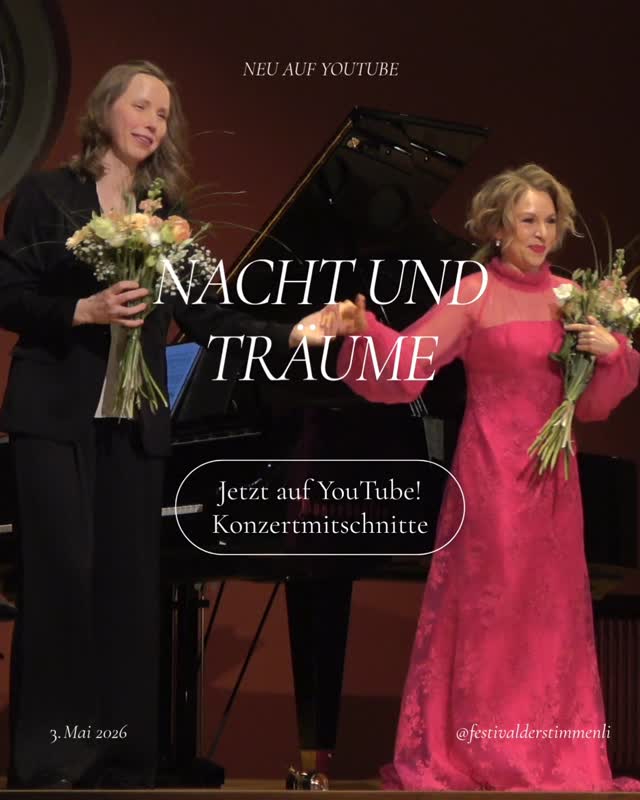
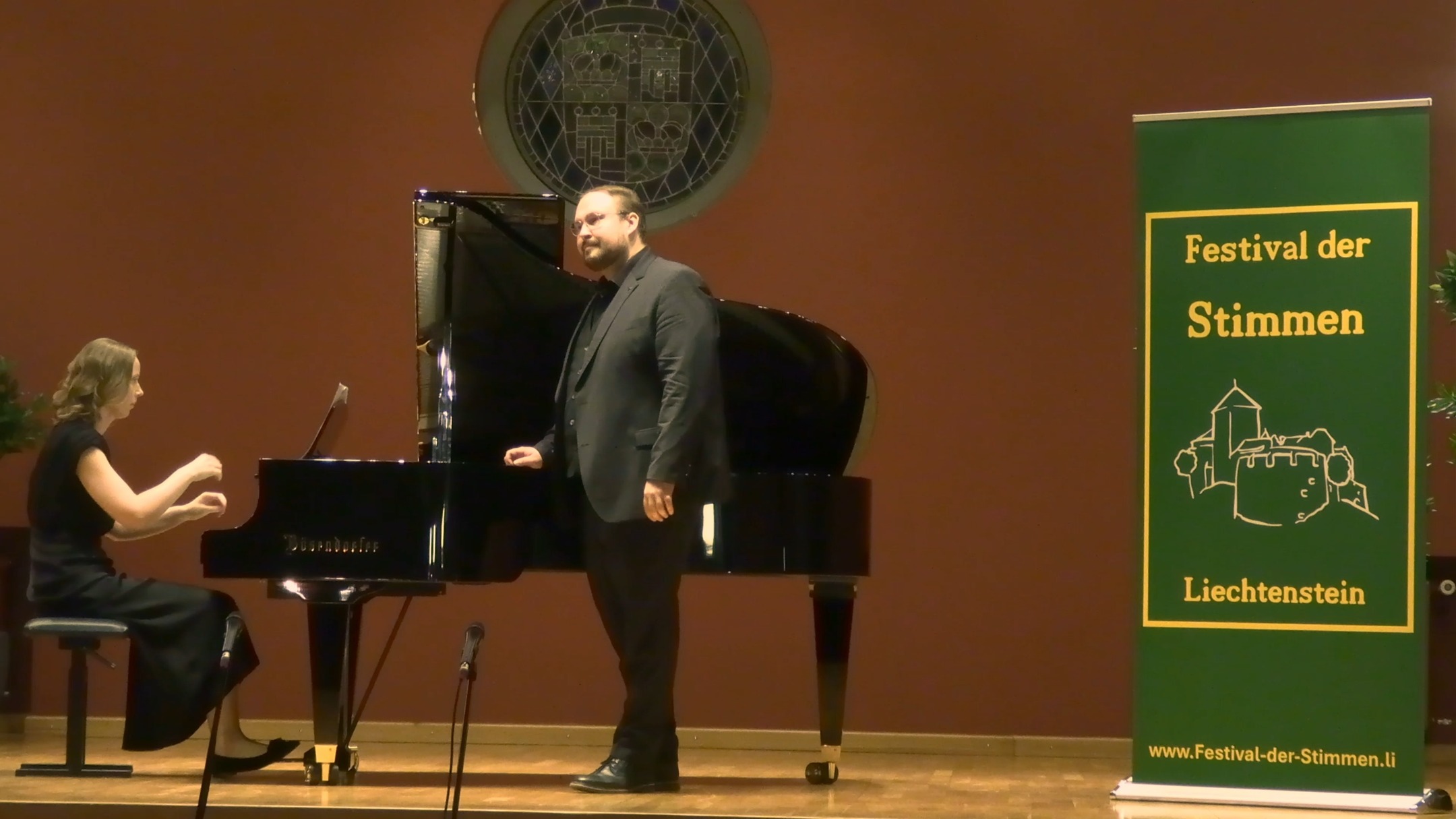
Current Performers with Whom I Collaborate
Analysis – Music
Lulling Pulse & Accompaniment Gesture
The gentle 6/8 rocking pulse forms the foundation of the song. The accompaniment envelops the vocal line with broken chords and small inner movements. This creates a sound world that soothes without standing still: the music seems like a quiet lullaby, yet beneath the surface a delicate tension remains.
This tension is essential. The nightingale is not simply invoked as a pastoral idyll, but as a possible disturber of a fragile equilibrium. Every phrase must therefore contain something protective: the music preserves a state that could tip over at any moment.
Harmonic Points of Glow
The most striking moment lies in the closing turn on “Amor”. Here the music opens for an instant: the line expands, the sound begins to glow, and the previously restrained energy of love becomes palpable. Yet Schubert does not surrender this moment to a grand gesture. Immediately afterwards, the music sinks back into the plea.
It is precisely this brief flare that makes the passage so effective. Amor does not appear as a triumphant force, but as something that is to be kept asleep. The harmony reveals what the text both fears and remembers: love here is not only happiness, but also potential unrest.
Visual Representation
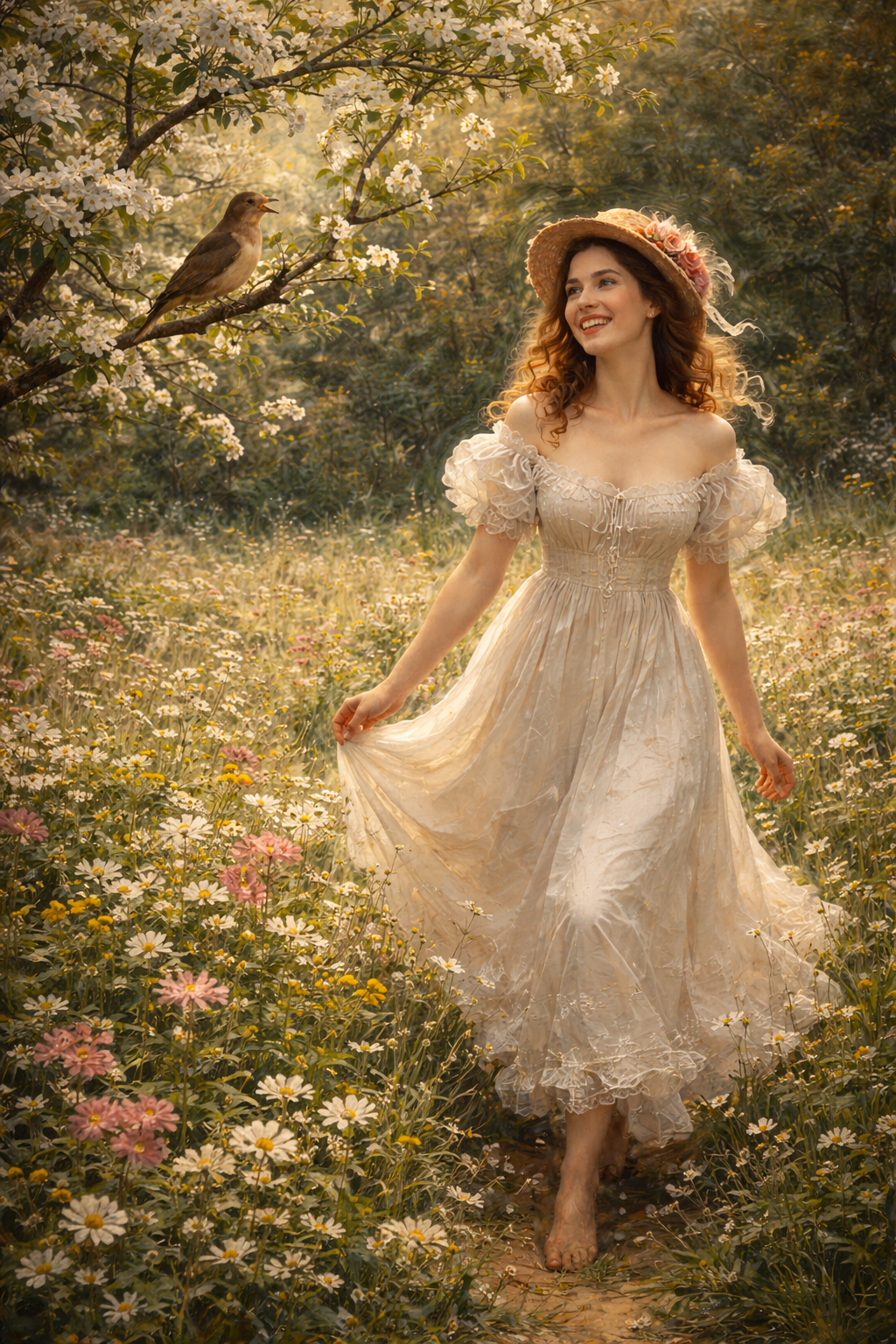
Artistic visualization by Evgenia Fölsche:
A woman stands in the midst of a richly blooming landscape,
surrounded by delicate colours and fresh green.
Nature seems to be awakening in spring:
blossoms open, and light falls softly through the branches.
Close to her sits a nightingale, attentive and yet free.
Its small body appears inconspicuous against the breadth of the scene,
and yet it is the sonic centre of the image.
Between woman and bird an invisible connection arises —
a dialogue without words.
The woman seems to be listening.
Her gaze is not fixed firmly on the bird, but slightly withdrawn,
as though she were hearing more than an external sound.
The image thus translates the basic idea of the song:
the nightingale’s song becomes the trigger of inner memory,
tender longing and, at the same time, danger.
As in Schubert’s music, nature and human feeling merge.
The blooming surroundings stand not only for outward beauty,
but for that sensitive resonance
which sound awakens in the heart — and which must nevertheless be gently contained
so that Amor does not awaken.
Analysis – Poetry
The poem “An die Nachtigall” unfolds, in only a few lines, an intimate scene of calm. At its centre is a state of stillness that is deliberately to be preserved. The nightingale, traditionally a symbol of passionate love poetry, is not welcomed here as a messenger of love, but asked to hold back.
Resting at the Heart
Er liegt und schläft an meinem Herzen,
mein guter Schutzgeist sang ihn ein;
The opening lines present an image of complete closeness. The sleeping “he” lies at the heart of the lyrical speaker. Sleep stands for protection, trust and stillness. The “guardian spirit” suggests that this state is not accidental, but watched over and preserved.
It remains open who this “he” exactly is. He can be understood as a real beloved, but also as a personified force of love: Amor himself, resting in the heart. It is precisely this openness that makes the text so effective.
Joy Born of Calm
und ich kann fröhlich sein und scherzen,
kann jeder Blum’ und jedes Blatts mich freun.
The joy of the lyrical speaker does not arise from intensification or passion, but from calm. Because the inner agitator sleeps, the speaker can turn back to the world. Flowers and leaves appear as signs of a regained capacity for perception.
Nature here is not a dramatic backdrop, but a resonant space of inner relief. The speaker can jest, see and rejoice — precisely because love is not stirred up.
The Plea to the Nightingale
Nachtigall, ach! Nachtigall, ach!
sing mir den Amor nicht wach!
The ending addresses the nightingale directly. The double invocation and the repeated “ach” give the plea a supplicating character. The bird must not become the trigger of passionate agitation. Its song could awaken Amor — and thereby destroy the inner calm from which the present joy first becomes possible.
Amor therefore stands here in ambivalent light. He is love, but not only as happiness. He also names the power that can evoke longing, unrest and pain. The poem does not protect itself from love as such, but from its painfully agitating reawakening.
Formally, the poem is simple and songlike. Short lines, a soft rhythm and the direct address create the impression of private speech — almost of a whisper.
Open Semantics & Further Work
The special power of “An die Nachtigall” lies in its suspension. The song does not answer unequivocally whether the scene describes fulfilled closeness or the calm after passion has been overcome. Both readings remain possible and act at the same time.
Precisely for this reason, the song continues to work. The nightingale stands not only for beauty, but also for the dangerous power of sound: what is beautiful can console — but also recall, open and wound. Song thus becomes a threshold phenomenon between nature and soul.
More on this idea in a theoretical context: The Semiotics of Song and Art That Continues to Work.
Meaning & Effect
“An die Nachtigall” can be read in two closely connected ways. In a first interpretation, the poem shows a moment of fulfilled love: the beloved rests at the speaker’s heart, the world is harmonious, and love requires no further intensification. The nightingale’s song could disturb this state — and therefore it is asked to remain silent.
At the same time, the poem opens a psychologically deeper reading. The sleeping “he” may be love itself personified: Amor as the embodiment of passionate, tormenting longing. That he sleeps means release. Painful love is at rest, and only now can the speaker once again be joyful, jest and perceive the world.
These two interpretations do not exclude one another. Rather, the special strength of the song lies in this ambiguity: happiness can arise both from fulfilled closeness and from the calm after passion has been overcome.
The effect of the song is quiet and gathered. It does not celebrate the upheaval of love, but the precious moment in which the heart comes to rest — whether through closeness or through the silencing of pain.
Concert Inquiry
Franz Schubert’s song “An die Nachtigall” belongs to Evgenia Fölsche’s Lied repertoire and can be used as a lyrical point of repose in thematic song programmes. Concert programmes can be designed flexibly and adapted to different scorings.
Evgenia Fölsche has collaborated, among others, with Maria Nazarova.
Send a Concert InquiryFrequently Asked Questions about Schubert: “An die Nachtigall” Op. 98 No. 1, D 497
Click on a question to display the answer.
Who wrote the text of “An die Nachtigall”?
The text is by Matthias Claudius (1740–1815).
In which key and meter is the song written?
G major, 6/8; Schubert’s performance marking is mäßig, meaning moderate.
How long does “An die Nachtigall” last?
Depending on tempo and phrasing, about 2–3 minutes.
What is the effect of the “Amor” passage?
The “Amor” passage is a brief musical point of glow: for an instant, the suppressed energy of love lights up before the music sinks back into the quiet plea.