“Helft mir, ihr Schwestern” is the fifth song from Robert Schumann’s cycle Frauenliebe und -leben op. 42, based on poems by Adelbert von Chamisso. After the inward transfiguration of the ring, the social ritual of the wedding now comes to the fore: the woman is adorned, prepared, and released from the circle of sisters into marriage. In the visual interpretation developed here, the bridal preparation appears as a solemn, beautiful, and at the same time formative act within the bourgeois world.
The text by Adelbert von Chamisso
From: Frauenliebe und -leben
German original
Helft mir, ihr Schwestern,
Freundlich mich schmücken,
Dient der Glücklichen heute mir.
Windet geschäftig
Mir um die Stirne
Noch der blühenden Myrte Zier.
Als ich befriedigt,
Freudigen Herzens,
Sonst dem Geliebten im Arme lag,
Immer noch rief er,
Sehnsucht im Herzen,
Ungeduldig den heutigen Tag.
Helft mir, ihr Schwestern,
Helft mir verscheuchen
Eine törichte Bangigkeit;
Dass ich mit klarem
Aug’ ihn empfange,
Ihn, die Quelle der Freudigkeit.
Bist, mein Geliebter,
Du mir erschienen,
Giebst du mir, Sonne, deinen Schein?
Lass mich in Andacht,
Lass mich in Demut,
Lass mich verneigen dem Herren mein.
Streuet ihm, Schwestern,
Streuet ihm Blumen,
Bringet ihm knospende Rosen dar.
Aber euch, Schwestern,
Grüss’ ich mit Wehmut,
Freudig scheidend aus eurer Schar.
Direct English translation
Help me, you sisters,
Kindly adorn me,
Serve me, the happy one, today.
Busy yourselves winding
Around my forehead
Still the ornament of blooming myrtle.
When I, satisfied,
With joyful heart,
Once lay in the beloved’s arms,
Still he kept calling,
Longing in his heart,
Impatiently for this present day.
Help me, you sisters,
Help me drive away
A foolish apprehension;
So that with clear
Eye I may receive him,
Him, the source of joyfulness.
Have you, my beloved,
Appeared to me,
Do you give me, sun, your light?
Let me in devotion,
Let me in humility,
Let me bow before my lord.
Scatter for him, sisters,
Scatter flowers for him,
Offer him budding roses.
But you, sisters,
I greet with melancholy,
Joyfully departing from your circle.
Work data & overview
- Composer: Robert Schumann (1810–1856)
- Cycle: Frauenliebe und -leben op. 42, No. 5
- Text source: Adelbert von Chamisso, Frauenliebe und -leben
- Origin of the composition: 1840
- First edition: 1843, published by Friedrich Whistling in Leipzig
- Key: B-flat major
- Tempo and character indication: animated and festive
- Scoring: voice and piano
- Duration: approx. 1½–2 minutes
- Position in the cycle: fifth song; bridal preparation and transition into marriage
Data on the poem
- Poet: Adelbert von Chamisso (1781–1838)
- Poem cycle: Frauenliebe und -leben
- Stanza form: 10 stanzas of 3 verses each
- Central motif: bridal preparation in the circle of sisters
- Guiding motifs: adornment, myrtle, flowers, apprehension, devotion, humility, farewell from sisterhood
Origin & contexts
Schumann’s Frauenliebe und -leben was composed in 1840 and follows Chamisso’s poem cycle in eight selected stations. After the first encounter, admiration, being chosen, and the ring, the fifth song leads into the immediate wedding situation.
“Helft mir, ihr Schwestern” shows a scene of female community. The bride addresses her sisters or companions, who adorn her and prepare her for the encounter with the bridegroom.
The myrtle refers to traditional bridal adornment. At the same time, the scene is more than a private preparation: it shows a social transition. The woman leaves the circle of sisters and enters the order of marriage.
Performance practice & reception
This song has a clearly more animated and festive character than the preceding songs. It requires lightness, clarity, and a certain inner excitement, without becoming outwardly theatrical.
Interpretively, the double movement is important: the speaker is happy and awaits the bridegroom; at the same time she speaks of “apprehension” and says farewell with melancholy to the circle of sisters. This mixture of festive joy and inner threshold shapes the expression.
Reference recordings — selection
- Christa Ludwig – Geoffrey Parsons
- Elisabeth Schwarzkopf – Gerald Moore
- Brigitte Fassbaender – Irwin Gage
- Barbara Bonney – Vladimir Ashkenazy
- Bernarda Fink – Anthony Spiri
Analysis – Music
Festivity and ritual movement
Musically, “Helft mir, ihr Schwestern” stands under the sign of movement and preparation. The gesture feels busy, bright, and festive. The music accompanies not only an inward feeling, but a social ritual.
This distinguishes the song from the previous stations: it is less a solitary monologue than a scene. Even though only one voice sings, a group of women is addressed and imaginatively present.
Joy, apprehension, and farewell
Beneath the festive surface lies a subtle ambivalence. The speaker asks the sisters to drive away her “foolish apprehension”. Happiness is therefore not free from nervousness and fear of the threshold.
The ending is especially significant: the woman departs “joyfully” and at the same time “with melancholy” from the circle of sisters. Musically, this moment can be understood as a transition from female community to the order of marriage.
Visual representation
Artistic visualization:
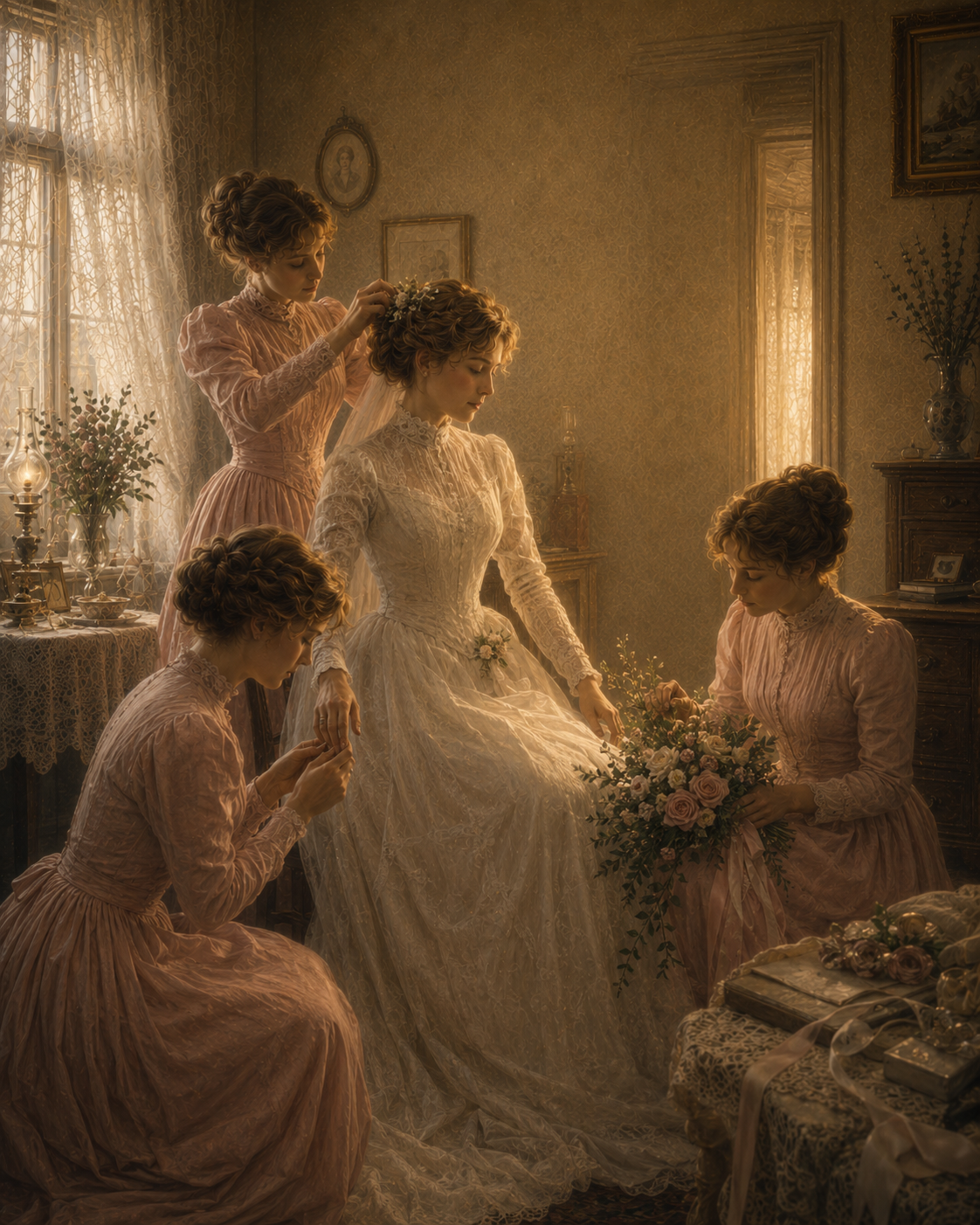
The scene again takes place in the bourgeois chamber of the cycle. This time, the room is not solitary, but filled with female busyness: three women in pink dresses help the bride dress and adorn herself.
The bride sits at the center of the image and wears a white dress. One woman arranges her hair, another attends to her hand, while the third prepares the bridal bouquet. Flowers, fabrics, and bright colors determine the surface of the scene.
The image takes up the words “Helft mir, ihr Schwestern” directly. The sisters appear as helping, ordering, and adorning figures. Their gestures are tender, but also ritualized.
Within the logic of the image cycle, this preparation means more than festive beauty. The woman is not only adorned, but inserted into her future role as wife. The bourgeois chamber becomes the place of a rite of passage.
The beautiful appearance is deliberately preserved here. There is not yet any visible break. Precisely for this reason, the image can show the festive surface of the bourgeois order of marriage: harmonious, warm, and at the same time formative.
Analysis – Poetry
Helft mir, ihr Schwestern,
Freundlich mich schmücken,
Dient der Glücklichen heute mir.
The poem begins as a direct address to the sisters. The speaker does not stand alone, but within a female circle that adorns and prepares her.
The word “serve” already shows the ritual order of the scene. On this day, the bride is the “happy one”, but at the same time she is the object of communal preparation.
Windet geschäftig
Mir um die Stirne
Noch der blühenden Myrte Zier.
Myrtle is a classic symbol of bridal adornment. It makes the situation clearly readable as wedding preparation.
The “busy” winding shows the practical side of the ritual: hands order, adorn, fasten, and prepare the bride for her appearance.
Helft mir, ihr Schwestern,
Helft mir verscheuchen
Eine törichte Bangigkeit;
Behind the festive surface, a moment of uncertainty appears. The speaker calls her fear “foolish”, yet precisely this formulation shows that the threshold to marriage is not entirely carefree.
The sisters are meant not only to adorn, but also to stabilize. They help bring the bride into the required posture.
Bist, mein Geliebter,
Du mir erschienen,
Giebst du mir, Sonne, deinen Schein?
The man appears once again as a source of light. He is “sun” and origin of radiance. The poem thereby connects to the logic of transfiguration in the first songs.
Lass mich in Andacht,
Lass mich in Demut,
Lass mich verneigen dem Herren mein.
The language of humility returns. The bride does not meet the man as an equal counterpart, but in a posture of devotion and bowing.
In a critical reading, it becomes especially clear here that the wedding means not only fulfillment in love, but also insertion into a hierarchical relationship.
Aber euch, Schwestern,
Grüss’ ich mit Wehmut,
Freudig scheidend aus eurer Schar.
The ending unites joy and farewell. The woman leaves the circle of sisters. A phase of life ends, and marriage begins.
The melancholy shows that the transition is not only gain. It also means separation from a previous female social space.
Statement & effect in the cycle
“Helft mir, ihr Schwestern” is the wedding and transition song of the cycle. The transfiguration of the preceding songs is now carried out socially and ritually.
The ring from the previous song leads here to bridal preparation. The inward confession becomes an outward act: the woman is adorned, arranged, and released from the sisterhood.
Within the image cycle, this song is especially important because it shows the bourgeois order in its most beautiful form. Everything appears harmonious, loving, and festive.
At the same time, it becomes visible that this beauty forms. The sisters help the bride, but they also help to place her into a new role. The later rupture is not yet there; the appearance initially remains entirely intact.
Evgenia Fölsche – Performances & audio
Pianist Evgenia Fölsche regularly engages with the Romantic art song and its psychological, poetic, and social layers of meaning in song programs. Frauenliebe und -leben is especially suited to an interpretation that connects musical inwardness with a critical perspective.
Frequently asked questions about Schumann: “Helft mir, ihr Schwestern”
Click on a question to show the answer.
What is “Helft mir, ihr Schwestern” about?
The song shows the bridal preparation. The woman asks her sisters or companions to adorn her and prepare her for the encounter with the bridegroom.
Why is the myrtle important?
Myrtle is a traditional sign of bridal adornment. In the poem, it clearly marks the situation as wedding preparation.
What role do the sisters play?
The sisters help the bride with her adornment. At the same time, they stand for the female social space that the woman now leaves with melancholy.
Why does the image seem festive and narrow at the same time?
The scene shows the beauty of the wedding ritual, but remains in the narrow bourgeois chamber. This makes marriage visible as a solemn and at the same time limiting transition.
How does the song fit into the cycle?
It stands after the ring song and before the marital intimacy of “Süßer Freund, du blickest”. It shows the transition from engagement to marriage.