“An meinem Herzen, an meiner Brust” is the seventh song from Robert Schumann’s cycle Frauenliebe und -leben op. 42, based on poems by Adelbert von Chamisso. After the announcement of pregnancy in the previous song, the child itself now appears: the woman experiences motherhood as the highest happiness. In the visual interpretation developed here, the scene remains warm and fulfilled, yet for the first time the pictorial space visibly narrows — a first formal crack in the beautiful appearance of the cycle.
The text by Adelbert von Chamisso
From: Frauenliebe und -leben
German original
An meinem Herzen, an meiner Brust,
Du meine Wonne, du meine Lust!
Das Glück ist die Liebe, die Lieb’ ist das Glück,
Ich hab’s gesagt und nehm’s nicht zurück.
Hab’ überschwänglich mich geschätzt,
Bin überglücklich aber jetzt.
Nur die da säugt, nur die da liebt
Das Kind, dem sie die Nahrung gibt;
Nur eine Mutter weiß allein,
Was lieben heißt und glücklich sein.
O, wie bedaur’ ich doch den Mann,
Der Mutterglück nicht fühlen kann!
Du lieber, lieber Engel du,
Du schauest mich an und lächelst dazu!
An meinem Herzen, an meiner Brust,
Du meine Wonne, du meine Lust!
Direct English translation
At my heart, at my breast,
You my bliss, you my delight!
Happiness is love, love is happiness,
I have said it and I do not take it back.
I once valued myself extravagantly,
But now I am overjoyed.
Only she who nurses, only she who loves
The child to whom she gives nourishment;
Only a mother alone knows
What it means to love and to be happy.
Oh, how I pity the man
Who cannot feel maternal happiness!
You dear, dear angel, you,
You look at me and smile as you do!
At my heart, at my breast,
You my bliss, you my delight!
Work data & overview
- Composer: Robert Schumann (1810–1856)
- Cycle: Frauenliebe und -leben op. 42, No. 7
- Text source: Adelbert von Chamisso, Frauenliebe und -leben
- Origin of the composition: 1840
- First edition: 1843, published by Friedrich Whistling in Leipzig
- Key: D major
- Character: bright, lively, and joyful
- Scoring: voice and piano
- Duration: approx. 1½–2 minutes
- Position in the cycle: seventh song; maternal happiness and first formal narrowing before the final rupture
Data on the poem
- Poet: Adelbert von Chamisso (1781–1838)
- Poem cycle: Frauenliebe und -leben
- Stanza form: short, songlike couplets
- Central motif: maternal happiness as the highest form of love
- Guiding motifs: heart, breast, child, nursing, motherly love, bliss, delight, angel
Origin & contexts
Schumann’s Frauenliebe und -leben was composed in 1840 and condenses Chamisso’s poem cycle into a sequence of eight musical stations. After the wedding and the announcement of pregnancy, motherhood now moves to the center.
“An meinem Herzen, an meiner Brust” is the brightest and most immediately joyful song of the cycle. The woman holds the child close and experiences the role of mother as fulfillment, intensification, and completion of love.
In a critical reading, however, this happiness is not free of ambivalence. The woman now defines the highest form of love through motherhood. The cycle thus approaches the point at which the bourgeois order seems completely fulfilled — shortly before it breaks apart in the final song.
Performance practice & reception
This song requires an open, bright, and flexible tone. The joy should feel immediate, but not sentimentally overstretched. The language is simple, almost childlike in its directness, and precisely in this lies its effect.
Interpretively, it is essential that the happiness does not appear only as outward jubilation. It is physical, close, and domestic: the child lies at the heart and at the breast. The expression should therefore combine warmth, lightness, and intimate closeness.
Reference recordings — selection
- Christa Ludwig – Geoffrey Parsons
- Elisabeth Schwarzkopf – Gerald Moore
- Brigitte Fassbaender – Irwin Gage
- Barbara Bonney – Vladimir Ashkenazy
- Bernarda Fink – Anthony Spiri
Analysis – Music
Jubilation, movement, and maternal happiness
Musically, “An meinem Herzen, an meiner Brust” feels brighter and more immediate than the preceding songs. Joy is no longer shy, no longer questioning, but present and physically palpable.
The song character is concise and direct. Repetitions and simple exclamations give the expression a quality of immediacy. Happiness no longer seems to require explanation; it speaks itself in the movement.
Happiness and beginning confinement
Although the song itself celebrates maternal happiness, within the cycle it stands immediately before the final rupture. Retrospectively, this gives the joy a fragile quality.
In the visual interpretation, this fragility is not expressed through the mother herself, but through the structure of the image: the space narrows. The happiness is real, but it takes place within an increasingly enclosed domestic world.
Visual representation
Artistic visualization:
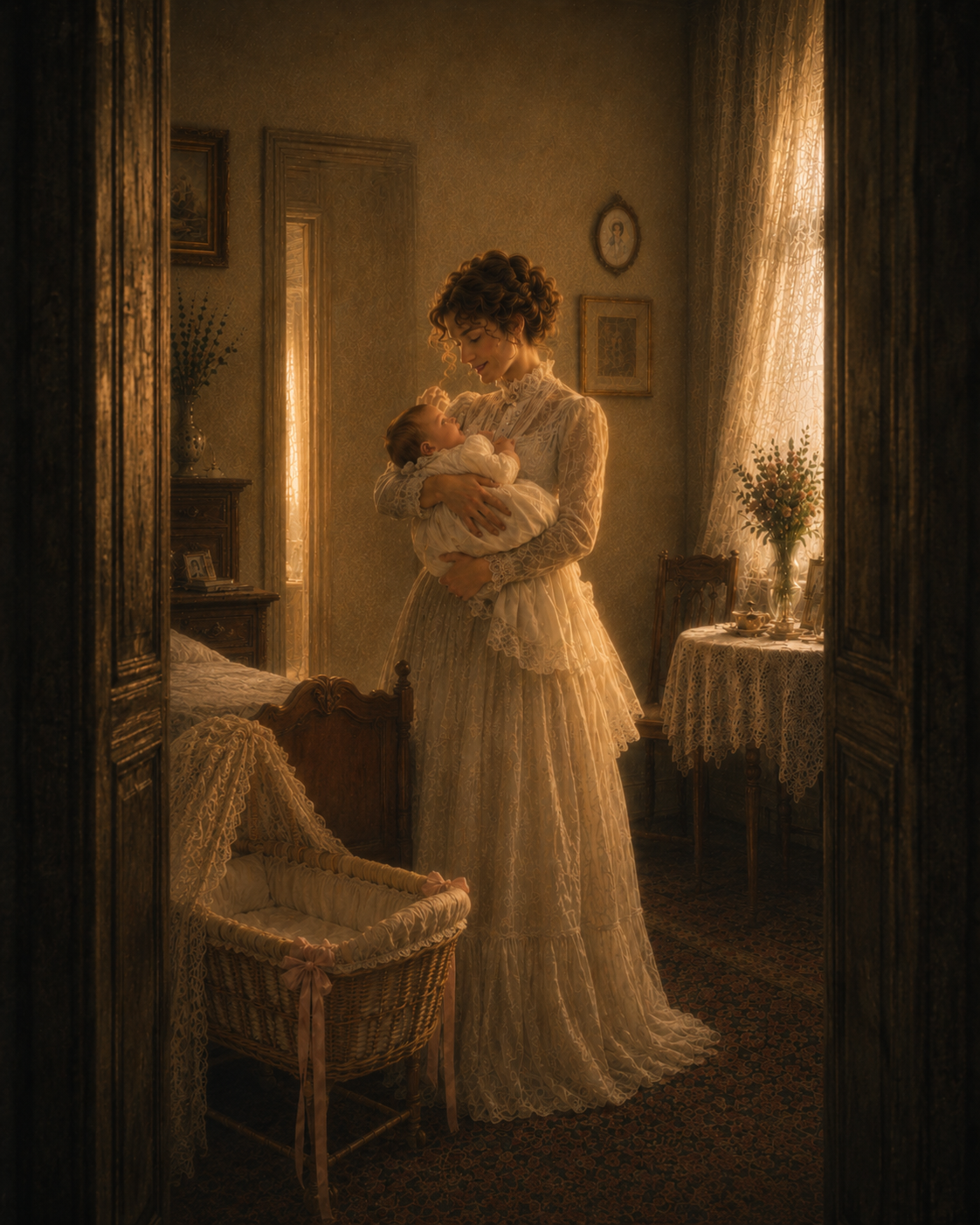
The scene takes place in the same chamber as the previous image: in the husband’s house, with the window on the right side. The man is no longer present. At the center stands the woman as mother.
She lovingly holds her baby close. Her face appears joyful, warm, and fulfilled. Beside the bed stands the cradle that had only been announced in the previous song. The dream has become reality.
The image takes up the verses “An meinem Herzen, an meiner Brust” directly. The child is the center of her devotion; motherly love appears as bodily closeness, warmth, and happiness.
At the same time, for the first time a visible crack appears in the order of the image. Dark vertical beams at the edges of the picture narrow the view. The scene remains bright and intimate, but the room feels more enclosed.
Within the image cycle, this is decisive: maternal happiness is not denied. It remains beautiful and real. Yet it takes place in a domestic world that increasingly closes in. The later collapse of the beautiful appearance announces itself formally for the first time.
Analysis – Poetry
An meinem Herzen, an meiner Brust,
Du meine Wonne, du meine Lust!
The poem begins with immediate bodily closeness. The child lies at the mother’s heart and breast. Love no longer appears as gaze, ring, or expectation, but as touch.
The words “bliss” and “delight” give maternal happiness an intense, almost exuberant coloring. The speaker experiences the child as the fulfillment of her entire existence.
Das Glück ist die Liebe, die Lieb’ ist das Glück,
Ich hab’s gesagt und nehm’s nicht zurück.
The formula “happiness is love” sounds simple and absolute. It has the force of a confession that knows no limitation.
At the same time, the repetition shows how strongly the speaker now concentrates her interpretation of life on this happiness. Love and happiness are completely identified with one another.
Nur die da säugt, nur die da liebt
Das Kind, dem sie die Nahrung gibt;
Motherhood is explicitly defined through nursing. Love appears as the giving of nourishment, as bodily care, and as an inseparable bond between mother and child.
As a result, the woman is bound even more strongly to the domestic and bodily interior space. The happiness is intense, but it is also spatially and socially narrowly located.
Nur eine Mutter weiß allein,
Was lieben heißt und glücklich sein.
These verses elevate motherly love to the highest form of loving. Only the mother, the poem claims, knows the true meaning of love and happiness.
In a critical reading, female fulfillment is here sharpened entirely toward motherhood. The song celebrates this role, but at the same time makes its exclusivity visible.
O, wie bedaur’ ich doch den Mann,
Der Mutterglück nicht fühlen kann!
Here, for once, the man is not elevated, but pitied. He cannot experience this happiness himself. For a moment, the woman possesses a knowledge that remains closed to him.
Nevertheless, this knowledge remains bound to her role as mother. Her special experience is also her new definition.
Du lieber, lieber Engel du,
Du schauest mich an und lächelst dazu!
The child is addressed as an angel. The transfiguration that at the beginning was directed toward the man, and later toward the ring, now passes to the child.
Thus the cycle’s logic of light and sanctity continues. The beautiful appearance remains intact, but its center has shifted.
Statement & effect in the cycle
“An meinem Herzen, an meiner Brust” presents motherhood as the pinnacle of happiness. The woman experiences herself no longer only as lover or wife, but as mother.
In the image cycle, this high point is deliberately shown as warm and beautiful. The child is not a sign of unhappiness, but the center of genuine devotion and joy.
At the same time, the first visible crack begins here. The dark side beams narrow the space. The bourgeois chamber, which until now was the place of appearance and transfiguration, now becomes palpable as an enclosed world.
This creates a double effect: maternal happiness remains credible, but it appears within an increasingly narrow frame. This prepares the radical reversal of the final song, in which, after the husband’s death, labor, poverty, and abandonment become visible.
Evgenia Fölsche – Performances & audio
Pianist Evgenia Fölsche regularly engages with the Romantic art song and its psychological, poetic, and social layers of meaning in song programs. Frauenliebe und -leben is especially suited to an interpretation that connects musical inwardness with a critical perspective.
Frequently asked questions about Schumann: “An meinem Herzen, an meiner Brust”
Click on a question to show the answer.
What is “An meinem Herzen, an meiner Brust” about?
The song shows the mother’s happiness with her child. The woman experiences physical closeness to the baby as the highest form of love and happiness.
Why is the child at the center?
After pregnancy and marriage, motherhood becomes the new center of life. The child gathers the woman’s love and appears as an “angel”.
What is the meaning of the cradle in the image?
The cradle was announced in the previous song. Now it stands visibly in the room and shows that the expected “lovely dream” has become reality.
Why do dark beams narrow the image?
The beams are the first formal crack in the cycle. They show that maternal happiness takes place in a domestic world that is becoming increasingly narrow.
How does the song prepare the end of the cycle?
The song still shows genuine happiness, but the space begins to close in. In the following final song, the beautiful appearance breaks apart completely.