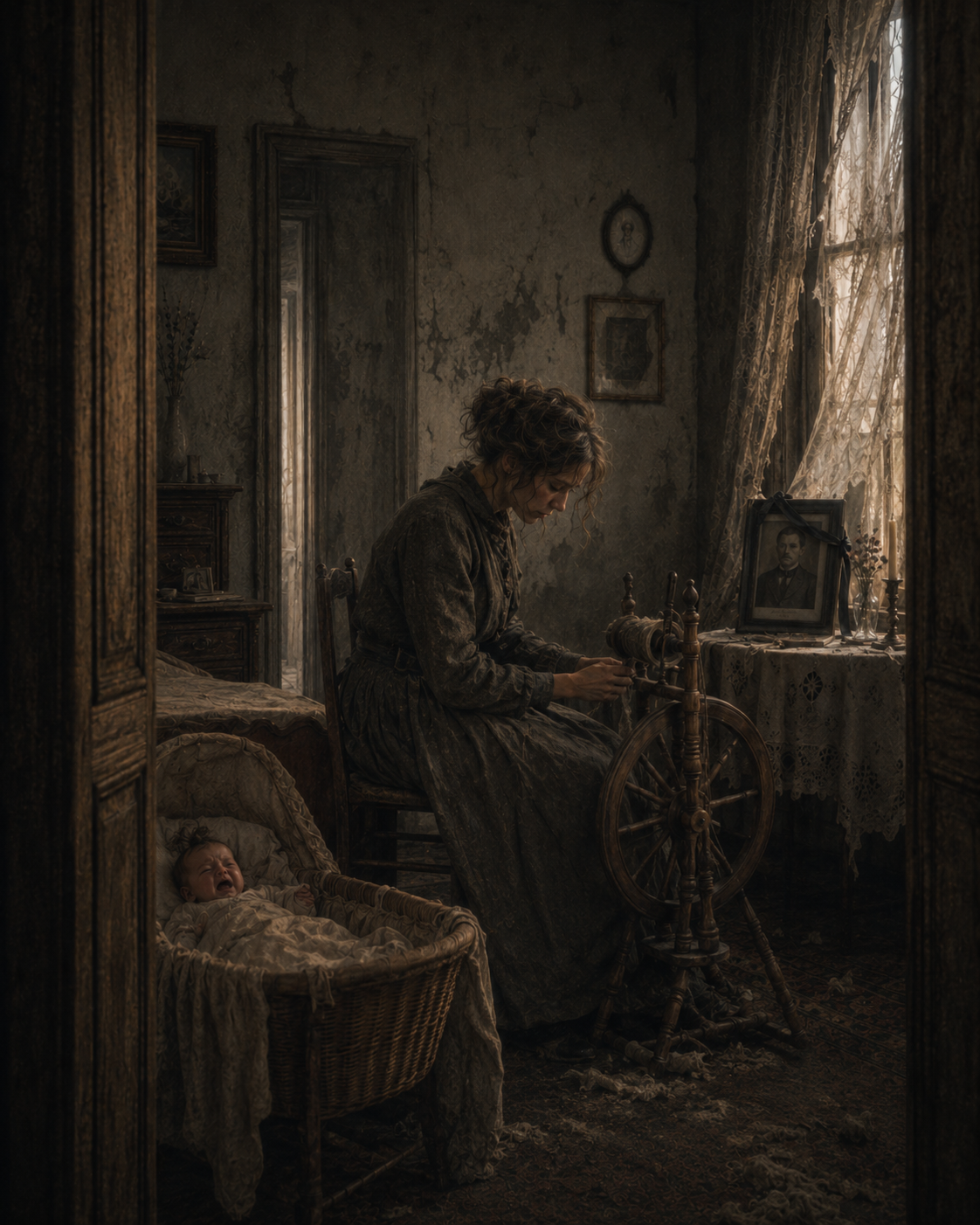
“Nun hast du mir den ersten Schmerz getan” is the eighth and final song from Robert Schumann’s cycle Frauenliebe und -leben op. 42, based on poems by Adelbert von Chamisso. After transfiguration, ring, wedding, pregnancy, and maternal happiness, the cycle ends with the death of the man. In the visual interpretation developed here, the entire bourgeois appearance now breaks apart: what remains is the woman as widow, working, impoverished, with a crying child and the dead man present only as a mourning portrait in the background.
The text by Adelbert von Chamisso
From: Frauenliebe und -leben
German original
Nun hast du mir den ersten Schmerz getan,
Der aber traf.
Du schläfst, du harter, unbarmherz’ger Mann,
Den Todesschlaf.
Es blicket die Verlass’ne vor sich hin,
Die Welt ist leer.
Geliebet hab’ ich und gelebt, ich bin
Nicht lebend mehr.
Direct English translation
Now you have caused me the first pain,
And this one struck deep.
You sleep, you hard, merciless man,
The sleep of death.
The abandoned one gazes before her,
The world is empty.
I have loved and lived, I am
No longer alive.
Work data & overview
- Composer: Robert Schumann (1810–1856)
- Cycle: Frauenliebe und -leben op. 42, No. 8
- Text source: Adelbert von Chamisso, Frauenliebe und -leben
- Origin of the composition: 1840
- First edition: 1843, published by Friedrich Whistling in Leipzig
- Key: D minor
- Character: slow, heavy, lamenting, and frozen
- Scoring: voice and piano
- Duration: approx. 3–4 minutes
- Position in the cycle: eighth and final song; death of the man, widowhood, and collapse of the previous order of life
Data on the poem
- Poet: Adelbert von Chamisso (1781–1838)
- Poem cycle: Frauenliebe und -leben
- Stanza form: short, condensed verses of lament
- Central motif: the first pain as the death of the beloved man
- Guiding motifs: pain, death-sleep, abandonment, empty world, end of life’s meaning, memory
Origin & contexts
Schumann’s Frauenliebe und -leben was composed in 1840 and ends with a radical rupture. After the stations of first encounter, transfiguration, ring, wedding, pregnancy, and maternal happiness, the cycle closes with the death of the man.
“Nun hast du mir den ersten Schmerz getan” changes the entire cycle retrospectively. The man, who was previously the source of light, meaning, and order in life, is now dead. The woman remains behind, and with his death her own life also seems emptied.
Schumann’s postlude is especially significant: after the voice has ended, the music of the first song returns. A circle is formed. The memory of the beginning appears not as a true return, but as the painful echo of a lost life.
Performance practice & reception
The final song requires extreme restraint. It should not be expanded sentimentally, but needs weight, stillness, and an almost frozen sonority. The pain is not explosive, but paralyzed.
Interpretively, the decisive tension lies between personal lament and complete emptiness. The woman still addresses the dead man, but the relationship is no longer alive. The singing stands at the edge of falling silent.
The postlude is essential to the effect of the song. Here the piano takes over memory and leads the cycle back to its beginning. The singer has already fallen silent; what remains is musical remembrance.
Reference recordings — selection
- Christa Ludwig – Geoffrey Parsons
- Elisabeth Schwarzkopf – Gerald Moore
- Brigitte Fassbaender – Irwin Gage
- Barbara Bonney – Vladimir Ashkenazy
- Bernarda Fink – Anthony Spiri
Analysis – Music
Pain, stillness, and emptiness
Musically, “Nun hast du mir den ersten Schmerz getan” stands in sharp contrast to the bright maternal happiness of the previous song. The movement is slowed, the sound darkened, the energy withdrawn.
The pain does not appear as a dramatic outburst, but as stillness. The woman speaks as if from inner paralysis. It is precisely this spareness that makes the song so shattering.
The words “The world is empty” form the emotional center of the poem. Music and language condense here into a state in which the outer world continues to exist, but has lost all meaning for the speaker.
The postlude as a retrospective view of the cycle
After the end of the vocal part, the piano brings back the music of the first song, “Seit ich ihn gesehen”. This return is not consolation in any simple sense. Rather, it shows that the whole story has now become memory.
The beginning appears from the perspective of the end. What once was promise, wonder, and awakening now resounds as a lost image. The piano takes over the voice of memory while the woman herself has fallen silent.
In this way Schumann closes the cycle in a circular form. Love does not end in a new future, but in the memory of its beginning. The postlude makes audible that the woman’s life revolved around this man — and with his death falls into emptiness.
Visual representation
Artistic visualization:
The scene no longer shows the warm, ordered chamber of the earlier images. The beautiful bourgeois interior has broken apart. What remains is a poor, dark room in which the woman works as a widow.
She sits at a sewing machine. Her body is bent, her face exhausted and turned away. Work now takes the place of earlier transfiguration. Love, marriage, and maternal happiness have become a condition of survival.
In the foreground, a child is crying. Motherhood, which in the previous song still appeared as the highest happiness, has not disappeared here, but appears under entirely different conditions: as care, burden, and responsibility in poverty.
In the background hangs the portrait of the deceased man. He is no longer present as a living counterpart, but only as memory and mourning image. Precisely through this, his power over the scene remains palpable.
The visual interpretation makes the rupture of the cycle visible: what previously appeared as a closed bourgeois order now reveals its reverse side. After the man’s death, the woman is left not in poetic transfiguration, but in labor, poverty, and abandonment.
Analysis – Poetry
Nun hast du mir den ersten Schmerz getan,
Der aber traf.
The poem begins with a direct address to the dead man. The pain is called the “first pain”. This makes it seem like something that previously had no place in the woman’s life.
The brief phrase “And this one struck deep” is extremely harsh. It says little, but precisely this brevity shows how deeply the pain has hit. The language is no longer overflowing, but broken off and condensed.
Du schläfst, du harter, unbarmherz’ger Mann,
Den Todesschlaf.
The man is both addressed and accused. “Hard” and “merciless” are strong words, yet they are not directed against a deliberate action, but against the fact of his death.
Death appears as sleep, but not as peaceful consolation. The “sleep of death” separates definitively. The man, who had previously been the source of meaning in life, has become unreachable.
Es blicket die Verlass’ne vor sich hin,
Die Welt ist leer.
The woman no longer calls herself happy, bride, beloved, or mother, but “the abandoned one”. Her identity is defined by loss.
“The world is empty” is the central sentence of the song. It is not only the man who is missing; the whole world has lost its meaning. Everything that had previously been related to him falls into emptiness.
Geliebet hab’ ich und gelebt, ich bin
Nicht lebend mehr.
The ending sums up the logic of the entire cycle. Loving and living were inseparably connected for the woman. With the end of love through the man’s death, her own sense of life also ends.
“No longer alive” does not mean the woman’s physical death, but an inner extinction. She continues to exist, but her life no longer appears to her as life.
Precisely here the critical dimension of the cycle becomes especially clear. If the woman’s existence is wholly oriented toward the man, then his death leads not only to grief, but to the collapse of her entire world.
Statement & effect in the cycle
“Nun hast du mir den ersten Schmerz getan” is the radical final rupture of the cycle. Everything that had previously been built up as love, happiness, marriage, and motherhood now stands under the sign of loss.
In the image cycle, this rupture is deliberately made visible not only psychologically, but socially. The woman is not only a grieving lover, but an impoverished widow who must work and remains responsible for her child.
This calls the beautiful appearance of the previous images into question retrospectively. The bourgeois order that previously promised protection, meaning, and beauty now reveals its harshness after the death of the man.
The final song is therefore not only a song of grief, but also a song of exposure. It shows what remains when the man around whom the entire order of life revolved is no longer there: labor, poverty, loneliness, and memory.
Evgenia Fölsche – Performances & audio
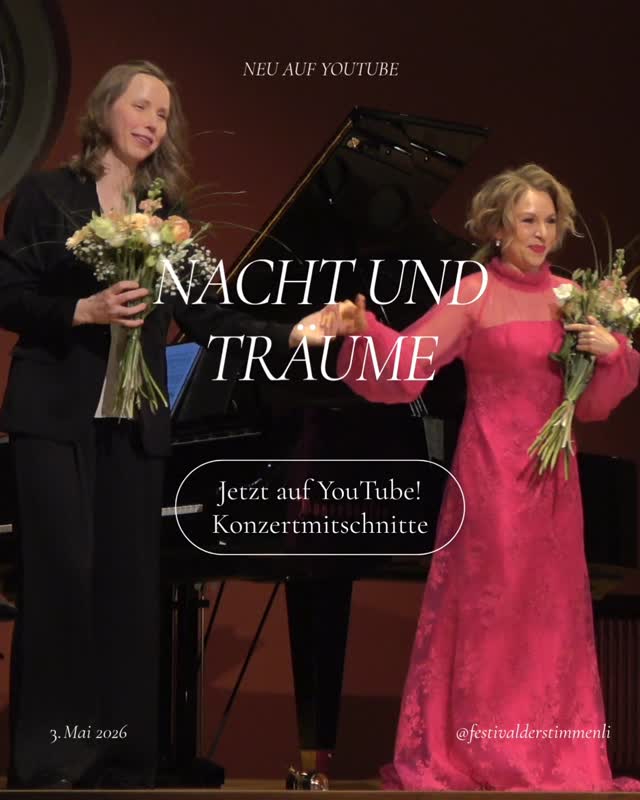
Pianist Evgenia Fölsche regularly engages with the Romantic art song and its psychological, poetic, and social layers of meaning in song programs. Frauenliebe und -leben is especially suited to an interpretation that connects musical inwardness, memory, and critical perspective.
Frequently asked questions about Schumann: “Nun hast du mir den ersten Schmerz getan”
Click on a question to show the answer.
What is “Nun hast du mir den ersten Schmerz getan” about?
The song shows the death of the man and the woman’s grief. She experiences his death as the first great pain, one that empties her whole world.
Why is this song the rupture of the cycle?
Everything that had previously been built up — love, marriage, motherhood, and bourgeois shelter — breaks apart with the man’s death. The previous order loses its meaning.
What is the meaning of the piano postlude?
In the postlude, the music of the first song returns. This closes the cycle in a circular form: the beginning now appears as memory of a lost life.
Why does the image show the woman working?
The working widow makes visible what remains socially after the man’s death: not only grief, but also poverty, responsibility, and survival.
How does Frauenliebe und -leben end?
The cycle ends with death, emptiness, and memory. The final song shows no new future, but the collapse of the world that had formed around the man.