“Er, der Herrlichste von allen” is the second song from Robert Schumann’s cycle Frauenliebe und -leben op. 42, based on poems by Adelbert von Chamisso. After the first visionary encounter in “Seit ich ihn gesehen”, the man now becomes the object of admiring veneration: bright, glorious, noble, and distant. In the visual interpretation developed here, this veneration is at the same time made visible as bourgeois self-subordination.
The text by Adelbert von Chamisso
From: Frauenliebe und -leben
German original
Er, der Herrlichste von allen,
Wie so milde, wie so gut!
Holde Lippen, klares Auge,
Heller Sinn und fester Mut.
So wie dort in blauer Tiefe,
Hell und herrlich, jener Stern,
Also er an meinem Himmel,
Hell und herrlich, hehr und fern.
Wandle, wandle deine Bahnen;
Nur betrachten deinen Schein,
Nur in Demut ihn betrachten,
Selig nur und traurig sein!
Höre nicht mein stilles Beten,
Deinem Glücke nur geweiht;
Darfst mich niedre Magd nicht kennen,
Hoher Stern der Herrlichkeit!
Nur die Würdigste von allen
Darf beglücken deine Wahl,
Und ich will die Hohe segnen,
Viele tausendmal.
Will mich freuen dann und weinen,
Selig, selig bin ich dann;
Sollte mir das Herz auch brechen,
Brich, o Herz, was liegt daran?
Direct English translation
He, the most glorious of all,
How so gentle, how so good!
Lovely lips, clear eye,
Bright mind and firm courage.
Just as there in blue depth,
Bright and glorious, that star,
So he in my heaven,
Bright and glorious, noble and distant.
Move, move along your paths;
Only to behold your shine,
Only to behold it in humility,
Only to be blessed and sad!
Do not hear my silent prayer,
Dedicated only to your happiness;
You must not know me, lowly maid,
High star of glory!
Only the worthiest of all
May make your choice happy,
And I will bless the noble one,
Many thousand times.
I will then rejoice and weep,
Blessed, blessed I am then;
Even if my heart should break,
Break, o heart, what does it matter?
Work data & overview
- Composer: Robert Schumann (1810–1856)
- Cycle: Frauenliebe und -leben op. 42, No. 2
- Text source: Adelbert von Chamisso, Frauenliebe und -leben
- Origin of the composition: 1840
- First edition: 1843, published by Friedrich Whistling in Leipzig
- Key: E-flat major
- Tempo character: lively and inward
- Scoring: voice and piano
- Duration: approx. 3 minutes
- Position in the cycle: second song; expansion of the first transfiguration into humble veneration
Data on the poem
- Poet: Adelbert von Chamisso (1781–1838)
- Poem cycle: Frauenliebe und -leben
- Stanza form: 6 stanzas of 4 verses each
- Central motif: veneration of the man as an unreachable star
- Guiding motifs: star, heaven, humility, prayer, self-abasement, distant glory
Origin & contexts
Schumann’s Frauenliebe und -leben was composed in 1840, the composer’s so-called year of song. During this period, Schumann turned with particular intensity to the art song and composed several of his most important song cycles.
Chamisso’s poem cycle tells of a bourgeois-romantic woman’s life in successive stages: first encounter, admiration, being chosen, ring, wedding, pregnancy, motherhood, and loss. “Er, der Herrlichste von allen” still belongs entirely to the phase of appearance and transfiguration.
Compared with the first song, the man is now experienced not only as an inner image, but as the measure of an entire world. The woman defines herself through her gaze upon him: he is star, glory, and unreachable height.
Performance practice & reception
Interpretively, the song requires a special balance. On the one hand, it has a brighter, more animated tone than the opening “Seit ich ihn gesehen”. On the other hand, its liveliness must not become external: the momentum arises from an inner excitement that is at the same time marked by humility and self-restraint.
For the singer, the challenge is to make admiration and pain audible at the same time. The lyrical I praises the man, but places itself beneath him. Precisely this tension between blessedness and sadness determines the expression of the song.
Reference recordings — selection
- Christa Ludwig – Geoffrey Parsons
- Elisabeth Schwarzkopf – Gerald Moore
- Brigitte Fassbaender – Irwin Gage
- Barbara Bonney – Vladimir Ashkenazy
- Bernarda Fink – Anthony Spiri
Analysis – Music
Movement, momentum, and gesture of veneration
After the quiet rapture of the first song, the music in “Er, der Herrlichste von allen” opens into a more animated expression. The tone is brighter and more urgent, as if the admiration of the lyrical I now had to be spoken aloud.
At the same time, the gesture remains controlled. The music is not free jubilation, but a form of directed veneration. The man appears as an ideal whom the voice follows without truly being able to reach him.
The distant star as a musical image
The text compares the man to a star in blue depth. Musically, this image can be understood as a tension between nearness and distance: the voice speaks of immediate admiration, yet the object of this admiration remains elevated and unreachable.
The expression of the song therefore lies not only in praise, but in distance. The beloved is not perceived as a partner on the same level, but as a shining point above one’s own life.
Visual representation
Artistic visualization:
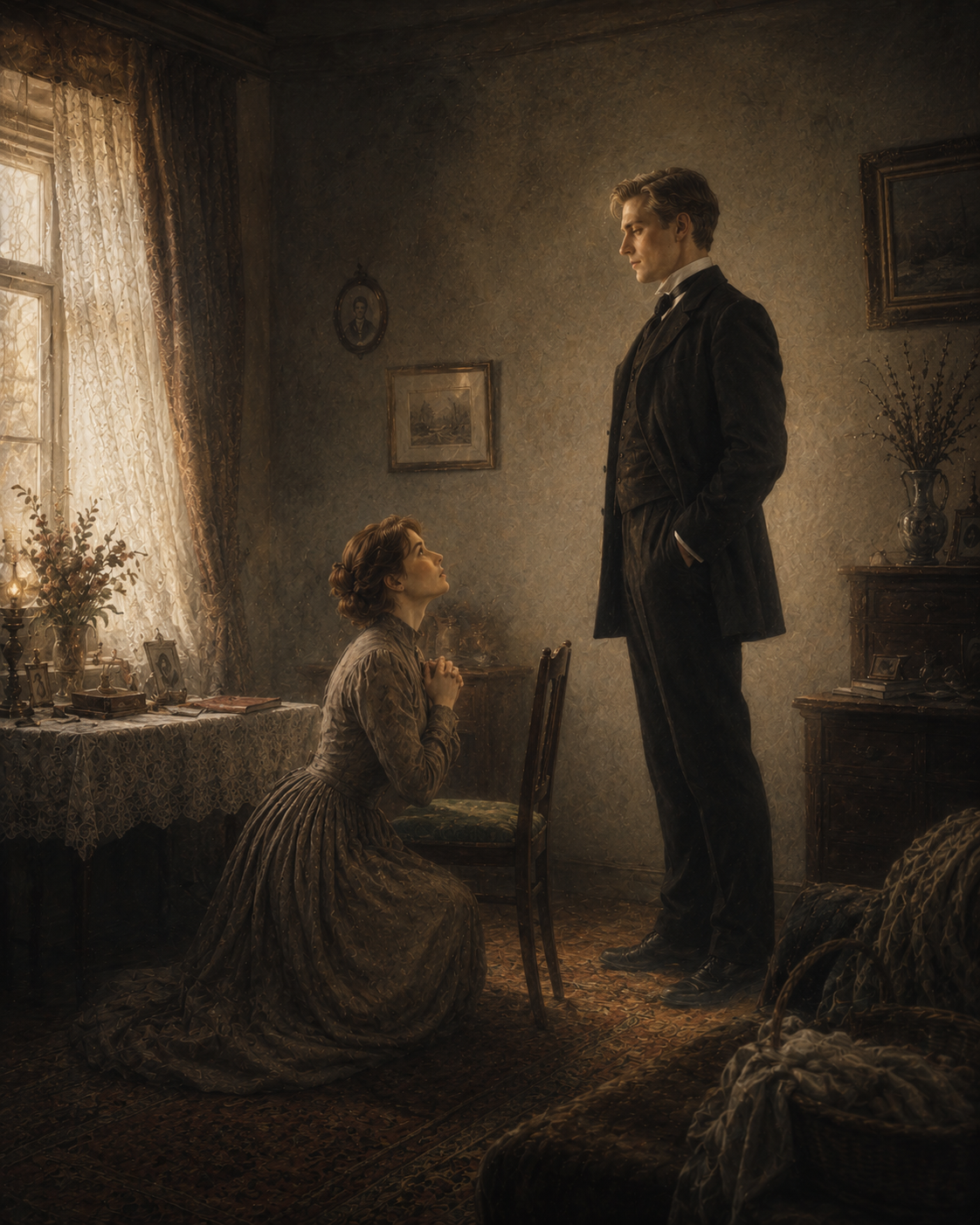
The scene takes place in the same bourgeois chamber as the first image of the cycle. This time, however, the man no longer appears as a blurred vision of light. He stands in the room as a real presence: upright, calm, dressed in dark bourgeois clothing.
The woman is positioned lower in the image. She kneels or sinks down before him in a humble posture, her gaze raised toward him. Her gesture is not theatrical, but quiet and bound to the domestic sphere. Precisely through this, the hierarchy between the two figures becomes visible.
The image takes up the central formulations of the song: “Nur in Demut ihn betrachten” and “Darfst mich niedre Magd nicht kennen”. The man is no longer merely an inner image, but a social reality. The transfiguration thus becomes more concrete and at the same time more problematic.
The chamber remains ordered, warm, and bourgeois. It does not yet appear destroyed or desolate. The beautiful appearance is intact. But within this order it is already visible how the woman diminishes herself and elevates the man.
In the overall cycle, this representation marks the transition from vision to subordination. The first song showed the man as a figure of light. This second song shows how transfiguration becomes a relationship: he stands, she kneels; he is distant and glorious, she beholds him in humility.
Analysis – Poetry
Er, der Herrlichste von allen,
Wie so milde, wie so gut!
Holde Lippen, klares Auge,
Heller Sinn und fester Mut.
The poem begins with emphatic praise. The man is not described in a concrete action, but as the sum of ideal qualities: gentle, good, clear, bright, and firm.
This idealizing language makes him less an individual person than an image. He appears as a projection surface for goodness, strength, and inner brightness.
So wie dort in blauer Tiefe,
Hell und herrlich, jener Stern,
Also er an meinem Himmel,
Hell und herrlich, hehr und fern.
The comparison with the star lifts the man out of the immediate world of life. He is visible but unreachable; bright, yet distant. The woman looks up to him without placing herself on equal footing with him.
The double movement is decisive: the man is elevated, the woman subordinates herself. Her love is not yet possession or fulfillment, but contemplative veneration.
Wandle, wandle deine Bahnen;
Nur betrachten deinen Schein,
Nur in Demut ihn betrachten,
Selig nur und traurig sein!
The repetition of “only” narrows the scope of action of the lyrical I. She does not want to intervene, demand, or claim. What remains to her is contemplation.
The combination of blessedness and sadness shows the ambivalence of this attitude. Admiration makes her happy, but it is also based on distance and self-renunciation.
Höre nicht mein stilles Beten,
Deinem Glücke nur geweiht;
Darfst mich niedre Magd nicht kennen,
Hoher Stern der Herrlichkeit!
Here self-abasement becomes explicit. The speaker calls herself a “lowly maid” and declares the man to be the “high star of glory”. Love becomes devotion.
In a critical reading, the bourgeois gender order becomes clearly visible here: the woman does not recognize herself as an equal counterpart, but as a serving, praying, and retreating figure.
Nur die Würdigste von allen
Darf beglücken deine Wahl,
Und ich will die Hohe segnen,
Viele tausendmal.
The speaker does not expect to be chosen herself. She even imagines blessing another woman if that woman is chosen by the man. Her own longing is translated into self-renunciation.
Will mich freuen dann und weinen,
Selig, selig bin ich dann;
Sollte mir das Herz auch brechen,
Brich, o Herz, was liegt daran?
The ending intensifies the attitude of self-renunciation to the point of being willing to hold fast to her own broken heart. The I accepts its own dissolution as long as the man remains in his glory.
This makes the song a decisive step in the cycle: the first infatuation becomes a structure of subordination.
Statement & effect in the cycle
“Er, der Herrlichste von allen” continues the transfiguration begun in the first song. From the inner image of the man, an ideal emerges against which the woman measures her own life.
The beautiful appearance is still unbroken. The man appears as star, as light, as the embodiment of goodness and greatness. Yet precisely this elevation creates a clear hierarchy.
Within the image cycle, this hierarchy is made visible. The woman kneels, the man stands. He has become more real, but at the same time the social order that elevates him and lowers her becomes clearer.
Thus the song forms an important second station: after the visionary overlay of the first song comes the practicing of humility. The later collapse of appearance is prepared by this, without needing to become visible already at this point.
Evgenia Fölsche – Performances & audio
Pianist Evgenia Fölsche regularly engages with the Romantic art song and its psychological, poetic, and social layers of meaning in song programs. Frauenliebe und -leben is especially suited to an interpretation that connects musical inwardness with a critical perspective.
Frequently asked questions about Schumann: “Er, der Herrlichste von allen”
Click on a question to show the answer.
What is “Er, der Herrlichste von allen” about?
The song describes the admiring veneration of the man. He appears to the woman as a bright, distant ideal to which she subordinates herself in humility.
Why is the man compared with a star?
The star stands for brightness, beauty, and unreachability. The man is visible and admired, but remains elevated and distant.
What role does humility play in this song?
Humility is a central motif. The speaker does not want to demand or possess the man, but only to behold his shine and devote herself to his happiness.
How does the song fit into the cycle?
It follows the first visionary encounter. Infatuation now becomes veneration and prepares the later bond through being chosen, the ring, and marriage.
How should the artistic visualization be understood?
The woman kneels before the standing man in a bourgeois chamber. This makes visible that romantic transfiguration also produces a structure of subordination.