“Du Ring an meinem Finger” is the fourth song from Robert Schumann’s cycle Frauenliebe und -leben op. 42, based on poems by Adelbert von Chamisso. The ring becomes the visible sign of being chosen and of the coming marriage. In the visual interpretation developed here, the ring shines like a small sun and thus takes over the transfiguring power that, at the beginning of the cycle, still came from the image of the man.
The text by Adelbert von Chamisso
From: Frauenliebe und -leben
German original
Du Ring an meinem Finger,
Mein goldenes Ringelein,
Ich drücke dich fromm an die Lippen,
Dich fromm an das Herze mein.
Ich hatt’ ihn ausgeträumet,
Der Kindheit friedlich schönen Traum,
Ich fand allein mich, verloren
Im öden, unendlichen Raum.
Du Ring an meinem Finger,
Da hast du mich erst belehrt,
Hast meinem Blick erschlossen
Des Lebens unendlichen Wert.
Ich will ihm dienen, ihm leben,
Ihm angehören ganz,
Hin selber mich geben und finden
Verklärt mich in seinem Glanz.
Direct English translation
You ring on my finger,
My little golden ring,
I press you devoutly to my lips,
You devoutly to my heart.
I had dreamed it out,
Childhood’s peacefully beautiful dream,
I found myself alone, lost
In the desolate, endless space.
You ring on my finger,
Only then did you teach me,
You opened to my gaze
The endless value of life.
I want to serve him, live for him,
Belong wholly to him,
Give myself away there and find
Myself transfigured in his radiance.
Work data & overview
- Composer: Robert Schumann (1810–1856)
- Cycle: Frauenliebe und -leben op. 42, No. 4
- Text source: Adelbert von Chamisso, Frauenliebe und -leben
- Origin of the composition: 1840
- First edition: 1843, published by Friedrich Whistling in Leipzig
- Key: E-flat major
- Tempo and performance indication: Innig
- Scoring: voice and piano
- Duration: approx. 2½–3 minutes
- Position in the cycle: fourth song; the ring as a sign of being chosen, bond, and self-surrender
Data on the poem
- Poet: Adelbert von Chamisso (1781–1838)
- Poem cycle: Frauenliebe und -leben
- Stanza form: 4 stanzas of 4 verses each
- Central motif: the ring as a sign of meaning and bond
- Guiding motifs: ring, piety, heart, childhood dream, value of life, service, belonging, radiance
Origin & contexts
Schumann’s Frauenliebe und -leben was composed in 1840, the composer’s so-called year of song. The cycle follows Chamisso’s sequence of poems in eight musical stations and condenses them into a closed emotional and dramaturgical arc.
“Du Ring an meinem Finger” stands at the center of the first half of the cycle. After the first encounter, reverent subordination, and scarcely comprehensible being-chosen, a concrete sign now comes to the fore: the ring.
The ring is more than a piece of jewelry. It stands for engagement, coming marriage, social recognition, and the woman’s readiness to orient her life entirely toward the man.
Performance practice & reception
The song requires an inward, collected tone. Unlike “Ich kann’s nicht fassen, nicht glauben”, it is not marked by passionate turmoil, but by quiet devotion. The singer must take back the emotional intensity and direct it inward.
In the song, the ring is addressed almost like a counterpart. This creates a special intimacy: not the man himself stands at the center of the speech, but the symbol of his bond. The performance should make this symbolic concentration audible.
Reference recordings — selection
- Christa Ludwig – Geoffrey Parsons
- Elisabeth Schwarzkopf – Gerald Moore
- Brigitte Fassbaender – Irwin Gage
- Barbara Bonney – Vladimir Ashkenazy
- Bernarda Fink – Anthony Spiri
Analysis – Music
Inwardness and devotion
The performance indication Innig points to the special character of this song. The expression is not outwardly festive, but concentrated, devotional, and quiet. The music seems to gather around a small, luminous center.
The singing feels like an intimate address. The woman speaks directly to the ring and thereby gives it an almost sacred meaning. The song is less narration than inner confession.
The ring as musical center
Unlike the previous songs, the focus here is not the man himself, but a sign. The ring gathers the previous hopes and transforms them into a concrete form.
Musically, this corresponds to a calmer, more composed attitude. Happiness is no longer only an overwhelming dream, but takes shape: as ring, as bond, as future order of life.
Visual representation
Artistic visualization:
The woman sits in the same bourgeois chamber of the cycle. She is alone and looks at her raised hand. On her finger she wears the golden ring, which shines like a small sun.
The light no longer emanates from the man himself, but from the sign of the bond. The ring outshines the room and bathes the narrow chamber in warm, transfiguring light. This creates a deliberate connection to the first image of the cycle, in which the man appeared as a figure of light.
The woman’s posture is quiet, collected, and almost devotional. She does not look at the ring as mere jewelry, but as revelation. This corresponds to the words of the song: “Ich drücke dich fromm an die Lippen, / Dich fromm an das Herze mein.”
At the same time, the chamber remains closed. The ring brings radiance and meaning, but no spatial freedom. The bourgeois world in which her life unfolds remains narrow and domestic.
In the overall cycle, this scene marks the sacralization of the bond. What previously began as a vision of the man now shifts to a social symbol: the engagement ring. The beautiful appearance is still unbroken.
Analysis – Poetry
Du Ring an meinem Finger,
Mein goldenes Ringelein,
Ich drücke dich fromm an die Lippen,
Dich fromm an das Herze mein.
The poem begins with a direct address to the ring. Through this, the object is personalized and elevated. The ring is not merely jewelry, but a counterpart whom the woman meets with piety.
The words “devoutly”, “lips”, and “heart” give the scene an almost sacred intimacy. The ring is venerated, kissed, and pressed to the heart.
Ich hatt’ ihn ausgeträumet,
Der Kindheit friedlich schönen Traum,
Ich fand allein mich, verloren
Im öden, unendlichen Raum.
The second stanza looks back on a state of lostness. The speaker describes herself as alone in the “desolate, endless space”. Without a bond, life appears empty and without orientation.
The ring ends this emptiness. It gives the world form, direction, and meaning. At the same time, it becomes clear how completely the meaning of life is now tied to the bond with the man.
Du Ring an meinem Finger,
Da hast du mich erst belehrt,
Hast meinem Blick erschlossen
Des Lebens unendlichen Wert.
The repetition of the opening line strengthens the central position of the ring. It becomes a teacher, indeed almost a revealer. Through it, the woman recognizes “the endless value of life”.
In a critical reading, the power of the bourgeois symbol becomes apparent here: the ring reveals not only love, but a socially defined role in life.
Ich will ihm dienen, ihm leben,
Ihm angehören ganz,
Hin selber mich geben und finden
Verklärt mich in seinem Glanz.
The final stanza formulates the consequence of the bond. The woman wants to serve the man, live for him, and belong wholly to him. Self-surrender appears as the path to her own transfiguration.
This is precisely where the ambivalence of the song lies: the speaker experiences surrender as meaning and radiance. At the same time, it means the abandonment of an independent self.
Statement & effect in the cycle
“Du Ring an meinem Finger” is a key song in the cycle. The transfiguration of the man is now transferred to a concrete sign. The ring gathers love, being chosen, social recognition, and the prospect of marriage.
Within the image cycle, this shift is decisive. In the first song, the man himself shone. Here, the ring shines. This makes visible that not only a person, but also the bourgeois institution of the bond is transfigured.
The woman experiences this bond as elevation. Yet the language of the poem also shows service, belonging, and self-surrender. The beautiful appearance remains, but its structure becomes clearer.
The song prepares the following bridal preparation: from the ring as sign, the next song moves to the social ritual of the wedding.
Evgenia Fölsche – Performances & audio
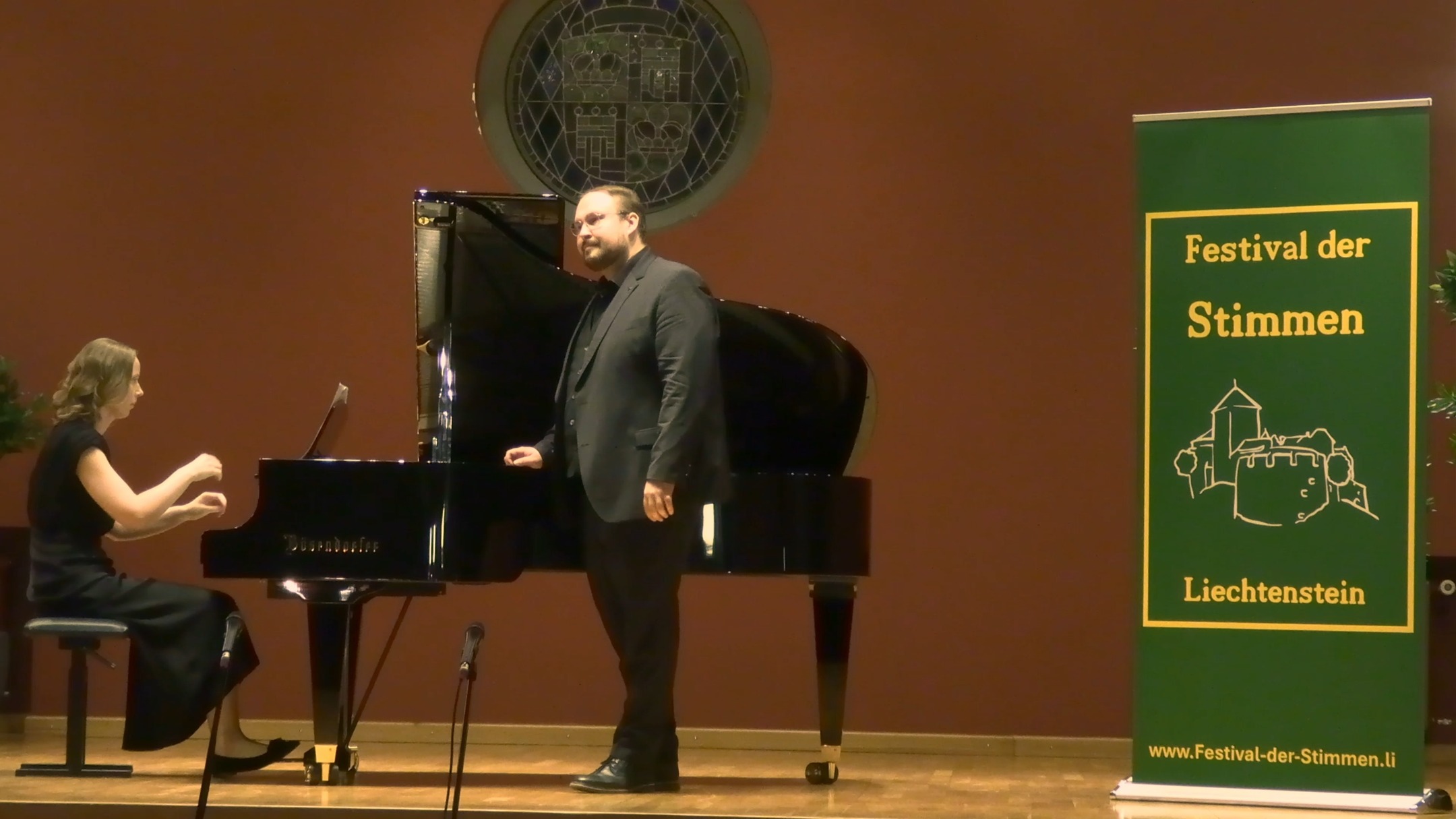
Pianist Evgenia Fölsche regularly engages with the Romantic art song and its psychological, poetic, and social layers of meaning in song programs. Frauenliebe und -leben is especially suited to an interpretation that connects musical inwardness with a critical perspective.
Frequently asked questions about Schumann: “Du Ring an meinem Finger”
Click on a question to show the answer.
What is “Du Ring an meinem Finger” about?
The song describes the contemplation of the ring as a sign of being chosen and of bond. The woman experiences the ring as the symbol of a new order of life.
Is the ring an engagement ring?
In the context of the cycle, the ring is most likely to be understood as an engagement ring. It points to the coming marriage and to the social bond with the man.
Why does the ring shine in the visualization?
The shining shows the transfiguration of the symbol. After the man himself appeared like a figure of light in the first song, the ring now takes over this transfiguring function.
What role does piety play in the song?
The words “fromm” and “Herze” give the contemplation of the ring a devotional, almost sacred coloring. The ring is treated like a holy object.
How does the song fit into the cycle?
It stands between being chosen and the wedding. The ring turns the dreamlike happiness of the previous songs into a socially visible sign of the bond.