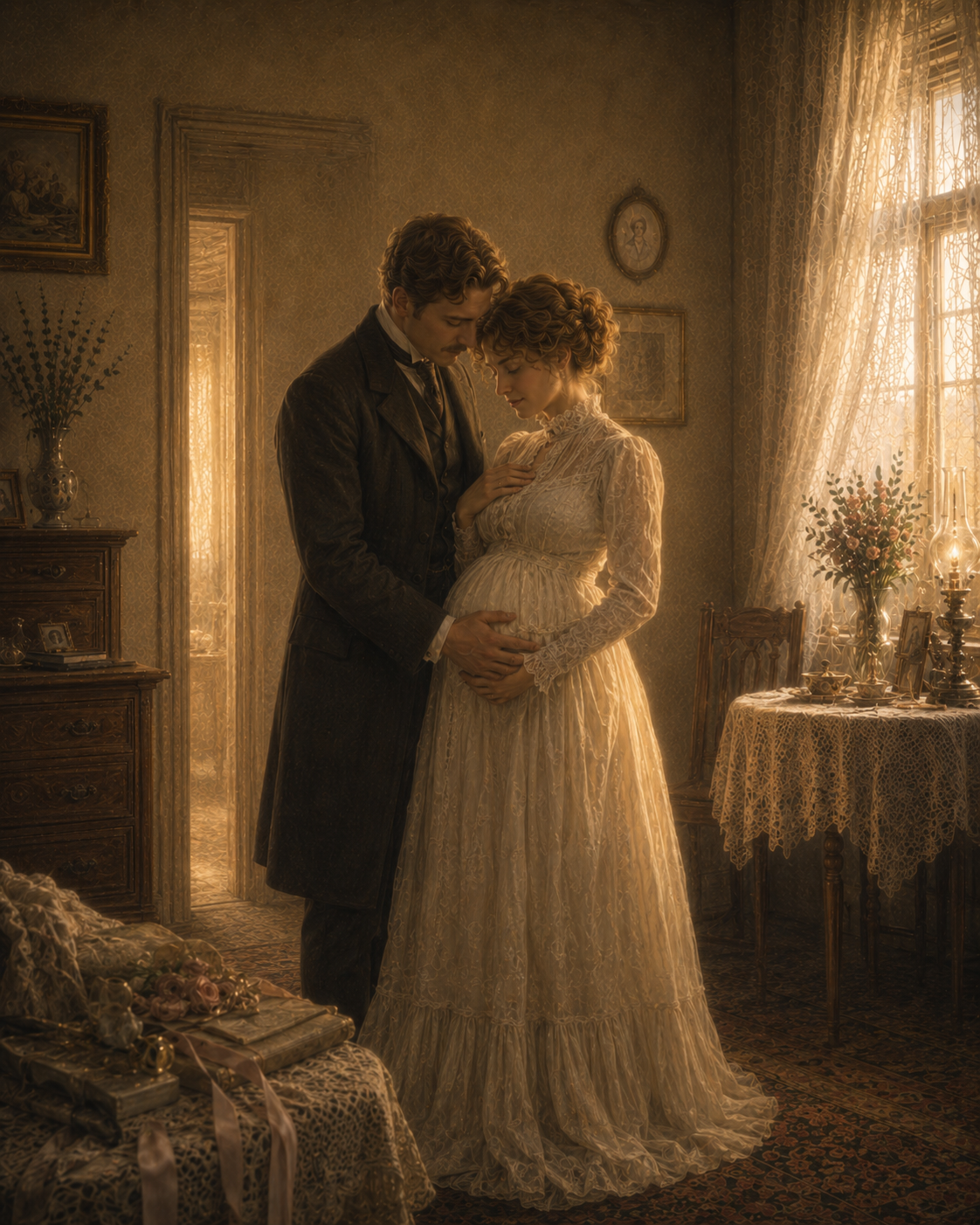
“Süßer Freund, du blickest” is the sixth song from Robert Schumann’s cycle Frauenliebe und -leben op. 42, based on poems by Adelbert von Chamisso. After the ring and the wedding, marriage now appears as an intimate interior space: the woman tells her husband of her pregnancy. In the visual interpretation developed here, the beautiful appearance is still preserved, yet the chamber has changed: it is now the chamber in the husband’s house, mirrored in relation to the earlier bourgeois world.
The text by Adelbert von Chamisso
From: Frauenliebe und -leben
German original
Süßer Freund, du blickest
Mich verwundert an,
Kannst es nicht begreifen,
Wie ich weinen kann;
Lass der feuchten Perlen
Ungewohnte Zier
Freudig hell erzittern
In dem Auge mir.
Wie so bang mein Busen,
Wie so wonnevoll!
Wüsst’ ich nur mit Worten,
Wie ich’s sagen soll;
Komm und birg dein Antlitz
Hier an meiner Brust,
Will in’s Ohr dir flüstern
Alle meine Lust.
Weisst du nun die Thränen,
Die ich weinen kann?
Sollst du nicht sie sehen,
Du geliebter Mann?
Bleib’ an meinem Herzen,
Fühle dessen Schlag,
Dass ich fest und fester
Nur dich drücken mag.
Hier an meinem Bette
Hat die Wiege Raum,
Wo sie still verberge
Meinen holden Traum;
Kommen wird der Morgen,
Wo der Traum erwacht,
Und daraus dein Bildniss
Mir entgegen lacht.
Direct English translation
Sweet friend, you look
At me in wonder,
You cannot understand
How I can weep;
Let the moist pearls,
Unaccustomed adornment,
Tremble joyfully bright
In my eye.
How anxious my breast,
How full of bliss!
If only I knew with words
How I should say it;
Come and hide your face
Here at my breast,
I want to whisper into your ear
All my delight.
Do you now know the tears
That I can weep?
Should you not see them,
You beloved man?
Stay at my heart,
Feel its beat,
So that more firmly and ever more firmly
I may press only you.
Here beside my bed
There is room for the cradle,
Where it may quietly hide
My lovely dream;
The morning will come
When the dream awakens,
And from it your image
Will smile back at me.
Work data & overview
- Composer: Robert Schumann (1810–1856)
- Cycle: Frauenliebe und -leben op. 42, No. 6
- Text source: Adelbert von Chamisso, Frauenliebe und -leben
- Origin of the composition: 1840
- First edition: 1843, published by Friedrich Whistling in Leipzig
- Key: G major
- Tempo and performance indication: Langsam, mit innigem Ausdruck
- Scoring: voice and piano
- Duration: approx. 4 minutes
- Position in the cycle: sixth song; marital intimacy and announcement of pregnancy
Data on the poem
- Poet: Adelbert von Chamisso (1781–1838)
- Poem cycle: Frauenliebe und -leben
- Stanza form: 8 stanzas of 4 verses each
- Central motif: announcement of pregnancy to the husband
- Guiding motifs: tears, breast, heart, whispering, cradle, dream, child as image of the man
Origin & contexts
Schumann’s Frauenliebe und -leben was composed in 1840 and follows Chamisso’s poem cycle in eight musical stations. After the wedding, the focus shifts from the public ritual into the private space of marriage.
“Süßer Freund, du blickest” is one of the most intimate songs of the cycle. The speaker explains her tears to the man not as pain, but as the expression of an overflowing joy that can hardly be put into words.
The decisive content is spoken only indirectly: there shall be room for the cradle beside the bed. The “lovely dream” will awaken in the morning, and from it the man’s image will smile back at the speaker. What is meant is the expected child.
Performance practice & reception
The song requires a particularly intimate shaping. The voice should declaim less than speak and sing confidentially. The tone is not public, but domestic and almost whispered.
Interpretively, the mixture of apprehension and bliss is important. The woman’s tears are not signs of suffering, but of an overwhelming inner movement. The expression should therefore remain soft, inward, and at the same time tense.
Reference recordings — selection
- Christa Ludwig – Geoffrey Parsons
- Elisabeth Schwarzkopf – Gerald Moore
- Brigitte Fassbaender – Irwin Gage
- Barbara Bonney – Vladimir Ashkenazy
- Bernarda Fink – Anthony Spiri
Analysis – Music
Slowness and inward expression
The performance indication Langsam, mit innigem Ausdruck determines the character of the song. The music unfolds not as festive jubilation, but as a quiet, inwardly directed communication.
The slowness creates a space of intimacy. The man is addressed directly, yet the actual message is conveyed hesitantly, almost gropingly. The music gives this restraint time.
Cradle, future, and domestic sound space
With the mention of the cradle, the intimate present opens into a future. The child is not yet visible, but it already determines the imagination of the room.
The music holds this future in a delicate state of suspension. It does not paint an external scene, but the inner movement between tears, joy, bodily closeness, and expectation.
Visual representation
Artistic visualization:
The scene takes place in a new chamber: it is no longer the room of the parental home, but the chamber in the husband’s house. It resembles the earlier chamber almost completely, yet is arranged in mirror image. The window is now on the right side.
The woman stands in the middle of the room. Her pregnancy is clearly visible in her body. The man stands close to her and gently places his hand on her belly. The gesture is tender, calm, and domestic.
The image takes up the intimate character of the song: the woman reveals to the man not only her tears, but also the cause of her emotion. The expected child becomes the “lovely dream” that will soon awaken.
The mirrored chamber is decisive for the image cycle. It shows that the woman has entered a new domestic order. The space feels familiar, but not free: the bourgeois world continues in the husband’s house.
The beautiful appearance is still preserved here. The scene is warm, bright, and intimate. There is not yet any visible rupture. Marriage appears as a protected space of closeness, fertility, and tender expectation.
Analysis – Poetry
Süßer Freund, du blickest
Mich verwundert an,
Kannst es nicht begreifen,
Wie ich weinen kann;
The poem begins with an intimate address. The man is present and looks at the woman in wonder. At first, her tears seem incomprehensible to him because they cannot be interpreted simply as sorrow or pain.
The situation is domestic and confidential. Unlike in the earlier songs, the man is no longer distant or standing above her as an ideal, but is with her in the shared interior space. The relationship is now marriage, closeness, and physical presence.
Lass der feuchten Perlen
Ungewohnte Zier
Freudig hell erzittern
In dem Auge mir.
The tears are not interpreted as pain, but as “unaccustomed adornment”. They are the expression of a joy that becomes bodily visible. Weeping does not appear as loss of control, but as a transfigured sign of inner fullness.
The image of the “moist pearls” ennobles the tears. Here too, the beautiful appearance of the bourgeois order of love remains intact: even overwhelming emotion appears adorned, precious, and poetically transfigured.
Wie so bang mein Busen,
Wie so wonnevoll!
Wüsst’ ich nur mit Worten,
Wie ich’s sagen soll;
The speaker describes a state between apprehension and bliss. Her body already knows what language cannot yet express. Her joy is not calm, but accompanied by inner tension.
Precisely this wordlessness is decisive. Pregnancy is not named directly at first, but experienced as a bodily secret. The poem shows a threshold between intuition, communication, and speakability.
Komm und birg dein Antlitz
Hier an meiner Brust,
Will in’s Ohr dir flüstern
Alle meine Lust.
The woman draws the man toward her. The message is not to be spoken publicly, but whispered into his ear. The song stages marriage as a space of confidential communication.
The closeness of breast, ear, and whisper makes the scene physical and at the same time tender. Language becomes quiet, almost hidden. What is decisive belongs not to the public sphere, but to the protected interior space of marriage.
Weisst du nun die Thränen,
Die ich weinen kann?
Sollst du nicht sie sehen,
Du geliebter Mann?
Now the tears receive an explanation. The woman asks whether the man now understands them. The initial incomprehension becomes shared knowledge.
At the same time, she claims that the man should see these tears. They are not hidden from him, but become part of marital intimacy. The tears are a sign of bond and communication.
Bleib’ an meinem Herzen,
Fühle dessen Schlag,
Dass ich fest und fester
Nur dich drücken mag.
The physical closeness is intensified further. The man is to remain at the woman’s heart and feel its beat. The heart is not only a Romantic symbol here, but a sign of living, bodily emotion.
The intensification “more firmly and ever more firmly” shows the need for support and fusion. In the expectation of the child, the woman orients herself even more strongly toward the man. Her joy remains bound to his presence.
Hier an meinem Bette
Hat die Wiege Raum,
Wo sie still verberge
Meinen holden Traum;
Now the meaning of the tears becomes clear. The cradle is to stand beside the bed. The private space of the couple becomes the future space of the child.
The cradle is still empty, but it already changes the room. It transforms marital intimacy into the expectation of motherhood. The “lovely dream” is the unborn child, already imagined and prepared for within the domestic space.
Kommen wird der Morgen,
Wo der Traum erwacht,
Und daraus dein Bildniss
Mir entgegen lacht.
The dream will awaken in the morning: hidden expectation is to become visible life. The child appears as the fulfillment of a future that already shapes the interior space.
What is striking is that the child is imagined as “your image”. Motherhood therefore remains related to the man: in the child, his image is to smile back at her. Within the cycle, this is an important shift. The man is now not only beloved and husband, but is continued in the child.
At the same time, this final turn once again reveals the structure of the cycle: the woman experiences happiness, future, and meaning in relation to the man. Pregnancy appears as the most intimate happiness, but also as a continuation of the order in which her life revolves around him.
Statement & effect in the cycle
“Süßer Freund, du blickest” marks the transition from wedding to motherhood. Marriage appears as a protected, intimate space in which the woman reveals her pregnancy to the man.
In the image cycle, it is decisive that the chamber now appears mirrored. It is the new chamber in the husband’s house. This makes visible: the woman has changed place, but the structure of the bourgeois interior world remains.
The image still shows pregnancy entirely within the warm glow of fulfillment. The coming role of mother appears as happiness, closeness, and a promise of the future.
At the same time, the song prepares the next image. The cradle, which is only announced here, stands visibly in the room in the following song. There, maternal happiness is initially celebrated, but the first formal rupture of the cycle begins.
Evgenia Fölsche – Performances & audio
Pianist Evgenia Fölsche regularly engages with the Romantic art song and its psychological, poetic, and social layers of meaning in song programs. Frauenliebe und -leben is especially suited to an interpretation that connects musical inwardness with a critical perspective.
Frequently asked questions about Schumann: “Süßer Freund, du blickest”
Click on a question to show the answer.
What is “Süßer Freund, du blickest” about?
The song shows an intimate moment between woman and husband. She explains her tears as the expression of overwhelming joy and hints at her pregnancy.
Why does the woman weep in this song?
Her tears are not tears of sorrow. They arise from apprehension, bliss, and overwhelming joy over the expected child.
What is the meaning of the cradle?
The cradle stands for the coming child. It still belongs to the future, but it already changes the meaning of the domestic space.
Why is the chamber shown in mirror image?
The mirrored chamber shows that the woman now lives in the husband’s house. The room is new and at the same time structurally the same: the bourgeois interior world continues.
What position does the song have in the cycle?
It stands after the wedding and bridal preparation and prepares the mother song “An meinem Herzen, an meiner Brust”. Pregnancy forms the transition to motherhood.