Frédéric Chopin: Scherzo No. 1 in B minor, Op. 20 breaks with expectations of the genre from the very first moment: two sharply dissonant chords tear through the silence — less an “upbeat” than an eruptive incision that places the following Presto con fuoco under extreme tension. This “scherzo” does not seek to entertain, but to confront. At its center appears an unexpectedly quiet island in B major, where Chopin quotes the Polish Christmas carol Lulajże, Jezuniu — an image of memory, homeland, childhood and consolation, set against the dark outer frame.
Work data and form
Basic data
- Composer: Frédéric Chopin (1810–1849)
- Title: Scherzo No. 1 in B minor, Op. 20
- Tempo: Presto con fuoco
- Time signature: predominantly 3/4
- Genesis: sketches in 1831, Vienna; completed in Paris around 1832/33
- First publications: 1835, including Paris and Leipzig
- Dedication: Thomas Albrecht
- Duration: approx. 9–11 minutes
- Special feature: quotation of Lulajże, Jezuniu in the B major middle section
Form & dramaturgy
In broad terms, the work can be described as A–B–A + coda. Analytically, however, what matters is that Chopin treats this design as a dramatic architecture of tension: the outer frame feels like a musical state of emergency — highly motoric, saturated with dissonance, marked by abrupt gestures and restless breathing. The middle section in B major, by contrast, appears as an inner refuge: a chorale-like melody in the middle voice, surrounded by broad wave-like figurations. In the reprise and coda, the opening material is condensed and intensified; the closing stretch feels less like resolution than final escalation.
Related articles: Scherzo No. 2 · Scherzo No. 3 · Scherzo No. 4 · Overview: Chopin’s Scherzi
Genesis & source situation
Vienna in 1831 is often named as the place of early sketches for Op. 20, while Paris is cited as the place of completion. The work appeared in print in 1835, including editions by Schlesinger in Paris and Breitkopf & Härtel in Leipzig. The source situation includes early prints, bibliographical evidence and later critical editions; editorial details such as variants, articulation questions and textual differences vary by edition. For practical work, it is therefore worth consulting critically annotated Urtext editions.
Historical resonance & Polish symbolism
Chopin’s early 1830s were shaped by uprooting and political upheaval. Scherzo No. 1 is not program music in the strict sense — it does not “narrate” concrete events. Yet it gathers affects that reception history has repeatedly associated with exile, loss, fear and inner radicalization. This is precisely why the design of the piece feels so compelling: the outer frame appears like a permanent state of alarm, while the B major middle section marks a counterpole that does not triumph, but merely glimmers into view.
The quotation of Lulajże, Jezuniu is more than “folklore”: as a Polish Christmas carol, it carries associations of childhood, family, faith and homeland into the music. Chopin does not place this melody as a radiant top voice, but often as a middle voice — an inner singing. The accompanying waves act like a protective yet fragile cloak of sound: consolation standing within the storm.
Performance & reception
A formal premiere date is not securely documented; after publication, the work spread quickly. Since the 19th century, it has both unsettled and fascinated listeners through its break with genre expectations: the “scherzo” is no witty interlude here, but a large-scale dramatic form. Commentators continue to emphasize the shock gesture of the opening bars, the racing motor energy and the contemplative B major island — a dramaturgy that captivates audiences and performers alike.
Reference recordings selection
- Arthur Rubinstein – The Chopin Scherzos (RCA)
- Vladimir Horowitz – studio and live recordings
- Alfred Cortot – historical cycles and reissues
- Sviatoslav Richter – cycles with all four Scherzi
- Maurizio Pollini – DG editions and box sets
- Martha Argerich – concert recordings and editions
- Evgenia Fölsche – Musical Bildungsroman
Listening tip: Comparing “energy/tension” in Horowitz, “noble line” in Rubinstein and “architectural clarity” in Pollini reveals how wide the interpretive spectrum of this work can be — without losing the core contrast between outcry and inner chorale.
Visual representation
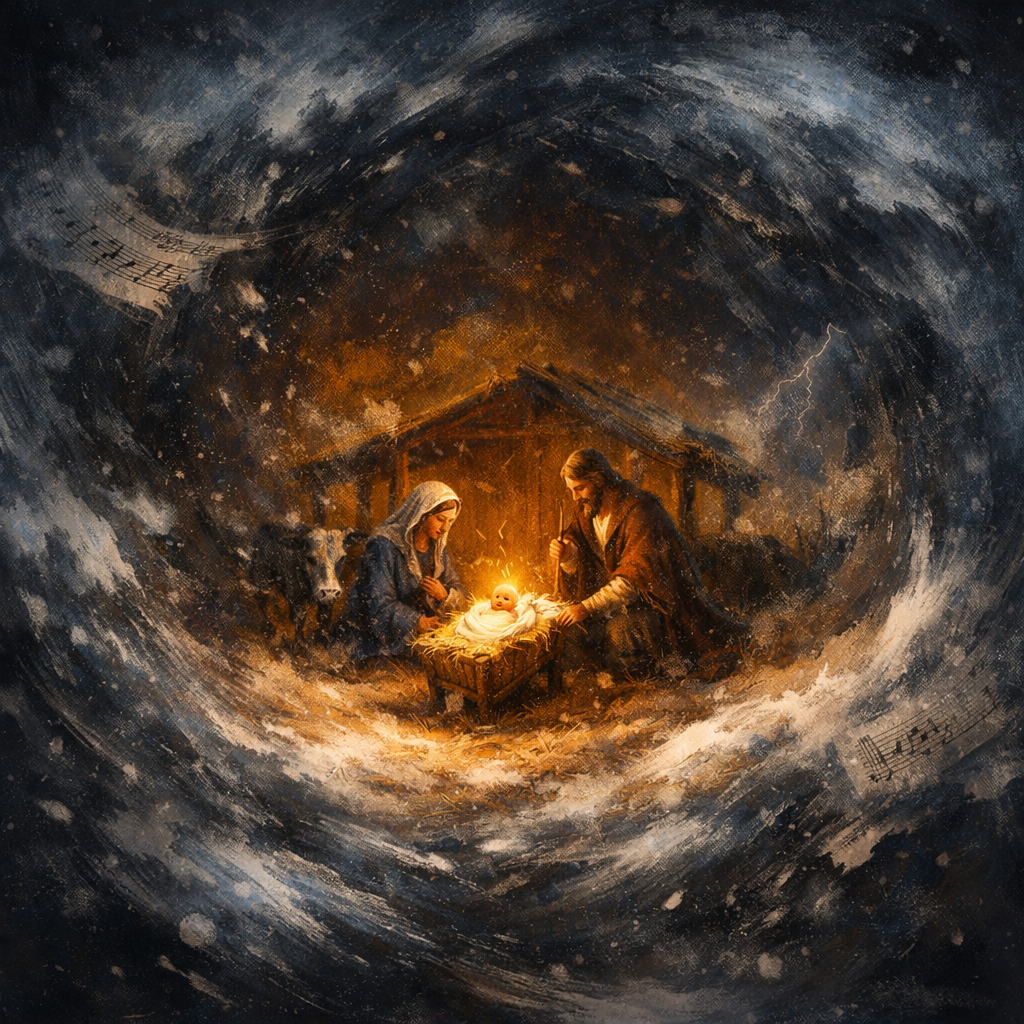
Artistic visualization by Evgenia Fölsche:
The artistic representation translates this contrast into a nocturnal scene between turmoil and inner retreat.
While dark forms of movement mirror the eruptive energy of the opening, the bright center forms a protected space —
the Holy Family as a visual counterpart to the lyrical B major middle section. The motif of exile and spiritual inwardness
thus becomes tangible both musically and visually.
Music-theoretical analysis
Themes, motives, gestures
The opening chords are less a “theme” than a rhetorical statement: they define a situation to which the following material reacts as if under pressure. The A section works with gestures of intensification — racing figuration, abrupt accents, registral extremes and chains of sequences that do not so much “develop” as drive forward. Formally, this creates a dramaturgy of short eruptions: attack — resonance — renewed attack. The music sounds like a monologue chasing itself.
The B section confronts this with chorale-like cantabile writing. Its placement is crucial: the melody appears as an “inner voice” in the middle register, giving it the character of memory. The arpeggiated waves of accompaniment envelop the line — not as decorative ornament, but as sound direction creating both closeness and distance: shelter already surrounded by unrest.
Harmony & tonal plan
- Outer frame in B minor: dense chromaticism, sharp dissonances and dominant fields create a sense of permanent unrest.
- Middle section in B major: stability remains fragile; passing tones, ornamentation and registral waves make the “island” appear suspended.
- Reprise/coda: condensation and intensification of the material; sequences and octave doublings concentrate the energy.
Texture, compositional writing, sound direction
- Registral dramaturgy: extreme registers tear open the sound space — breadth and threat as sonic effect.
- Virtuosic figuration: octave chains, double notes, wide arpeggios and chordal fanfares serve the rhetoric.
- Voicing: in the B section, the chorale-like middle voice must be carried above the accompanying wave.
- Pedal: supportive but controlled in the outer sections; transparent in the middle section, with half or quarter pedal.
Expression & interpretation
The effect of Op. 20 arises from a dialectic: outcry versus consolation, ordeal versus memory. Consolation is not the conclusion, but an in-between space — an inner place repeatedly threatened by the outer frame.
In this way, the work becomes an exemplary break with genre: the scherzo tips into the existential, becoming an “anti-scherzo”. A Polish Christmas carol at the center of one of the darkest piano works of its time is a gesture of enormous symbolic force.
Performance practice – practical notes
- The two opening chords: a dramatic statement shaped by timing and resonance.
- Pulse vs. breath: keep the inner pulse stable while shaping phrases so they do not sound mechanical.
- Middle section: carry the middle voice, let the accompanying waves support it, and keep the pedal transparent.
- Coda: think structurally: condensation, registral dramaturgy and clear directed tension.
Evgenia Fölsche – performances & recording
Pianist Evgenia Fölsche has presented Chopin’s Scherzo No. 1 in several concert programs and has also recorded the work. Her interpretation emphasizes the dramatic rhetoric of the opening, the sustained middle voice in the B major chorale and a clearly contoured, never over-pedaled sound in the reprise and coda.
Music & contact
Evgenia Fölsche plays Frédéric Chopin, Scherzo No. 1 Op. 20: