“Kriegers Ahnung” is No. 2 from Franz Schubert’s posthumously published song cycle Schwanengesang D 957 (1828/29), based on a poem by Ludwig Rellstab. At night, surrounded by the “circle of brothers in arms,” the soldier gropes between homesick memory and foreboding of death – a stoic tread over a throbbing ground. Schubert shapes this into a through-composed night piece in C minor, 3/4, calm, with a heavy tread: a dull drum-bass, dim firelight, and a narrow, speech-close line.
The Poem (Ludwig Rellstab: Gedichte - Erstes Bändchen, Berlin 1827)
In deep repose around me lies
the circle of my brothers in arms;
my heart feels so anxious and so heavy,
so hot within me from longing.
How often I have rested so sweetly
on her warm bosom!
How kindly the glow of the hearth appeared
when she lay within my arms!
Here, where the fire’s gloomy gleam
alas, plays only upon weapons,
here the breast feels utterly alone,
and the tear of melancholy wells up.
Heart, may consolation not forsake you!
Many a battle still calls –
soon I shall surely rest and sleep soundly,
dearest heart – good night!
Work Data & Overview
- Composer: Franz Schubert (1797–1828)
- Cycle: Schwanengesang D 957, No. 2 (Kriegers Ahnung)
- Text source: Ludwig Rellstab (1799–1860)
- Composition: 1828; First publication (posthumous): 1829
- Key / Meter / Tempo: C minor, 3/4, calm, march-like
- Duration: approx. 3:30–5:30 minutes
- Scoring: Voice and piano (transpositions common)
- Form: through-composed; episodic inner images with a recurring bass motif
Poem Data
- Author: Ludwig Rellstab (1799–1860)
- Stanza form: 4 quatrains; cross rhyme
- Devices: antithesis of campfire and weapons, image of homesickness (hearth/embrace) versus camp-night, imperative self-address to the heart, formula of farewell
Genesis & Cycle Context
As the second Rellstab song, Kriegers Ahnung contrasts the bright world of Liebesbotschaft with night and heaviness. The inner monologue layers an image of memory (home / embrace) against the present state (weapons / fear); the ending (“Gute Nacht!”) gently brushes the world of Winterreise, yet remains here militarily sober.
More on the song cycle in the overview: Schwanengesang – Overview.
Performance Practice & Reception
Pulse & diction: an even 3/4 tread without waves of pathos; consonants clear, vowels covered. No lachrymose display – the gesture of consolation remains turned inward.
Piano texture: a low, drumming bass (broken chords / fifths) as camp motif; the right hand as dim reflections of flame. Use pedal sparingly, keep the dynamics centered; thicken the color only at certain points such as “melancholy / tear / battle.”
Reference Recordings (Selection)
- Dietrich Fischer-Dieskau – Gerald Moore
- Ian Bostridge – Antonio Pappano
- Christoph Prégardien – Michael Gees / Andreas Staier (fortepiano)
- Mark Padmore – Paul Lewis
- Hans Hotter – Gerald Moore
Analysis – Music
Drum Pulse & Night Image
The left hand establishes a steady, heavy tread; above it lie dimmed chordal gleams – a campfire that illuminates only weapons. The vocal line remains syllabic and narrowly guided; its brief ascents (“Herzliebste”) quickly sink back into the ground pulse.
Harmony, Form & Foreboding
Within the field of C minor, side-steps open only momentary brightenings; a return of the bass motif frames the episodes. The ending (“Gute Nacht”) does not soothe – it accepts the march: foreboding without resolution.
Visual Representation
Artistic visualization by Evgenia Fölsche:
In a nocturnal war camp
a warrior stands alone.
The surroundings remain dark;
only a muted light
draws his figure
out of the shadows.
Tents and distant fires
suggest the place
without fully revealing it.
In his hands he holds
the cloth of his beloved.
The fabric appears delicate
in contrast to his
heavy clothing and
the hardness of the camp.
This small, personal
token connects him
with another world –
far from battle and duty.
His gaze is tense,
yet composed.
No open despair,
but rather a quiet foreboding
lies in his features.
It is the moment
between hope
and inner knowledge,
between memory
and premonition.
The image takes up
the song’s dark
sound-world.
Like the heavy,
sustained chords in the piano,
penetrated by inner unrest,
outward stillness
is here condensed with
inward motion.
The warrior stands
in the half-light –
caught between
present and farewell,
between duty
and love.
Analysis – Poetry
Ludwig Rellstab’s poem “Kriegers Ahnung” belongs to the darkest songs of Schwanengesang. It places longing for love in an extreme situation: a soldier lies in camp at night before battle. Surrounded by sleeping comrades in arms, he senses his approaching death and directs his thoughts toward the distant beloved. Love, memory, and foreboding of death merge into a single inner monologue.
The first stanza describes the outer situation:
In deep repose around me lies
the circle of my brothers in arms;
my heart feels so anxious and so heavy,
so hot within me from longing.
The night camp is still; the comrades sleep. Yet within this apparent calm, inner unrest grows. “Anxious and heavy” stands against longing’s inward heat – the coldness of the surroundings and the heat of the heart form a tense contrast. Even here it becomes clear: the true scene is not the battlefield, but the speaker’s inner world.
The second stanza moves into memory:
How often I have rested so sweetly
on her warm bosom!
How kindly the glow of the hearth appeared
when she lay within my arms!
The soldier recalls former shelter: warmth, hearth-fire, embrace. This image of domestic nearness stands in sharp contrast to the cold resting-place of war. Memory becomes the only refuge – the beloved appears as the embodiment of peace and life.
In the third stanza, the present returns:
Here, where the fire’s gloomy gleam
alas, plays only upon weapons,
here the breast feels utterly alone,
and the tear of melancholy wells up.
The firelight falls not on faces, but on weapons – an emblem of impending death. Loneliness emerges despite the surrounding comrades. The tear of melancholy makes the intuition of loss physically tangible.
The final stanza addresses the speaker’s own soul:
Heart, may consolation not forsake you!
Many a battle still calls –
soon I shall surely rest and sleep soundly,
dearest heart – good night!
The speaker tries to console himself. Yet the thought of battles still to come leads toward the recognition of a near end. “Sleep soundly” means not only rest, but final sleep. The farewell greeting to the beloved becomes a quiet message of death.
Formally, the poem is simple and strophic, with a calm narrative tone and clear rhymes. The language avoids pathos and gains its piercing intensity precisely through that restraint.
Meaning & Effect within the Cycle
“Kriegers Ahnung” shows love in the shadow of death. The separation of the lovers is not caused here by society or by distance alone, but existentially: war threatens life itself. Longing becomes the last inward refuge.
Within Schwanengesang, the song forms a deep contrast to the idealized harmony of Liebesbotschaft. Where the brook there acts as a tender messenger, here fire, weapons, and night prevail. Nature is no consoling companion, but the dark stage-light of fate.
The soldier takes leave of the beloved without her knowing it. This gives the song a tragic double layer: love remains unbroken – but it ends in advance. Memory replaces presence, dream replaces future.
Thus “Kriegers Ahnung” becomes a compelling meditation on love, fear, and transience – a central expression of the late, existential world of Schubert’s final years.
Evgenia Fölsche – Performances & Audio
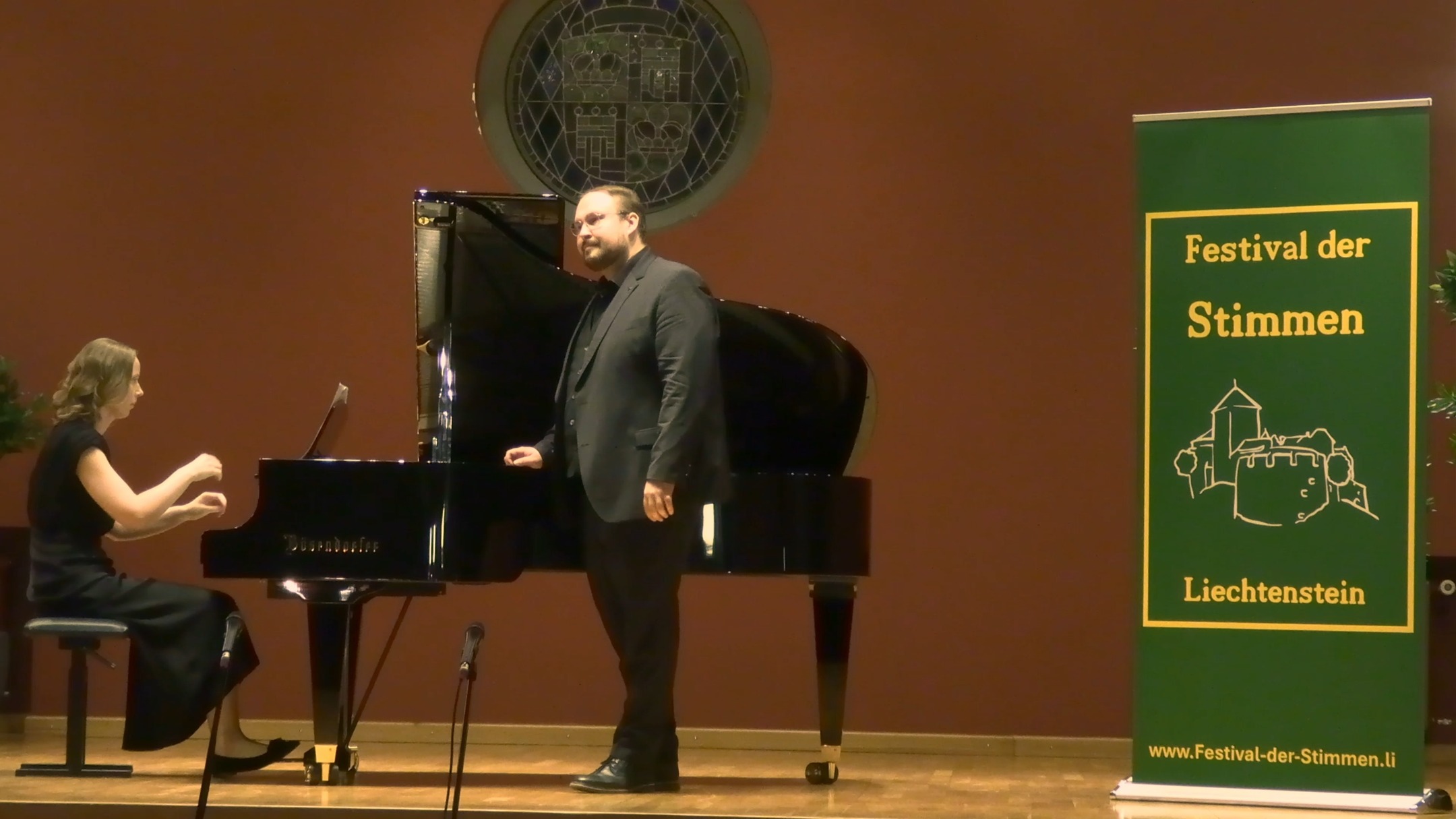
Pianist Evgenia Fölsche chooses a calm, heavy basic tempo, a dry bass profile, and a speech-close vocal delivery: inward tension before outward pressure.
Audio example: Kriegers Ahnung with Dietrich Fischer-Dieskau and Gerald Moore
Concert Inquiry
Schwanengesang by Franz Schubert is part of Evgenia Fölsche’s Lied repertoire and is performed regularly in collaboration with renowned singers. Concert programs can be designed flexibly and adapted to different ensembles.
Evgenia Fölsche has collaborated, among others, with singers such as Benjamin Russell and Johann Kristinsson, who include Schwanengesang in their repertoire.
Send concert inquiryFrequently Asked Questions about Schubert: “Kriegers Ahnung” (Schwanengesang No. 2)
Click on a question to reveal the answer.
Is “Kriegers Ahnung” strophic?
No: it is through-composed; a recurring bass motif creates coherence between the episodes.
What are the key and meter?
C minor, 3/4, calm / march-like; the pulse recalls a muted funeral march.
How much “pathos” is appropriate?
Restrained: weight comes from tone color and diction, not from volume. The consoling formula at the end remains inward, without demonstrative escalation.