“Das Fischermädchen” is No. 10 from Franz Schubert’s posthumously published song cycle Schwanengesang D 957 (1828/29), based on a poem by Heinrich Heine. A seducer addresses the boat girl: boat to shore, head to heart — the sea becomes an image of a changeable inner life. Schubert shapes this into a bright, songful miniature in A-flat major, 6/8, rather slow: barcarolle-like rocking, gentle radiance, and a discreet inward pull.
The Poem (Heinrich Heine – Buch der Lieder, 1827)
You lovely fisher-girl,
Bring the boat to shore;
Come to me and sit down,
We shall caress hand in hand.
Lay your little head upon my heart,
And do not be too afraid,
For you trust yourself carelessly
Each day to the wild sea.
My heart is quite like the sea,
It has storm and ebb and flood,
And many a beautiful pearl
Rests in its depths.
Work Data & Overview
- Composer: Franz Schubert (1797–1828)
- Cycle: Schwanengesang D 957, No. 10 (Das Fischermädchen)
- Text source: Heinrich Heine (1797–1856), Buch der Lieder
- Composition: August 1828; First publication (posthumous): 1829
- Key / Meter / Tempo: A-flat major (original), 6/8, rather slow
- Duration: approx. 2:00–3:00 minutes
- Scoring: Voice and piano (transpositions common)
- Form: songlike A–B–A (frame – inner promise – return)
Poem Data
- Author: Heinrich Heine (1797–1856)
- Stanza form: 3 quatrains; simple, direct, speech-like tone
- Devices: sea/heart metaphor (ebb/flood), tender imperative (“come,” “lay”), seduction through a promise of safety
Genesis & Cycle Context
Within the Heine group (Nos. 8–13), Das Fischermädchen forms the bright interlude between the introspective chamber of Ihr Bild and the nocturnal vision of Die Stadt. Dramaturgically, it unfolds the rhetoric of seduction in the lyrical self — the sea as a mirror of a restless inner life.
More on the song cycle in the overview: Schwanengesang – Overview.
Performance Practice & Reception
Pulse & diction: calm 6/8 rocking (felt in one to the bar), consonants soft, text close to speech. No salon sweetness: simplicity carries the song.
Piano texture: an even barcarolle with delicate rise and fall; transparent pedal, finger legato. Small brightening points on “heart / pearl,” immediately withdrawn.
Reference Recordings (Selection)
- Dietrich Fischer-Dieskau – Gerald Moore
- Ian Bostridge – Antonio Pappano
- Matthias Goerne – Alfred Brendel
- Christoph Prégardien – Andreas Staier (fortepiano)
- Gerald Finley – Julius Drake
Analysis – Music
Barcarolle & Wooing Gesture
The continuous rocking motion (6/8) paints the movement of water and at the same time soothes the address. The voice remains syllabic, with delicate rises on imperatives and words of the heart — wooing without pressure.
Harmony, Form & Inner Glow
Within the frame of A-flat major, the middle section (B) opens brief mediant side-glances (ebb / flood), before the A–B–A return restores the appearance of safety. The closing postlude stills the wave — a promise remains a promise.
Visual Representation
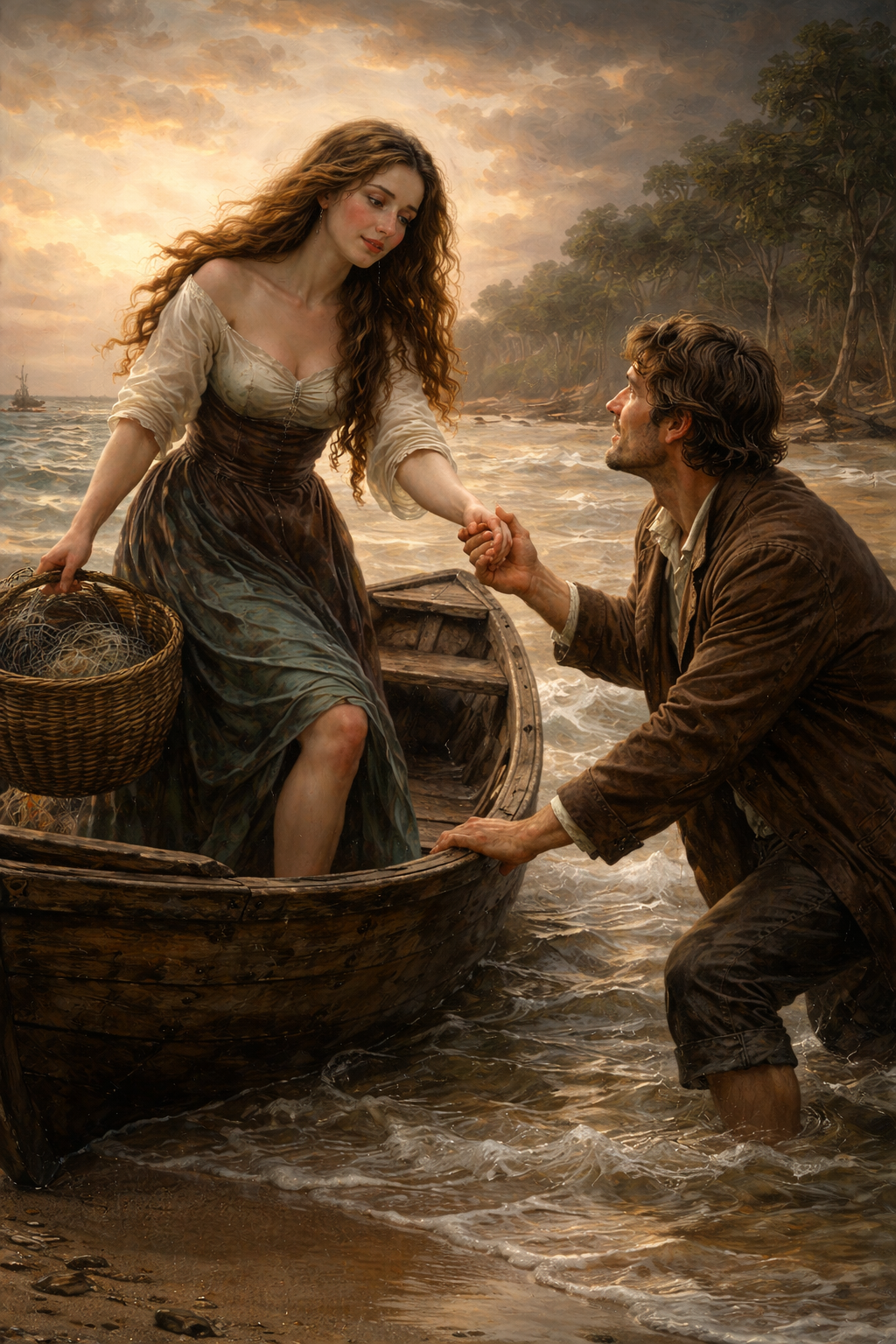
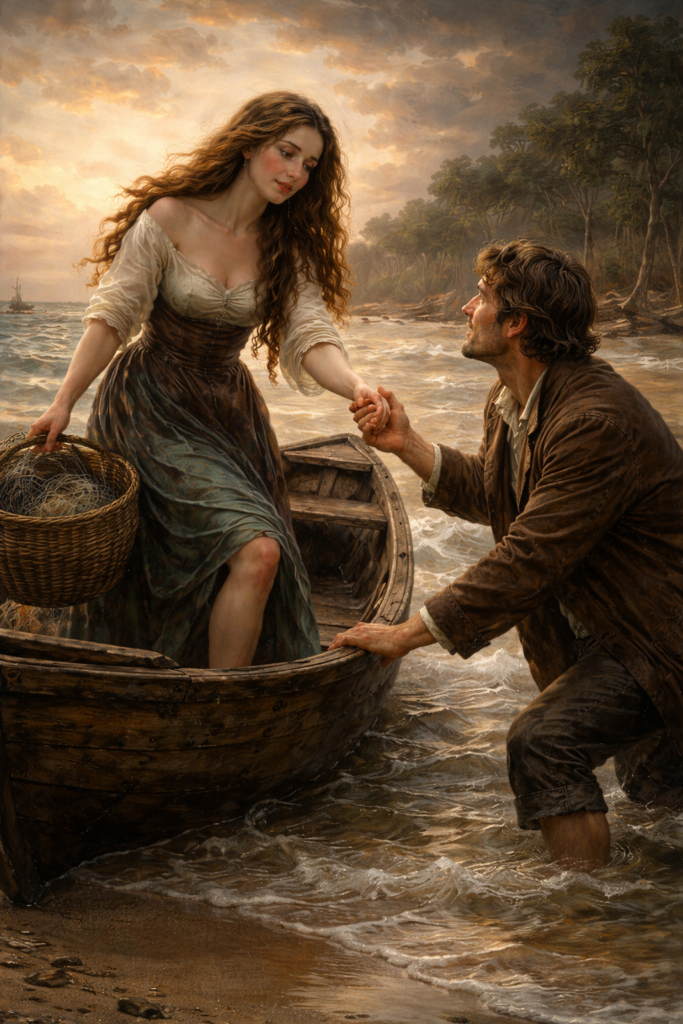
Artistic visualization by Evgenia Fölsche:
On the shore of a quiet lake,
a man stands in the shallow water,
his posture confident
and attentive.
Before him in the boat sits
a beautiful fisher girl,
still warmly tinged
by the sunlight.
With a gentle touch
the man helps her out of the boat
and over onto the soft
sand of the shore.
The movement seems
careful and trusting,
a moment of surrendering trust.
The water glitters softly
in the light, which is already
turning toward evening.
The trees along the shore cast
long shadows that fill
the picture with quiet calm.
The image picks up the light
and sensitive atmosphere
of the song:
like the flowing
piano lines
that move forward
in an even pulse,
the scene here too conveys
a feeling
of motion and nearness.
The gesture becomes
a symbol of care
and tenderness —
a silent exchange
in which the simple
action becomes,
without words,
full of meaning.
Analysis – Poetry
Heinrich Heine’s poem “Das Fischermädchen” belongs to the Heine group of Schwanengesang. It presents a speaker tenderly courting a young fisher girl. At first glance the poem appears to be a simple love song; yet beneath its gentle surface lies a multilayered mirroring of landscape and emotional life.
The first stanza opens the scene with direct address:
You lovely fisher-girl, bring the boat to shore.
The speaker calls the girl from the water to the safety of the land. The shore stands for nearness, security, and human encounter. The invitation “we shall caress hand in hand” sketches an intimate and trusting situation.
The second stanza deepens the tone of tenderness:
Lay your little head upon my heart, and do not be too afraid.
Physical closeness is imagined. At the same time, the speaker reminds the girl that she entrusts herself every day to the “wild sea.” The sea appears as a dangerous, unpredictable power — a first prelude to the later self-interpretation of the heart.
The third stanza introduces the central metaphor:
My heart is quite like the sea, has storm and ebb and flood.
The speaker’s heart is equated with the sea: changeable, deep, traversed by violent motions. In its depths rest “many a beautiful pearl” — images of hidden sensitivity and inner riches meant to be revealed to the beloved.
The natural metaphor interweaves outer and inner world. The real sea on which the girl lives becomes the mirror of the lover’s psychic landscape.
Formally, the poem is simple and songlike in structure. Short stanzas, clear rhymes, and plain language create a folk-like immediacy that underlines the intimate tone of courtship.
Meaning & Effect within the Cycle
“Das Fischermädchen” shows a rare island of seeming lightness within the Heine songs of Schwanengesang. After existential songs of pain such as “Der Atlas” or “Ihr Bild”, a moment of tender approach reappears here.
Yet the idyll remains fragile: the speaker’s heart resembles the sea — beautiful, but restless and dangerous. Love here signifies both promise and risk.
Characteristically for Heine, the poem combines Romantic natural metaphor with psychological self-interpretation. The wooing of intimacy already carries within it a premonition of future vulnerability.
Schubert sets this in a simple, flowing melody with wave-like accompaniment — the sea becomes audible, while the tenderness remains threaded through with quiet unease.
Evgenia Fölsche – Performances & Audio
Pianist Evgenia Fölsche reads the song as a subtle barcarolle: elastic one-in-a-bar feeling, lean middle register, speech-close line — radiance without sweetness.
Audio example: Das Fischermädchen with Dietrich Fischer-Dieskau and Gerald Moore
Concert Inquiry
Schwanengesang by Franz Schubert is part of Evgenia Fölsche’s Lied repertoire and is regularly performed in collaboration with renowned singers. Concert programs can be designed flexibly and adapted to different ensembles.
Evgenia Fölsche has collaborated, among others, with singers such as Benjamin Russell and Johann Kristinsson who include Schwanengesang in their repertoire.
Send concert inquiryFrequently Asked Questions about Schubert: “Das Fischermädchen” (Schwanengesang No. 10)
Click on a question to reveal the answer.
Is “Das Fischermädchen” strophic?
Formally it appears songlike (A–B–A): two similarly shaped outer sections frame a lightly contrasted middle section.
What are the key, meter & character?
A-flat major (original), 6/8, rather slow; barcarolle-like rocking and simple, speech-like delivery.
Which transpositions are common?
Frequently G major (medium) or F major (low) — the tonal balance remains effective with a calm 6/8 pulse.