Visual Representation
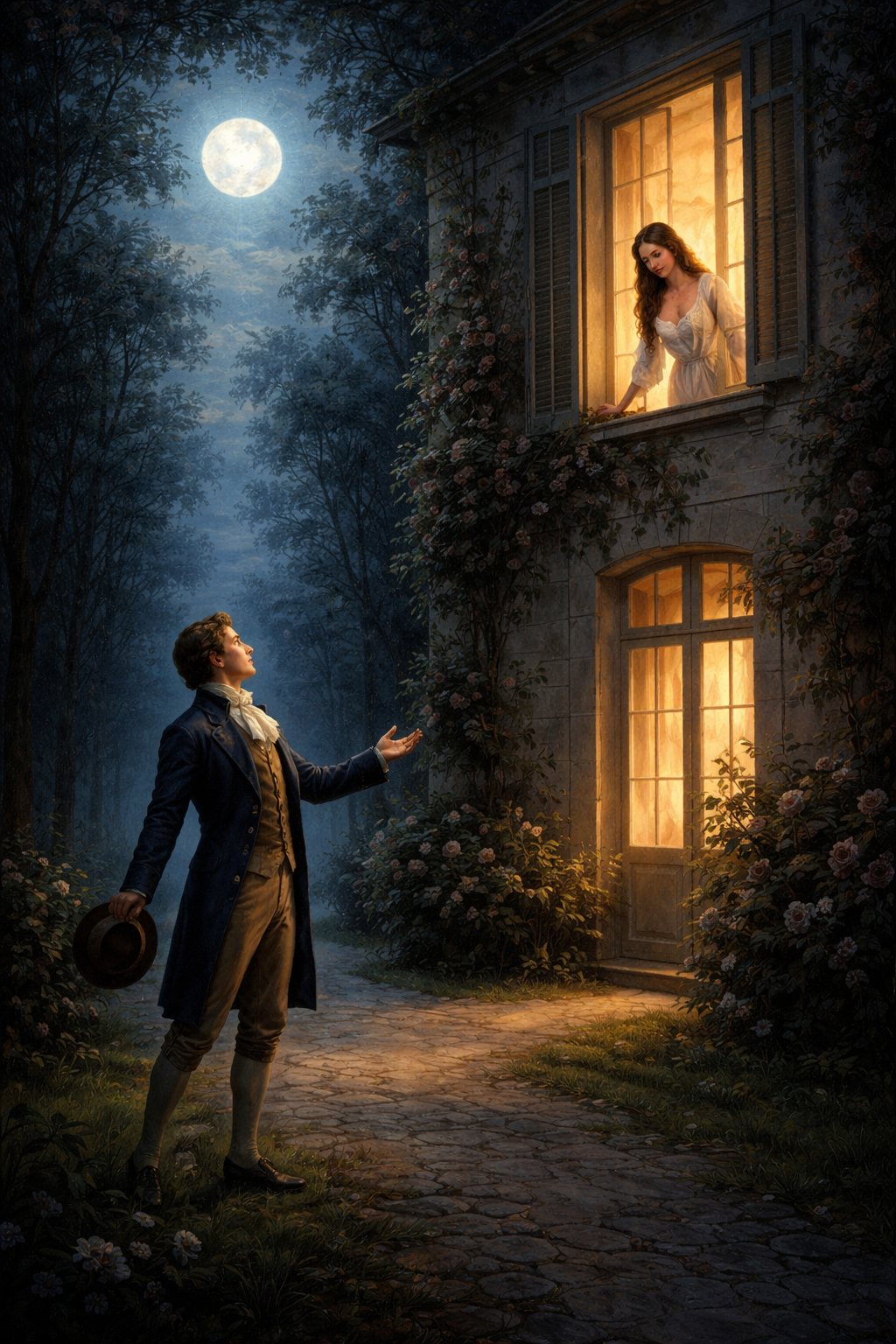
Artistic visualization by Evgenia Fölsche:
In a quiet night
a man stands
in silvery moonlight
before the window of
his beloved.
The darkness around him
appears soft and calm;
only the light of the moon
envelops his figure.
His face is turned
upward,
as though he were
gently carrying
his voice aloft.
His posture reveals
an intimate plea
and tender hope.
The nocturnal space
becomes the resonant space
of his song.
In the illuminated window
stands the woman.
Warm light surrounds her
and forms
a radiant contrast
to the cool night.
Her gaze is directed
toward him –
a silent dialogue
between inside and outside,
between closeness and distance.
The image reflects
the gently rocking motions
of the song.
Like the accompanying
piano figures,
which move onward
in a calm pulse,
night and sound
are joined here.
Moonlight and window-light
become symbols
of longing and hope –
a moment of tender
approach,
borne by soft,
intimate music.
Analysis – Poetry
Ludwig Rellstab’s poem “Ständchen” belongs to the best-known songs of Schwanengesang. It shapes the classic Romantic scene of the nocturnal call of love: the speaker stands under the cover of night before the beloved’s house and asks her to come down to him. Sounds of nature, moonlight, and birdsong become allies of love.
The first stanza opens with the soft call:
Softly my songs implore
Through the night to you;
Down into the silent grove,
Beloved, come to me!
The songs themselves become messengers of the heart. They “implore” through the night – music replaces speech and creates closeness despite distance. The speaker invites the beloved into the “silent grove”: a sheltered, nature-filled space of love beyond social control.
The second stanza unfolds the nocturnal surroundings:
Whispering, slender treetops rustle
In the moon’s light;
Fear not, fair one,
The hostile eavesdropping of the traitor.
Trees and moonlight create an intimate atmosphere. At the same time, danger appears: the “hostile eavesdropping” of a traitor – a symbol of social surveillance or moral control. Yet the speaker invokes trust: nature itself protects the lovers.
In the third stanza, the nightingales enter:
Do you hear the nightingales singing?
Ah, they implore you,
With the sweet lament of their tones
They implore for me.
The nightingale is the classical symbol of Romantic love-lament. Its song takes over the speaker’s plea by proxy. Nature once again becomes the mediator of human feeling.
The fourth stanza deepens the image:
They understand the breast’s longing,
They know love’s pain,
And with their silver tones
They stir every tender heart.
The nightingales become feeling beings who know longing and pain. Their “silver tones” touch every “tender heart” – love appears as a universal force binding all beings together.
The closing stanza culminates in the direct call:
Let your breast too be moved,
Beloved, hear me!
Trembling, I await you;
Come, make me happy!
The speaker now reveals himself: trembling, waiting, openly vulnerable. The plea becomes urgent and personal. The poem ends openly – whether the beloved comes remains unsaid.
Formally, the poem is strictly strophic, with many imperatives and direct addresses. Sound, repetition, and soft phonetic patterns create an intimate, flowing language – ideally suited to Schubert’s song-like setting.
Meaning & Effect within the Cycle
“Ständchen” presents love as a nocturnal realm of enchantment between hope and risk. The speaker dares to move from inward longing into the open call – music, nature, and voice merging into a single act of wooing.
Within Schwanengesang, the song forms a high point of Romantic love poetry. After longing, separation, and foreboding of death, the vision of fulfilled closeness appears here once again – yet suspended between dream and reality.
Nature is not merely a companion, but the sheltering space of love. Night, moon, trees, and birds create a counterworld to society. This makes the song an embodiment of Romantic inwardness and escape from the world.
Thus “Ständchen” becomes a musical icon of Romantic love lyricism: soft, longing, suspended – a timeless image of the loving human being waiting in the dark for an answer.
Liszt: Piano Transcription of Schubert’s “Ständchen”
Franz Liszt transformed Schubert’s song “Ständchen” from the cycle Schwanengesang into one of the best-known piano transcriptions of the nineteenth century (S. 560 No. 7). The point here is less virtuosity than the idea of the “singing piano”: the vocal line is to carry like a voice, while the accompaniment preserves the serenade-like character of the original.
Liszt adopts Schubert’s distinctive guitar-like arpeggiated texture and shapes it into a supple piano setting. The melody appears clearly projected and cantabile, while the accompanying figures form a soft, continuous carpet of sound. What matters most here are voicing and pedal control: transparency and songfulness take precedence over tonal “brilliance.”
Formally, the transcription remains closely aligned with the song, yet expands the closing section: the music dies away delicately, as though the nocturnal wooing were fading into space. Tonally, different versions exist (including D minor and F major), the major-key variant often acquiring a milder, more hopeful coloration.
In reception, Liszt’s “Ständchen” became a touchstone of lyrical piano art. The technical demands are moderate; what proves decisive are balance of sound, legato culture, and a discreetly guided rubato. In this way, the pianist becomes a singer – and the piano becomes the voice of Romantic longing.
Evgenia Fölsche – Performances & Audio
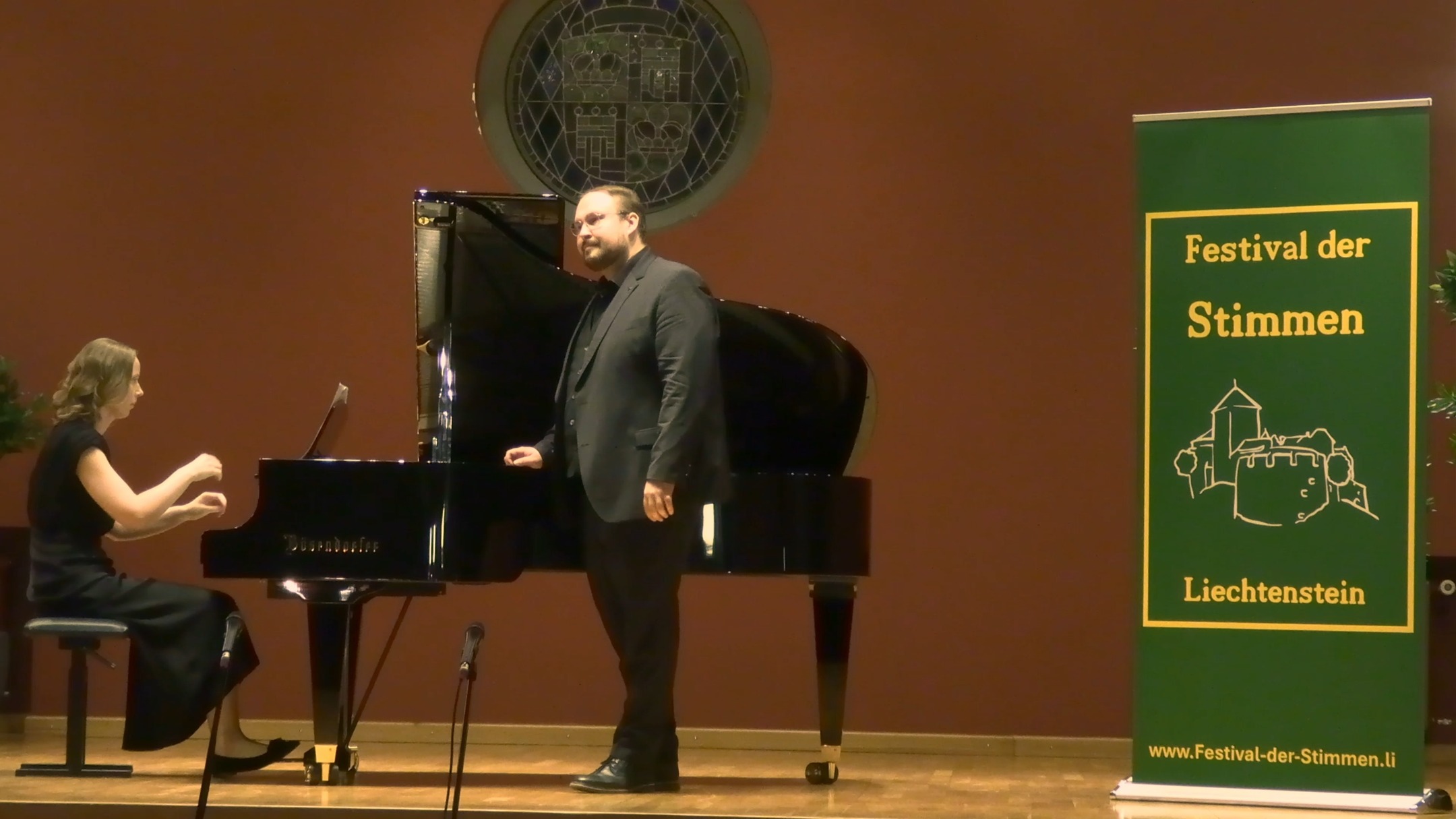
Pianist Evgenia Fölsche keeps the serenade-flow airy and transparent: finger-connected legato, a lean middle register, and fine caesuras – intimacy before effect.
Audio example: Ständchen with Dietrich Fischer-Dieskau and Gerald Moore
Concert Inquiry
Schwanengesang by Franz Schubert is part of Evgenia Fölsche’s Lied repertoire and is performed regularly in collaboration with renowned singers. Concert programs can be designed flexibly and adapted to different ensembles.
Evgenia Fölsche has collaborated, among others, with singers such as Benjamin Russell and Johann Kristinsson, who include Schwanengesang in their repertoire.
Send concert inquiryFrequently Asked Questions about Schubert: “Ständchen” (Schwanengesang No. 4)
Click on a question to reveal the answer.
Is “Ständchen” strophic?
Yes: strophic (3 stanzas) with subtle variants in phrasing and dynamics; the closing line is often repeated in performance.
What are the key and character?
D minor, not too slow; a floating serenade pulse with quiet arpeggios suggesting a “guitar” texture.
How much rubato is stylistically appropriate?
Carefully: small breathing expansions at textual caesuras (“Softly,” “nightingales,” “trembling”), otherwise a calm flow – intimacy instead of broad rhetorical arching.