“Die Taubenpost” is the concluding number of Franz Schubert’s posthumously published song cycle Schwanengesang D 957/D 965A (often listed as No. 14), after Johann Gabriel Seidl. The singer possesses a “carrier pigeon” — at the end unmasked: its name is longing. Schubert clothes this in a light, song-like yet varied chamber piece in G major, alla breve (2/2), rather slow: buoyant syncopations, a gentle tread, and a tender final arc.
The Poem (Johann Gabriel Seidl)
I have a carrier pigeon in my pay,
Most devoted and faithful is she;
She never cuts the goal too short for me,
Nor does she ever fly past it.
I send her many thousand times
Each day out on reconnaissance,
Past many a beloved place,
Until she reaches my beloved’s house.
There she secretly peers in at the window,
Watches her glance and step,
Delivers my greetings playfully
And brings hers back with her.
I no longer need to write a little letter,
I give the tear itself to her;
Oh, she cannot safely bear it,
So zealously does she serve me.
By day, by night, in waking and in dream,
To her all that is the same:
If only she can wander, wander,
Then she is richly blessed!
She never tires, she never grows faint,
The path is always new to her;
She needs no lure, she needs no reward —
The dove is so faithful to me!
Therefore I cherish her so faithfully at my breast,
Assured of the fairest gain;
Her name is — longing! Do you know her? —
The messenger of a faithful heart.
Work Data & Overview
- Composer: Franz Schubert (1797–1828)
- Cycle: Schwanengesang D 957; Die Taubenpost as D 965A (often appended as No. 14)
- Text source: Johann Gabriel Seidl (1804–1875)
- Composition: 1828; First publication (posthumous): 1829 (in the collected volume); Seidl’s poem was first printed only in 1853
- Key / Meter / Tempo: G major, alla breve (2/2), rather slow (two beats to the bar)
- Duration: approx. 3:00–4:00 minutes
- Scoring: Voice and piano (transpositions common)
- Form: varied strophic form in paired stanzas (1+2, 3+4, 5+6) with a closing coda on the “longing” stanza
Poem Data
- Author: Johann Gabriel Seidl (1804–1875)
- Stanza form: 7 quatrains; the point of the allegory in the final stanza
- Devices: personification (carrier pigeon), the topos of longing, scenic miniatures (window/greetings), refrain-like repetitions (“wander”)
Genesis & Cycle Context
Die Taubenpost is regarded as Schubert’s last song and was added by the publisher Haslinger to Schwanengesang as a friendly envoi; poetically, it does not belong to the Rellstab/Heine groups. Yet in many performances it still closes the cycle — a bright-melancholic leave-taking. :contentReference[oaicite:1]{index=1}
More on the song cycle in the overview: Schwanengesang – Overview.
Performance Practice & Reception
Pulse & diction: two beats to the bar (alla breve) under a marking of rather slow; text close to speech, buoyant — light, never hurried. No sentimentality, rather a sense of bright sorrow.
Piano texture: characteristic syncopations and playful little chord-turns (pigeon-call / interweaving of bass and upper voice); pedal clear. The ending (“Her name is — longing”) with a gentle brightening, followed by a calm postlude. :contentReference[oaicite:2]{index=2}
Reference Recordings (Selection)
- Dietrich Fischer-Dieskau – Gerald Moore
- Ian Bostridge – Julius Drake
- Matthias Goerne – Alfred Brendel
- Christoph Prégardien – Michael Gees
- Andrè Schuen – Daniel Heide
Analysis – Music
Syncopated “Step” & Pigeon Gesture
The accompaniment relies on off-beat accents (bass first, right hand after), creating a light swaying — a kind of musical pigeon-step. The line is syllabic and cantabile; small upward inflections appear on words of greeting and longing.
Harmony, Form & Longing Coda
Within the field of G major, brief color-excursions (including B-flat major and E-flat major) gently widen the space; the varied strophic design binds each pair of stanzas into musical units. The final stanza becomes a lyrical coda — the envoi of the whole collection. :contentReference[oaicite:3]{index=3}
Visual Representation

Artistic visualization by Evgenia Fölsche:
A carrier pigeon rises
from opened hands
into the air.
The moment of release
is captured —
between nearness
and beginning distance.
A small letter
is attached to its leg.
It appears light and inconspicuous,
and yet it carries
a great message:
longing,
hope, and
tender remembrance.
The hands from which
the bird is released
remain in the image —
still slightly raised,
as if they wished
to accompany the flight.
The sky opens
wide and bright,
a space of movement
and expectation.
The image takes up
the cheerful,
yet wistful basic mood
of the song.
Like the buoyant,
springing piano figures,
which recall the fluttering
of wings,
the message here too
rises upward.
The pigeon becomes the symbol
of ever-returning
longing —
that inward “carrier pigeon”
which ceaselessly
travels between heart
and distance.
Evgenia Fölsche – Performances & Audio
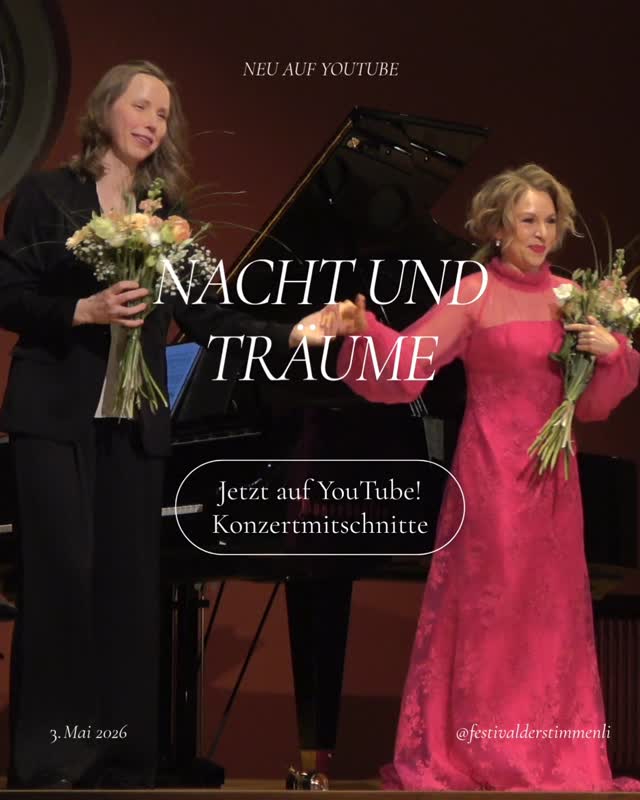
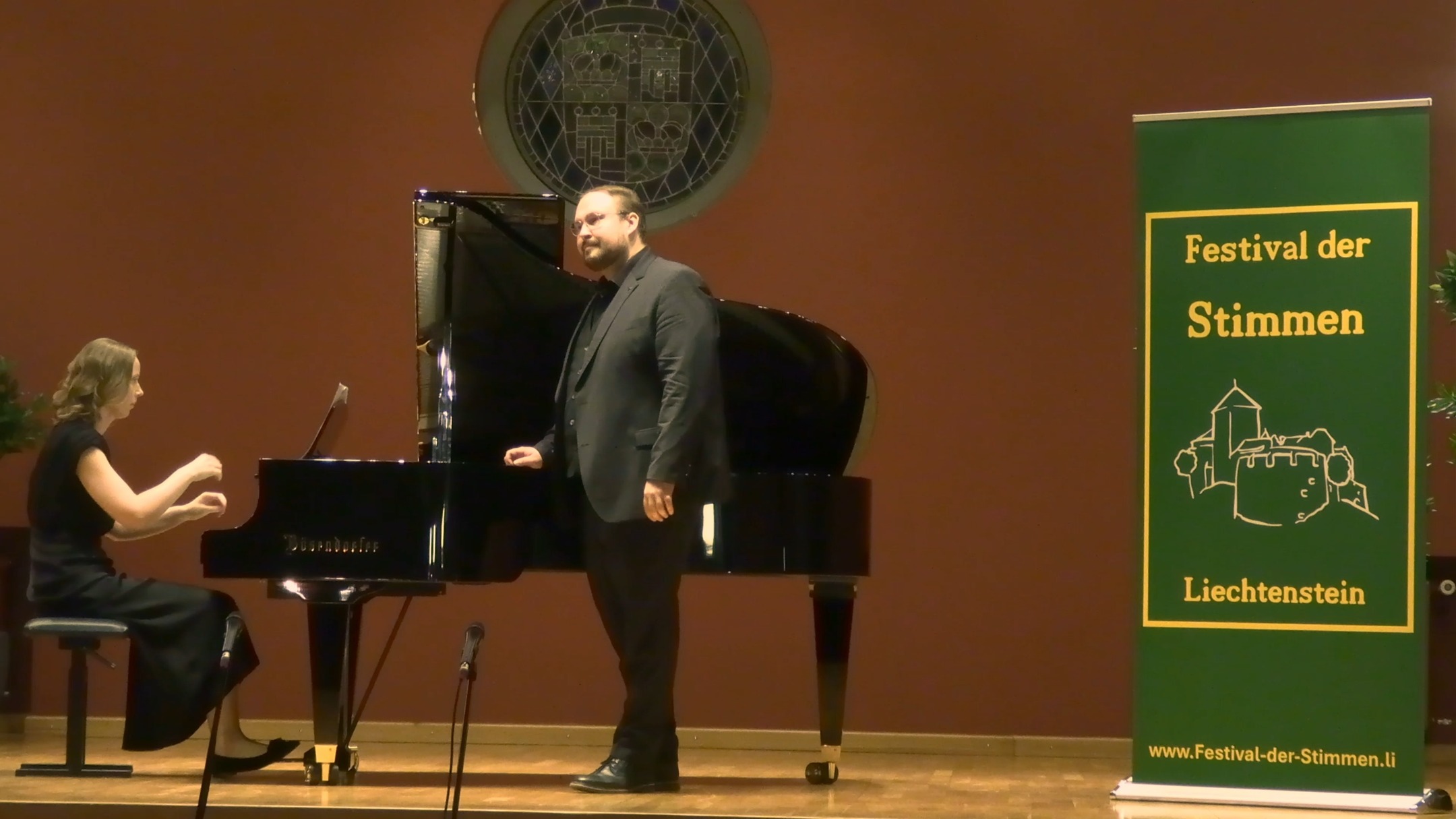
Pianist Evgenia Fölsche emphasizes the light tread: elastic two-in-the-bar feeling, transparent syncopated texture, speech-close line — the coda as a gentle pause.
Audio example: Die Taubenpost with Dietrich Fischer-Dieskau and Gerald Moore
Concert Inquiry
Schwanengesang by Franz Schubert is part of Evgenia Fölsche’s Lied repertoire and is regularly performed in collaboration with renowned singers. Concert programs can be designed flexibly and adapted to different ensembles.
Evgenia Fölsche has collaborated, among others, with singers such as Benjamin Russell and Johann Kristinsson who include Schwanengesang in their repertoire.
Send concert inquiryFrequently Asked Questions about Schubert: “Die Taubenpost” (Schwanengesang D 957/D 965A)
Click on a question to reveal the answer.
Does “Die Taubenpost” really belong to Schwanengesang?
Historically, Seidl’s song was added later by the publisher; today it is almost always included in performance and is regarded as Schubert’s last song. :contentReference[oaicite:4]{index=4}
What are the key, meter, and tempo?
G major, alla breve (2/2), rather slow — clearly performed and sung in two beats to the bar. :contentReference[oaicite:5]{index=5}
Is the song strophic?
Varied strophic form: the stanzas are set in pairs; the final stanza forms a coda with the revelation of “longing.” :contentReference[oaicite:6]{index=6}