“Liebesbotschaft” is No. 1 from Franz Schubert’s posthumously published song cycle Schwanengesang D 957 (1828/29), based on a poem by Ludwig Rellstab. A brook becomes the bearer of a message: it is to carry greetings, consolation, and dreams of love to the distant beloved – from daylight into sleep. Schubert shapes this as a lightly flowing, strophic water-piece in A major, 6/8, gently animated: a gliding stream of arpeggios that privileges textual color over pathos.
The Poem (Ludwig Rellstab: Gedichte - Erstes Bändchen, Berlin 1827)
Rustling little brook,
so silvery and bright,
do you hasten to my beloved
so cheerful and so swift?
Ah, dear little brook,
be my messenger;
carry to her
the greetings of the distant one.
All her flowers
tended in the garden,
which she so lovely
wears upon her breast,
and her roses
in crimson glow,
brook, refresh them
with your cooling flood.
If she by the shore,
lost in dreams,
remembering me,
lets her little head droop,
comfort the sweet one
with a kindly glance,
for her beloved
will soon return.
When the sun inclines
with reddish glow,
rock the dear one
gently into slumber.
Murmur her
into sweet repose,
whisper to her
dreams of love.
Work Data & Overview
- Composer: Franz Schubert (1797–1828)
- Cycle: Schwanengesang D 957, No. 1 (Liebesbotschaft)
- Text source: Ludwig Rellstab (1799–1860)
- Composition: 1828; First publication (posthumous): 1829
- Key / Meter / Tempo: A major, 6/8, gently animated
- Duration: approx. 2:20–3:00 minutes
- Scoring: Voice and piano (transpositions common)
- Form: strophic (4 stanzas) with subtle variants in articulation/voicing
Poem Data
- Author: Ludwig Rellstab (1799–1860)
- Stanza form: 4 eight-line stanzas; a mixed pattern of couplet and cross rhyme
- Devices: personification of the brook, messenger metaphor, framing by times of day (day–evening–sleep), tender imperatives
Genesis & Cycle Context
Liebesbotschaft opens the Rellstab group within Schwanengesang – a posthumous collection published by Schubert’s brother, bringing together songs on texts by Rellstab and Heine. This opening sets the tone: an external image (the brook) as the bearer of a tender, bright inwardness; a “breathed” cantabile that leads by contrast into the following numbers (Kriegers Ahnung, Frühlingssehnsucht …).
More on the cycle in the overview: Schwanengesang – Overview.
Performance Practice & Reception
Pulse & diction: an elastic 6/8 flow, syllables bright and borne by the breath; no “grand arches” over the text – the word carries the line.
Piano texture: flowing arpeggios/broken chords as the water’s surface; transparent pedaling, with finger legato preferred. Warm the color slightly on “roses / glow / slumber / dreams” – but without sweetness overdone.
Reference Recordings (Selection)
- Dietrich Fischer-Dieskau – Gerald Moore
- Ian Bostridge – Julius Drake
- Christoph Prégardien – Andreas Staier (fortepiano)
- Jonas Kaufmann – Helmut Deutsch
- Peter Schreier – Sviatoslav Richter
Analysis – Music
Brook Gesture & 6/8 Flow
The right hand traces a supple band of arpeggios (water shimmer), while the left grounds it with softly stepping bass tones. The 6/8 pulse makes both rocking (stanza 4) and cheerful hastening (stanza 1) possible from the same material – a semantic double exposure.
Harmony, Form & Sound Image
Within the field of A major, brief side-steps (dominant/E major; parallel colorations) open up perspectival points of light. The strophic design frames four moments of time and affect: greeting – refreshment – consolation – slumber. Bright thirds, luminous registers, and delicate non legato prevent sentimentality.
Visual Representation
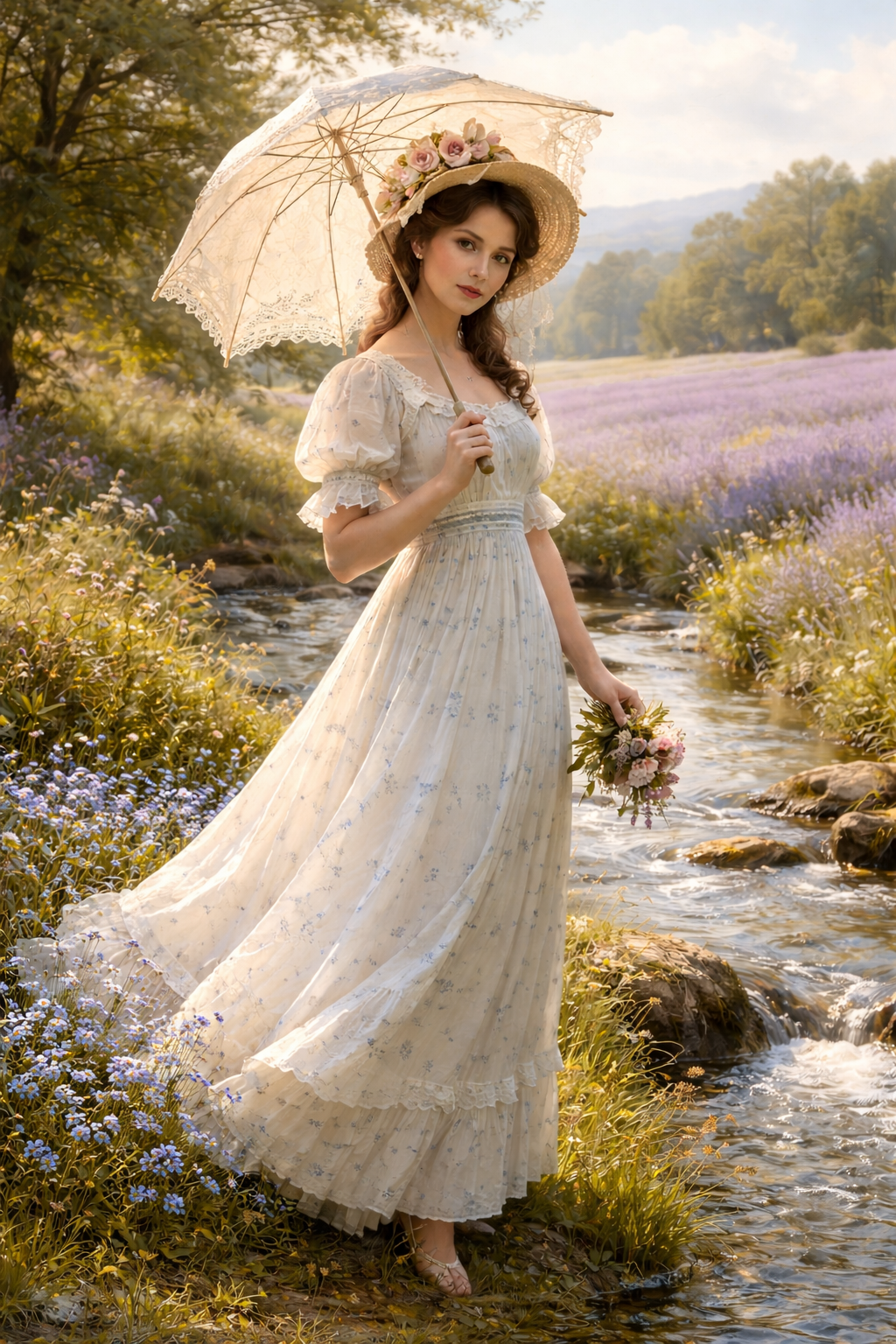
Artistic visualization by Evgenia Fölsche:
On a warm summer day
a woman stands by the bank
of a gently flowing brook.
The water moves
quietly and clearly,
as though carrying
an invisible message
onward into the distance.
To her left
delicate forget-me-nots
are in bloom.
Their fine blue color appears
still and intimate –
a symbol of faithful remembrance
and unbroken
connection.
To the right, wide
lavender fields unfold.
Their violet shimmer
fills the scene with
summer warmth
and gentle sensuality.
The fragrance seems
to hang in the air
and to keep the landscape
in tender motion.
The woman herself seems to be listening,
almost absorbed in thought.
Her gaze follows the course
of the water,
as though she were sending
thoughts and feelings along with it.
The image takes up
the song’s central idea:
the brook becomes
the bearer of a love message.
Like the flowing figures
in the piano, which press
steadily forward,
the water here too
glides on without pause.
Nature and feeling
merge –
the landscape becomes
a resonant space
of tender longing.
Analysis – Poetry
Ludwig Rellstab’s poem “Liebesbotschaft” belongs to the Rellstab songs of Schwanengesang. At its center stands the image of flowing water as a messenger between lovers separated by distance. Unlike the brook motif in Die schöne Müllerin, water here does not appear as a companion of fate, but as a tender bearer of a harmonious world of love.
The first stanza opens with an address to the brook:
Rustling little brook,
so silvery and bright,
do you hasten to my beloved
so cheerful and so swift?
Ah, dear little brook,
be my messenger;
carry to her
the greetings of the distant one.
The brook is personified as a living being. Its movement stands for urgency and longing. The speaker asks it to convey loving greetings. Nature thus becomes the ally of the feeling self – a classic motif of Romantic animation of nature.
In the second stanza, the gaze turns toward the beloved:
All her flowers
tended in the garden,
which she so lovely
wears upon her breast,
and her roses
in crimson glow,
brook, refresh them
with your cooling flood.
The beloved appears embedded in a blooming garden world. Flowers and roses stand for beauty, love, and sensitivity. The brook is meant to refresh her with cool water – a tender image of the mutual interpenetration of nature and feeling.
The third stanza sketches a scene of inward absorption:
If she by the shore,
lost in dreams,
remembering me,
lets her little head droop,
comfort the sweet one
with a kindly glance,
for her beloved
will soon return.
The beloved is imagined as dreaming, in longing remembrance of the distant lover. The brook is to console her and speak hope. Reality and wish-image merge: the speaker creates the scene he hopes for.
The fourth stanza leads the image into evening rest:
When the sun inclines
with reddish glow,
rock the dear one
gently into slumber.
Murmur her
into sweet repose,
whisper to her
dreams of love.
The course of the day mirrors the emotional progression: from movement and brightness, the poem leads into gentle twilight. The brook becomes the beloved’s cradle, whispering dreams of love to her. Thus a closed circle of nature-sound, sleep, and love emerges – a poetic ideal world full of harmony.
Formally, the poem is strictly strophic and marked by songlike simplicity. Repeated addresses, flowing imagery, and soft sound patterns create an atmosphere of quiet intimacy.
Meaning & Effect within the Cycle
“Liebesbotschaft” presents love as a long-distance bond full of longing, yet without conflict. Unlike the tragic world of Die schöne Müllerin, love here remains unbroken, sustained by hope and trust.
The brook functions as an ideal mediator: it bridges spatial separation, carries greetings, consoles, and rocks the beloved to sleep. Nature appears as a sympathetically resonant space for human feeling – a central idea of Romantic lyric poetry.
Within Schwanengesang, the song forms a moment of quiet intimacy. It stands among songs of farewell and loss, yet imagines a counterworld of harmony, beauty, and tender expectation.
In this way, “Liebesbotschaft” becomes a musical and poetic miniature of an idealized utopia of love – a final gleam of Romantic hope in late Schubert.
Evgenia Fölsche – Performances & Audio
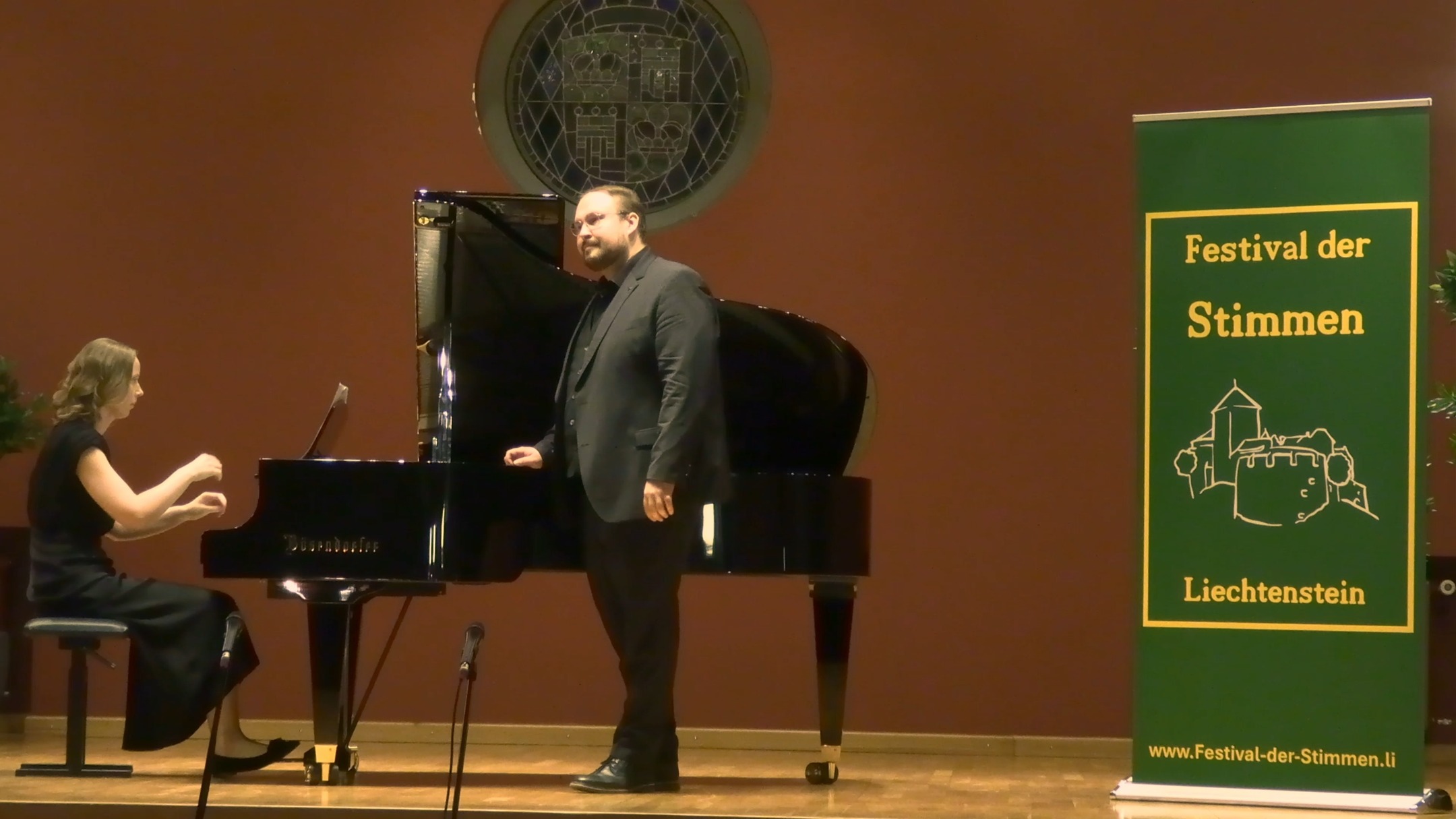
Pianist Evgenia Fölsche keeps the flow elastic and transparent: finger-connected legato, a lean middle register, and speech-close articulation – warmth as color, not as weight.
Audio example: Liebesbotschaft with Dietrich Fischer-Dieskau and Gerald Moore
Concert Inquiry
Schwanengesang by Franz Schubert is part of Evgenia Fölsche’s Lied repertoire and is performed regularly in collaboration with renowned singers. Concert programs can be designed flexibly and adapted to different ensembles.
Evgenia Fölsche has collaborated, among others, with singers such as Benjamin Russell and Johann Kristinsson, who include Schwanengesang in their repertoire.
Send concert inquiryFrequently Asked Questions about Schubert: “Liebesbotschaft” (Schwanengesang No. 1)
Click on a question to reveal the answer.
Is “Liebesbotschaft” strophic?
Yes: strophic (4 stanzas) – small variations in phrasing and voicing serve textual expression.
What are the key and meter?
A major, 6/8, gently animated; flowing arpeggios depict the brook.
How much rubato is stylistically appropriate?
Elastic with the breath, but streamlined: small expansions at semantic caesuras; no broad waves, so that the flowing character remains intact.