“Ihr Bild” is No. 9 from Franz Schubert’s posthumously published song cycle Schwanengesang D 957 (1828/29), based on a poem by Heinrich Heine. A glance at the beloved’s portrait becomes a vision: the face “begins to live,” smiles — and the recognition of loss suddenly crashes in. Schubert shapes a muted, through-composed nocturne in E minor, 4/4, very calm, sustained: a slender, breathing vocal line above hovering fields of chords.
The Poem (Heinrich Heine – Buch der Lieder, 1827)
I stood in dark dreams
And stared at her portrait;
And the beloved face
Secretly began to live.
A smile wondrously
Drew itself around her lips,
And as though from tears of melancholy
Her pair of eyes shone forth.
My own tears too were flowing
Down from my cheeks —
And ah, I cannot believe it,
That I have lost you!
Work Data & Overview
- Composer: Franz Schubert (1797–1828)
- Cycle: Schwanengesang D 957, No. 9 (Ihr Bild)
- Text source: Heinrich Heine (1797–1856)
- Composition: 1828; First publication (posthumous): 1829
- Key / Meter / Tempo: E minor, 4/4, very calm, sustained
- Duration: approx. 2:00–3:00 minutes
- Scoring: Voice and piano (transpositions common)
- Form: through-composed; three short inner sections (vision – brightening – collapse)
Poem Data
- Author: Heinrich Heine (1797–1856)
- Stanza form: 3 quatrains; calm, regular cadence
- Devices: vision / animation of a portrait, oxymoron of gentle smile and tears, climax of negation (“cannot believe”)
Genesis & Cycle Context
Within the Heine group (Nos. 8–13), Ihr Bild follows the forceful Atlas as an inward miniaturization: instead of titanic burden, a hovering inner time. The song forms the quiet pole of the sequence (Die Stadt, Am Meer, Der Doppelgänger) and demonstrates Schubert’s art of quiet pain.
More on the song cycle in the overview: Schwanengesang – Overview.
Performance Practice & Reception
Pulse & diction: an absolutely steady basic pulse; consonants soft, vowels sustained. No large overarching curve — straight, speech-like delivery with only minimal expansions of breath on meaningful words (“smile,” “tears of melancholy,” “lost”).
Piano texture: quiet chordal fields / broken chords like “breaths”; transparent pedal, finger legato. Color intensifies at the brightening point (stanza 2), followed by a controlled withdrawal into the initial coolness.
Reference Recordings (Selection)
- Dietrich Fischer-Dieskau – Gerald Moore
- Ian Bostridge – Julius Drake
- Christoph Prégardien – Andreas Staier (fortepiano)
- Matthias Goerne – Alfred Brendel
- Elly Ameling – Dalton Baldwin
Analysis – Music
Visionary Stillness & “Portrait” Gesture
The opening suspends time: calm, uniform accompaniment that makes the staring audible. In stanza 2, Schubert slightly lifts the surface — a wondrous smile as a delicate arch of brightening; stanza 3 falls back into sobriety.
Harmony, Form & Fall into Recognition
Within the field of E minor, brief mediant and dominant side glances open a glow on “smile / tears of melancholy.” The through-composed miniature frames a short window of light; the closing turn (“that I have lost you”) narrows tightly — recognition without consolation.
Visual Representation
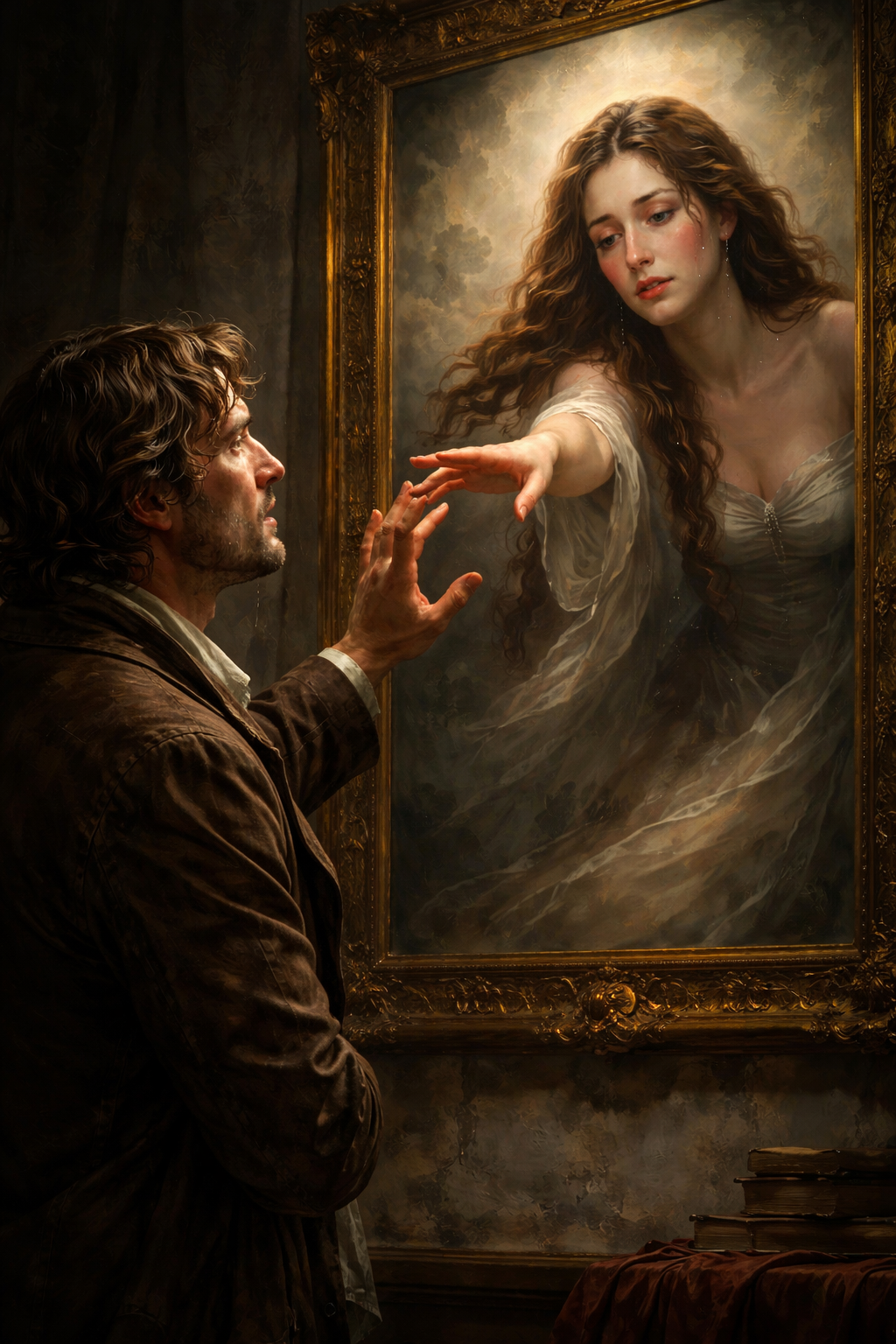
Artistic visualization by Evgenia Fölsche:
A man stands before a
painting. His gaze is
motionless, fixed upon the image,
which shows a woman
stretching her arm out
toward him.
Between reality and
representation there arises
a silent field of tension.
The woman seems
close to him — and yet
remains untouchable.
The outstretched arm
seems like a gesture of
approach, perhaps
also of memory.
Yet the canvas remains
a boundary. The nearness is
illusory.
The light in the room is
subdued. It emphasizes the
separation between the
living viewer and
the image, which can only
be projection.
Musically, Schubert unfolds
an atmosphere
of inner rigidity.
The piano moves
restrainedly, almost
haltingly, as if mirroring
the lingering before the
picture. The vocal line
carries memory and
pain within it —
quiet, yet penetrating.
The image takes up this
constellation:
the man encounters not
the woman herself,
but her likeness.
His longing is directed
toward a past
that exists only
in the image.
Thus the representation condenses
the song’s central motif:
memory as a living
force and at the same time
as unreachable distance.
What becomes audible
in the music as
quiet inwardness
appears here visibly —
as a gaze into a picture
that promises nearness
and yet reveals only
absence.
Analysis – Poetry
Heinrich Heine’s poem “Ihr Bild” belongs to the late Heine songs of Schwanengesang. It describes a vision of the lost beloved appearing to the speaker in a dream. Between reality and imagination there arises a painful moment in which memory, longing, and recognition pass into one another.
The first stanza opens the scene within the dream:
I stood in dark dreams and stared at her portrait.
The speaker is in “dark dreams” — a hovering state between sleeping and waking. He contemplates the beloved’s image, which is at first only a rigid likeness. The atmosphere is still, inward, marked by melancholy absorption.
Then the image begins to live:
And the beloved face secretly began to live.
The rigid image awakens. Memory becomes vision. This quiet “secretly” heightens the impression of an inexplicable, almost uncanny process — a passage from dead memory into seeming presence.
The second stanza describes the face of the apparition:
A smile wondrously drew itself around her lips.
The beloved’s smile appears idealized, remote. Yet at the same time her eyes shine “as though from tears of melancholy.” Joy and sorrow mingle — the image is beautiful, yet suffused with loss.
The third stanza presents the speaker’s response:
My own tears too were flowing down from my cheeks.
Dream and reality merge completely. The speaker weeps in reality — the image has fully seized his emotions. The vision offers no consolation; rather, it deepens the pain.
The ending brings the bitter recognition:
And ah, I cannot believe that I have lost you!
The dream ends in bare despair. The loss becomes conscious, yet remains incomprehensible. The speaker cannot accept the separation — a moment of pure, speechless grief.
Formally, the poem is simple in construction, almost folk-song-like. Short stanzas, clear images, and simple language intensify the immediacy of feeling. It is precisely this simplicity that makes the effect so piercing.
Meaning & Effect within the Cycle
“Ihr Bild” shows love as pure memory, becoming briefly alive once more in a dream. Yet the vision brings no redemption — it makes the loss fully conscious in the first place.
See also the scholarly article on Illusion of Presence
Heine deliberately leaves open the cause of the separation. The scene of image and dream, the seemingly living face, and the tears of the apparition suggest, however, that the beloved is not merely distant but irrevocably withdrawn from the speaker — possibly through death. At the same time, a worldly interpretation remains possible: she has left him and is “lost” to him. It is precisely this hovering between real loss and otherworldly vision that gives the poem its special poignancy.
Unlike the early Romantic love songs, Heine here does not create a hopeful longing but a psychologically precise scene of being unable to let go.
Within Schwanengesang, this song belongs to the quietest and most intimate moments. It stands between the great eruptions of pain (as in “Atlas”) and the bitterly ironic songs of the later group.
Schubert sets this poem in music of simple, almost speech-like line. Precisely this restraint of expression allows the inner pain to emerge all the more insistently.
For a comparison of the different settings of the same Heine poem: Analysis of Clara Schumann’s “Ich stand in dunklen Träumen” (op. 13) .
Evgenia Fölsche – Performances & Audio
Pianist Evgenia Fölsche reads the song as a living still image: utterly calm pulse, lean middle register, speech-close contour — brief radiance, long disillusionment.
Audio example: Ihr Bild with Dietrich Fischer-Dieskau and Gerald Moore
Concert Inquiry
Schwanengesang by Franz Schubert is part of Evgenia Fölsche’s Lied repertoire and is regularly performed in collaboration with renowned singers. Concert programs can be designed flexibly and adapted to different ensembles.
Evgenia Fölsche has collaborated, among others, with singers such as Benjamin Russell and Johann Kristinsson who include Schwanengesang in their repertoire.
Send concert inquiryFrequently Asked Questions about Schubert: “Ihr Bild” (Schwanengesang No. 9)
Click on a question to reveal the answer.
Is “Ihr Bild” strophic?
No: through-composed; the three quatrains form an inner dramaturgy (vision → brightening → recognition).
What are the key and meter?
E minor, 4/4, very calm; hovering chordal fields in the piano, speech-close line in the voice.
How do you shape the “smile” musically?
With minimal brightening (slight crescendi, somewhat warmer legato, higher register) — followed by immediate withdrawal so that the ending does not become sentimental.